

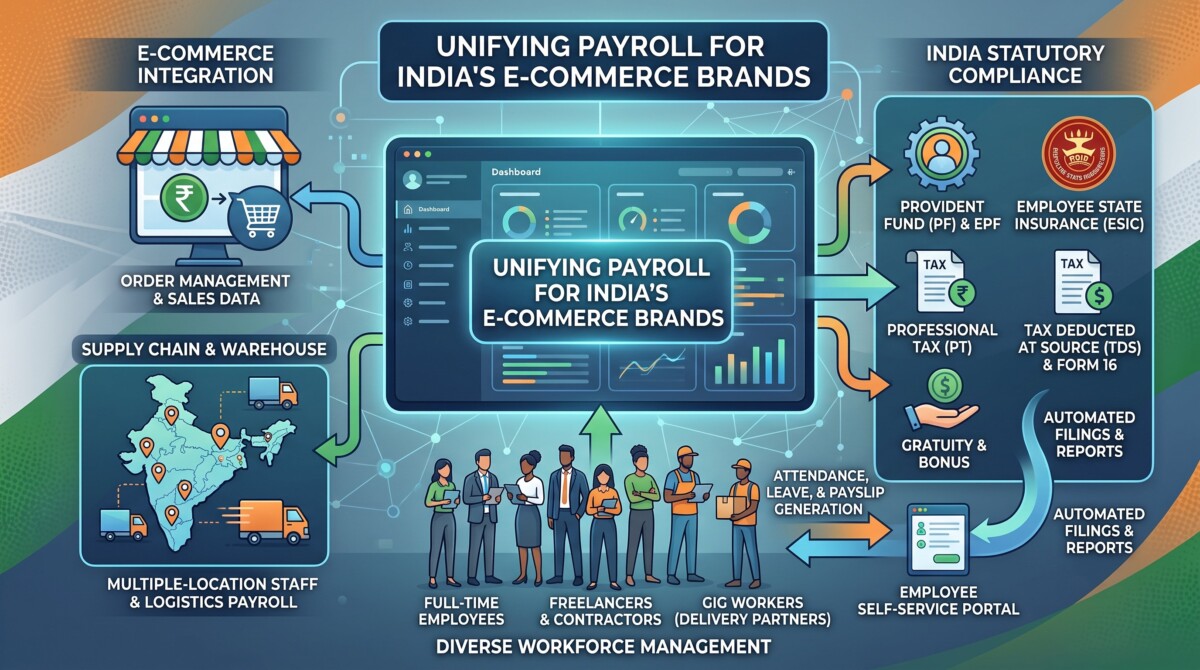
For ecommerce brands employing people in India, payroll software choice comes down to workforce shape, not feature count. Shift-based warehouse and support teams need multi-state statutory automation. Brands with roughly 50 employees or fewer are usually better served by lighter tools than enterprise suites.
The payroll mistake that costs ecommerce brands most in India is not picking the wrong vendor. It is buying an enterprise compliance engine at 40 employees because the demo was impressive, then paying for it monthly while a spreadsheet still runs the warehouse shift data feeding it.
On 21 November 2025, India’s four Labour Codes came into force and quietly rewrote the arithmetic underneath every payslip in the country. Most brands did not notice, because nobody’s salary changed. What changed was the wage base those salaries are measured against.
For a Shopify brand running a warehouse in Bhiwandi and a support pod in Pune, that is not a legal footnote. It is a live liability sitting inside the spreadsheet someone in accounts updates on the 28th of every month.
The pattern across brands at the $500K to $2M stage is remarkably consistent. The store scales faster than the back office. Headcount goes from 8 to 45 in eighteen months. Marketing gets a proper stack, fulfillment gets a warehouse management system, and payroll stays exactly where it started: one spreadsheet, one overworked person, and a chartered accountant who files whatever they are sent. Then a state inspector asks for the ESIC half yearly return, or an employee’s provident fund passbook shows a twelve month gap, and the cost of that neglect arrives all at once.
This matters more every year, because how fast India’s D2C market is compounding means more brands are crossing the headcount thresholds where statutory obligations switch on. What follows is not a feature comparison. It is a sequence: understand your workforce, understand what the statute demands of that specific shape, then look at tools. For a meaningful share of brands reading this, the honest answer at the end is that you do not need enterprise payroll software at all.
Ecommerce payroll in India breaks generic tools because your headcount is not uniform. A single brand can run salaried performance marketers in Bengaluru, hourly pickers in a Maharashtra warehouse, and forty surge staff hired for six weeks around Diwali, each carrying different attendance rules, different state obligations, and different statutory thresholds.
A software company with 60 salaried employees in one city has one payroll problem, and almost any tool solves it. An ecommerce brand with 60 people has four or five payroll problems running simultaneously. The salaried team is straightforward. The warehouse team is paid against biometric attendance with overtime rules that vary by state. The seasonal cohort joins and exits inside a single contribution cycle. The customer support pod may run night shifts with their own allowance structure. And if you operate in three states, you are managing three separate professional tax regimes on top of everything else.
The failure mode is predictable. Brands buy payroll software that handles the salaried population beautifully, then keep running the warehouse in a parallel spreadsheet because the tool cannot ingest shift data cleanly. Now you have two systems, one source of truth that is not actually the source of truth, and a monthly reconciliation that takes someone two full days.
This is the premature complexity trap in a different costume. The instinct at $1M is to buy the platform that handles everything you might need at $10M. The better move is to buy the tool that handles the workforce you have today, with a documented migration path for the workforce you expect in twenty four months. Optimize for the outcome, which is accurate and compliant payroll in under four hours a month, rather than for feature coverage you will not use.
The four Labour Codes took effect on 21 November 2025, and the change that matters most for payroll is the new uniform definition of wages: basic pay plus dearness allowance plus retaining allowance must constitute at least 50 percent of total remuneration. If allowances exceed that, the excess is added back to the wage base for statutory calculations.
This is not a rounding adjustment. Indian employers have historically structured CTC with basic pay at 30 to 40 percent and allowances carrying the rest, specifically to reduce provident fund, gratuity, and ESI liability. Under the codes, that structure no longer produces the intended result. Per the government notification making all four Labour Codes effective, the codes rationalise 29 existing labour laws into a single framework, and the wage definition propagates across all of them.
The second order effect is the one brands miss. The ESI wage ceiling sits at ₹21,000 per month in gross wages, and it has not moved since January 2017. But if the wage base your contributions are calculated against changes, some employees who sat comfortably outside ESI coverage under your old CTC structure may now fall inside it. Your coverage population can shift without a single person getting a raise.
For a 45 person ecommerce team, the practical consequence is a mandatory audit. Pull your CTC structures, calculate the basic plus DA ratio for every employee, and identify who moves across a threshold. Illustrative benchmark: brands that historically ran basic at 35 percent of CTC typically see employer side statutory cost rise by roughly 3 to 6 percent of payroll once rebalanced. That is a real margin line, and it is better modeled in a spreadsheet in advance than discovered in a filing.
Before evaluating any payroll vendor, document three numbers: how many people you employ in each state, how many are paid against attendance rather than fixed salary, and what percentage of your current CTC structure sits in allowances. Those three answers eliminate most of the vendor list before you sit through a demo.
The state count drives complexity more than headcount does. Professional tax is a state subject with different slabs, different filing frequencies, and different due dates. Minimum wage notifications vary by state and by skill classification. A brand with 200 employees in one state has a simpler compliance surface than a brand with 60 employees split across Maharashtra, Karnataka, and Tamil Nadu. If a vendor cannot demonstrate live state specific rule handling with your actual states named, they are selling you a national average.
The attendance ratio determines whether payroll can run as a monthly batch or must run as a continuous data pipeline. If 70 percent of your team is salaried, monthly is fine. If 70 percent is attendance driven, you need a genuine integration with whatever captures that attendance, and the quality of that integration is the single highest leverage feature in the entire evaluation.
The CTC ratio tells you how much rebalancing work sits between you and compliance under the new codes. Do this arithmetic yourself before a vendor does it for you, because it is the number a salesperson will use to create urgency.
This audit pairs naturally with a broader look at team structure. If you are simultaneously working out where roles should live, building a remote hiring pipeline that does not churn covers the sourcing and onboarding side of the same decision.
Four statutory capabilities are genuinely non negotiable, and everything else on a vendor feature list is differentiation rather than requirement. Those four are accurate multi state calculation, correct government file generation, both tax regime support, and rule updates shipped without a change order.
On calculation: the system must compute provident fund, ESI, professional tax, and tax deducted at source per employee per state without manual intervention. According to the current contribution rates published by ESIC, the employee share is 0.75 percent of wages and the employer share is 3.25 percent, and contributions are due within 15 days of the last day of the calendar month in which they fall due. A tool that gets the percentage right but the coverage population wrong has failed the only test that matters.
On file generation: the system must produce the electronic challan cum return for provident fund, Form 24Q for quarterly withholding, and Form 16 at year end, in the exact format the portal accepts. Ask to see a generated file from a real client account with the data redacted. A demo that shows the screen where you click generate is not the same as a file that uploads successfully.
On rule updates: when a state revises its professional tax slab, the update should land in your system without a support ticket or an invoice. This is where enterprise platforms genuinely earn their price. Vendors serving large multi state employers, including payroll system software built for organisations running hundreds of locations, maintain compliance libraries specifically for this. Whether you need that depth is a stage question, addressed further down.
Ask every vendor the same question: show me the statute mapping behind one specific rule. The ones who can will show you. The ones who cannot will show you a certification badge instead.
Payroll accuracy in an ecommerce operation is determined almost entirely by the quality of the attendance handoff, not by the payroll engine itself. If a human being exports a CSV from a biometric device and imports it into payroll every month, you have introduced the error, regardless of how sophisticated the calculation layer is downstream.
Three integrations carry the weight. Attendance capture should flow directly from biometric readers, facial recognition terminals, or a geofenced mobile app into the payroll engine, so that loss of pay days, overtime, and shift differentials calculate from source data. Bank disbursement should generate host to host files or direct integration with your bank, rather than a manually formatted upload. And the accounting sync should push journal entries into Tally, Zoho Books, or whatever ledger you run, so salary expense posts without a second data entry pass.
For ecommerce specifically, the attendance integration is the one that breaks under load. Your warehouse headcount is not stable. It doubles for six weeks around Diwali and again around end of year, and every one of those temporary workers generates attendance records that must reconcile before the 28th. A brand doing this manually at 200 seasonal workers will spend somewhere between 20 and 30 hours on reconciliation in a peak month, which is time your operations lead does not have during peak.
The systems thinking here matters more than the tooling. Planning seasonal staffing before peak season hits is what makes the payroll integration survivable. Buying software in October to solve a November staffing problem is a sequence error.
Payroll systems hold the most sensitive data in your business: bank account numbers, permanent account numbers, home addresses, and exact compensation for every person you employ. The three questions that separate real security posture from marketing language are about encryption specifics, role scoping, and data residency.
On encryption, ask whether data is encrypted at rest and in transit, and ask which standard. A vendor who answers with a general assurance rather than a specification is telling you something.
On role scoping, the requirement is granular and practical. Your Pune warehouse supervisor should see attendance and leave for their site and nothing else. Your finance lead should see everything. Your founder should see everything. A regional manager should not be able to pull a company wide salary export. Ask the vendor to configure a restricted role live during the demo rather than describing one.
On residency, Indian employee data increasingly needs to sit on Indian servers, and the Digital Personal Data Protection framework has moved this from a preference to a compliance consideration. If you are a North American brand with an India based team, this is the question most likely to be missed, because your default assumption is that your existing US based HR system covers it. It probably does not, and your India entity carries the obligation regardless of where your headquarters sits.
One additional ask that costs nothing: request the vendor’s incident history. Not their certifications, their incidents. How they answer tells you more than any badge.
Indian payroll pricing splits into two models, and the total cost difference between them at your headcount is usually larger than the difference between vendors. Flat monthly subscription suits stable headcount. Per employee per month pricing suits growing or seasonal headcount, until it does not.
The trap for ecommerce brands is the per employee model against a seasonal workforce. A brand paying per active employee per month with 45 permanent staff and 180 seasonal workers for two months is paying for 225 seats during peak. Ask specifically how seasonal and exited employees are counted, and whether there is a minimum commitment that survives the season ending.
Three cost lines are routinely quoted separately from the headline price: implementation and data migration from your existing system, year end processing covering Form 16 generation and annual returns, and integration fees for connecting your attendance hardware or accounting software. Get all three in writing before signing. Illustrative benchmark: implementation typically runs one to three times the monthly subscription for mid market tools, and materially more for enterprise platforms.
If you employ fewer than roughly 50 people in India, in one or two states, with a mostly salaried team, enterprise payroll software is the wrong purchase and you should not let a demo convince you otherwise. The compliance depth that justifies enterprise pricing is depth you will not use for at least three years.
The credible alternatives at that stage are worth naming plainly. Zoho Payroll and RazorpayX Payroll serve smaller Indian teams well, with straightforward statutory handling and pricing that scales sensibly from a low base. greytHR and Keka sit in the mid market and handle attendance integration and multi state professional tax competently, which is usually the threshold where spreadsheets genuinely stop working. Enterprise platforms including PeopleStrong, Darwinbox, and the Workday and SAP tier are built for organisations running thousands of employees across hundreds of locations, and they are excellent at that job. They are not built for your 40 person brand, and buying them early means paying for capability while still doing the manual work, because implementation depth scales with the platform.
There is a fourth option that most ecommerce brands underweight. If you are a North American or European brand with a small India based team and no local entity, an employer of record such as Deel or Remote carries the statutory liability entirely. You pay a per employee fee, they handle registration, filing, and compliance exposure. The economics stop working somewhere around 15 to 25 people, at which point incorporating and running your own payroll becomes cheaper. Below that threshold, an employer of record is usually the better answer even though nobody selling payroll software will tell you so.
The broader principle holds regardless of which you choose. Match the tool to the workforce you actually have, and revisit the decision when the workforce changes shape rather than when a renewal notice arrives. Building a flexible workforce model and building the payroll infrastructure underneath it are the same decision, made twice.
The right payroll software for an ecommerce brand in India depends on three variables: how many states you employ people in, what share of your team is paid against attendance rather than fixed salary, and your total headcount including seasonal workers. Brands under 50 employees in one or two states are generally well served by lighter cloud tools such as Zoho Payroll, RazorpayX Payroll, or greytHR. Brands running multi state warehouses with significant shift based labour need a system with genuine biometric attendance integration and state specific rule handling, which typically means a mid market HRMS like Keka or a full enterprise platform. Feature count is the wrong selection criterion. Workforce shape is the right one.
India’s four Labour Codes took effect on 21 November 2025 and introduced a uniform definition of wages requiring that basic pay plus dearness allowance plus retaining allowance make up at least 50 percent of total remuneration. If allowances exceed that share, the excess is added back to the wage base used for provident fund, gratuity, and ESI calculations. For a D2C brand that structured CTC with a low basic component, this raises employer side statutory cost without any salary changing. It can also move employees across the ESI wage ceiling of ₹21,000 in gross wages, changing your covered population. Audit every CTC structure and model the cost impact before your next payroll cycle rather than after a filing.
At 15 employees in a single state with a mostly salaried team, dedicated payroll software is optional but a spreadsheet is already risky. The threshold that matters is not headcount alone, it is whether statutory registration has been triggered. ESI applies to covered establishments with 10 or more persons in most states, and provident fund obligations attach at 20 employees. Once you are filing electronic challan cum returns monthly and generating Form 16 annually, manual processing becomes an error source rather than a cost saving. A lightweight cloud tool at this stage typically costs less per month than one hour of your accountant’s time spent fixing a filing mistake.
Indian payroll software is priced either as a flat monthly subscription or per employee per month, and the model matters more than the rate for ecommerce brands with seasonal headcount. Under per employee pricing, a brand with 45 permanent staff and 180 seasonal workers pays for 225 seats during peak months. Ask specifically how seasonal joiners, mid month exits, and inactive employees are counted, and whether a minimum commitment persists after the season ends. Three costs are routinely quoted separately from the headline rate: implementation and data migration, year end processing covering Form 16 and annual returns, and integration fees for attendance hardware or accounting software. Get all three in writing before signing anything.
Yes, through an employer of record, and below roughly 15 to 25 employees this is usually the better economic choice than incorporating. Providers such as Deel and Remote employ your India based team on their own entity, carry statutory registration and filing liability, and charge a per employee monthly fee. You direct the work; they handle provident fund, ESI, professional tax, and withholding. The tradeoff is cost per head, which is materially higher than running your own payroll. The crossover point where incorporating and buying payroll software becomes cheaper typically lands somewhere between 15 and 25 employees, though it moves depending on how many states you employ across and how much compliance overhead you are willing to absorb internally.





