

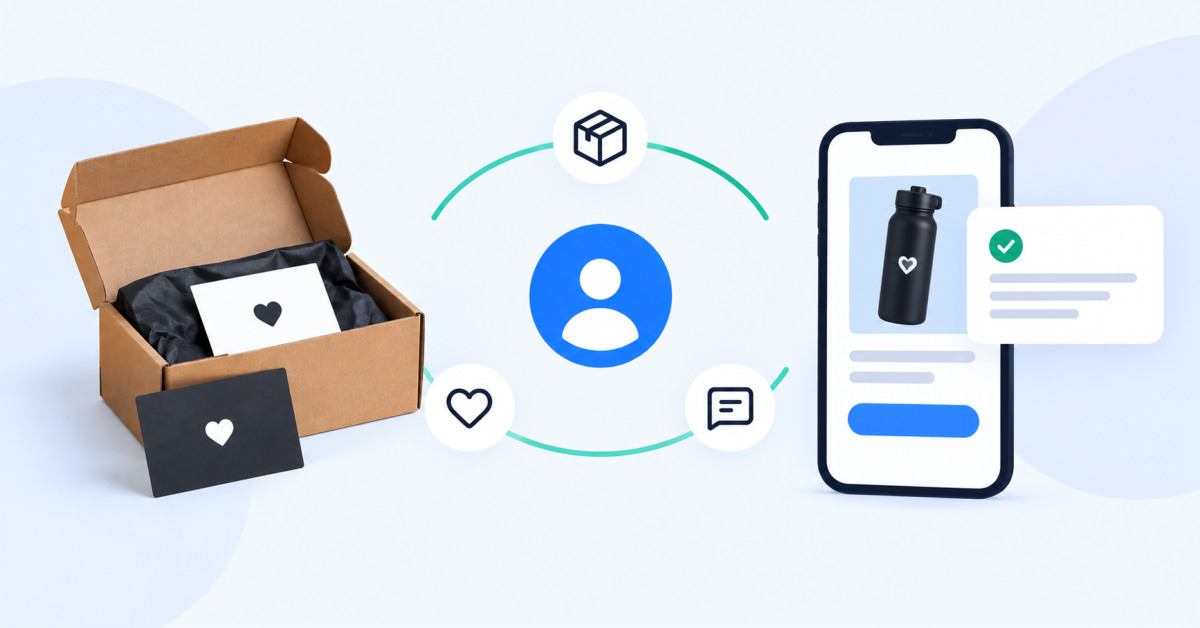
Physical brand touchpoints strengthen digital customer relationships when they solve a real customer need at the right moment, reinforce the brand experience, and create a useful reason to return online. The goal is not more promotional merchandise. It is a more memorable relationship after checkout.
The most effective physical touchpoint is not the item with the biggest logo. It is the item a customer would still choose to keep if the logo disappeared.
A customer might spend twenty minutes comparing products, read three reviews, place an order, receive five automated emails, and still remember almost nothing about the store a week later.
That is one of the oddities of ecommerce. Brands can track almost every click but still struggle to leave much of an impression once the transaction is over. The digital journey is efficient, measurable, and easy to optimize. It is also crowded. Confirmation emails look like other confirmation emails. Retargeting ads disappear between dozens of other ads. Even well-designed stores compete inside the same browser window.
Physical touchpoints work differently because they enter the customer’s actual environment. The challenge is making them feel like part of the relationship rather than another piece of promotional clutter.
Most ecommerce teams obsess over everything that happens before the purchase. Landing pages get rebuilt. Product descriptions are tested. Checkout friction is reduced. Paid acquisition costs are watched every day. Then the customer converts and suddenly the experience becomes operational: payment received, order packed, tracking number sent, package delivered.
That handoff is efficient, but it can also flatten the brand. Think about two stores selling similar products at similar prices. One sends the item in anonymous packaging with a generic invoice. The other does not necessarily spend much more, but the package, printed material, product presentation, and small details clearly belong to the same company the customer saw online.
The second experience is easier to remember because the website was not the end of the interaction.
This does not require luxury packaging or elaborate unboxing theatrics. In fact, forcing an “Instagrammable unboxing experience” onto every product category can look ridiculous. A replacement part, office supply, or B2B order does not need layers of tissue paper and a handwritten quote about community.
The physical experience only needs to make sense for the transaction.
An ad disappears when the campaign stops.
A useful object does not.
That sounds obvious, but promotional merchandise is often selected as if usefulness were secondary. Teams start with a unit price, filter by whatever can carry a logo, then order thousands of items that recipients never asked for. A better filter is brutally simple: would someone keep this if the logo were removed?
If the answer is no, the branding probably will not rescue it. Some products naturally stay in circulation because they solve small recurring problems. Bags, drinkware, travel accessories, notebooks, storage items, or products connected to a customer’s work can remain visible for months. That gives the brand repeated exposure without paying for another impression every time the item is used.
The category has to fit the audience, though. A food delivery company, outdoor retailer, beverage brand, event organizer, or hospitality business might have a logical reason to use Cooler Bags as part of a customer or partner campaign. The same item would feel random coming from a SaaS company selling accounting software.
Relevance beats novelty.
There is a tendency to treat branded merchandise as a separate marketing channel. In practice, it usually works better when attached to an existing moment.
A first order is one possibility, but not always the best one. Sending an expensive branded product to every new customer makes little sense when many of them will never buy again.
A loyalty milestone is different.
Someone who has ordered six times, referred two friends, or spent a meaningful amount already has a relationship with the company. A physical reward at that point carries different weight because it recognizes something that has already happened.
The same logic applies elsewhere:
Not every order needs an extra object. In some categories, better packaging or a useful printed insert will do more than merchandise.
Connecting a physical item to a digital experience sounds easy. Print a QR code. Send people back to the website. Done.
Except customers already know how to find a website. “Scan to visit our homepage” is not a compelling reason to unlock a phone, open the camera, and wait for a page to load. The physical-to-digital connection needs to offer something that is unavailable, faster, or more useful than simply typing the brand name into Google.
A skincare brand could link packaging to a short routine based on the exact products in the order. A specialty food company could send customers directly to recipes. A furniture seller might provide assembly videos. Event merchandise could unlock presentation materials or photographs from the event.
The important part is not the technology. It is the reason to interact. Even something as basic as a printed card can work when it solves the right problem. A customer who has just opened a complicated product is more likely to use a clear setup guide than an invitation to “join the conversation on social.”
There are moments when marketing should stop trying to be clever.
The ability to print a logo across the entire surface does not mean you should.
Promotional products often fail because the company designs them for itself rather than for the person who will own them. A huge logo may maximize visibility during a presentation, but it can also make the recipient less likely to use the item in public.
That trade-off matters. If the purpose is long-term use, the product needs to look like something a person would voluntarily carry, wear, keep on a desk, or take on a trip.
Brand recognition can come from quieter details:
A specific color combination. A small mark. Packaging that matches the store. Familiar typography. A phrase customers already associate with the company. A graphic system that appears across emails, social content, printed material, and the physical product.
Apple does not need to write “APPLE” in giant letters across every object to make it recognizable. Smaller brands obviously do not have that level of recognition, but the principle still holds. Branding is not the same thing as logo size.
There is also a quality problem. Customers connect the quality of an item with the company that gave it to them, whether that is fair or not.
A flimsy zipper, badly printed logo, weak handle, or cheap fabric becomes part of the brand experience.
Physical campaigns make performance marketers uncomfortable because attribution becomes messy.
With paid media, the sequence looks clean: impression, click, conversion.
A branded product might sit in someone’s kitchen for eight months before a friend notices it. A corporate gift could influence a renewal without ever generating a trackable click. An event item may keep a brand familiar to someone who does not purchase until much later.
Trying to force all of that into last-click attribution misses the point.
There are still plenty of useful signals. For a loyalty campaign, compare repeat purchase rates between recipients and similar customers who did not receive the item. For events, track campaign-specific landing pages, QR visits, demo bookings, or post-event engagement. For referral merchandise, unique codes make attribution easier.
Qualitative feedback is useful too. Ask recipients whether they use the product. Watch for customer photos. Check whether people bring the item back to recurring events.
A smaller test often reveals more than a large rollout. Send 100 units to a clearly defined customer group. See what happens. If nobody uses them, ordering another 5,000 because the unit price gets cheaper would be impressive procurement logic and terrible marketing.
One reason ecommerce relationships feel disposable is that customers can move between brands with almost no friction.
A competitor is one search away. Prices can be compared instantly. Product discovery increasingly happens through marketplaces, social feeds, creators, and AI tools rather than by repeatedly visiting the same store.
That makes memory more valuable. Physical contact gives brands access to moments where the competitive environment is less crowded. There are no ten rival ads sitting next to a package on a kitchen table. A useful product in an office does not disappear because another company increased its Meta budget.
The effect is difficult to manufacture at scale, which is probably why many ecommerce businesses default to sending more email instead.
But physical touchpoints do not need to become a massive separate strategy. Sometimes they are simply the missing bridge between a transaction that happened online and a customer relationship that is supposed to continue afterward.
The strongest ones rarely scream for attention. They stay useful, appear at the right moment, and make the brand easier to remember when the customer eventually returns to a screen.
The best physical touchpoints for ecommerce brands are items or materials that solve a real problem for a specific customer at a specific stage of the relationship. Useful packaging, setup guides, product-care cards, reorder reminders, loyalty gifts, travel accessories, event materials, and practical merchandise often outperform generic logo products. The best choice depends on the product category, customer lifetime value, and occasion. A low-margin first order may need a helpful insert, while a high-value loyalty milestone may justify a durable item the customer will use repeatedly.
An ecommerce brand should send branded merchandise when a customer has reached a meaningful relationship milestone or when the item improves a relevant moment in the customer journey. Strong triggers include repeat-purchase milestones, successful referrals, VIP-tier entry, product launches, events, corporate relationships, and seasonal campaigns. Avoid sending costly merchandise to every new customer without testing whether it creates stronger retention or advocacy. The item should feel earned, useful, and connected to why the customer is receiving it, rather than functioning as a generic promotional giveaway.
A QR Code should connect physical packaging to a digital experience that is faster, more useful, or more personalized than visiting a brand homepage. Good destinations include product-specific setup guides, tutorials, recipes, care instructions, warranty registration, reorder flows, loyalty benefits, event materials, and support resources. A generic “scan to visit our website” prompt rarely creates enough value to justify the customer’s effort. The QR destination should remain mobile-friendly, accurate, secure, and owned by a team member who can update it when the underlying product, offer, or policy changes.
Brands can measure physical customer gifts by comparing recipients with a similar holdout group and tracking changes in repeat purchase rate, average order value, referrals, retention, event engagement, and customer feedback. Use unique codes or QR destinations where direct tracking is appropriate, but do not rely only on clicks because many physical-touchpoint effects are delayed. Start with a defined group of around 100 recipients, establish a clear hypothesis, and review both quantitative outcomes and usage signals such as photos, survey feedback, repeat event use, or unsolicited mentions.
A Shopify brand should spend on physical touchpoints only after the expected relationship value exceeds the fully loaded cost of the item, fulfillment, and operational complexity. Begin with a small test budget tied to a high-value segment rather than adding merchandise to every order. A brand with low repeat purchase or thin margins should prioritize packaging clarity, product education, and post-purchase automation first. Brands with stronger retention, higher lifetime value, or important B2B and community relationships can justify more meaningful gifts when the item supports a measurable loyalty, referral, or retention goal.




