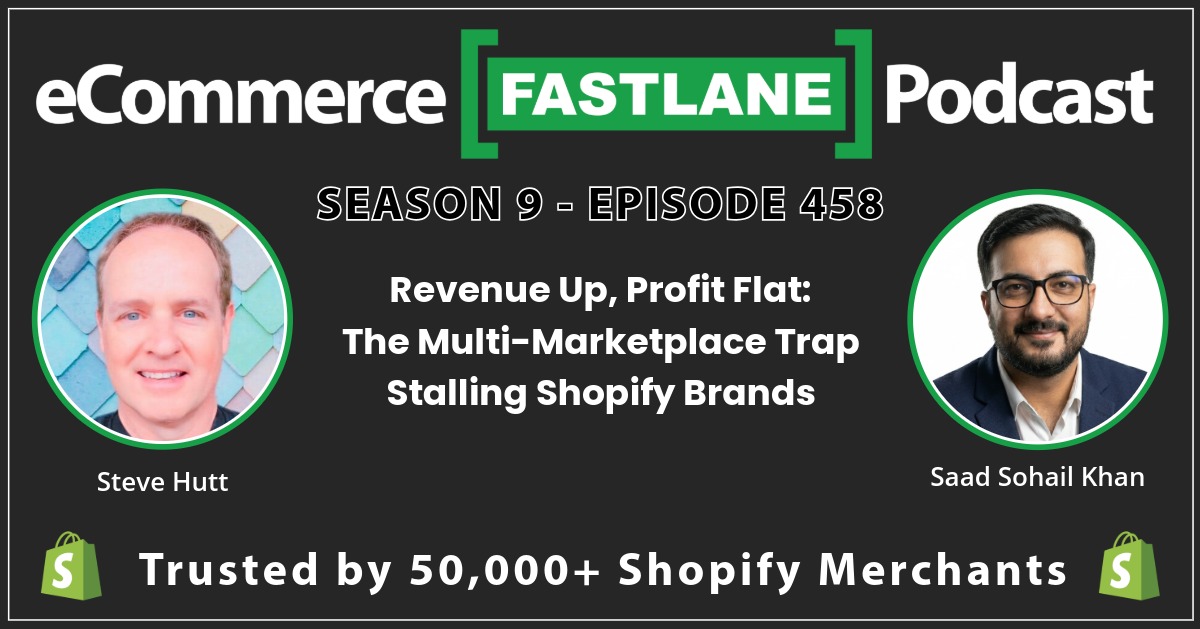
Every Shopify brand that hits seven figures eventually hears the same suggestion: “We should be on Amazon. And Walmart. And TikTok Shop.”
Six months later, revenue is up, but profit is flat, the team is stretched thin, and nobody can answer a basic question: where are we actually making money? If you’re a $1M to $10M Shopify brand watching marketplace expansion turn into marketplace fragmentation, this episode is your playbook for fixing it.
Saad Sohail Khan has been operating in ecommerce since 2008, starting with dropshipping on eBay before exiting multiple direct-to-consumer businesses. In 2017, he founded SpectrumBPO, now a Dallas-based marketplace agency with 400+ in-house specialists (no freelancers, no white-labels) actively managing over 200 brands and having supported more than 1,000 to date. Several of their current clients are doing $5M+ per month on marketplaces alone.
In this conversation, Saad breaks down the integrated execution framework his team uses to help brands expand across Amazon, Walmart, eBay, and TikTok Shop without ad spend leakage, attribution chaos, or operational burnout. He also walks through a post-payment engagement model that’s almost unheard of in the agency world. Whether you’re a $40K/month brand ready for your first marketplace or an established operator already running $1M+ months across channels, this is the marketplace execution playbook you’ve been missing.
Let’s dive in. 👇
✅ The marketplace fragmentation tax. Most $1M to $10M brands are paying it without realizing. Saad walks through the warning signs that your team structure, not your ad spend, is the real reason profit has stalled across Amazon, Walmart, and TikTok Shop.
✅ Why throwing more money at ads usually backfires. Saad’s first move with most new clients isn’t increasing budget. It’s a 20% to 30% Amazon ad cut in month one without losing sales.
✅ The post-payment agency model that shouldn’t exist. SpectrumBPO executes a full month of work before asking for a dollar. How 400+ in-house experts (zero freelancers, zero white labels) make that math work, and why this should change how you evaluate any agency.
✅ The reconciliation gap quietly draining your Amazon margin. Most brands have thousands of dollars in unclaimed reimbursements sitting in their accounts right now from missing units, damaged inventory, and FBA errors. The fix takes a system, not a tool.
✅ What “growth-priced” agency pricing actually looks like. Low monthly packages in the hundreds, paired with a small performance fee on the incremental revenue created. Why flat retainers no longer fit how marketplace agencies should actually be paid.
✅ The AI discoverability split most brands haven’t noticed. Shopify quietly opened agentic storefronts to ChatGPT, Gemini, Microsoft Copilot, and Google AI Overviews. Amazon went the opposite direction with Rufus. What this means for your visibility over the next 12 months.

Inventory and operations software built for growing product brands.
Sell everywhere with full control of your operations. Katana gives you a real-time, single source of truth for your orders and stock across every channel and location – Shopify, Amazon, wholesale, and retail all connected in one platform.
Stay ahead of demand with accurate inventory data, no matter where or how you sell.
Integrate with your favorite tools and go live in as little as a week. The operational depth you need, without the ERP price tag or complexity.
Start the free plan to test it with your own data, no credit card required.
Most marketplace expansion stories follow the same script: a Shopify brand hits traction, someone says “we should be on Amazon,” and six months later there’s a freelance PPC person in one country, a listing specialist in another, a designer who’s never spoken to either, and a fulfillment partner operating in their own silo. The revenue line is up, the profit line is flat, and nobody can clearly explain what’s actually working. Saad Sohail Khan has watched that pattern play out for nearly two decades. He built SpectrumBPO specifically to break it.
In this conversation, Saad shares how the brand he formalized in 2017 grew into a 400+ person operation managing 200+ active brands across Amazon, Walmart, eBay, and TikTok Shop, all with a fully in-house team trained from scratch, including a management layer that’s largely been with him for eight to ten years. You’ll hear why he won’t onboard brands doing under roughly $40K per month, why his first move with a new client is often cutting wasted ad spend by 20% to 30%, and why one of the most overlooked profit levers on Amazon isn’t a shiny new tool. It’s systematic reconciliation on missing units, damaged inventory, and FBA reimbursements that quietly add up to thousands of dollars.
Saad also challenges a common assumption about marketplace growth: most brands don’t have a traffic problem; they have a clarity and execution problem. When the right specialists own the right channels and everything is integrated, that structure will almost always outperform simply throwing more budget at ads. He breaks down why team design matters more than the mythical “Amazon expert,” and why no single person can truly own PPC, content, graphics, catalog, and pricing across multiple platforms at scale.
The conversation wraps with a candid look at how AI is changing discoverability. Shopify quietly switched on agentic storefronts for U.S. merchants, opening them up to discovery through tools like ChatGPT, Gemini, Microsoft Copilot, and Google AI Overviews. Amazon, meanwhile, has taken a very different path with Rufus and stayed outside Shopify’s universal commerce protocol. Saad’s perspective on where this is likely headed over the next 12 months, and what brands can do now to stay visible across both open and closed ecosystems, is worth the listen on its own.
This isn’t a sales pitch. It’s a practical blueprint for marketplace expansion that actually grows margin, not just top-line revenue.
👉 Don’t add a new marketplace without a clear owner. Amazon, Walmart, and TikTok Shop only work when someone is accountable for the whole channel, not just “their piece” of it. If your setup is a freelance PPC person, a listing specialist, and a designer who’ve never been on the same call, you don’t have a multichannel operation. You have three disconnected experiments.
👉 Cut wasted ad spend before you increase ad spend. Saad’s team routinely finds 20% to 30% of Amazon ad budgets that can be removed in month one without hurting sales, by shutting down campaigns that look fine in-platform but aren’t truly converting. The principle: fix listings, content, and keyword coverage first, then drive paid traffic into pages that are built to convert. Most brands reverse that order and then wonder why margins erode.
👉 Treat reconciliation as a core profit lever, not an afterthought. Missing units, damaged inventory, and FBA fee discrepancies can easily add up to thousands of dollars per month in reimbursements you’re entitled to but never claim. If you’re doing $50K+ per month on Amazon and not running regular reconciliation, you’re leaving real cash behind every single cycle.
👉 Have a minimum bar before you (or they) say yes to an agency. SpectrumBPO’s floor of roughly $40K to $50K per month exists for a reason. You need product-market fit, basic operations, and clean listings in place before optimization and scale work pays off. If an agency will take any client at any stage, that usually says more about their business model than their belief in your success.
👉 Align pricing with growth, not just retainers. Saad’s model uses modest monthly packages paired with a 1.5% to 2% fee on the incremental revenue his team helps create, which means they only win when the brand grows. Whether you’re hiring an agency, a fractional leader, or a freelancer, look for compensation structures where their upside depends on your upside. Pure retainers rarely create that tension.
👉 Optimize for AI-driven discoverability, not old-school keyword stuffing. Shopify’s agentic storefront and Amazon’s Rufus are pulling from richer signals than traditional SEO alone. The brands that surface in ChatGPT, Gemini, and Google AI Overviews tend to have clean product data, strong on-site content that reinforces those products, and clear authority signals. If your SEO conversations are still mostly about backlinks and keyword density, you’re already a step behind.
Saad Sohail Khan
Founder & CEO, SpectrumBPO
Saad started his ecommerce journey back in 2008 or 2009 with eBay dropshipping, then went on to build and exit multiple direct-to-consumer businesses before deciding the operator world needed a different kind of marketplace partner. In 2017, he founded SpectrumBPO with a simple mandate: build an in-house, integrated team that acts like a true execution partner for brands expanding across marketplaces, not another fragmented vendor stitching together freelancers.
Today, SpectrumBPO is headquartered in Dallas, Texas, with offshore operations in Pakistan, a branch office in the UAE, and a dedicated logistics center supporting client prep and fulfillment needs. The agency manages 200+ active brands with 400+ in-house experts, has supported more than 1,000 brands to date, and even white-labels for over a dozen U.S.-based agencies. Saad’s leadership team, many with eight to ten years of tenure, is built almost entirely from fresh graduates trained through a six-month in-house program he helped design.
What makes Saad’s perspective especially useful is that he’s been on both sides of the table. He started as an operator, and he now runs one of the few agencies in the space willing to put real skin in the game: SpectrumBPO doesn’t take a single dollar from new clients until after the first full month of work has been delivered.
Featured in This Episode:
Over 9 seasons, I’ve been incredibly fortunate to chat with some of the brightest founders building amazing Shopify brands, as well as the partners shaping the app and marketing ecosystem. Every conversation has taught me something new, and I’m grateful for the chance to learn alongside you.
What matters most is that this podcast helps you solve real challenges and discover new ways to grow. Your support, feedback, and stories have made this journey truly special. Thanks for tuning in, sharing your wins and losses, and being part of the eCommerce Fastlane community.
Stay Connected: Leave an Honest Rating/Review on Apple Podcasts or Spotify. Follow & Subscribe on YouTube for new episodes.
Steve Hutt:
Welcome back to eCommerce Fastlane. I am your host, Steve Hutt. Today’s conversation is all about Shopify brands that should be expanding into Amazon, Walmart, and maybe even TikTok Shop, but want to do it without burning margins, burning out their team, or losing their sanity in the process.
There’s a pattern I keep seeing. I’ve watched this for years from inside Shopify. A brand hits traction on their Shopify store, maybe a million a year, maybe up to ten million a year, and someone, usually a marketer, says, “Hey, we should be on Amazon.” Next thing you know, someone else says, “We should be on Walmart,” and, “The young people are buying on TikTok Shop right now.”
Steve Hutt:
Here’s what typically happens next. They hire a PPC freelancer in one place, a listing person somewhere else, and a designer overseas. The fulfillment partner doesn’t talk to any of them and has no idea what’s going on. Six months later, revenue is up because they’ve added a marketplace, but profit is flat. The team is dysfunctional, not necessarily totally fried, but there’s real burnout. And the big thing is no one can answer a simple question: “Where are we actually making money?” That’s where my guest comes in.
My guest, Saad Khan, is the founder and CEO of a company called SpectrumBPO. You’ll find the link in the show notes at spectrumbpo.com. Saad started his company back in 2017 with a very small team. He’s the kind of operator who’s been in the trenches in the early days, actually running ecommerce businesses. I’m hoping we’ll learn a lot today about what it means to run a store and then make the pivot to an agency model that isn’t just consulting and reporting.
Steve Hutt:
SpectrumBPO’s whole business model is built around execution, integration, and accountability. They position themselves as a true business partner. So I’d like to welcome Saad to the show.
Saad Sohail Khan:
Thank you so much for such a nice introduction, Steve. Thank you so much.
Steve Hutt:
My pleasure. I did some digging on LinkedIn to figure out your backstory. You were clearly an operator and business owner in direct-to-consumer, which I love. Can you talk a bit about those early days, deciding entrepreneurship was for you and wanting to get involved in ecommerce?
Saad Sohail Khan:
I’d like to take you back to 2008 or 2009. That’s when I started working in ecommerce. I was mostly doing dropshipping on eBay and a little bit on Amazon as well. Amazon was not that popular at that time; everyone was on eBay.
I used to sell different products and eventually figured out a couple that did really well. At one point, I needed external help. I wasn’t in a position to hire in-house people in the U.S., so that was the first time I worked with an offshore team of two to three people. We did a lot together over the next few years.
That experience turned out really well. In the nearby Dallas area, I started connecting small businesses I knew with offshore teams, so they could get a lot of services done at a fraction of the cost. I kept doing that for many years, and it went well. I was running a couple of ventures and exited a few successful businesses.
Saad Sohail Khan:
Over time, my offshore team kept growing. They were working on my projects, and I was also helping a few nearby businesses. Around 2015, I started thinking seriously: why not offer services to brands struggling on marketplaces like eBay, Amazon, and Walmart?
I knew that if you have a dedicated, integrated team, you can do much better. A lot of people I knew had freelancers: one “Amazon expert,” one person for ads, someone for content or graphics. But for small business owners, managing a team of three or four people in different locations becomes a mess. A lot of their time gets consumed in management instead of focusing on growth.
So the idea was: why not create an agency that becomes a one-stop solution for struggling brands looking to expand online?
Spectrum as a brand started in 2017. Before that, I was already working with four or five brands, consulting them, and my small team was looking after all aspects of their marketplace operations. In 2017, we formalized it as Spectrum. Initially, the idea was to be a one-stop solution for smaller brands struggling to scale on marketplaces, so they could focus on growth while Spectrum handled day-to-day operations.
That idea turned out to be really strong. In the first year, we grabbed more than a dozen clients. That journey continued, and today we’ve worked with more than a thousand brands. Currently, we’re handling a little over 200 brands with the help of more than 400 in-house experts.
Saad Sohail Khan:
The journey wasn’t easy. We went through a lot of ups and downs, but eventually we were able to scale the idea. The best part is, when we say we’re a one-stop solution, we really are. From fulfillment requirements to daily operational needs, including ads, optimizations, graphics, content, and catalogs, everything is taken care of by Spectrum.
We offer all these services under one roof. I always tell clients: one person, no matter how good, cannot be an expert at everything.
A lot of the clients we work with used to work with freelancers they considered “Amazon experts” or “Walmart experts.” But these platforms have evolved so much that multiple specialties are required to execute a successful operation.
At Spectrum, we execute projects as a team. There is an allocated expert based on the requirement, but a full team works on each project. For example, if we’re handling all operations of your Amazon store, you need a PPC expert for ads and optimizations, plus a lot of work on graphics, content, and catalogs. We have all these experts in-house with years of experience. We’ve developed this expertise over time.
Saad Sohail Khan:
We don’t hire ready-made “experts” from the market. Our biggest challenge while scaling Spectrum was human resources. In the Pakistani market, there weren’t many truly trained people, even though many claimed they were, usually because they’d taken an online course.
What we did differently is, I’d say, the primary reason for our success, even though it was hard. Instead of hiring so-called experts with a bit of ecommerce knowledge, we started hiring fresh graduates from the market, regardless of their degree. If they were interested in learning ecommerce, we brought them in and trained them in-house.
We designed a complete internal training program with tutorials and resources we created. At the same time, we already had a lot of clients, so trainees did practical work alongside their learning. For a solid six months, Spectrum invests in these people. During that time, they work as assistants to experts, juggling different projects to build real experience before they manage any client independently.
That approach turned out really well. Over the years, we’ve trained hundreds of people. Our 400-plus in-house experts all came up through this system. Some have left, of course, but the majority we trained are still with us.
We’re one of the very few companies where the entire management layer, more than 50 people, has mostly been with us for the last eight to ten years.
Steve Hutt:
Right.
Saad Sohail Khan:
The reason is the level of trust we’ve given our people. That’s what has kept them with us.
Steve Hutt:
Yeah.
Saad Sohail Khan:
We think that’s phenomenal. Almost every agency I talk to says their major issue is retaining people.
One important point: I know almost all the fellow agencies that are doing well. Spectrum differentiates itself because 90% of agencies in the market don’t have their own in-house teams. They either work with freelancers or with white-label partners.
By the way, Spectrum handles white-label work for more than a dozen U.S.-based agencies. We do practically everything for them, but we never disclose our identity to their clients.
Steve Hutt:
Fair enough.
Saad Sohail Khan:
We also don’t consider agencies as competitors. The kind of service and pricing we offer is very hard to match, mainly because we have our own in-house people. Whether we have projects or not, we have to pay our people. We’re not 100% dependent on new client revenue, and that gives us the luxury to operate the way we think is right.
Most agencies rely heavily on freelancers or third-party partners. We’re always open to collaboration and partnership. That’s what we’re already doing with a lot of companies in the ecommerce space.
Steve Hutt:
Right. Yeah, it’s an amazing story. I love that. At the end of the day, it reminds me of how Shopify operated early on. They would hire early grads as well.
They had this thing called the “life story.” It wasn’t really about a traditional resume; it was about the decisions you made in your life that led to us talking today and maybe getting hired by Shopify. They wanted to understand the “why” behind everything: “You did this. Why did you do that?”
It helped them get into the psychology of the person and see if they had a growth mindset. Is the glass half full or half empty? That was a big part of the conversation.
We had these mantras: being merchant-obsessed, thriving on change, being a constant learner, building for the long term. I still remember them because they mattered so much. Those were the qualities that made a great employee, at least from Shopify’s perspective: being okay with change and being a constant learner. I think that’s why Shopify is and was so successful.
It sounds like you’ve taken that same kind of mindset.
Saad Sohail Khan:
I agree with everything you just said. In our scenario, people are the ones who drive the company’s success. As much as we focus on our clients, we focus equally on our employees. We make sure their growth is intact. As the company grows, they grow with us.
All of the people we have were trained by Spectrum. When they came to us, they had no idea about ecommerce. They’d maybe heard of Amazon or Walmart. That’s it. We trained them from scratch. And it wasn’t just theory. We made sure they did practical work right away.
That’s how we trained our people. Eventually, they turned into champions of Spectrum. Today, we handle every type of client, from small companies to mid-sized brands, and some big ones doing a little over $5 million per month just on marketplaces.
Saad Sohail Khan:
With the exposure we’ve gained from working with hundreds of clients over the years, we’re in a position to execute almost any kind of project. There’s hardly any category left that we haven’t touched.
Steve Hutt:
Yeah, it’s amazing. I did some early research before recording and went through your LinkedIn. You talk a lot about how brands don’t typically have a traffic problem; they have a clarity and execution problem.
Using your own language there, can you unpack that a bit? Let’s say someone listening is doing around $500K a month on their Shopify store. Most founders in that situation are convinced they just need to spend more on ads to acquire net new customers.
What’s your view on that mindset, “I want to grow, so I just need a bigger ad budget”?
Saad Sohail Khan:
First of all, we’ve brought a lot of clients from Shopify onto Amazon and Walmart. I slightly disagree with a lot of the noise in the market. It’s not true that you have to depend on ads all the time.
Yes, in the beginning, if you’re struggling with sales, your listings aren’t optimized, and you’re not showing up, then you do need ads to get some visibility. We push ads at the start. But from day one, we tell clients that the goal over time is to control spend. Even if we increase ad spend in some areas, you should see a significant increase in sales and better conversion.
The main idea is that your strategy shouldn’t be purely focused on ad spend.
Saad Sohail Khan:
Especially when you’re on multiple marketplaces, there needs to be synergy and integration across channels, and the right people need to be working on them.
In our case, if a client is on Walmart, eBay, and Amazon, dedicated experts handle each one. It’s not one person trying to manage eBay, Amazon, and everything else. The right people with years of experience on each platform are involved.
So I don’t think traffic is the main issue. Most people can get traffic. The problem is that everything isn’t integrated properly.
There’s also a misconception that you just need to keep increasing ad spend. That’s not true. If your listings are properly optimized, your A+ content is good, and you’re optimizing on a regular basis, especially because keyword traffic fluctuates every few days or weeks, then someone needs to be watching that consistently.
If you’re doing the basics consistently and correctly, a lot of problems go away. We do spend to push sales further, but the focus is not entirely on ad spend.
Saad Sohail Khan:
That’s what we teach our clients. If you’re managing campaigns properly and monitoring them regularly, you can control a lot of wasted ad spend.
In many cases, when clients come to us spending, say, $10,000 a month on ads, the very next month we reduce their ad spend by 20 to 30% without hurting sales. Our audit team evaluates everything and finds a lot of waste.
First, we make sure there’s no leakage or waste in ad spend. Then we see what’s working and what’s not.
The key takeaway for your audience is that integration between channels is crucial, and you must understand what you’re doing. The idea across platforms is similar, but execution is different, and you need to understand those differences.
Steve Hutt:
Yeah, interesting. I’ve talked to a lot of people trying to break into Amazon, and one thing they find frustrating is the dynamic nature of pricing, especially with commodity products.
There are processes and even AI tools that dynamically change pricing based on profitability. At the same time, Amazon Ads can give you a lot of visibility on keywords, especially if you’re not organically winning the buy box.
What’s your take on that combination, dynamic pricing and Amazon Ads, and how frustrating it can be for sellers?
Saad Sohail Khan:
It really varies from product to product and category to category. It depends on what you’re selling. It’s very hard to give a single, blanket answer without looking at the product and the market saturation.
Steve Hutt:
Right.
Saad Sohail Khan:
But yes, it’s important. The dynamics are changing every single day. If you manage things wisely, a lot of problems can be resolved.
We have clients selling at much higher prices than their competitors and still getting strong sales because their branding is really good. Many people don’t focus on that.
One thing some of our clients do is they regularly update their infographics. They keep their audience engaged through fresh visuals and messaging.
Branding is a critical component of your product.
Saad Sohail Khan:
Another thing I missed earlier: when someone comes to us, we do a very detailed audit. It takes hours to complete before we decide whether to onboard them.
We’re not a new agency. We’ve been in the market close to a decade. We want to work with clients where we can genuinely add value. It’s not just about onboarding for the sake of it.
If you look at our online reputation, you’ll see we’ve worked hard to maintain it. One primary reason is we’re very selective when onboarding.
Initially, we’d work with all types of clients, especially newer businesses. But we observed that many newbies want everything done by a third party. They say, “We’ve identified a product, now you source it, do everything for us.”
I used to tell them, “If I’m doing everything, what will you do? I might as well launch the product myself.”
Saad Sohail Khan:
Now, we prefer to work with clients doing at least $40,000 to $50,000 per month. That’s the minimum requirement. It’s the first indicator that they’ve achieved something on their own. With our expertise, the idea is then to take them to the next level.
We also have a model I don’t think any other company offers. We don’t ask for any upfront payment. It’s a post-payment plan. We work with you on whatever package you choose, fully dedicated, for one month. At the end of the month, if you’re satisfied with our work and ethics, you pay us. If you’re not, you’re free to walk away and we won’t ask for money.
Steve Hutt:
Right. Wow.
Saad Sohail Khan:
I don’t know any agency that works for you first and then asks for payment after a month of service.
We can do that because we’re confident in what we’ve done over the years. We’re already working with hundreds of active clients, so we have that luxury.
Another reason is that our experts are all in-house. They’re our people. We trust our abilities and expertise.
That’s also why, before onboarding any client, we put in hours of research in the audit phase to decide whether we can add value. In many cases, the product itself isn’t good enough. It’s not just about onboarding a client for one or two months.
We have dozens of clients who’ve been with us for years. Some started at $20,000 to $30,000 a month, and now they’re doing $300,000 to $400,000 per month.
Saad Sohail Khan:
Our pricing structure is low enough to be accessible to almost anyone, even a beginner thinking about launching a brand. The real money Spectrum makes is from your growth.
For example, if you come to us doing $50,000 a month, we have three or four models based on your needs. Our maximum plan is around $1,600 to $1,700 per month. In that, we handle your content, graphics, optimizations, and catalogs, essentially everything.
The real money we make is from the growth. Let’s say you’re doing $50,000, and after two months you’re doing $70,000. On that additional $20,000, the new revenue we’ve helped generate, we charge between 1.5% to 2%.
Steve Hutt:
Right.
Saad Sohail Khan:
The idea is to take every potential brand to its full potential so we can make real money from growth, and they do as well.
Steve Hutt:
I appreciate the performance-based side of that. I agree. Having the first month with no cost is a very interesting model. It feels like a no-brainer for listeners who have some traction but aren’t on Amazon yet, or aren’t doing well, or want to expand to Walmart or eBay.
One thing I want to touch on, and this is a bit of a pivot, is attribution, which is a big complaint when people expand from Shopify into marketplaces.
You look at Shopify’s analytics, or Google Analytics, or Meta, TikTok, whatever, and these platforms tend to inflate their ROAS in their favor. On paper, ROAS looks great. But when you look at contribution margin, what actually hits the bank account, it’s very different.
So with that attribution problem in mind, what’s leaking here? What’s your view on the bigger picture around attribution, contribution margin, and true campaign profitability when you expand into marketplaces?
Saad Sohail Khan:
Again, it varies by product. But if you’ve done your homework or you’re working with a third-party partner like us, we can usually calculate profitability accurately, as long as we know the real numbers.
We know all the gray areas that a newbie might miss: the real ad spend, actual platform charges, FBA fees, and so on. With those numbers, we’re in a much better position to guide clients on whether something will be profitable.
We use a lot of different tools to make sure there’s no leakage and that numbers are accurate. Online data can vary, but we have our own internal mechanisms too. We don’t rely on a single data point; we triangulate from multiple angles.
If we have real numbers, we can guide clients accurately so there are no surprises later where they realize they’re not actually making money.
Margins are shrinking over time because of saturation and competition, that’s true. But that can still be managed. We have clients doing really well in terms of profitability.
Saad Sohail Khan:
The biggest issue for many clients is they don’t reconcile anything. They don’t know what they’re spending, what they’re making, or what reimbursements they’re owed.
For example, reimbursements for missing or damaged units, many don’t track them at all. When we start reconciling accounts for new clients, we often recover thousands of dollars that were pending on the marketplace side.
Most clients don’t even know how to do this. It takes a bit of time and effort, but if you do things properly, it’s manageable.
Yes, margins are shrinking due to saturation, but if you have a good product, you can still do very well. We have clients who are extremely successful with wholesale models, and many doing very well with private label.
Saad Sohail Khan:
Over the years, we’ve launched hundreds of brands. I won’t claim every brand was successful. The success rate is maybe 10 to 20%. In most cases, clients were aware of the risk from day one.
Often, clients come to us with a product already chosen and ready to go. Everything is “sorted” from their perspective, and we have no option except to launch it.
In the last couple of years, we’ve pulled back from working with complete newbies unless they bring a genuinely strong product, either thoroughly researched or with real innovation. If our team believes the chances are good, we’ll go ahead. There are never guarantees, of course.
That’s why we prefer to work with partially established brands doing at least $40,000 to $50,000 per month in sales. With our expertise, we’re about 90% confident that if we can’t double sales, we can at least increase them by 40 to 50%.
A brand usually has exposure only to its own products or a handful of products. A company like ours has worked with tens of thousands of SKUs across hundreds of brands. There’s a lot we can do just by tweaking things they’re not doing yet.
Our focus is entirely on client growth. That’s why our pricing models start around $600 a month and go up to about $1,700, unless you need multiple people.
Saad Sohail Khan:
We also have clients where we’ve allocated 15 to 20 people. These are huge accounts doing multiple millions a month, and they require a lot of effort and expertise. In those cases, we put multiple resources on the account to handle all day-to-day operations.
As I mentioned earlier, we have our own logistics center in Dallas. We’re based in Dallas, Texas, with an offshore team in Pakistan and a branch office in the UAE. Our logistics center offers prep services for our clients. Those services are only for clients using our broader services, not as a standalone offer.
That’s why we can claim to be a true one-stop solution.
Steve Hutt:
Let’s talk about AI for a minute, because it’s the elephant in the room. There are a lot of tools and initiatives happening.
On the Shopify side, they activated this “agentic storefront” by default around March. That means merchants can be surfaced inside ChatGPT, Google AI, Microsoft Copilot, Gemini, and so on. A lot of brands don’t realize this. There wasn’t much fanfare; it just quietly turned on for U.S. stores.
I know you’ve written a bit about this too. I don’t think this is a keyword problem; I think it’s a structure and data problem, how brands are cited, linked, and referenced inside these chat solutions.
On the other side, you’ve got a walled garden. Amazon wants nothing to do with Shopify’s universal commerce protocol. They’re not participating in the agentic storefront concept. Instead, they have their own AI solution, Rufus.
So what’s your take on both sides? For Shopify brands, are they actually being found correctly? Is their structured data and schema in order for discoverability in chat tools? And what is Amazon doing with Rufus? Is that a completely different bet on how people will find products?
Saad Sohail Khan:
That’s a really good and tricky question. It has been a crazy couple of years in AI.
In the last two or three years, we’ve been working a lot on AI tools. We’ve built many internal tools. Previously, we relied on third-party tools or Google Sheets and Excel, but we’ve automated a lot of processes recently.
What I’ve observed is that if your products are well structured everywhere, your website, your SEO, your content, that’s the best way to be found by AI tools.
In the last year or two, everything has moved toward automation. Whether companies admit it or not, everyone is trying to automate. There’s a race to see who gets there first.
We figured out a few things and implemented them at Spectrum. If you go to our site and ask ChatGPT, Claude, or Gemini something like, “Who are the top companies providing Amazon services?” sometimes Spectrum shows up, sometimes it doesn’t.
The data these AI tools use mostly comes from search engines.
Saad Sohail Khan:
So if you’re structured well across the web and placed correctly on different platforms, your chances of showing up in AI tools increase. The underlying data is largely the same. AI tools are pulling from Google and similar sources.
A lot of things will unfold in the coming months and years. It’s a never-ending game, and there’s no concrete, final answer. Every day there’s something new, and you start thinking, “What’s happening now?” There’s really no end to it.
One clear impact is that a lot of jobs are becoming obsolete. Customer support roles will likely shrink significantly. I think many software development roles may shift dramatically too.
Let’s see how it plays out. Companies already working seriously with AI tools are on the right track. The future is definitely tied to AI.
That’s why Spectrum has an in-house software development department. It’s not open to clients right now because there’s a lot of R&D happening. The core idea is to automate everything we can, so we’re less dependent on third-party tools.
A lot of things that were complicated before can now be handled with AI, and we’re doing that internally. If we eventually build something truly valuable, we’d love to open it up to clients as well.
Steve Hutt:
Right. I’ll close the AI chapter with this. When you look at Gemini and Google’s AI Overviews, the citations you see are heavily influenced by the top organic listings. That’s where Gemini is pulling from. It’s still a Google property.
Same with AI Overviews: there are similarities with organic search. So when people say SEO is dead, I don’t buy it. The fundamentals of on-page and off-page are still important.
What’s changing is that people aren’t just going to Google anymore. Tools like ChatGPT and Claude don’t scrape Google’s top 10 like Gemini does. Their training comes from things like Generative Engine Optimization and Answer Engine Optimization.
They crawl for structured data, brand signals, expertise, and authoritativeness. That’s how they form answers. I agree with you: it’s a moving target and very complex.
Saad Sohail Khan:
One thing I’d add: SEO isn’t obsolete, but it has changed a lot. It’s much more focused on content now.
I’ve seen this firsthand. Products with strong content tend to get pulled into AI responses more often, especially when that content lives in blogs and articles around the product. AI engines pull a lot of data from those blog posts.
So SEO today is more about content than the old techniques of backlinks alone. Backlinks still matter, but the main focus should be on high-quality content.
Steve Hutt:
Yeah, absolutely.
Saad Sohail Khan:
If you’re investing in SEO, that’s where your effort should go.
Steve Hutt:
So where do you think all this is headed? I know you’ve said it’s “wait and see,” but AI is reshaping a lot, from discovery on Amazon with Rufus, to multi-channel shifts, to Shopify brands realizing they need to be “everywhere.”
Rufus is interesting because it’s a conversational shopping assistant. It’s different from simple keyword search. It understands context better.
Looking 12 months out, what’s happening? Fulfillment is evolving, multi-channel is shifting in real time, and founders are trying to figure out which AI tools are worth their time and will deliver real ROI.
Saad Sohail Khan:
It’s still hard to say anything concrete. But if I look 12 months ahead, I can imagine people asking AI, “I need to buy this product. Where can I get the best price and best quality?”
AI will respond with options from Shopify stores, Amazon, Walmart, eBay, TikTok, everywhere. Everything will be dependent on AI. That’s the direction things are headed given the pace of AI innovation.
At the back end, all these channels are integrating more AI than they publicly talk about. Every other day, we see a new AI feature, and things shift again.
If you stay connected to these developments, that’s the right way to move forward. That’s our focus as well. If we think we can improve any process with AI, we’re open to it and actively exploring.
That’s what I’d suggest to everyone. If you want to stay on top, you have to keep exploring and adapting.
Saad Sohail Khan:
Because if you don’t, you’ll fall behind quickly.
Steve Hutt:
Yeah. Before we wrap up, I’ve learned a lot. I always joke about this, but I’m on page two of notes, and that’s usually a sign of a great episode.
What stands out for me is how much fragmentation there is across marketplaces and even within agency setups.
On the one hand, you’ve got Amazon, Walmart, eBay, Etsy, and so on. On the other hand, there are agencies listening who might be thinking about your white-label model.
There are really three types of listeners right now. First, early-stage folks just trying to get traction on Shopify who haven’t yet made the move to Amazon, eBay, or Etsy. Second, mid-market brands doing upwards of $500,000 a year, around $50,000 a month, which you’ve said is your sweet spot starting point. Third, agency partners who want to expand their capabilities via a strategic partner like Spectrum.
Can you speak to those three groups and outline some next steps for each?
Saad Sohail Khan:
Sure. First, as a business owner working across multiple marketplaces, you have to accept that you cannot be the expert on every platform.
Yes, you can and should have good knowledge, and you’ll always be curious and exploring. But at some point, you need a partner or outside experts.
As a mid-sized entrepreneur, you usually can’t afford all that expertise fully in-house, so you engage a third party. That’s where we come in. Our goal is to focus on your growth and create a win-win situation.
For newbies, there are many companies willing to work with them. Sometimes we do as well, if the product is genuinely strong. Even though we publicly say we work with brands doing $50,000 a month, we get a lot of inquiries from people at the very beginning.
Sometimes we ask about their product, and if it makes sense, we talk further and do an audit to see if it could work for both sides.
If you’re a newbie, your focus should be on understanding how marketplaces work and building your knowledge. Eventually, you will need help. There are so many moving parts that it becomes very hard for a founder to be equally good at all of them.
Saad Sohail Khan:
You might bring in help at the start and later feel ready to manage things yourself. That’s fine. But in my experience, many failures happen because someone heard a friend was doing well on eBay, so they jumped in without understanding the product or the market.
You should be well prepared before launching or scaling on any ecommerce platform. The market is not what it was a few years ago. It’s very competitive. I’m not trying to discourage anyone, but I do want people to do real due diligence before entering.
At some point, you’ll need a third-party partner. Even if you think you don’t, at least consult someone. You don’t have to work with them long-term, but you’ll learn things you might be missing.
Steve Hutt:
It’s interesting when you talk about domain expertise. That’s what really hits home with what Spectrum is about.
I always joke that many founders are “jack of all trades, master of none.” That’s where you come in. You have domain expertise. You’ve mastered, and are constantly learning and expanding, by channel.
Because you’re fully in-house, communication is strong. There are no silos in the sense of disconnected freelancers. The only silos are in domain expertise, and those groups still talk to each other. That’s a great strategy.
Saad Sohail Khan:
Exactly. Even though I’ve been in ecommerce since 2008 to 2009, I can’t claim I know everything. In the last couple of years, I’ve been more focused on management. My team, the people in operations, often know more than I do about the day-to-day changes.
No one can be a jack of all trades at the level needed now, and that’s not the right way to build.
As I mentioned, we execute projects in teams. We allocate the most relevant expert, then bring in other specialists for graphics, content, catalogs, research, and so on. These are people with real backgrounds and experience in those specific areas.
That’s why we’re successful. All those skills are bundled into one package instead of clients hiring everyone separately. We sell plans based on hours, starting at about $599 per month up to around $1,599 or $1,699.
And again, the real money we make is from your growth.
Steve Hutt:
I love that. This has been amazing. I’ve learned a lot.
I appreciate you taking the time to come on and share your story and the services you offer. It’s definitely needed in the market right now. A lot of founders and marketers are wearing too many hats.
If you’re looking to scale your business, it’s worth having a conversation with Spectrum. I’ll put everything in the show notes. You’ve got quite a few case studies, and there will be something that resonates.
You really understand how to be a business partner and avoid being just another fragmented outsourcer. It’s all in-house, and I really appreciate that’s how you run your business.
Thanks for coming on the show today.
Saad Sohail Khan:
Thank you so much for all the kind words, and thank you for inviting me on your show. Thank you, Steve.
Steve Hutt:
All right, have yourself a great afternoon.
Well, that’s it for today’s episode. I’d like to thank you personally for being a loyal listener of eCommerce Fastlane. It’s my hope that this podcast gives you a ton of value through growth strategies, tactics, and insider tips on the best Shopify apps and marketing platforms, all with my goal of helping you build, manage, grow, and scale a successful, thriving company powered by Shopify.
Thanks for investing some time today and listening to the show. I’m so proud and excited that you have a growth mindset and are a constant learner. I truly appreciate you and your entrepreneurial journey.
Enjoy the rest of the week, and keep thriving with Shopify.ecommercefastlanepodcast