
Unilever just shifted 50% of its ad budget from traditional channels to influencer marketing, scaling from roughly 10,000 to 300,000 creators in under two years.
Procter & Gamble is running the same play. So is most of the FMCG world. If you’re operating a Shopify store right now, you can feel the second-order effect every time you check your Meta dashboard: CPMs are climbing, organic reach is flatlining, and the attribution picture gets murkier every quarter.
The brands quietly building the most defensible 2026 acquisition channel are doing something that costs almost nothing to start. They are sending free product to passionate micro-creators in exchange for authentic posts, then stacking the resulting content library across every channel they own. It works at $50K months and it works at $50M plus. The real question is not whether to run this play. It is how to run it at scale without burning a quarter managing a hundred manual outreach threads.
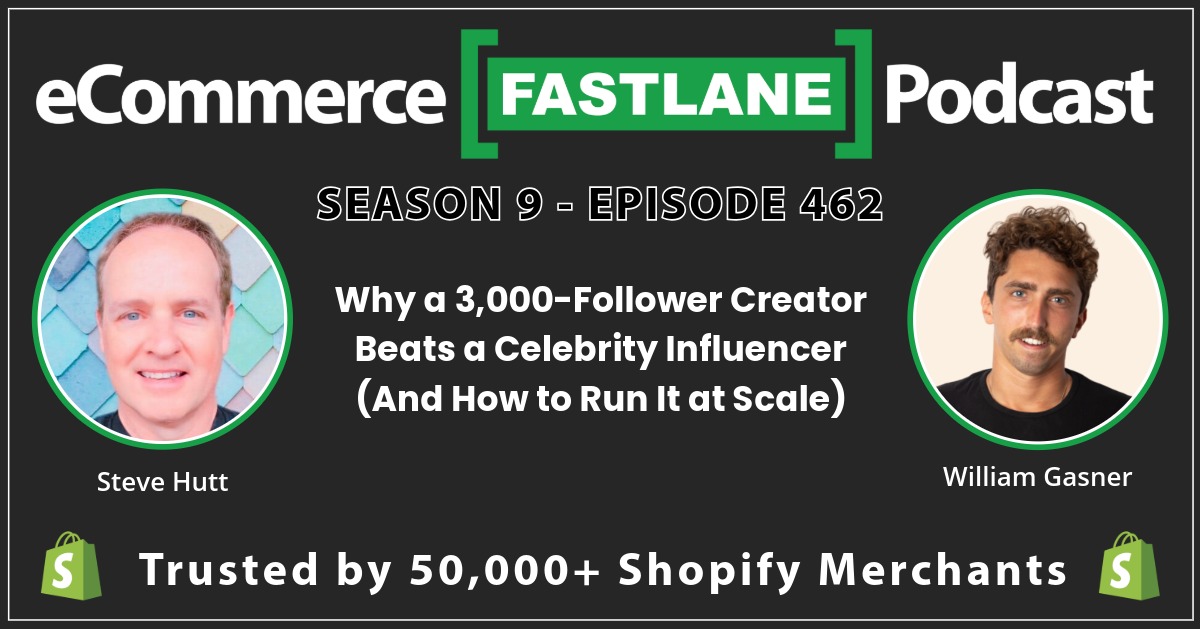
William Gasner is the Co-Founder and CMO of Stack Influence, a two-sided creator marketplace that powers campaigns for brands ranging from first-time founders all the way up to Unilever and Procter & Gamble. He has lived this on both sides of the table: as a six-time founder who built and exited multiple seven-figure ecommerce businesses, and now as the operator of a platform running thousands of monthly brand and creator collaborations. His perspective on creator commerce has been featured in Forbes, Business Insider, and Wired.
In this conversation, we get into the actual mechanics. Product seeding at scale, the Amazon cold-start problem, whitelisting (the most under-implemented paid social move in the ecosystem right now), lifetime content rights, and a clear-eyed take on where AI helps in influencer marketing and where it is actively hurting brands that use it.
One heads-up before you press play. Amazon has officially moved Prime Day 2026 to June, earlier than most brands have planned for. If you have ever wanted to use external traffic to crack Amazon’s first page, the window William describes in this episode is open right now.
Let’s dive in. 👇
✅ Why micro and nano creators (under 100K followers, sometimes just a few thousand) consistently outperform celebrity influencers in 2026 — including the algorithmic shift that broke the old “follower count equals reach” math and why a 3,000-follower yoga teacher can now reach millions through discovery.
✅ How the product seeding model actually works at scale — and why trading product for posts self-selects for passion promoters who genuinely care about your category, rather than creators chasing a check.
✅ The Amazon cold-start problem in plain English — including why influencer-driven external traffic is the cleanest signal you can feed Amazon’s algorithm right before a peak event, and why brands are running this play one to two months ahead of Prime Day, Black Friday, and Sephora launches.
✅ The whitelisting playbook most Shopify brands still haven’t run — how to put your ad budget behind a creator’s own profile so the post never reads like an ad, and why this consistently lifts conversion rates over running the same creative through your brand handle.
✅ How to negotiate lifetime non-exclusive content rights upfront — and why a single $50 product seed can produce a UGC asset library you reuse across website, email, retargeting, and paid social for years.
✅ Where AI is quietly hurting brand trust right now, and where it actually adds leverage — including the specific use cases William is recommending (brief generation, hook analysis, ad copy, supporting product photography) and why authentic human creators are getting more valuable, not less, as feeds fill with synthetic content.

Plytix gives you one place to create and manage all of your product content on Shopify.
Import your entire Shopify catalog in one click, and from there, you can bulk edit thousands of products, variants, metafields, and images with AI that actually knows your products.
Create new listings, optimize for SEO and AI search, translate and localize content, generate and enhance images, and sync everything across your Shopify stores and markets without breaking a thing.
Your whole team can work from the same place with unlimited users, commenting, and version history, so everyone stays on the same page. With Plytix, your listings stay accurate, your products get discovered, and your product catalog finally feels under control.
William’s core argument lands fast: social platforms have democratized distribution faster than most brands realize, and the old equation of follower count equals reach is structurally broken. A creator with 3,000 followers can now reach millions through algorithmic discovery, which means the strategic move is not finding bigger creators. It is running more of the right small ones, at volume, and letting the algorithm decide which content travels.
Product seeding is the entry point. You send free product. The creator posts in exchange. There is no upfront fee, no negotiation, no minimum follower threshold. What that simple trade quietly filters for is more powerful than it looks at first glance. Nobody invests their own time promoting a product they don’t actually care about, so the model self-selects for what William calls passion promoters. A yoga teacher who picks your supplement off a marketplace catalog will outconvert a paid celebrity post almost every time, at a fraction of the cost. Add the lifetime non-exclusive content rights that Stack Influence negotiates into every collaboration, and a single campaign becomes a reusable asset library for your website, email flows, retargeting pools, and paid social creative. The campaign is the seed. The content library is the compounding return.
One of the most under-used plays in the conversation is using influencer campaigns to crack Amazon’s cold-start problem. Amazon needs conversion data to decide where your listing ranks, and high-converting external traffic from creators feeds the algorithm exactly the signal it wants. That is why Stack Influence sees a sharp spike in campaign launches one to two months before peak events, and with Prime Day 2026 officially moving to June, that window is now. The same logic applies to Walmart, Target, Sephora, and any marketplace where external traffic translates into rank.
The deeper tactical layer is whitelisting. Once an influencer creates content, they can grant the brand a permission code to run paid ads through their own profile. Your ad budget amplifies authentic creator content from the creator’s handle, not a branded account, and conversions climb because the ad never quite reads like an ad. The tactic has been available for years. Most Shopify brands still haven’t run it. On AI, William is direct: AI-generated influencer content is already triggering consumer backlash in comments and tanking engagement, and the brands winning right now are using AI for the unglamorous work (briefs, hook analysis, ad copy, supporting product photography) while letting real humans carry the on-camera moments.
This is not theory. It is a practical blueprint for moving spend out of saturated ad auctions and into a channel that gets stronger as ad costs get worse.
👉 Treat micro-influencer seeding as a portfolio, not a single bet. The shift from celebrity creators to nano and micro is fundamentally a risk diversification strategy. Spread the same budget across hundreds of small collaborations and let the algorithm pick which content travels. The math works at volume, not at the individual creator level. If you only have budget for five creators, you are running a test, not a channel.
👉 The content rights are worth more than the original promotion. Get lifetime non-exclusive UGC rights in writing before product ships, not after. The post is the appetizer. The asset library is the meal. UGC consistently outperforms polished brand creative on website conversion, email engagement, and paid social, which means a single $50 product seed can generate creative you reuse for years.
👉 Time your campaigns to feed Amazon’s algorithm before peak events. With Prime Day 2026 moving to June, the cold-start window is opening earlier than most brands have planned for. If you sell on marketplaces, push external creator traffic four to eight weeks before the peak so Amazon has the conversion signal it needs to rank you before consumer search volume surges. The same playbook applies to Walmart, Target, and Sephora.
👉 If you are already working with creators and not whitelisting their posts, you are leaving the biggest single lift on the table. Whitelisting is the most under-implemented paid social play in the Shopify ecosystem right now. Ask for the permission code on your top-performing creator pieces and run paid budget through their profile, not yours. The conversion lift is almost always worth the operational step.
👉 Use AI for the unglamorous parts and let humans carry the camera. AI-generated influencer content is actively hurting brand trust right now, with audiences calling it out in comments and engagement dropping. The right use cases are brief generation, hook analysis, ad copy iteration, and supporting product photography. The authentic human moment is the asset AI cannot fake, and the brands betting on real creators are gaining ground as feeds fill with synthetic content.
William Gasner
Co-Founder & CMO, Stack Influence
William is a six-time founder who spent close to fifteen years selling on Amazon and Shopify, building and exiting multiple seven-figure ecommerce businesses along the way. Stack Influence is the platform he wishes he’d had access to during that run: a two-sided marketplace that flips the traditional influencer database model by letting vetted creators choose which brands and products they actually want to promote.
The company is headquartered in Miami and now powers campaigns for brands at every stage of growth, from first-time founders running their initial launches to enterprise operators like Unilever and Procter & Gamble. By handling creator vetting, rights management, and campaign logistics in-house, Stack Influence makes it possible to run hundreds, or even thousands, of monthly collaborations without building a large internal influencer team.
What makes William’s lens especially useful for Shopify operators is that he has actually sat on both sides of the table: as a merchant fighting for efficient acquisition, and now as the operator of the platform running those campaigns at scale for some of the largest brands in the world.
Featured in This Episode:
Over 9 seasons, I’ve been incredibly fortunate to chat with some of the brightest founders building amazing Shopify brands, as well as the partners shaping the app and marketing ecosystem. Every conversation has taught me something new, and I’m grateful for the chance to learn alongside you.
What matters most is that this podcast helps you solve real challenges and discover new ways to grow. Your support, feedback, and stories have made this journey truly special. Thanks for tuning in, sharing your wins and losses, and being part of the eCommerce Fastlane community.
Stay Connected: Leave an Honest Rating/Review on Apple Podcasts or Spotify. Follow & Subscribe on YouTube for new episodes.
Steve Hutt:
Well, hey there, welcome back to eCommerce Fastlane. I’m your host, Steve Hutt. If you’re running a Shopify store right now, you know exactly what I’m talking about when I say customer acquisition costs are a major challenge for brands. And they’re only going to get worse. We’re at the end of Q2 right now, but it just continues to ramp up. You’d think it would get slower in the summer months, but a lot of people are already ramping up, thinking about Q3, and then with the holiday season, Q4, BFCM, and all that — the competition for share of wallet just keeps growing. With that competition comes increasing costs. It’s the brutal honesty of what’s actually going on.
Steve Hutt:
What’s interesting about today’s recording is I have a great new friend on the show. His name is William, and he’s the co-founder and CMO of a company called Stack Influence. This guy really knows what he’s talking about. He’s a six-time founder who’s built multiple seven-figure ecommerce businesses, so he’s eating his own dog food. He really knows what it takes to be an operator and entrepreneur in direct-to-consumer. I did a tiny bit of research too — he’s been featured in Forbes, Business Insider, and Wired. Those are fantastic links to have.
Steve Hutt:
What’s really caught my attention is that he’s cracked the code on something I believe in: 92% of consumers trust information from actual consumers more than from traditional brand advertising. These authentic recommendations from real people make a difference, and that’s what we’re going to talk about today. We’re going to dig into who micro-influencers are, what this influencer marketing thing is all about, whether you’re executing well with it, whether you’re dabbling, or whether it hasn’t been successful. Is product seeding working for you? There are so many ideas to explore, and we’ve got the absolute right guy to do it. Hi William, welcome to eCommerce Fastlane.
William Gasner:
How’s it going, Steve? Thank you for having me on.
Steve Hutt:
Oh, my pleasure. We joked about this before recording, but at the end of the day, you have a fantastic platform, and a lot of major Shopify brands have put their flag in the sand and said, “We’re using Stack Influence to manage the creators and UGC people who are actually helping build the business.” It reduces those acquisition costs, which is the key thing. So let’s talk about the cost thing, because it’s a perfect storm right now with Meta and Google. It just keeps climbing, and organic reach is declining. Knowing all of that, what are you seeing right now, and why are people choosing to come to Stack Influence?
William Gasner:
Great questions. It’s a very exciting time to be an ecommerce seller, and also to be in the influencer marketing world. All the points you brought up about advertising becoming incrementally harder as more ecommerce sellers enter the ecosystem — that’s absolutely a fact. What’s happening is ecommerce sellers are taking budgets away from traditional marketing arms and pushing them toward the micro-influencer space. Unilever just came out with a stat that they’re taking 50% of their ad budget away from traditional advertising like Meta and Google and pushing it toward influencer marketing. So it’s an exciting time to be in this space and to help brands tap into and scale up these influencer tactics.
William Gasner:
Let me give you a quick high-level overview for those listening who’ve heard of influencers but haven’t dove deep into the different types and strategies. Most people, when they think about influencer marketing, think of celebrity influencers — people with millions of followers, the Kardashians. That’s how influencer marketing got its first footing. Simple math: you give someone with a huge following base a product, they promote it to their audience, you make a bunch of sales. What’s evolved over the past few years is that those larger influencers have become less trustworthy. Trust is also why ads are becoming harder — we’re bombarded by advertisements on every single platform, whether you’re on social media, WhatsApp (which just announced they’re running ads after saying they wouldn’t), or TV. You zone out. That happened with the larger influencer creators too. People realized those creators are getting paid enormous sums of money to do promotions, so it’s less trustworthy and authentic.
William Gasner:
If someone’s biased by a massive payment, you might not really trust their recommendation, and they might not really care about the product. They’ll just promote whatever they’re getting paid for. So a lot of brands have moved toward the smaller influencer space. When I say smaller influencer, the industry calls them nano or micro influencers — people with less than a hundred thousand followers, and even some with only a few hundred or a few thousand followers. Some people listening might ask, how is someone with 3,000 followers ever going to be an effective promoter for me? They have such a small reach. But because of that tight-knit, smaller follower base, those followers are much more engaged, and they trust that person at a much higher capacity. Trust and engagement levels correlate with sales. Now, you might also think there’s a limited number of people you can reach with a smaller creator. The reality is that social media has dramatically changed over the past few years. Content is now more important than follower base. You can have a brand-new social profile, and if you post a TikTok or do Instagram Reels and that content gets good engagement, the social platforms will show that content beyond your follower base. You can get viral posts with billions of views with a very small follower base.
William Gasner:
So the social platforms have democratized the creator world and enabled anyone with a social profile to become a content creator or influencer. That’s not to say every single person is going to go viral. The name of the game is diversifying risk and scaling things up. What brands have realized is, “I could pay a huge amount to Meta or Google, or I could pay a celebrity influencer tens of thousands of dollars for a promotion. But what if I just gave away products to a hundred different people, didn’t pay them, and traded a product in exchange for a post?” Maybe half of them don’t convert super well, but as long as a majority do, and maybe some go extremely viral, you’re going to get an amazing ROI from those promotions. That’s really what we set out to build with Stack Influence — a way to help brands scale up these small creator collaborations and automate the management of them.
William Gasner:
If you’re dealing with two or three larger people, it’s not too difficult. You’re negotiating big fees and so on. But if you’re dealing with hundreds — and some brands on our platform do thousands of collaborations a month — it’s a lot of bandwidth. Even for teams like Unilever, who have 30 people on their influencer marketing team, it’s almost impossible to manage that amount of creators. That’s where Stack Influence comes into play. We can dive into the strategies and how we got there, but that’s the sum of it.
Steve Hutt:
That’s amazing. Thank you for sharing that, because now it’s much more clear. I knew the benefits of micro and nano influencers, but I’d add this: it’s the trust level and authentic connection a lot of these micro or nano influencers have with their followers, even under 10,000, or certainly under a hundred thousand. You always follow them, you’re interested in what they’re up to, where they’re traveling, what they’re using. It’s the angle of how they create that relationship — sometimes they don’t push it hard.
Steve Hutt:
They’re more like, “Hey, I found this really cool thing,” or “Hey, they sent this to me and I tried it, and you know what, I like it.” That sort of advertising is so interesting today because people trust it. It’s not just about getting a free product or an affiliate link. People feel like, “Okay, wow, I trust them.” It’s like Gary Vaynerchuk’s old book — jab, jab, jab, right hook. Give, give, give, then ask. That’s what’s happening with really good nano and micro influencers. They tend to share a lot of what’s going on, complimentary for free, sometimes without any affiliate links. They’re just building their awareness. Then all of a sudden there’s this great product they do want to recommend, and they get paid for it based on whatever the revenue model is. People tend to buy it. It’s really cool.
William Gasner:
Absolutely. To add to that — when someone’s doing something initially for a free product (obviously you want to pay people too, and you mentioned affiliate commissions and performance models), no one’s going to do something for a product they don’t actually care about. So you’re going to be promoting something that I like to call passion promoters. These new-age, smaller creators are passion promoters. You’re going to promote something you’re actually passionate about. If you’re into yoga, you might only promote health and wellness products and athletic and fitness gear. You’re not going to promote an electronic product because that’s not a great fit for your following base.
William Gasner:
So it becomes very niche, and it becomes a real customer testimonial. At the end of the day, the most effective form of marketing in the history of the world is word-of-mouth marketing. These smaller creators are, in essence, word-of-mouth marketing at scale. It’s become an amazing tactic on the promotion side. And the content that’s produced by these people — if you can get rights as a brand to utilize that content across other marketing channels and even advertising channels — there are a million stats out there showing it increases your ad conversions, decreases your ad costs, and can be utilized on a website to increase conversions as social proof. It shows, “Hey, real people are actually using this product.” You need some professional photography to make your brand look polished, but you also want real consumers showing how your product works and what the benefits are. At the end of the day, what human beings relate to is other people like us. Even with AI coming into the game, we’re going to see things shift, but the authentic type of testimonial is only going to become more powerful, because we’re going to be thirsty for that real testimonial from a true consumer as opposed to something perfectly curated or even fake with AI.
Steve Hutt:
Yeah, you bring up a good point about UGC as a strategic growth lever — not just on social, but anywhere, through email campaigns and retargeting. There’s so much UGC can do. One question I have, and then we’ll dig into the Stack Influence platform itself, because there are two main sides for sign-up — the Shopify merchant side and the creator side, and it’s a good union together. But on UGC: how is rights management handled through the platform? What’s your thought on this? You start building a relationship with creators — sometimes it’s just an exchange for product, sometimes it turns into an affiliate link where they get paid based on sales performance. If they produce something powerful that does well, who owns the rights to the content they produced? Is it legal that the merchant now owns it and can repurpose it through other channels? Because if it’s working on one platform, maybe it’s worth testing on others.
William Gasner:
100%. Through the Stack Influence platform, we deal with all the legal logistics to get every single creator to give up non-exclusive rights to use the content. The influencer can utilize it themselves, but the brand actually has lifetime rights to repurpose it across any channel they wish — social media, online ad platforms, marketing, email, website, you name it. We feel it’s a very important aspect of an influencer campaign. If you’re doing this yourself, you should absolutely try to negotiate those rights with influencers ahead of time, because that content itself may provide an amazing ROI just by repurposing it. Take the promotion aside — that content is so valuable. UGC just performs so much better than even perfectly curated professional content these days. So it’s an important aspect to think about when you’re diving into the influencer world.
Steve Hutt:
Yeah. So let’s talk about the platform itself. When you go to the homepage of stackinfluence.com, there’s a brand sign-up and a creator sign-up. Can you talk a bit about why your platform is unique in allowing both parties to show up? What does the day-to-day or week-to-week look like for the merchant, and then for the creators? Gosh, I don’t know how many — over 11 million or more creators on your platform — and it seems like they can be sliced and diced based on their reach, the market they serve, past performance metrics. Talk a little bit about the platform.
William Gasner:
Absolutely. The Stack Influence platform is very unique in the industry. What’s unique is that we set out to build a two-sided marketplace, as opposed to a pure SaaS product. When I was an ecommerce seller, we utilized a huge amount of influencer marketing. The only tools available — and it’s still the case today — the majority of influencer tools out there basically just have a database of influencers, which in simple terms means they have contact information. The solution they’re providing is tools to outreach to those people and manage some payments and negotiations — like a CRM. That can work well when you’re working with a handful of larger creators. But when you’re trying to deal with smaller creators at scale, it’s not an effective solution. You might have to outreach to a thousand people to get one person who’s the right fit and will actually do something for you. It still takes a huge amount of manual logistics.
William Gasner:
What we found when we were selling ecommerce products ourselves was that if we could create a dedicated community of people we trust, who we’ve already vetted, and tap into them at any given point to do a collaboration, it becomes a much more scalable and effective way of going about it. That’s why we built this marketplace. We don’t just have a database of random people — we have a dedicated community of people who apply, get pre-vetted by our system, and then get access to a shopping marketplace, in essence, to pick products that are the ideal fit for them. As opposed to just shipping a random product to someone we think is the right fit, we have the influencer choose the product itself. We get these layers of intent to make sure the match is properly done. That’s the magic of the system.
William Gasner:
So starting on the influencer side: influencers apply, they go through a rigorous vetting process. Once approved, they get access to a curated marketplace catered to products we believe are the right fit for them. Then they can pick products they actually like. Maybe we know they’re interested in baby products, but they might not want a product for a one-year-old versus a three-year-old, and we might not have that data. That layer of intent is really effective for making the match proper. They do ongoing campaigns. We don’t let them do too many — we don’t want to oversaturate their social profile. So we limit things, and that’s how they interact with the system.
William Gasner:
On the brand side, we try to simplify this as much as possible. A brand signs up — if you go to Stack Influence, you sign up — you’ll get on a call with someone so we can align on your growth goals, your products, and make recommendations for what stage of growth you’re at. Once you have the lay of the land, what you’ll simply do is set how many influencers or collaborations you’d like to achieve in a specific time frame. Maybe it’s two months, maybe it’s 12 months. Maybe it’s a hundred influencers, maybe it’s 10,000 influencers. Then you upload some information on your products. Maybe you want to promote three products, maybe 30. You set goals on a per-product basis. Once those goals are in the system, the brand gets to sit back, relax, and the platform does the heavy lifting. We get influencers to actually buy products, so shipping logistics are streamlined. We make sure influencers opt in and follow specific campaign guidelines the brand also has a hand in curating. We make sure they post on time, post in general, and don’t just steal a product. We do the analysis and provide metrics so the brand can see the social results, which were the best influencer promotions, and how sales were generated from these collaborations.
William Gasner:
We also provide a portal to see all the final social content, so you don’t have to search for things or download all those final UGC assets — we get you the rights to everything. It’s an all-encompassing way to streamline these micro and nano collaborations while doing it in the hundreds and thousands, without actually having to lift a finger to accomplish these types of things.
Steve Hutt:
Yeah, this is amazing. As a good host, I did a little research before we were recording today, and I noticed there are others in the direct influencer platforming space — some notable ones, and even a unicorn competitor doing its thing. But one thing I noticed is that you have some key differentiators. What sets Stack Influence apart from the other competitors, based on what I see, is the compensation models, which are quite interesting in a couple of ways. One: there’s a product-only compensation model, meaning you get a product in exchange for a post, and that’s the end of the conversation. Then you see how that goes and continue if it’s fruitful.
Steve Hutt:
There’s also a pay-per-post performance structure. So I want to talk about the different payment options and how you can interact with your influencers. Part two of the question: a lot of the competitors I find are charging a monthly subscription fee or a per-content fee, where Stack is interesting because they only charge essentially after there’s a successful transaction happening.
William Gasner:
Absolutely. The fundamentals payment structure — and what we’ve based our entire business off of — is a pure product seeding model, meaning a brand just has to give away a free product in exchange for a promotion. How we charge as the platform: there are no monthly fees. You hit the nail on the head — we simply charge you a flat small fee, ranging from $20 to $40 depending on your objectives and scales, per successful post. That’s an important thing, because a lot of other platforms will charge you huge sums with no guarantee you’re going to get anything in return.
William Gasner:
How we go about this guaranteed, influencer-insurance model: we actually get influencers to become real consumers. I briefly mentioned this before, but what happens is, in order to receive a product from a brand, the influencer doesn’t just have it shipped to them. We get the influencer to go buy that product from, let’s say, the brand’s Shopify store. Only once they complete a successful social post does the brand reimburse the influencer for their expenses. If they bought something for $15, they get that $15 back. Now they got the product for free, and on top of that, they just pay us a flat fee. The brand is never paying for something they don’t actually receive.
William Gasner:
It’s a really unique solution in the market, because if you talk to anyone else doing product seeding, they’re going to tell you, “Yeah, we’ll send out a hundred products to a hundred different people for you, but what you’re going to get back is maybe 50 final social posts, and you’re going to be losing 100 pieces of actual product.” In our system, if a hundred people buy a product and only 50 complete posts, you just made 50 extra free sales, because you never had to reimburse those people. You came out on top. And you only have to pay anything for the people who successfully create something. It’s a pay-as-you-go, guaranteed model. We found it was just the best way to go about it.
William Gasner:
Internally, we actually reward influencers out of the fees that brands pay us. We pay influencers on top for certain performance metrics. If they produce good content and get good promotional values, we reward them incrementally. So on the influencer side, they’re not just getting product — even though that’s their initial incentive, we want to reward them in the long term based on the value they’re providing.
Steve Hutt:
What happens with Amazon or other marketplaces? When I was at Shopify, one of the strategies we always talked about was multi-channel strategy — maybe not putting your full product catalog on Amazon, but we can’t ignore the fact that probably close to half of all ecommerce transactions (40% for sure, but I’d call it probably half) of all ecommerce transactions online are done on Amazon. They have incredible organic reach. Whatever product people are looking for, the Amazon listing is probably coming up first. Is there a strategy for an influencer to send traffic over to Amazon? Is there a spillover or halo effect? Do they actually buy on Amazon, or do these influencers let people know it’s available on Amazon but then say, “I want to learn more about it,” and end up going direct to the brand on their Shopify store? It’s such an interesting concept about the power of what Amazon has, but I’m curious about the influencer side of promoting these marketplaces.
William Gasner:
100%, great question. Marketplaces are a really interesting use case for influencer marketing. As you mentioned, it’s a crazy stat, but about 50% of every ecommerce sale in the US is going through Amazon itself. Creating a robust Shopify and DTC store is extremely valuable, and that’s also valuable when you’re listing on Amazon. Consumers want to see you have a presence outside of the marketplace, not just be Amazon-focused. But to take advantage of that 50% consumer base, nowadays you want to have some presence on Amazon.
William Gasner:
The difficulty with Amazon — and this is the same with any ecommerce marketplace — is that at the end of the day, it’s a search engine. Similar to Google, 75% of people, when they search for something on Amazon, don’t go past the first page. For any given search term, there might be thousands of pages. People think, “Okay great, I’ll create a listing and start taking advantage of that 50% of consumers on Amazon.” That’s not the case. Maybe you’re on page 9,933, and you’re not making any sales once you’re there. I think the stat is something like 3,000 new sellers join Amazon every single day. Competition is crazy fierce. So how do you position yourself within the marketplace to actually gain visibility? Similar to a Shopify store — how do you rank within Google, how do you show up on search engines? In the Shopify and website world, it’s optimizing for content, SEO, backlinks. On Amazon, the main metrics they want to see are: what are your conversion rates on your listing, how many sales do you have, do people add your product to cart, do they leave reviews, and so on.
William Gasner:
There’s something on Amazon they call the cold start problem. When you first list on Amazon, Amazon faces this dilemma: they’re not going to put you on the first page right away, because it’s a major risk. There are about 43 listings on the first page. If they put you there and your product really wasn’t high-converting, Amazon’s losing money. So it’s a risk for them to start pushing you to the top. But at the same time, it’s also a risk to not place you at all, because what if your product is the best of the bunch and converts extremely well? They could be making a lot more money on your product.
William Gasner:
The only way Amazon can really solve this is to incrementally collect data based on how your listing converts within the marketplace. Organically, what they’ll do is incrementally place you for some high-volume keywords. They might put you on the first page for one keyword for 30 minutes and then take you away — “let’s see what happens.”
Steve Hutt:
Yeah, exactly.
William Gasner:
What you can actually do to really solve that problem for them is start generating external traffic. What I mean by that is: you run an influencer marketing campaign and drive that influencer to promote the product through Amazon. What you’re now doing is giving Amazon the data it needs to determine where to place you within the marketplace. It’s an amazing turnkey system that works really well if you do it effectively. Now, not all external traffic is treated equal. If you run a Facebook campaign and your conversion rates are really low, that could actually hurt your listing. You’re giving Amazon bad data that says this product doesn’t deserve to be there. So you want to invest in channels that are very trusted and high-converting. That’s why a lot of brands utilize influencers for Amazon growth — the conversion rates are really high.
William Gasner:
What you can then do is get this extra ROI where you’re not only making sales, getting content from influencers, and getting the halo effects of brand awareness — if you start driving these high-converting sales and these metrics Amazon loves, you’ll rank higher within the marketplace. Then if your product performs at those higher rates, those sales aren’t going to stop. You’ll be what we call sticky, and stay there, and Amazon becomes a major channel for your ecommerce business. That’s the formula a lot of brands, especially on our platform, are now utilizing influencer campaigns for — not only to create awareness and UGC content and assets for their Shopify stores, but also to grow on online marketplaces like Amazon, Walmart, Target, and Sephora.
Steve Hutt:
So I want to bring up another topic around Amazon, because the timing is really good right now when you think about Prime Days. They’ve decided to run four days now — I think it’s July 8th to 11th — and Prime Days is massive. Has there been any thought, with your platform and the brands and the influencers, about what people are thinking right now? This episode is being released before Prime Days. What are we recommending? Is it status quo, same as normal? Because what’s happening with Prime Days advertising is the share of wallet gets larger — it’s hyped up for Prime members only. I’m getting emails in my inbox about it. I know it’s there, and they want to promote it, and they’ve extended it to four full days. What’s the mindset now, or the execution now, to really maximize this time period?
William Gasner:
Great question, and you’re spot on. Prime Days is a very important day for people running campaigns on our platform, based on all the metrics I just explained. We’re seeing a huge uptick in influencer campaigns usually a month to two months prior to Prime Days — prior to July, prior to the November Prime Days. It really comes back to that cycle: if you can show Amazon a lot of good growth and get your listings to an optimum position prior to having all these new eyeballs on Amazon searching, which is one of the largest days for consumers to actually go to Amazon, you’re going to hit it out of the park. That’s one tactic a lot of people miss with influencers. There are two sides to it. You want to have an always-on strategy, especially with smaller creators — consistent brand awareness. But at certain points during the year, you want to concentrate things to really boost up that awareness and growth, whether you’re on Amazon or Shopify.
William Gasner:
Maybe it’s just the holiday season, maybe your product is seasonal and you only sell during summer — you want to start driving more growth in spring to really get that optimum awareness, and on Amazon specifically, that optimum search positioning prior to having all those consumers on the platform searching for that product. That’s the formula for success. So you’re right — people are pushing a lot of growth prior to July Prime Day. It’s one of our busiest times of the year.
Steve Hutt:
Amazing. I want to talk a little bit about some more advanced tactics. I’ve seen this happen a lot on Instagram accounts, where it seems like a brand takes over an influencer’s account. I’m not sure what the technical side is — how does a brand physically get access to a full takeover for the day and do three or four posts and some crazy stuff? Can you talk about how that works, and how it might be similar to or different from when the influencer is doing the work versus the brand doing the work on the influencer’s own dedicated channel?
William Gasner:
Absolutely. This is something we’re investing heavily in this year and in the upcoming years. The industry term for this is whitelisting.
Steve Hutt:
Ah, okay.
William Gasner:
Basically, after an influencer does a promotion for you, they can give you a unique code — and you need to get this from them. Something we’re building on our system is an automated way to get those codes and streamline them. Once you have this code, you can put it into your Meta ad account or TikTok ad account, and basically their profile becomes a portal or funnel for you to run ads through. So think of it this way: you have Molly, this influencer, produce great content, and now instead of just taking Molly’s content and running it under your brand — let’s say you’re Nike running it under the Nike Instagram account — you’re putting ad dollars behind Molly’s own Instagram post and her profile. You’re funding it. It becomes an amazing advertising tactic. It just dramatically increases conversions. The bottom line is, it’s just more authentic.
William Gasner:
When a consumer comes across it — and Nike’s a unique example because they have great brand following, but for any given brand — when you see an ad, you know it’s an ad, you know it’s from the brand, and it’s innately less trustworthy because you think a huge amount of money is behind it. But if all of a sudden this post comes into your feed from Molly herself, and she’s a yoga teacher promoting this health and wellness product, it’s more trustworthy, more authentic, but it’s backed by ad dollars that get it way more visibility than it would have organically. It’s a really amazing tactic, whether you’re on Instagram or TikTok. TikTok has created a lot of internal processes to streamline this system amazingly. You can combine it with affiliate marketing, choose the best affiliates who produce the best sales, and feed those whitelisted ads into your ad system. The algorithm does the work to pick which one is best.
William Gasner:
This came out a few years ago — it’s not brand new — but a lot of brands are unaware of this tactic and have yet to implement it. For the ones doing it, it’s providing unbelievable results. It’s something we’re planning and in the process of building a lot of automation into, because it takes work to get those codes, pick which content is best, feed that into your ad system, and set ad budgets. That’s going to be a big evolution of our system — what we call content or influencer syndication. Streamline the seeding, streamline the promotion. But now, what do you do with all of that, those relationships, that content? We want to build automations so you can seed those pieces of content and influencer profiles into affiliate programs, into whitelisting advertisements, maybe the content onto your social profiles or your website, and really create this dynamic, automated ecosystem around the influencer collaboration.
Steve Hutt:
This is really cool. I just thought of another idea I’d love to pick your brain on. It’s about cookies and the cookie apocalypse. There’s a seven-day window for attribution right now. I’m curious — do you guys run your own third-party pixel tracking tool? Have you built your own? The reason I’m asking is the customer journey isn’t really fluid from top to bottom. It’s not just from awareness, consideration or discovery, to a purchase. Purchase is the end, but then are they making a second purchase? Understanding that whole journey. What’s your mindset around the current attribution systems we have, and GDPR and all these compliance things that brands are trying to navigate, while still wanting data and being able to action it?
William Gasner:
Yeah, absolutely. One thing with the evolution of cookie tracking and influencers becoming more popular is that targeting is getting harder on ad platforms because cookies are getting more difficult to track. That’s one big advantage to influencers in general — you can target a very niche audience just by identifying the right creators to work with, because their follower bases are pretty targeted. So it’s becoming a replacement for classical targeting mismatches. Influencers can provide much more targeted and better data for that initial promotion.
William Gasner:
Within the influencer promotion itself, tracking sales is a mixed bag. There are a few reasons behind this, and there are ways to do this properly. But social platforms innately hate having people leave the social platform. They want people stuck on Instagram or TikTok. Classically, Instagram posts don’t even allow clickable links, which hurts attribution and full-funnel tracking. But that is changing — TikTok can enable actual clickable posts, advertisements can do so, you can put trackable links in bios in certain types of content on Instagram, like Stories. The key is to have good conversion tracking and actual attribution links within whatever promotion you’re pushing forward, and to get influencers to push it through multiple channels that actually have that attribution. Once you have those in place, it becomes quite easy to see that full funnel.
William Gasner:
As for recurring sales, you’re going to need things in place within your Shopify store. Amazon has some of this data of who’s coming back to rebuy. So you have to piece a few different puzzle pieces together. It’s absolutely something a lot of brands and companies are creating tools for, and something we’re working on, to streamline that — because it’s a hard thing with influencers. If you know your metrics really well, you can see the incremental halo effects from everything. But some people miss that. This is the natural state of ecommerce in general — how do you attribute the sales coming in organically? Maybe it’s from social media, maybe from influencer promotions, maybe from your Amazon listing growing. There are ways to figure that out. The gold standard is pure tracking attribution. So it’s important to create those funnels, especially with affiliate programs where you might only be giving commission based off attributed sales that come from an influencer. Those are the tactics you really need to implement to have full-funnel tracking capabilities.
Steve Hutt:
Yeah, one thing I’d recommend, and you make a good point, is maybe adding a third-party pixel tracking platform to your Shopify store. If you think of Triple Whale, for example, or Northbeam, or Hyros — these are platforms that help you fully understand the customer journey, whatever personally identifiable information is available. Every site visitor has some kind of unique identifying pattern, sale or no sale. There are even new tools now that can unhash the unknown site visitor — like the Opensends and the Retentions and those sort of tools. That’s a whole other conversation about how do we deal with unknown site visitors and how do we market to them when they haven’t opted in yet, and all that craziness. But Triple Whale, Hyros, and Northbeam are certainly options. It would be an interesting platform update for you in the future to think about — how do you interact through APIs with some of these third-party pixel tracking tools? Can you leverage any of this longer-tail data that may not be available from these social platforms? It’s a quite interesting concept.
William Gasner:
Absolutely. And integrating the analysis of unknown website visitors, as you mentioned — RB2B and those tools — can be extremely effective for figuring out that funnel of data. As you collect influencer information, you can really strengthen your entire customer portfolio as well.
Steve Hutt:
Very cool. So I have a question about AI. It’s obviously the elephant in the room. It has so many applications. I wrote about it recently — it’s in my newsletter next week. It’s so interesting, so many applications of it. A lot of marketers and brand founders are a little apprehensive about how they’re using it. They’re worried about brand voice, they’re worried about whether it’s accurate data. They don’t necessarily want to start replacing employees in exchange for research. There are so many different ways of using AI. What have you seen recently in your space? I see a flood of AI-generated social media posts and these headless YouTube channels. There’s a lot of craziness going on, right? And it seems a little inauthentic. Even some of the ones trying to look like humans, moving their hands and mouths — you can tell. We’re at an inflection point. But you have firsthand experience. What’s your thought on AI-generated content? Where are things headed? What are you recommending brands do today with their creators on your platform?
William Gasner:
Yeah, really great question. It’s a wild world. In this day and age, things are evolving rapidly. The content is getting better. Veo, Google’s video generation, just came out, which can do pretty good voiceover content. But what we’re seeing is — and you briefly mentioned this — when brands are creating pure ads or pure content with AI, human beings can still pick up that it’s fake, and that becomes inauthentic and untrustworthy. You’ll see ads people do with AI, and all the comments say, “This is fake news, this is AI, what the heck is this?” That’s actually hurting your brand more than it’s helping.
William Gasner:
Now, there are some ways to utilize AI that can be a useful tool. What we’re recommending brands do is use AI to find best practices or guidelines for influencers. Use it to analyze a huge amount of different social posts in your niche. Figure out what types of hooks and content captions you should be recommending influencers create. Sourcing through data is an extremely valuable use case for AI systems. Also, generic product photography — putting your product in a different shot as opposed to maybe doing a full photo shoot. There are amazing capabilities out now that are doing really well. Sometimes it doesn’t work super well for complicated text on packaging, but that can also be a great use case.
William Gasner:
I am a bit biased because I believe in the human influence. But at the end of the day — when we first came out, we were thinking, “Maybe AI influencers are going to take over and there won’t be any human influencers ever again.” The trend we’re starting to see, and I think it’s only going to become more of a reality, is that people are pushing back on AI influence, in the same way they’re pushing back on the celebrity influence or professional product photography. It’s almost going to make the authentic creators, like the blurry photos and videos, even more impactful, because they stand out in the mixture of us being bombarded by perfectly curated content.
William Gasner:
That’s my thoughts on it. At the same time, I do recommend brands stay abreast of all the changes. Utilize it for certain purposes when it can be a useful tool. Maybe it’s editing a video — once you’ve captured a huge amount of authentic UGC content, there are some really cool tools coming out that can help with that. Whether it’s curating influencer briefs or captions or ad copy, absolutely use it as a tool. But I don’t think it’s going to become a total replacement for the entire industry.
Steve Hutt:
Yeah, totally with you on that. I’ll put my link in the show notes for founders and marketers listening, because there really is a lot of other areas, maybe outside of the influencer space, that people need to think about. Content creation is one — actual blog posts and things like that. But there are merchandising opportunities. There’s customer service. There’s legal stuff. There are operational things through chatbots. There’s quite a bit out there, and I’ve written a pretty in-depth report about what I’m seeing right now in terms of AI applications in general for Shopify stores.
Steve Hutt:
Thanks for sharing that angle. It’s important to understand the inauthenticness happening right now. It’s definitely improving, but I feel you’re right — the human itself is the one that’s going to shine. That goes back to our original comment about trying to build that authentic line from the influencer to the end consumer, through the brand, and this trust and engagement. Super important.
Steve Hutt:
Before we wrap up for today, what do you believe some of our next steps could be? Because of the size of my show, there are thousands of people listening to this episode right now. They’re going to be all over the map in terms of their entrepreneurial journey, business complexity, or business size. Let’s talk about the early-stage people — maybe under a thousand orders a month, just doing their thing, getting product-market fit.
Steve Hutt:
Let’s talk about those stages, and then about the next stage, those firmly in mid-market to enterprise. How does your platform help? Do we start with resources first? What are some of the next steps for those listening today?
William Gasner:
Our platform is catered to whether you’re a brand just starting out or a multi-million-dollar or billion-dollar brand. We have clients like Unilever and Procter & Gamble, but also people who are just getting their feet wet. Influencers are a fantastic strategy for both, especially when you’re launching a new product or just starting out. I’d say it’s actually the best tactic to start with, because you’re not only getting your product in the hands of people — you’re getting feedback, almost customer testimonials. You’re also getting some initial sales and initial consumer-based content about your product that can strengthen your ads when you start to pursue advertising. So it’s a full package of benefits, as opposed to “I’m going to start running Facebook ads right away without really having tested the market or produced great content.”
William Gasner:
It’s fantastic for them. But also, as I mentioned earlier in the podcast, Unilever is investing half of all their ad budget into influencers, so they realize the power of how much it can scale a brand. Our platform caters to both. To sign up, go to stackinfluence.com — top right-hand corner. I mentioned this briefly before, but you’re going to book a call with one of our experts. They’ll guide you through recommendations on how many influencers you actually need, based on the stage of growth you’re in. When you’re first starting out and have no sales, you might not need that many influencers to really promote.
William Gasner:
Once you’re an established brand with hundreds of thousands of orders a month, you’re probably going to need a lot more awareness to see that larger impact. We’ll help you cater the strategy that’s the best fit for your brand and products. Then we’ll help set up a campaign. We have dedicated campaign managers who set everything up for you, walk you through how the whole system works, hold your hand as everything progresses, and you’ll monitor it as it’s going. Check us out at stackinfluence.com. Feel free to follow us for tips and tricks at basically any social platform at Stack Influence. Don’t hesitate to reach out to me personally — connect with me on LinkedIn at William Gasner.
Steve Hutt:
Lovely. I’ll make sure to put in the show notes all the contact information and social channels. You have a really good blog — I just grabbed your RSS feed a second ago. With your permission, I’m going to start syndicating some of your content. You’ll still get full attribution for it, but it’s nice to spread the wealth around. I have about a hundred or so other partners whose RSS feeds I use, and it helps cast a wider net for discovery. You have some great concepts and a great platform, and I want to make sure we get the message out that the opportunity is there. You’re very unique in the marketplace. Thank you so much for coming on the show and sharing today.
William Gasner:
Absolutely. Thanks for having me on, Steve.
Steve Hutt:
All right, take care.
Steve Hutt:
Well, that’s it for today’s episode. I’d like to thank you personally for being a loyal listener of eCommerce Fastlane. It’s my hope that this podcast is offering you a ton of value through growth strategies, tactics, and exclusive insider tips on the best Shopify apps and marketing platforms, all with my personal goal to help you build, manage, grow, and scale a successful and thriving company powered by Shopify. Thanks for investing some time today and listening to the show. I’m so proud and excited that you have a growth mindset and are a constant learner. I truly appreciate you and your entrepreneurial journey. Enjoy the rest of the week, and keep thriving with Shopify.




