Here’s what most Shopify brands doing $20 million or more in revenue eventually realize the hard way: the model was never the bottleneck.
Confident-sounding wrong answers. Dashboards that don’t match the numbers your team already trusts. Analysts are wasting hours re-explaining the business to AI in every conversation. That’s not a model problem. It’s a context problem.
If you’re wondering whether your AI experiments are actually driving results or just creating the illusion of progress, consider this your wake-up call.
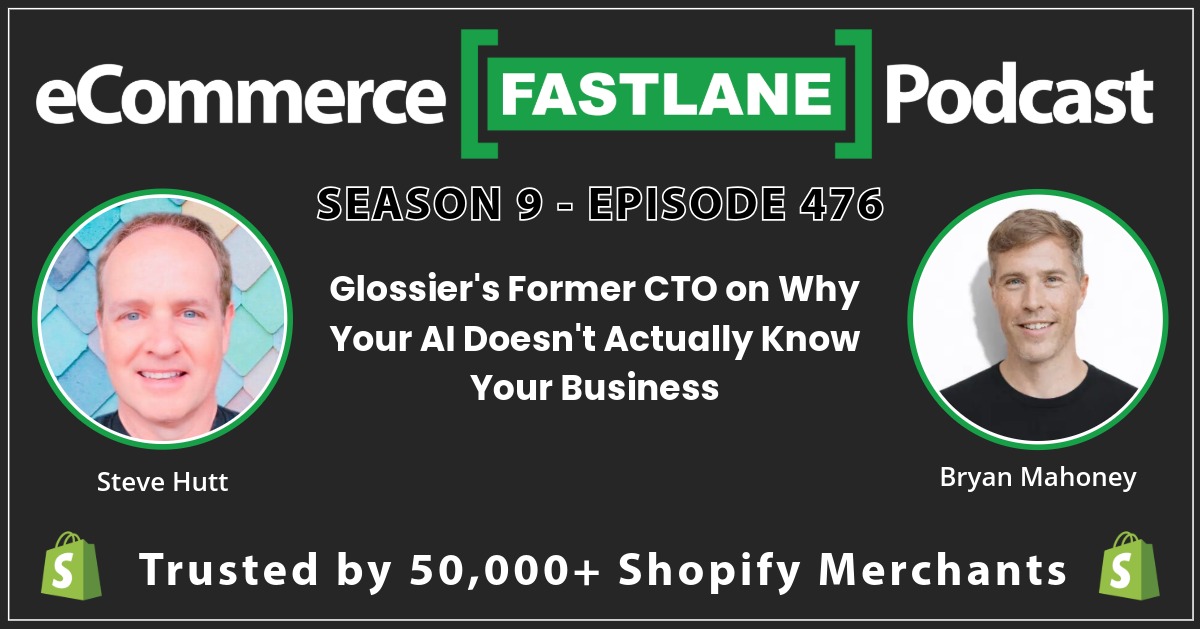
Bryan Mahoney has spent over a decade building the data and technology foundations behind some of DTC’s most recognized brands. Across 12 years connected to Glossier, including his time as Chief Technology Officer, he helped scale the team and infrastructure behind one of Shopify’s most iconic growth stories. He later co-founded Chord, a commerce data and AI platform used by brands like Sonos, Caraway, Ruggable, and Sakara to turn fragmented first-party data into something AI can actually trust.
In this episode, Bryan breaks down what he calls the “context layer,” the unglamorous but critical data work that has to come before any AI agent, chatbot, or dashboard can be trusted to make decisions. He explains why markdown files aren’t real organizational context, why dimensional modeling matters even more in an AI-driven world, and why the brands seeing real ROI from AI are the ones that did the foundational work first.
Let’s dive in. 👇
✅ Why “confidently wrong” AI is a context problem, not a model problem, and what it actually takes to close the gap between AI that sounds right and AI that is right.
✅ Why a folder of markdown files doesn’t qualify as organizational context, and what a real context layer needs instead.
✅ Why Chord’s ideal customer starts around $20 million in revenue, and what earlier-stage brands in the $2 to $5 million range should be building now so they’re ready for a true AI context layer later.
✅ How brands actually learn to trust AI agents, and the pattern Bryan sees as teams move from double-checking every answer in a dashboard to relying on the conversational interface first.
✅ Why the first 90 days matter more than the first “wow” feature, and what Chord’s onboarding looks like when the goal is establishing trust before layering on new use cases.
✅ Why more context, not more model spend, is the real cost lever, and how a well-built context layer can make the same model dramatically more efficient to operate.

MAI Fulfillment is a 3PL partner for brands that have outgrown basic fulfillment but do not want to get lost inside a massive, inflexible network. We specialize in ecommerce fulfillment, B2B distribution, retail-ready shipping, inventory management, returns, and value-added services that help brands operate with more control and confidence. Our value is in the combination of technology, execution, and real partnership.
We give you real-time visibility, reliable workflows, and operational support that helps prevent small fulfillment issues from becoming expensive customer problems. Whether you are managing online orders, wholesale growth, seasonal spikes, or multi-channel complexity, MAI provides the structure to scale without sacrificing accuracy or service quality. We are practical, responsive, and built around your growth. That is what makes us different from 3PLs that treat every brand the same.
Bryan Mahoney explains why the AI conversation most brands are having right now, the one about which model to use and how to write better prompts, is the wrong conversation entirely. The real story, in his view, is context. He opens with a moment that reshaped his own thinking: an analyst at a Chord customer built a beautiful report in Claude. Polished charts, confident narrative, the works. There was just one problem with it, and it’s the kind of problem only someone who already knew the business could have caught. Bryan uses that story to unpack the “confidently wrong” pattern he now sees across nearly every brand experimenting with AI, and why he doesn’t believe the model was ever the real constraint.
From there, Bryan walks through the architecture of Chord’s context stack, starting with what he calls layer zero: do you actually trust the data. Before any agent touches a brand’s numbers, Chord unifies and dimensionally models it, a discipline originally built for human analysts that now has to evolve for a world where agents, not people, are the primary consumers. On top of that sits the real context layer: business definitions, domain rules, decision logic, and a record of how those rules changed over time. And he’s blunt about the shortcut he sees everywhere. Markdown files are not organizational context, and in the episode he explains exactly why that gap comes back to bite teams once agents start making real decisions.
You’ll also hear the story behind one of Bryan’s favorite case studies: a beauty brand CEO who built an entire board deck in Claude by wiring it into his internal data sources, and moved so fast that his own IT team stepped in. What happened next ended up reshaping how Chord built its conversational tool. It’s a great operator-versus-infrastructure story, and it’s better heard than summarized. Bryan also breaks down why Chord’s ideal customer typically starts around $20 million in annual revenue, what earlier-stage brands in the $2 to $5 million range should be building toward instead, and the one piece of guidance he gives nearly every new customer about their first 90 days.
This isn’t a pitch to spend more on AI. It’s a blueprint for the unglamorous groundwork that has to happen before any AI agent earns the right to make decisions inside your business.
👉 Trust the data before you trust the agent. Don’t give an AI agent access to your numbers until you’ve unified and modeled that data. Skip it, and you get the confident, polished, wrong answer that only an experienced human catches.
👉 Markdown files are not a context layer. They’re siloed, undocumented, and impossible to audit as your business evolves. Real context needs shared definitions, rules, and a record of how and why they changed, not a folder of notes one person maintains.
👉 The real ROI conversation is still ahead. Most brands are still tinkering, where cost barely registers because everyone is testing what’s possible. Once the trust gap closes, brands with a strong context layer need far fewer round trips to the model, and that’s where the efficiency shows up.
👉 Match your data discipline to your revenue band. Chord’s sweet spot starts around $20 million, largely because that’s where consolidating a fragmented stack beats adding another point solution. At $2 to $5 million, the takeaway isn’t “not yet.” It’s to start building the data discipline now so you’re ready when you get there.
👉 Invest the first 90 days in the foundation, not features. Chord deliberately spends the first two months proving a brand’s numbers match what the team already trusts before tackling anything new. Promising everything on day one and delivering nothing by month two is the failure mode Bryan is actively designing against.
👉 Agents need supervision, not full autonomy, at least for now. Today’s agents are workflows built from real operator experience, not systems ready to run unsupervised. The brands getting the most value keep humans in the loop and use agents to give their teams, in Bryan’s words, superpowers.
Bryan Mahoney
Co-Founder & CEO, Chord
Bryan Mahoney has spent nearly three decades building technology for commerce, starting with one of the earliest commerce applications he wrote back in 1997. He spent 12 years working alongside the team at Glossier, first as an agency partner in 2014 and later as Chief Technology Officer, helping to build the data and technology infrastructure behind one of Shopify’s defining growth stories of the last decade.
In 2021, Bryan co‑founded Chord with fellow Glossier alum Henry Davis, creating a commerce data and AI platform now used by brands including Sonos, Caraway, Ruggable, and Sakara. Chord helps teams turn fragmented data into a trusted foundation their AI tools can actually use, driving measurable improvements in marketing performance and decision‑making. Bryan also hosts the Brilliant Commerce podcast, where he sits down with operators from other standout brands to unpack what really makes their tech, data, and teams work in practice.
Featured in This Episode:
Over 9 seasons, I’ve been incredibly fortunate to chat with some of the brightest founders building amazing Shopify brands, as well as the partners shaping the app and marketing ecosystem. Every conversation has taught me something new, and I’m grateful for the chance to learn alongside you.
What matters most is that this podcast helps you solve real challenges and discover new ways to grow. Your support, feedback, and stories have made this journey truly special. Thanks for tuning in, sharing your wins and losses, and being part of the eCommerce Fastlane community.
Stay Connected: Leave an Honest Rating/Review on Apple Podcasts or Spotify. Follow & Subscribe on YouTube for new episodes.
Steve Hutt:
Welcome back to eCommerce Fastlane.
Steve Hutt:
I am your host, Steve Hutt. Today, we’re going to chat about something I believe almost every brand I talk to right now is wrestling with: using AI. AI doesn’t actually know your business, and I think that’s the key thing here. It doesn’t know how you define revenue in a lot of cases, or how much customers are actually worth keeping, or even things like your Q3 or Q4 numbers that might look a little bit weird and you don’t quite understand why. So either you’re getting confident‑sounding, wrong answers—I get this a lot using AI—or your team is burning through a lot of hours feeding context into every single conversation instead of having a persistent memory or a system to manage all of this.
Steve Hutt:
That’s the reason why I have my guest on the show today. His name is Bryan Mahoney and he’s the co‑founder and CEO of a company called Chord, that’s C‑H‑O‑R‑D. Before Chord, Bryan was the CTO at Glossier, where he built the tech team and a lot of the data infrastructure behind, I’d argue, the poster‑child brand on Shopify. Harley Finkelstein talks about it a lot, and I think a lot of DTC brand founders have watched the incredible growth of Glossier over the last decade.
Steve Hutt:
Now he’s building what he calls a context layer. That word’s been thrown around a bit, but it’s very interesting how Chord is doing it. It’s this connective tissue between your commerce data and all the AI tools your team is using—Claude, Slack, and all these different things. My hope today is we’re going to unpack what trustworthy AI actually is. I think it’s a lot less about the model and more about the context layer underneath it. So, hi Bryan, welcome to the show.
Bryan Mahoney:
Yeah, thanks for having me, Steve. Excited to unpack all those meaty topics with you.
Steve Hutt:
I know, it’s wild. It’s top of mind for me, and it’s top of mind for my listeners. So let’s set the stage a bit. Before Chord, you were the CTO at Glossier. What did you see inside that business that eventually led you and your co‑founder to build Chord?
Bryan Mahoney:
Yeah, I mean, I got started—well, you said a decade, it’s actually been 12 years. I started working with the team at Glossier in 2014, if you can believe it. April of 2014 is when I first met Emily Weiss, the founder and CEO. She had recently hired Henry Davis, who agreed to join her as president and chief operating officer.
Bryan Mahoney:
I was based in Montreal at the time, running an agency that had done a lot of work in the early days of ecommerce and even before ecommerce, catalog commerce. My story predates Glossier—I think I wrote my first commerce application in 1997, so I’m that old.
Steve Hutt:
Yeah.
Bryan Mahoney:
When I met Emily and Henry, they explained they wanted to create the channel of the future. At that point I’d been working in ecommerce for 15‑plus years and I thought, “The channel of the future? What are you talking about? We know how to do this. It’s a storefront, it’s a shopping cart, it’s an order management system.” But they really talked about using technology to get closer to the customer, to have the customer be part of the conversation.
Bryan Mahoney:
The rest is history. Emily was obviously a visionary, had built up a following as an authority, and used Instagram in a way that Instagram hadn’t been used before. There was a lot of authenticity in what the team at Glossier was doing.
Bryan Mahoney:
We leveraged technology a lot. We wanted to make sure the digital experience was a huge part of your experience as a customer with the brand. It’s one reason why we saw so many customers helping us reach the next customer. They were excited to introduce their best friends to the brand. A lot of best friends were made waiting in line at a Glossier store or online in some of the communities.
Bryan Mahoney:
I talk a lot today about what it means to be an iconic brand or a “next‑to‑be” iconic brand, and I think Glossier set a high bar for that. What I saw was an opportunity to use technology not to move further away from your customer, but in fact closer.
Bryan Mahoney:
And I think in today’s AI era, where there’s this fascination about agents and making everything agentic, what keeps me up at night is the worry that we run the risk of losing some of the magic. What brings me back to consumer and to brand and iconic brands every day is that connective tissue between the customer, the brand, and the products that brand is putting out in the world that customers really want to experience.
Steve Hutt:
All right. It’s interesting, because I talk to a lot of brands, or at least I get DMs on social a lot. It’s so interesting—many of them say, “Hey, I’m doing AI right now.” That’s literally how they phrase it.
Steve Hutt:
I can guarantee you that you’re seeing this through a different lens than a lot of people, because when you actually get under the hood of most commerce teams, I bet you’re more shocked than awed by what’s actually going on. When they say “doing AI,” what does that currently look like for some of the businesses you’ve looked at?
Bryan Mahoney:
Yeah, I have this bit I’ve been doing. I went on this learning tour for the last month in multiple cities—Montreal, Los Angeles, New York—bringing commerce operators around a table. Instead of doing a demo, I facilitated an honest conversation about how we as an industry are, to use your words, “doing AI.”
Bryan Mahoney:
What I’m finding is we’re back in a stage where early adopters have a lot of individuals within their teams who are tinkering. I understand why. The technology on the surface can feel like magic. You ask a question and sometimes you get absolutely the right answer; other times you get answers that are confidently wrong. But it really feels like you can suddenly be a lot better at your job.
Bryan Mahoney:
I’ll tell you this story. I sat down with an analyst who pulled up a report he had generated. As soon as I saw the visuals, I knew right away that Claude had done it. It was spectacular. I asked him to walk me through how he built it.
Bryan Mahoney:
He said, “Absolutely.” He logged into a variety of different systems he had access to, exported some CSV files, and uploaded those CSVs into Claude. He also had dashboards in other systems, so he took screenshots of those dashboards and uploaded them to the same Claude thread. Then he issued a couple of prompts and—boom—this report came out.
Bryan Mahoney:
I thought, “That was amazing.” There’s a big part of the Chord platform that’s analytics and dashboards, so I wondered, “Is my business in trouble?” It was amazing what he was able to do.
Bryan Mahoney:
But he said, “Yeah, hold on a sec, Bryan. The numbers were all wrong.” The graphs looked amazing, but he knew—because he’s an analyst—that the chart was going in the wrong direction, or there was a hallucination in the numbers.
Bryan Mahoney:
I asked how he fixed that, and he said, “I kept prompting and kept prompting, and eventually it got to the right output.” Independently, I think that’s okay. Analysts, instead of living in Power BI or Looker and doing all that dashboarding work, are conversationally getting to outputs that are interesting.
Bryan Mahoney:
But then the light bulb went off for me. I said, “Okay, you’re going to deliver this to your senior leadership team tomorrow. What are you going to do next week?” He admitted, “Yeah, this isn’t really a repeatable process.”
Bryan Mahoney:
That’s when I come back to this idea: we’re all doing AI, but there’s a lot of experimentation and not a lot of coordination. Worse than that, we can’t lose our instinct to think critically. If Claude tells us to walk off a cliff, we shouldn’t walk off a cliff. That’s not the right answer.
Bryan Mahoney:
We have this incredible technology, and we need to make sure we’re setting it up to be successful and setting our organizations up to be successful. I know it’s said a lot—this idea of going slow to go fast—but in my mind it’s never been more true than in this moment. We really have to make sure we’re leveraging these tools correctly, setting ourselves up to be successful, and measuring ROI, not just how many tokens we’re throwing into the token furnace.
Steve Hutt:
Yeah, I know, it’s crazy. When people say “doing AI,” a lot of the time they’re talking about customer‑facing, conversion‑layer AI—anything that touches revenue. Think chatbots, support agents, order status, returns. There are a lot of ways to enhance the customer experience with on‑page personalization, leading content, merchandising—we could go down that whole rabbit hole.
Steve Hutt:
On the operations side, people are using AI for demand forecasting, inventory planning, even fraud. I’ve had fraud folks on recently. There are a lot of interesting things available right now. We have this intelligence layer through these frontier models. The question is: how are you using it?
Steve Hutt:
One conversation that keeps coming up is around the “context layer.” I saw you talk about this a lot on LinkedIn. For a founder hearing “context layer” for the first time, can you explain what that actually is? I think it’s the underpinning of the whole Chord platform.
Bryan Mahoney:
Yeah, I’m going to do my best to explain it. You’re absolutely right—there’s a lot being written about context. Even the frontier models themselves are advertising how important context is.
Bryan Mahoney:
I read a piece from the team at OpenAI about six months ago. They talked, in a very technical, almost white‑paper way, about how they built context for their internal product analytics team. Even sitting on top of arguably the most, or second most, powerful reasoning model in the world wasn’t enough to ask natural‑language questions and get reliable answers. They needed to build, in their case, this seven‑layer “context cake” to get to the right answer in a deterministic way.
Bryan Mahoney:
That’s important. These frontier models are largely nondeterministic by design. Say what you will about the sometimes lousy experience of building dashboards, but dashboards don’t change their mind from one day to the next. You ask the same question, you get the same answer.
Steve Hutt:
Yeah, it’s interesting. I wrote about this—I’ll put a link in the show notes. What’s cool is there’s this surrounding information that becomes the context. When I think about AI, search engines, and the human reader, it’s about how to correctly interpret and use the information.
Steve Hutt:
At the end of the day, we want to understand: do you trust the data? Who wrote it? Where did it come from? When, from whom? What assumptions is it built on? Having a source of truth is where the “context layer” comes in. If we’re bringing these pipes in, do we trust the data, and can we make good decisions from it?
Steve Hutt:
In the example you gave, there could be hallucinated dashboards—things that look great on paper but may not reflect what’s actually going on. These models sometimes corroborate their own story incorrectly. That’s the craziness around the context layer.
Bryan Mahoney:
They’re there because they want to do a job. You ask a question, their job is to give you an answer.
Bryan Mahoney:
I think we’re going to see a maturation of what context means. In Chord’s case, I like to say we’re a data foundation first and then a context engine that sits on top of that. We’ve made the very intentional decision to build very close to the data.
Bryan Mahoney:
I had someone on my (very nascent) podcast, a thoughtful commerce and data leader, who has a background in machine learning and data science. He said the challenge back then was always, “How do we get the data into a place where it’s clean and trustworthy, so we can deploy machine learning models on top of it, do reinforcement learning, and real data science work?”
Bryan Mahoney:
In his observation, this move towards AI adoption has made people forget that that work is still important. You can’t just deploy AI on top of siloed or untrustworthy data. That responsibility hasn’t gone away.
Bryan Mahoney:
So the first thing Chord does—layer zero in our approach to context—is ask: “Do we trust the data?” Chord brings in all of your data and unifies it. We grew up building dimensional models for our data. Dimensional modeling is a concept that makes it easier for analysts to do their work.
Bryan Mahoney:
You’re going to see, or at least I believe, that dimensional modeling has to evolve when the consumer of that data becomes agents instead of analysts. We do a lot of that work on day zero so we can build further context on top.
Bryan Mahoney:
When I think about further context, I mean things like definitions of how your business works; domain knowledge—what we know about commerce that you can use as a benchmark to make sure the answers we provide are right; rules; how decisions are made; logging and auditing—all of that.
Bryan Mahoney:
We have a design for what we call our context stack. I think it’s a design that will be applicable across commerce generally, whether a brand decides to use Chord or build it on their own.
Bryan Mahoney:
Going back to this learning tour, another example I give when I think about individuals tinkering inside organizations is this: markdown files are not organizational context. They are, by definition, siloed. You don’t see how they evolve over time. There’s no audit log. A lot of the governance—the unsexy stuff we don’t want to deal with—is really important for building trust and understanding how systems evolve.
Bryan Mahoney:
Without getting too technical, at Chord we think about having a centralized approach for maintaining this context and making sure that whatever surface you’re using Chord within—logging into the platform, inviting Chord into Slack, inviting Chord into Claude—those rules still apply. There’s a place you can go to see who created them, why they were created, and how they’ve evolved over time.
Steve Hutt:
I see. That makes sense. So we have this data layer, or data foundation, and you get that set. Then you build a context layer and you have a multi‑layer process as part of onboarding. The platform then matures based on these pipes—the context layers, plural.
Steve Hutt:
From there you move into the AI itself or agents that have particular roles based on the data they can access and the context they understand about the business. Can you talk about the agents layer within Chord? Maybe give a case study or a real‑world example of an agent that’s used regularly and has great ROI?
Bryan Mahoney:
Yeah, I think the data analyst as an agent is the first one we started to build. Before you hire an agent to do things like “Go manage my spend across all channels,” you better make sure you have access to data you trust.
Bryan Mahoney:
The best way to dogfood that is to look at what’s great about these agents and the access we can give them. If you think about the traditional way a senior leader would ask for a report: you have an idea on Sunday, go into Slack on Monday, ask the data team, “Can you pull this report for me?” The data team says, “We built that dashboard a month ago, did you check it?” You say, “No, I didn’t have time, can you just pull the report?” Then Wednesday you get the report and by Thursday you’ve looked at it. We can’t operate at that speed anymore.
Bryan Mahoney:
Having these agents—an army of them—waiting for you to ask a question and ready to provide an answer is where we started. To be honest, when we first launched these analyst agents, because we had a legacy analytics product, most early adopters would start in BI, make sure they had the answer they wanted, and then ask the agent to see if it could get the same answer.
Bryan Mahoney:
As someone looking at product analytics, I found that fascinating. It showed me where we were on the trust adoption curve. As our agent got smarter and smarter, the behavior inverted. They started with the conversation, then went to fact‑check it within the BI platform Chord provides.
Bryan Mahoney:
Increasingly, we’re seeing very little traffic in traditional business intelligence. It’s all within the conversational interface, because trust has been established there.
Bryan Mahoney:
Other agents we’ve introduced include anomaly detection. So beyond ad hoc questions, can you monitor deviations? Can you infer what I want to monitor based on prior conversations? We call these monitoring agents—things like delivering insights based on paid performance.
Bryan Mahoney:
We take all of that context and put it into a wrapper for someone who’s an expert in understanding what’s happening in your paid channels and making recommendations so you can lower acquisition costs. We’ve always had the ability to synchronize data out, not just ingest it. Activating data in the form of audiences is one example—we work a lot with CRM teams. Finding your high‑performing audiences, suggesting ways to reach out to them, and connecting those audiences to downstream platforms are things our agents do.
Bryan Mahoney:
The future for me is making sure we have the tools and infrastructure to run agents, and observability and logging so that as agents make decisions, you as an operator can see what’s being done. Ultimately, I want to give brands and operators the building blocks to build their own agents. They know their businesses better than we do. And that’s all part of the platform today.
Steve Hutt:
So it sounds like the technical term being thrown around a lot is “harness.” I follow Nate B. Jones out of Seattle—a product and AI guy with a great YouTube channel—and I’ve learned a lot from him. He uses the word “harness” because he feels the intelligence layer in these frontier models is best used when you have a harness on top of multiple models and you pick the model you need based on the work or agent.
Steve Hutt:
We’re not all just going to use, say, a single frontier model just because it exists. That brings up another interesting conversation: it’s expensive. Funny story—my son is working on a Roblox game right now and asked for an API key for Anthropic. I gave it to him, we selected a frontier model, and he burned through $20 literally in half an hour. I’m like, “What is going on here?”
Steve Hutt:
So my point about the harness is that I think the challenge right now, and where you fit in, is you’re being deliberate not to compete with Claude or OpenAI. You’re not Anthropic—you’re using those models but building this harness on top. You’re frontier‑model agnostic, so to speak.
Bryan Mahoney:
No, that’s right. We have a number of different failover modes too.
Steve Hutt:
Okay, good.
Bryan Mahoney:
We have pipelines that work alongside context to make outputs more deterministic and to learn from those outputs. We’re using the most efficient versions of those models along the way.
Bryan Mahoney:
Our incentive structure is to become your source of truth, the operating system for the agents you’re hiring to run your commerce operation. Our incentive structure is not to have you use the most tokens possible.
Bryan Mahoney:
We’re not talking much yet about ROI, but as an industry we’re still in this tinkering, building, experimenting phase. When we get back to ROI, it’s not just about cost. First, we have to trust the output. You don’t think much about cost at that point because you’re still understanding the limits of what’s possible.
Bryan Mahoney:
Forget the hype that says your business is going to be transformed overnight. These things take time. But once we’ve bridged the trust gap—and I think context is what gets you there—then we have to think about ROI.
Steve Hutt:
Right.
Bryan Mahoney:
The more context you have, the less reliant you are on multiple round trips to the models. You won’t have to use the biggest, most expensive models just to infer everything from messy data because you skipped the hard work. That’s not efficient.
Bryan Mahoney:
We’re going to get to a point—maybe we’re already there—where humans are cheaper than tokens, which is amazing to say. I look at the costs, believe me, and I’m not trying to sell a product that can’t be profitable one day. I think about this a lot.
Bryan Mahoney:
Maybe it’s early to say context is the unlock for efficient use of these models, but I kind of think it is. You’re absolutely right: we’re not competing with Anthropic, we’re not competing with OpenAI.
Bryan Mahoney:
What I want to do is show up and say, “What if I can overnight make your Claude 5x better, because it suddenly understands your business? What if I can make your Claude usage 5x more efficient?” That’s a nice value proposition. And forget 5x—what if it’s 10x? That’s what we’re working towards, and I feel pretty excited about our progress.
Steve Hutt:
It’s interesting, too, that there’s a lot of hype right now about open‑source models—things through ZAI or GLM 5.2. For regular, hardcore knowledge work—summarizing documents, giving insights—people have done research comparing frontier models from the big players against open‑source, third‑party models.
Steve Hutt:
There’s interesting stuff out there. From a cost‑saving standpoint, an open‑source model is basically just a hosting plan. I’m sure that context is available for you and others in the future, knowing it’s not just about frontier models.
Bryan Mahoney:
Yes, for sure. I’ll out myself a bit: I’m a tinkerer as well. Like a lot of people, I’ve been playing around with Open‑Claude setups. When I first got it running, I was using my Anthropic keys and then realized, “Wait a second, how much am I spending?” and shifted from there.
Bryan Mahoney:
It’s been a great testing ground for flipping back and forth between OpenAI models, Anthropic models, and some open‑source models. The utility I get from the open‑source models is 90‑plus percent the same.
Bryan Mahoney:
The more work I do training them, being thoughtful about skills, providing context—organizing my stuff, essentially—the more I’m able to extract real value from those “less sophisticated” models.
Steve Hutt:
Let’s talk about some case studies. I think it’s important to get into them—not necessarily to show direct ROI, but people feel good when they hear, “Hey, these folks at this premium brand did X, and here’s what their life looked like without Chord, and here’s what it looks like now.”
Steve Hutt:
Is there one that catches your eye that you can share publicly or anecdotally? Even if you’re under NDA, can you talk in general terms—here’s their life before Chord, then they came on board, implemented a couple of agents, got confidence in the context layer and connections, and now here’s where they are?
Bryan Mahoney:
Yeah, we have a number of case studies on the site. I’d like to say I love all my children equally.
Steve Hutt:
Yeah.
Bryan Mahoney:
But I’ll tell you another story. A large beauty brand on the platform chose to invest in Chord because they had a really expensive technology stack that was probably overbuilt relative to the size of their business. They wanted to right‑size that and lean into AI, and they wanted to challenge their teams to think differently and operate differently.
Bryan Mahoney:
It started with the CEO. He runs a big board but isn’t afraid to roll up his sleeves. He built his entire board deck in Claude by connecting it to a number of disparate data sources. He kind of went rogue—and as CEO, he’s allowed to—but then the IT team basically turned off his access. They said, “It’s amazing what you did, but we probably shouldn’t do that.”
Bryan Mahoney:
We’d been thinking a lot about our product roadmap. I always want it to be three or four months ahead of what our most forward‑thinking customers will need next. We had recently re‑engineered our core conversational tool to be built on top of an MCP engine we were building, because we kept encountering people like that CEO who were just building in Claude.
Bryan Mahoney:
So I said, “You got disconnected, but what if we could reconnect you to Chord and all the data we have on your behalf, in a way that’s governed and blessed by your IT team, and deliver that to you over MCP?” These are the tools we’ve enabled.
Bryan Mahoney:
Now we’re bringing together operators who want to move quickly with IT teams constantly challenged by, “We’re not moving quickly enough,” while still needing to keep data and customers’ data safe. I love being the peacekeeper between those two.
Bryan Mahoney:
We give the CEO or executive team what they want—to move quickly—in a way the technology team can get behind. Those are some of my favorite case studies. It’s not just “20 percent ROI here” or “reduced CAC there.” It’s about bringing teams together and letting them get the most out of this incredible asset they’re sitting on: their first‑party data.
Bryan Mahoney:
First‑party data has always been gold. As an industry, we’ve struggled to extract value from it because it’s hard. With AI, we’re closer than ever to getting the most out of that data that customers have trusted brands with—and they expect us to deliver great experiences on top of it.
Steve Hutt:
Yeah, it’s amazing. I see that Chord is really built for brands doing at least, as an entry level, around $20 million. We talked about the ICP—the ideal customer profile—for Chord. That’s typically a $20‑million‑plus brand.
Steve Hutt:
Can you talk about why the ICP has a starting point around $20 million in annual revenue? Then maybe as a follow‑up, we can talk about earlier‑stage brands that have product‑market fit, maybe in the $2–$5 million range. They need to be doing something to mature themselves up to Chord at that $20‑million‑plus range. So talk about those two types of ICPs and what you believe they should be doing.
Bryan Mahoney:
Yeah, they might be at different stages of their business, but from a mindset point of view, they’re the same. These are companies that don’t want to buy 25 different point solutions and then hire a big team to stitch them together.
Bryan Mahoney:
A company that’s more mature on its revenue curve realizes that, to get the most out of AI, they need a consolidated approach. We’re a logical fit for them. They have a technology team, and the conversation has always been, “Do I buy or do I build?” My answer has always been, “You should buy, then build.”
Bryan Mahoney:
We resonate with brands that want to do some building but also want to partner with a platform like Chord to accelerate that.
Bryan Mahoney:
On the other side, you have brands that have just launched, have product‑market fit, or are scaling quickly. They want to future‑proof their tech stack. Instead of buying a bunch of point solutions only to realize a year or two later they need to replatform, they want to avoid doing digital transformation when their business is really scaling—that’s the worst time to consolidate platforms.
Bryan Mahoney:
They’re trying to reach the same goal as everyone: do more with less, without affecting the product we put in customers’ hands. We want to meet customers where they are. We use revenue bands as a proxy for how much brands invest to acquire and win back customers. With the product we have today, we can make those efforts more efficient—getting more customers in the door the first time and back in the door the second, third, fourth, fifth, sixth time.
Steve Hutt:
Yeah, exactly. How does Chord look at marketplaces? Right now we’re talking more about an ecommerce platform—Shopify, or others—but people know they have to be on Amazon in many cases. How do you think about that?
Bryan Mahoney:
We think about it like this: omnichannel is the new DTC. We support most marketplaces. It’s really important.
Bryan Mahoney:
Amazon data can be a challenge, but we have great support for bringing Amazon data in—whether you’re selling on Amazon, advertising on Amazon, or doing both. We’re always looking to expand where we get data from so we can give brands a holistic picture of how their business is doing.
Steve Hutt:
Right, okay, that’s cool. I just wanted to be sure because there are people listening who know that’s how they expand. There’s also the B2B opportunity, which is a much larger opportunity than direct‑to‑consumer. People are thinking about how to get their product into more hands, which ultimately means more revenue.
Steve Hutt:
What about the first 90 days? I always talk about this on the show. When someone takes on a platform and gets on board with Chord, what do those first 90 days—or at least the first month—look like? What are the expectations from both the brand and your company?
Bryan Mahoney:
I’ll make this independent of Chord. To set the right expectations with any product—especially one leveraging AI—you’re going to get out of the platform what you put into it.
Bryan Mahoney:
We’ve become much more thoughtful over the years. For the first two months, we want to make sure we’re setting up the right foundation and getting your data in. Especially if you’re a brand that’s been around for a while, you’re not showing up with no data. You have real data. We want to establish confidence right away by understanding your data and giving you back the same numbers—or close enough—that your organization has been looking at.
Bryan Mahoney:
From there, we start to learn more about your business and help you train the model to establish organizational context. Early on, we’ll have agreed on one or two use cases we’re going to go after together.
Bryan Mahoney:
Instead of promising you everything two weeks after you drop a pixel on your site and then delivering nothing, we want to be really focused. If you’re struggling with audiences, we’ll focus on audiences. If there’s a churn problem, we’ll deploy something to tackle that problem.
Bryan Mahoney:
I always want to earn permission to go after bigger and bigger problems once the foundation is set. That’s why we typically encourage new customers to try us for two months. It does take about two months to get to the place where we can tackle those use cases. Sometimes it’s faster, but that’s usually the timeline.
Steve Hutt:
Yeah, this is amazing. I also see that, as far as your current go‑to‑market, the data analyst is kind of the initial agent, then audiences and targeting agents, spend optimization agents, and other more generic agents for questions, clarification, and so on.
Steve Hutt:
You’re also building a lot. I’m not sure if you’re building in public or if there’s a public roadmap, but I see quite a few agents in queue or aspirational. I feel you truly understand, based on your operator background, all the parts of merchandising, loyalty, pricing, forecasting, returns, and retention systems. You’ve executed on those at Glossier, and now you’re bringing that into a data‑powered solution.
Bryan Mahoney:
Yeah, there’s a lot on our roadmap. I think the foundation is there to build just about any agent today.
Bryan Mahoney:
I’ve always found that the best software gets built from real‑world use cases. Sometimes that’s called a design partner, or something similar. Instead of telling an organization, “Just hire these ten agents and your hands are off the wheel,” the honest answer is it takes time to build trust in these processes.
Bryan Mahoney:
These agents aren’t fully autonomous, no matter what hype you’re reading. These are workflows that come from the minds of humans who’ve been on the front lines as operators. They need supervision.
Bryan Mahoney:
I want to design a platform that keeps humans in the loop and gives them superpowers. I really challenge our product team to build tools and extract from real‑world customer work things that are reusable and generalizable, rather than pretending we have a fully baked solution for everyone operating in commerce.
Steve Hutt:
Yeah, this is amazing. We’ve covered a lot today and I really appreciate your time. I’m blown away—I’m on my third page of notes. I’ve scribbled down so many things. It’s so interesting. I’m all in on what you’re building.
Steve Hutt:
There are a lot of fragmented tools out there. Some are great, running off frontier models with decent harnesses, but they’re still point solutions solving a unique problem.
Steve Hutt:
The maturity of where you’re at and where you’re headed is that for brands upwards of $20 million—people like that are listening right now—if that’s you and you want to create a competitive moat, continue to grow, and implement AI with a source of truth, context layer, and agents, what do you believe the next steps are? We talked offline before recording, but I want to make sure we direct people to the right place for the next steps to learn more about Chord.
Bryan Mahoney:
Yeah, I think the easiest place is our website: Chord.co.
Bryan Mahoney:
I’m pretty active and responsive on LinkedIn as well. Whether you want to talk about what we’re building at Chord or just talk shop about how you and your organization are using AI, I love this stuff. Those would be the easiest ways.
Steve Hutt:
Okay, beautiful. I understand there’s also an offer for brands that fit the profile based on where they’re at and the value you can bring. What’s that offer about?
Bryan Mahoney:
We’re offering two‑month free pilots right now for qualifying brands. We have a couple of slots left as we move into the summer. We have a small but mighty implementation team, so there’s a limit to what we can take on.
Bryan Mahoney:
We’re always looking to work with iconic brands that want to take the next step toward leveraging AI the right way—AI that works, delivers ROI, and makes humans in the loop much more capable.
Steve Hutt:
This is amazing. Thanks, Bryan, for coming on the show. I’ll have everything in the show notes. Shout‑out to your podcast, Brilliant Commerce—I’ll put a link in, I’m going to follow it, and I’ll include details in the show notes.
Steve Hutt:
I wish you continued success. Thank you for really digging deep into this industry. As you know, I’ve been in commerce for a long time—nearing 20 years, six years at Shopify, and now five or six years with eCommerce Fastlane. I feel blessed to have the opportunity to speak with you today. I’ve learned a lot. Cheers to you and your team.
Bryan Mahoney:
All right, thanks again for having me. This was great.
Steve Hutt:
All right, take care.