

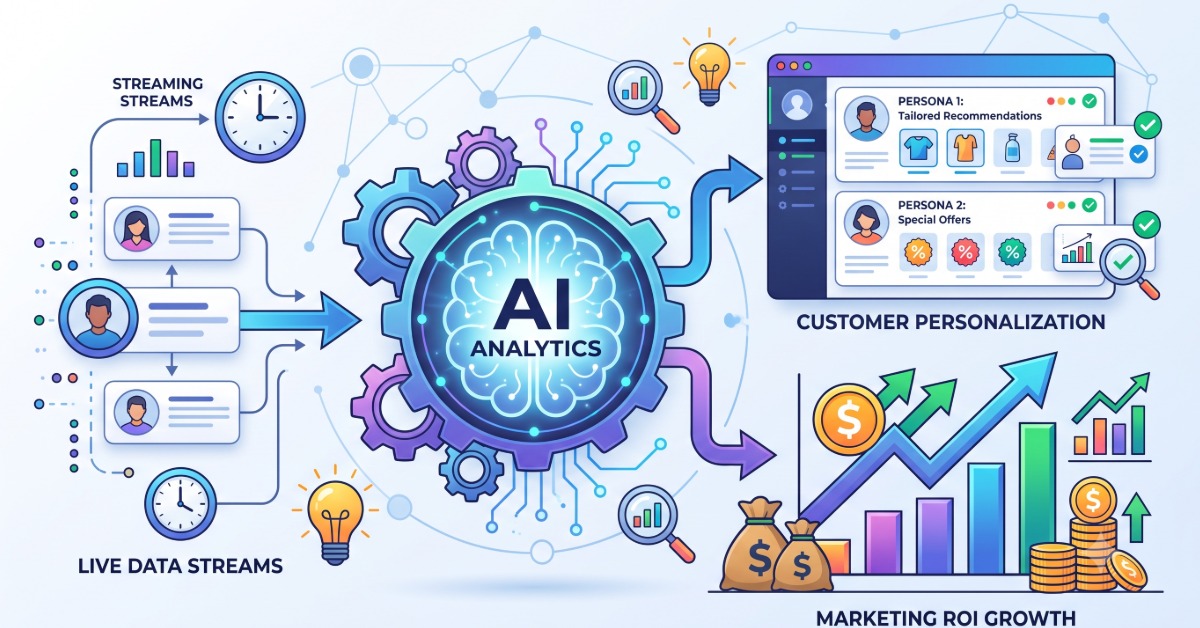
Personalization has a timing problem. A customer browses a product, abandons the cart, and gets a retargeting ad for it three days later, but by then they’ve already bought it elsewhere or forgotten why they wanted it. Marketing teams have spent a decade getting better at personalizing content and, in some ways, worse at personalization timing, because the data pipelines beneath most stacks still run in batches.
This guide walks through the concrete steps to close that gap using real-time AI analytics, from auditing your current latency to proving the ROI once you’ve fixed it.
Before you can call anything real-time, you need an honest number: how many minutes, hours, or seconds pass between a customer action and your system’s ability to act on it. Pull up your tag manager, your CDP, and your ad platform’s conversion API logs, and trace a single event, a product view, or an add-to-cart, from capture to the point it’s usable downstream. Most teams doing this for the first time are surprised to find a nightly batch job sitting somewhere in the middle of a pipeline they assumed was real-time.
The majority of a typical session occurs before login; sometimes the entire session does. If your identity resolution only kicks in once a customer has authenticated, you are working with only a fraction of the picture, no matter how fast your data pipeline is. Map how your current stack handles anonymous and pre-login traffic, and treat any gap here as a higher priority than raw speed, because a fast pipeline built on an incomplete identity graph just delivers incomplete answers faster.
Real-time data that only populates a dashboard someone checks the next morning isn’t actually being used in real time. Trace where your behavioral data flows after capture: does it automatically reach your ad platform’s conversion API, your personalization engine, your email, or your on-site messaging tool, or does a person have to manually export and upload it first? Every manual step in that chain is a place where ‘real-time’ quietly becomes ‘same-day, if someone remembers.’
Don’t try to make everything real-time at once. Start with the two or three use cases where timing has the most direct financial impact: paid media retargeting accuracy (since most programmatic auctions resolve in milliseconds), in-session personalization and offers (which only work if the signal is available while the customer is still on the page), and multi-touch attribution (which becomes more accurate once it can combine real-time actions with historical behavior instead of working from a partial, delayed view).
This prioritization is the practical argument behind Celebrus’s marketing optimization use case, which lays out marketing automation as three connected layers: historical (‘latent’) data for longer-term modeling, real-time triggers for in-the-moment decisions, and the combination of both for smarter, in-context decisioning. The framing is useful even outside any single vendor’s product, because it separates what real-time data is actually good for (triggers, in-session offers, retargeting accuracy) from what it isn’t a replacement for (trend analysis, historical modeling), and most personalization programs need both working together, not one instead of the other.
Cookieless, real-time identity data improves match rates for conversion APIs and lets retargeting reflect what a customer did minutes ago rather than days ago, which directly affects CPA and ad spend efficiency, especially as third-party cookie coverage continues to shrink. Most programmatic buys still run through real-time bidding auctions measured in milliseconds, so identity data that arrives even a few seconds late effectively arrives too late to inform the bid. Confirm your conversion API integration is receiving events in near real time, not on a delayed export.
For more on how the auction mechanics work, see the IAB Tech Lab’s OpenRTB standard, which documents how real-time bidding auctions actually resolve.
Serving the right offer while someone is still on the site or in the app, not in a follow-up email, requires behavioral signals to be available and actionable within the same session, which is only possible with true millisecond-level data delivery. Start with a single high-traffic page or flow, measure the lift, and expand from there rather than attempting a full-site rollout on day one.
Combining a customer’s real-time actions with their historical behavior produces sharper multi-touch attribution and more accurate LTV predictions, because the model isn’t working from a partial, delayed view of the journey. This is usually the step teams underestimate: the attribution model itself often needs to be rebuilt, not just fed faster data, to take advantage of the improved signal.
Personalization budgets get scrutinized most closely when results are hard to attribute, and lag is usually the reason. The scale of the upside is well documented: McKinsey’s research on personalization has found it can lower customer acquisition costs by as much as 50 percent and lift revenue by 5 to 15 percent, but those gains assume the personalization lands in the moment it’s most relevant. Set up a holdout group or a phased rollout so you can measure the incremental lift directly, rather than relying on before-and-after comparisons that get confounded by seasonality.
See McKinsey’s research on personalization for the underlying data behind those figures.
Latency creeps back in. New integrations get added, a vendor changes their sync frequency, someone adds a manual export step to solve an unrelated problem. Re-run the latency audit from step one on a recurring basis, quarterly at minimum, and treat any regression as seriously as you’d treat a tracking outage.
Closing the gap between intent and action doesn’t just make individual campaigns perform better; it makes the whole measurement chain more honest because the system responds to what a customer is actually doing rather than what they did several news cycles ago. That’s the real ROI case for real-time AI analytics: not that it’s faster for its own sake, but that it lets marketing act while the moment it’s reacting to still exists.





