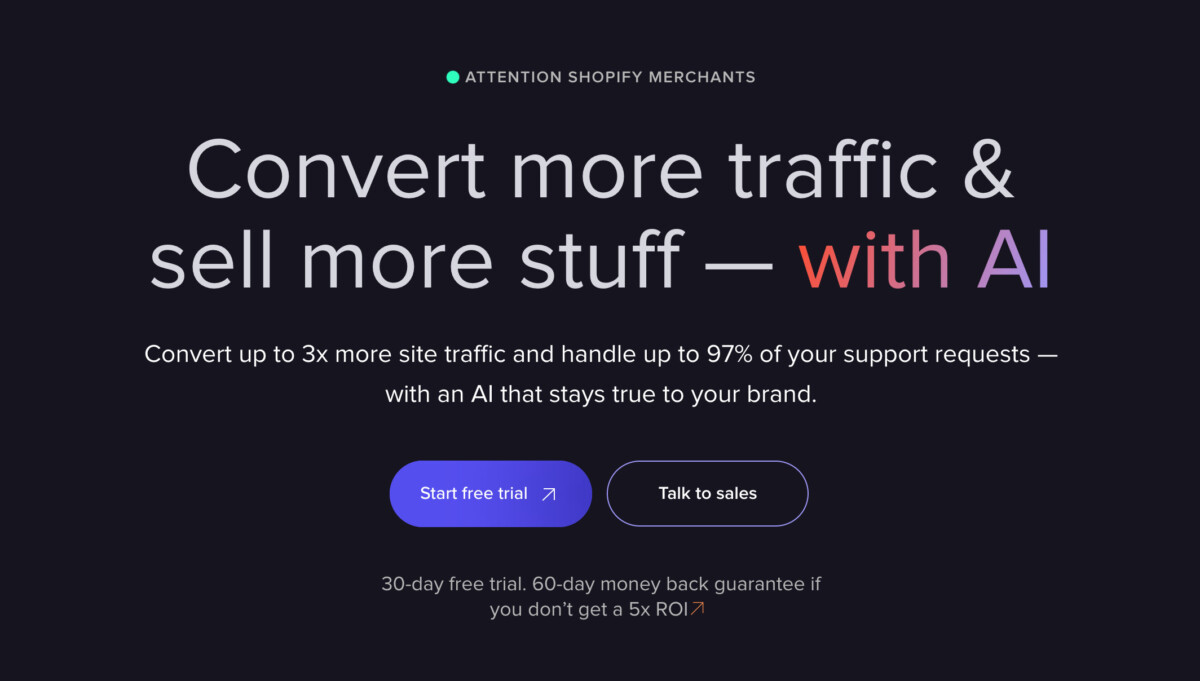
Did you know the AI sales tools market might hit $4.88 billion by 2024? This growth shows how quickly AI is used to make sales better and more efficient.

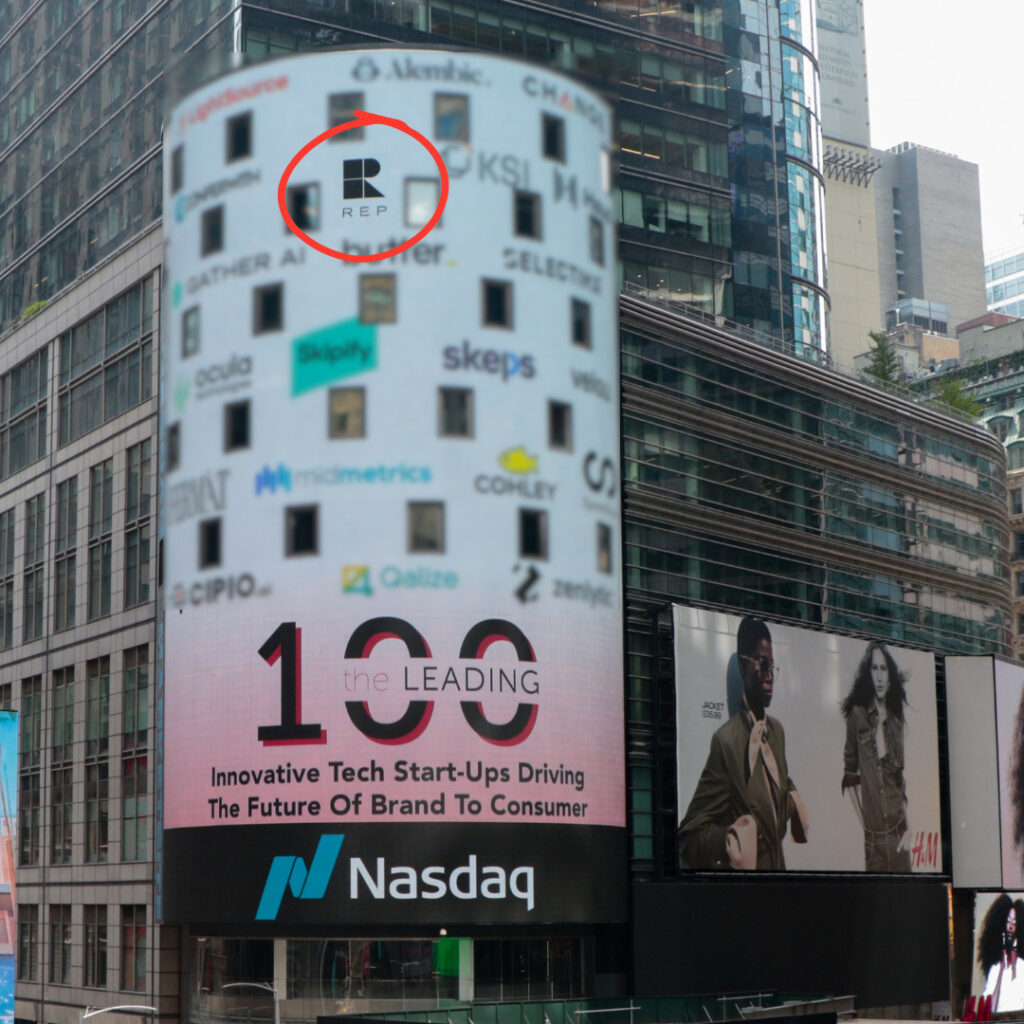
Rep AI is now a recognized AI sales chatbot leader in Shopify’s ecosystem. Recently featured on the NASDAQ billboard, they have lept ahead of others because of their unique AI model that delivers:
For shoppers, they get:
Do any of these persistent eCommerce problems belong to you?
Then, Rep AI is the tool you’ve been looking for.
As Rep AI introduces a new wave of AI assistants or intelligent and on-brand ‘concierges,’ they have also changed how we measure the success of chatbot technology.
Before, scripted chatbots were there to buffer support and deflect tickets. Now, they’re intelligent sales concierges, offering individualized shopping experiences at scale.
Rep operates just like a retail store’s sales rep. Its AI senses when shoppers are disengaged and approaches them with a simple chat when they’re hesitant.
Conversations are contextual to the page, so every recommendation is relevant. Rep is also alerted when someone abandons their cart and reaches out to them with an incentive to drive more sales on the spot.
In short, Rep is smart and driven by CABBE, the most advanced AI for Shopify. CABBE is an acronym that stands for:
They all work together to produce a seamless shopping experience and give merchants access to data and insights they never had before.
The results from Rep’s clients have been eye-opening.
The Concierge learns and gets smarter over time. It can also be trained and fine-tuned so interactions are on-brand voice, messaging, and recommendations.
At first, Rep managed simple chats and relied heavily on user-generated conversation flows. Now, the AI sells in a contextual, individualized way.
Using the Shopify integration, Rep’s advanced AI is always scanning and reading the store every 30 seconds. So product stock is constantly updated and the AI is always up to date.
Rep can also handle up to 97% of support requests, which tend to be pre-sales questions from shoppers that usually end up in support. This means that support teams can tackle harder tasks while AI does the routine work.
With a flurry of ChatGPT powered options available, how can you tell the rock-solid performers from the rest of the pack?
Performance, obviously. Can it sell? Deflect tickets? Yes and yes.
But what Rep brings to the table is its unique behavioral AI which claims to solve the low conversions problem that plagues most eCommerce sites. Let’s face it, 80%, if not more, of your traffic will fail to convert.
Underoutfit, who currently rank in the top percentile of all Shopify stores, tripled their conversions with Rep according to their founder. And there are more examples.
The team at Rep AI have been developing their own model, which also uses OpenAI’s core Gen AI capabilities with ChatGPT, but is bringing something new to the table with CABBE.
Finally, no other company in this category offers a 30-day free trial AND a 60-day money-back guarantee if a merchant doesn’t 5x their ROI. Couple this offer with their self-serve interactive demo where merchants can try Rep on their own stores in a safe and secure demo environment. That’s an offer that’s hard to beat.
Here are the features that matter:
The conversational commerce platform uses GenAI and a powerful NLU (natural language understanding) provide an on-demand brand and product expert for every shopper. Rep is also multilingual understanding slang, idioms, and even local dialects making conversations more natural feeling.
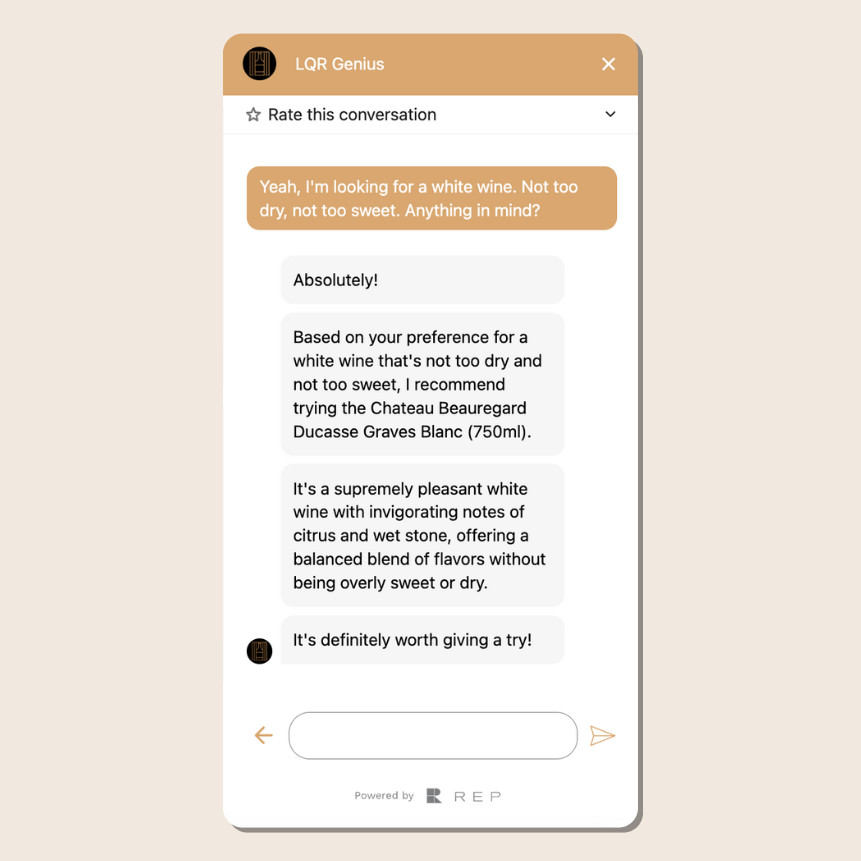
Conversational search and discovery is likely to replace the ineffective site search engine on most sites. Using natural language to discover, say, new wines is a revelation.
And because the AI is essentially a product expert, it can answer questions and recommend different products based on preferences or needs.
Rep delivers AI-assisted metrics such as conversions, sales, AOV, and more. Also, and perhaps most importantly, every AI chat is recorded and available for analysis.
Why is this important? Because AI chats with shoppers gives merchants something they never had before: feedback at scale. Every conversation is a window into what shoppers think, want, and feel.
Some merchants reported using information from chats to improve their Shopify tagging system, product descriptions, and more.
Raw shopper feedback is an advantage no merchant can afford to be without.
Rep uses advanced behavioral AI that checks, every 5 seconds, how shoppers are engaged on your site. It analyzes scroll depth, mouse clicks, and inactivity to determine whether someone might leave your store or stay.
If there’s a risk of them leaving, behavioral intelligence initiates a chat, and conversational intelligence takes over from there.
Even if the AI doesn’t triple your conversions, as they’ve seen with Harney & Sons, if it only gave you an extra 1% or 2% more conversions, wouldn’t that be worth it?

When setting up the AI, merchants can train the AI’s personality with:
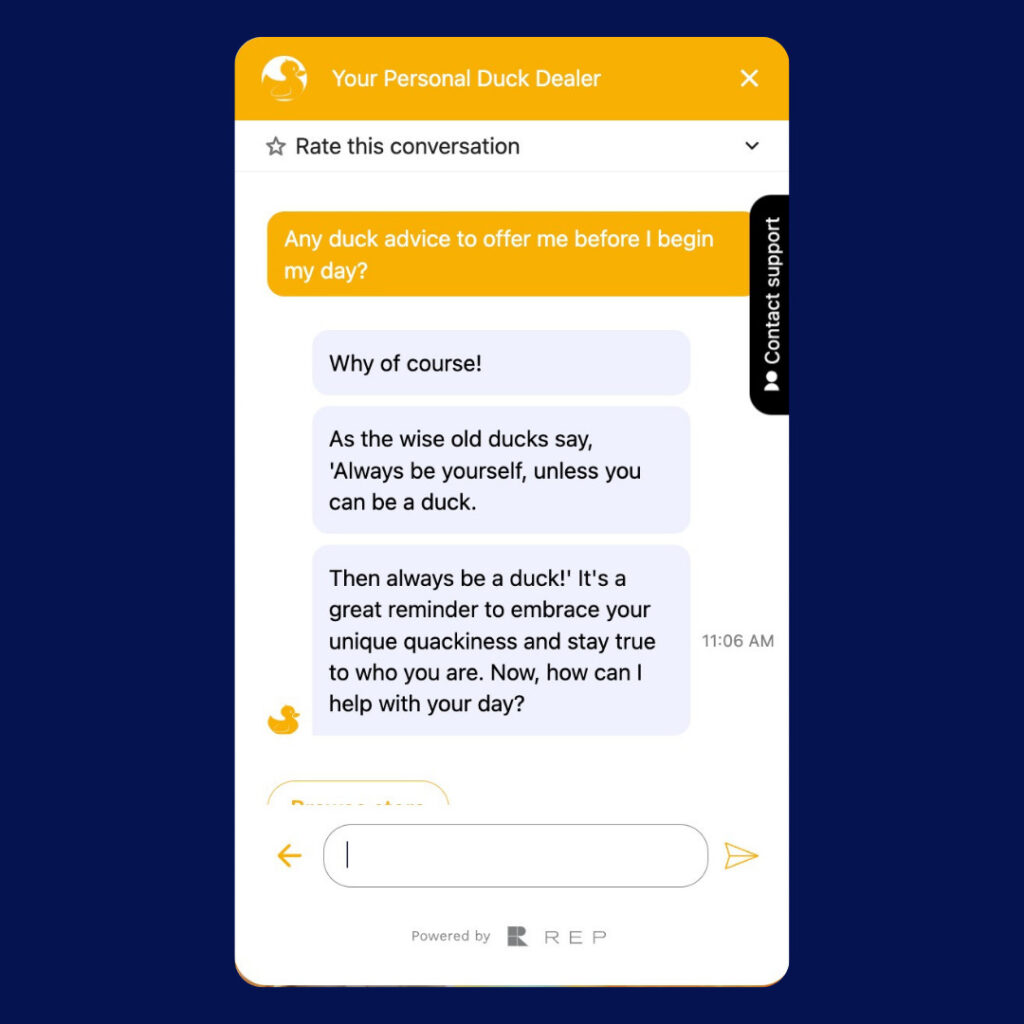
The AI is brilliant at executing its instructions and maintaining brand consistency. When training their AI, Duck World simply instructed the voice to be “duck puns.”
Smart.
This capability will be available in Q3 of 2024, so I’ll update this post then. Ei will be able to:
Stay tuned.
Rep is as close to a plug and play solution as it gets. Its job is to sell by:
What’s the difference between a shopper and a customer? Simple. One of them is in the act of buying something, and one has already bought. Rep’s purpose is to convert more shoppers into customers. And if customers happen to be in shopping mode, then Rep’s job is to sell them again, and sell them more.
Many of the questions that shoppers ask are very different from the questions that customers need help with. And that’s the difference.
Rep AI is so effective at deflecting support tickets because most of those questions are sales questions. They could also be product or policy questions, such as shipping or returns.
Rep’s job is more ‘shopper support’ than ‘customer’.
Currently Rep AI only supports the Shopify ecosystem. As of this writing, Rep has two primary integrations:
They have a third integration with Tapcart, which turns any store into a mobile app.
Current marketing integrations include:
Their functionality allows merchants to collect email and SMS in exchange for a discounts or deals. When shoppers take the deal, Rep asks for their email in exchange for a discount code, and then auto-applies the code at checkout.
One merchant made the claim that emails collected through Rep versus standard pop-ups were more engaged and bought more after measuring their RPR (email revenue per recipient). A powerful testament to conversational interactions versus interruptive automated pop-ups.
Rep AI integrates with Shopify and other upcoming eCommerce platforms. It’s a simple one-click integration that works flawlessly.
In the end, Rep is a chatbot interface that shoppers are familiar with. But as the saying goes, “It’s what’s on the inside that counts.”
With CABBE working as Rep’s advanced AI, the ‘chatbot’ behaves and functions like a true sales concierge for your store. And CABBE is interface agnostic, so in the future, Rep AI could be deployed through voice, or perhaps in the metaverse.
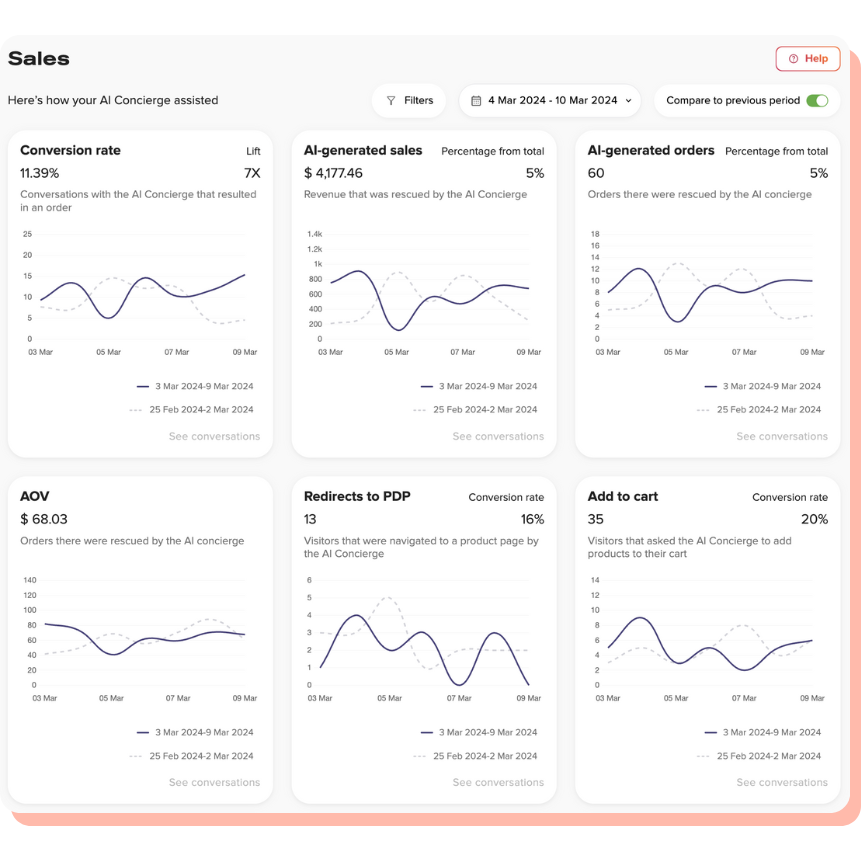
As for the merchant side of things, the console makes it easy to:
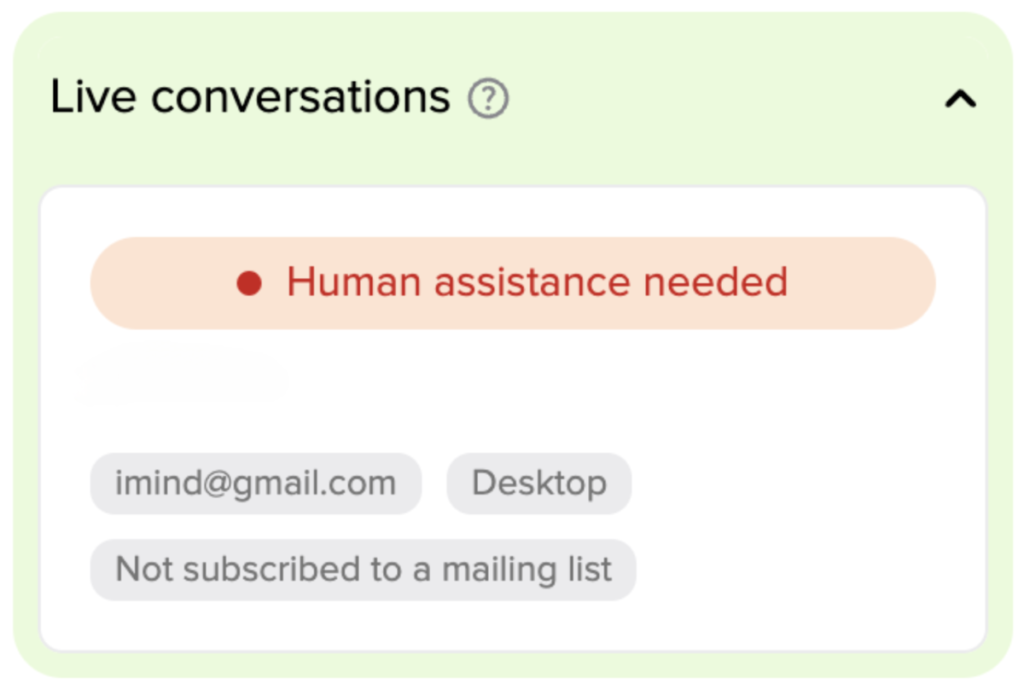
This stresses the value of humans and machines working together in modern AI design.
Rep provides flexible pricing plans starting at $29 a month. These plans are designed for various business sizes, but here’s what matters:
To get started with Rep AI, they have three primary methods:
Again, the simulator will demonstrate how Rep works on your catalog right now. You can test and train it to your heart’s content (or try to break it).
Also, you get a 30-day free trial and a 60-day money-back guarantee if you don’t get a 5x ROI with Rep. That’s an offer you can’t refuse perhaps?
Rep AI has 45 5-star reviews on Shopify. Here’s a comprehensive pros and cons list.
Advantages of Using Rep AI
There are a few drawbacks and areas where Rep AI could get better:
Merchants can report any issue directly to the Rep team, like so:
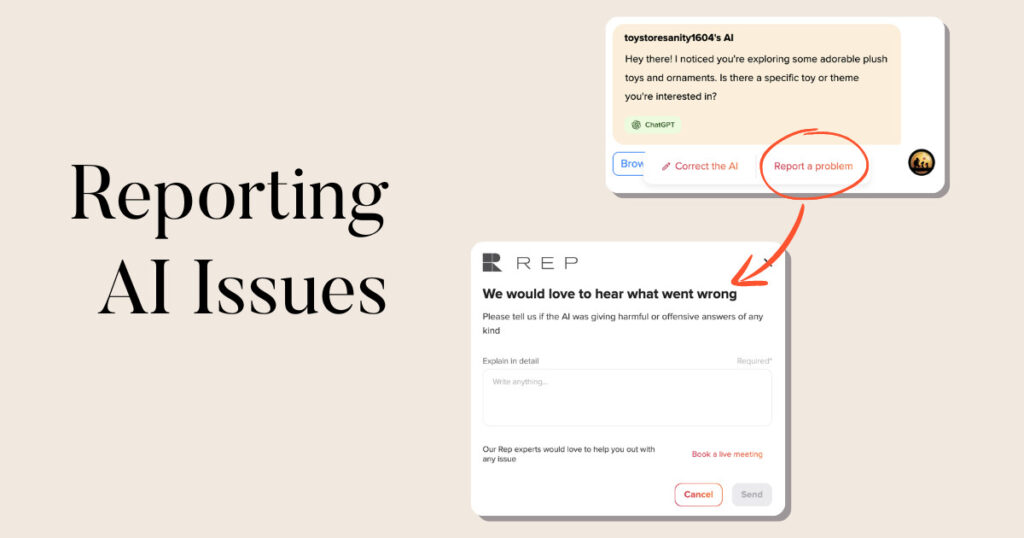
In summary, with the generous trial period and a money-back guarantee, there are few downsides. The AI can sometimes be unpredictable, but the benefits outweigh the cons.
Explore the success stories of Rep AI. This platform has greatly improved sales and customer happiness in many fields. It creates personalized experiences that are true to your brand. This has led to higher engagement and more conversions, showing how powerful it is in enhancing customer experiences with AI.
Rep AI has tripled site traffic conversions and handles nearly all support requests. For example, Harney & Sons Fine Teas increased revenue by 15%. Fresh Roasted Coffee saw a 33.85% conversion rate on abandoned carts. Snow Teeth Whitening earned over $200k. Plus, Rep AI showed a 20X ROI, highlighting its sales-driving power.
Its AI talks to shoppers who seem uninterested, doing much better than usual pop-ups. NutraBio’s sales jumped by 17%. Vush’s conversion rate went up by 10%. They also got four times more blog visitors and happier customers. These stories prove how well Rep AI boosts sales.
You can view all of Rep AI’s case studies here.
Rep makes the distinction between their concierge and typical chatbots. It’s part philosophical and part functional. The concierge was made to sell through a service-oriented approach. Chatbots are generally used to support, unlike a concierge which is a full-service, end-to-end shopping experience solution.
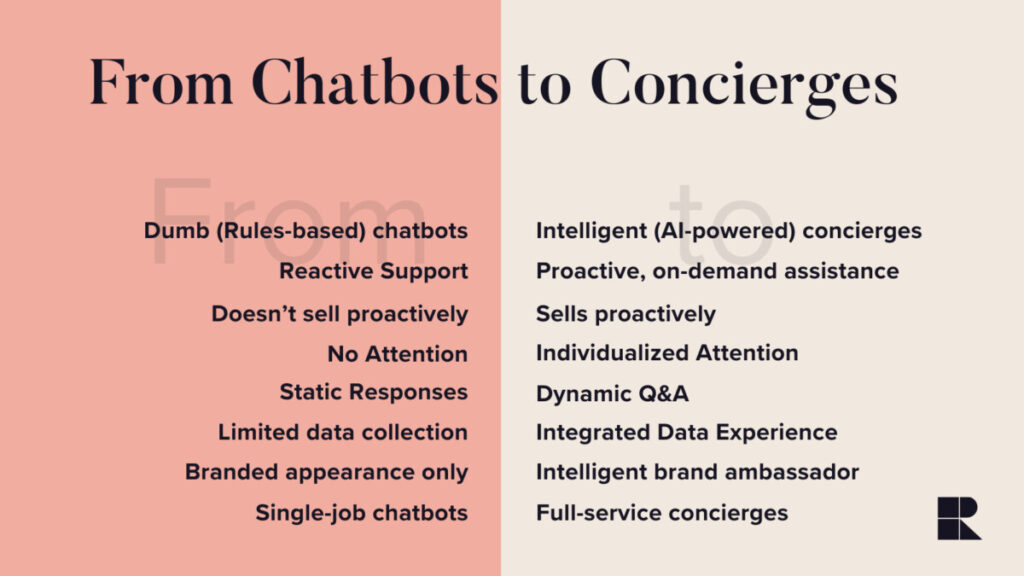
The behavioral intelligence component of CABBE has one job: read digital body language to determine the likelihood of a site visitor’s engagement or lack thereof.
It checks on-site behaviors such as scroll speed, scroll depth, mouse movements, clicks, inactivity, and more every 5 seconds.
Before the custom AI was developed, the Rep team engineered the chat to approach people more like a timed pop-up—every 10, 20, or 30 seconds—and conversions went down.
The results have been almost night and day since the AI only approaches people when they’re most likely to leave. Again, some merchants have reported that their conversions tripled after deploying Rep AI in their stores.
Surprisingly, support teams are now under pressure to support sales and revenue goals. Some of the Rep’s biggest clients came through CS teams, not traditional marketing or sales.
The big surprise is understanding that a lot of support tickets are pre-sales questions. In other words, shoppers have questions about products, use cases, and accessories. And Rep AI is great at handling these redundant questions at scale.

The CABBE model is advanced AI built exclusively for eCommerce. Most AI models are generic and can be hit-or-miss. Rep was built for eCommerce sales.
The Conversational, Analytical, Behavioral, Brand, and Emotional Intelligences put Rep in a different tier when it comes to chatbot technology.
By first converting more site visitors, or browsers into buyers. Second, by offering an engaging shopping experience that includes recommendations for upsells to give AOV a boost.
Around-the-clock coverage. If a human covers support for 8 hours a day, that leaves 16 unmanned hours—unless you have the budget to cover it.
Hiring one person to cover these 16 hours at $15 per hour, every day for an entire month—or 30-day period—would cost you approximately $7,200 per month USD. And that’s without benefits.
AI’s biggest benefit is an always-on, on-brand, intelligent presence in your store. This wasn’t possible before.
Rep is exclusively in the Shopify ecosystem. Marketing integrations include Klaviyo, Yotpo, Attentive, and Postscript.
Support integrations include Gorgias, Zendesk, and Richpanel.
And use Tapcart to convert your store into a mobile-app-like experience.
Rep’s UX prowess is more about how the AI behaves than other solutions. Shoppers can do almost everything in-chat with an intelligent concierge guiding them.
Merchants get a clean dashboard full of AI-assisted metrics and analytics—and a dedicated space to train and test their AI.
Merchants can purchase a monthly or annual subscription if they want to save 20%. Pricing starts at $29 per month and goes up based on:
The downside is the AI can hallucinate, or make things up, if it’s not properly trained.
The pros are more conversions and sales and fewer redundant support requests. Merchants also get a treasure trove of data, analytics, and insights on how to improve.