
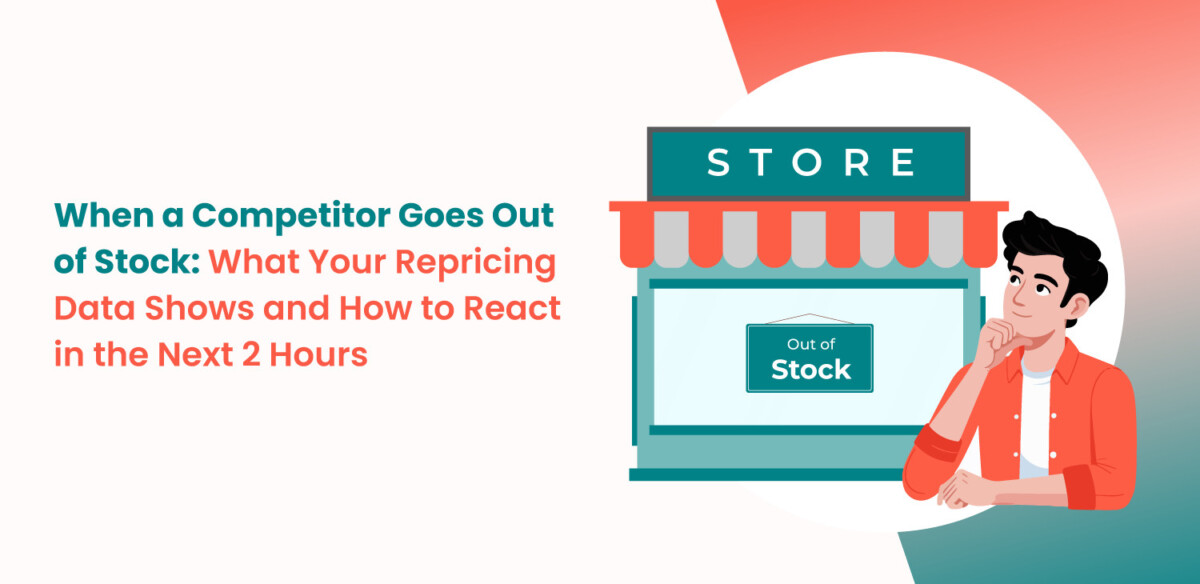
A competitor going out of stock is not a moment to lower your price. It is a moment to raise it. The sellers who understand this are capturing margin that everyone else is leaving on the table.
Every Amazon seller knows, in theory, that a competitor going out of stock is a good thing. One less price you have to compete against. A better shot at the Buy Box. More units moved.
In practice, most sellers do nothing with this information until long after the window has closed.
The seller who notices a competitor stock-out 4 hours after it happens and adjusts their price slightly downward is thinking about this backward. The seller who detects it within 20 minutes, raises their price, and captures premium margin during the demand that the departed competitor was serving , understands what a stock-out actually means in pricing terms.
This article walks through exactly what competitor stock-out data looks like in your repricing dashboard, and the specific 2-hour response protocol that separates sellers who exploit these windows from sellers who let them pass.
When a top competitor on your listing goes out of stock, three things happen in sequence:
The first 2 hours after Step 1 are where you have the highest share of redistributed traffic and the lowest new competition. By hour 4, most sellers with active repricing tools have detected the change and are competing for the newly available volume. By hour 8, the competitive dynamics have largely normalised.
A pricing behavior analysis across 1,400 competitive Amazon listings found that sellers who responded to competitor stock-outs within 2 hours captured an average of 34% higher margin-per-unit during the stock-out period compared to sellers who responded after 4 hours. The sellers who did not respond at all maintaining their existing price rules unchanged left an estimated 18–22% of available margin on the table during the event window.
The opportunity is real and it is time-bounded. The question is whether your repricing rules are configured to catch it automatically.
You do not need to monitor competitor listings manually to catch stock-out events. The signals appear automatically in your repricing data if you know what to look for:
Signal 1 — A Competitor Disappears From Your Competitor List
Most repricing tools display the active sellers competing for Buy Box on each of your SKUs. When a competitor goes out of stock, they exit this list. In a SKU with 6 active competitors, dropping to 5 is a meaningful signal. Dropping from 3 to 2 is a major one.
Set up alerts in your repricing tool for competitor count changes on your top-volume SKUs. A reduction of even one seller on a listing with fewer than 4 active competitors is worth an immediate response.
Signal 2 — Your Buy Box Win Rate Spikes Above Baseline
Your normal Buy Box win percentage for a SKU reflects the competitive equilibrium at your current price. If your tool shows a sudden spike. You are winning 80% of impressions on a SKU where you normally win 45% ,a competitor has likely gone out of stock or paused their listing.
This signal often precedes the competitor list change by 15–30 minutes because Buy Box distribution adjusts in near-real-time, while competitor list updates have a slight lag in most repricing tools.
Signal 3 — Your Repricing Frequency Drops
Counterintuitive but reliable: when a major competitor goes out of stock, your repricing tool fires less frequently on that SKU because there are fewer price changes to respond to. A sudden drop in repricing events on a high-volume SKU, especially combined with a Buy Box win rate spike is a reliable composite signal of a competitor stock-out.
| Time Window | Action | Why |
| 0–20 min | Confirm stock-out via competitor list change AND Buy Box win rate spike (require both signals) | Prevents false positives from normal pricing fluctuations |
| 20–40 min | Raise floor price by 8–12% on the affected SKU | Captures premium margin during redistributed traffic window |
| 20–40 min | Raise ceiling by same percentage or slightly more | Allows repricer to reach higher price if no competition re-enters |
| 40–90 min | Monitor Buy Box win rate every 15 minutes | Tracks whether new competitors are entering |
| 90–120 min | Watch for new competitors re-entering the listing | Signals when the response window is closing |
| 2+ hours | Begin stepping price back down if competitors return | Prevents overpricing as competitive dynamics normalise |
| Stock-out ends | Revert to standard rules within 30 minutes of competitor return | Avoids sustained overpricing that costs Buy Box share |
Manually executing this protocol every time a competitor stock-out occurs is not practical at scale, particularly if you manage 50+ SKUs or operate across multiple marketplaces. The goal is to automate the response so it fires without manual intervention.
The rule structure in most advanced repricing tools: create a Buy Box ownership threshold trigger that says — if my Buy Box percentage on this SKU exceeds X% over any rolling 60-minute window, raise my floor and ceiling by Y%. Set X at 20 points above your normal baseline for that SKU. Set Y at 8–12%.
The second half of the automation is the reversion trigger: if competitor count returns to baseline OR my Buy Box percentage drops back below X%, reset floor and ceiling to standard values within the next repricing cycle.
Tools like Alpha Repricer support Buy Box percentage monitoring at the SKU level, making it possible to configure these threshold triggers without building manual monitoring workflows. The repricing engine detects the Buy Box spike, adjusts the price range automatically, and reverts when the competitive signal normalises.
If you are selling across 50 actively competitive SKUs, the average category experiences 2–3 significant competitor stock-out events per SKU per month across the year. That is roughly 100–150 stock-out windows annually, each carrying a 2-hour opportunity window where automated response captures premium margin.
Sellers who have automated the response protocol capture an estimated 6–9% annual margin premium across their competitive catalog from stock-out windows alone. For a seller doing $500,000 in annual Amazon revenue at a 20% margin, that is $6,000 to $9,000 in additional gross profit per year from a configuration exercise that takes under an hour to set up.
The stock-out is not just an absence of competition. It is a pricing event. Treat it like one.
The key is requiring two signals simultaneously before acting. A price change from a competitor will not remove them from your competitor list in your repricing tool, and it will not cause a sharp spike in your Buy Box win rate that persists for 20 or more minutes. A stock-out produces both: the competitor disappears from the active seller list AND your Buy Box win percentage jumps significantly above your normal baseline. If only one signal fires, treat it as a pricing fluctuation and hold your current rules. When both fire together on the same SKU within a 15 to 30 minute window, you have a confirmed stock-out worth acting on.
Start with 8 to 12% above your current floor and ceiling, then refine based on your category’s competitive density. In categories with 2 to 3 active sellers, you can often push 15% without losing the Buy Box because remaining competition is thin. In categories with 6 or more active sellers, keep the adjustment tighter at 5 to 8% because other sellers respond faster and re-entry happens within the first hour. Track your Buy Box win rate during the first 3 to 4 stock-out events after implementing the rule. If your win rate drops below 50% after the price increase, the adjustment is too aggressive for your category.
Stock-out duration varies significantly by category and seller type. Sellers using Fulfillment by Amazon with strong inventory management systems typically restock within 24 to 72 hours for fast-moving products. Merchant-fulfilled sellers and smaller operators can be out for days or weeks. The 2-hour response protocol is designed to capture the highest-value window regardless of total stock-out duration. The reversion trigger in your repricing rules handles the return automatically, so you do not need to predict how long the stock-out will last. Your rules raise price when the signal fires and bring it back down when the competitor returns.
Yes, and FBA sellers are often better positioned to execute this protocol because their Buy Box eligibility is more stable than merchant-fulfilled sellers. The signals described here, competitor list changes and Buy Box win rate spikes, appear in your repricing dashboard regardless of your fulfillment method. The one consideration for FBA sellers is that your inventory levels affect your own Buy Box eligibility. If you are running low on FBA stock when a competitor goes out of stock, the algorithm may still favor you for the Buy Box, but make sure you have enough units to absorb the increased demand before raising your price. Running out of stock during a competitor stock-out window is a missed opportunity that cannot be recovered.
Alpha Repricer supports Buy Box percentage monitoring at the SKU level and allows threshold-based rule configuration of the type described here. SellerLogic, Informed.co, and BQool also offer Buy Box win rate tracking with varying degrees of rule customization. The specific feature to look for is a Buy Box ownership percentage alert or trigger that can be set at the SKU level, not just at the account level. Account-level Buy Box data averages across your entire catalog and will not catch individual SKU stock-out events reliably. If your current tool only offers account-level Buy Box metrics, that is the first limitation to address before implementing this protocol.





