

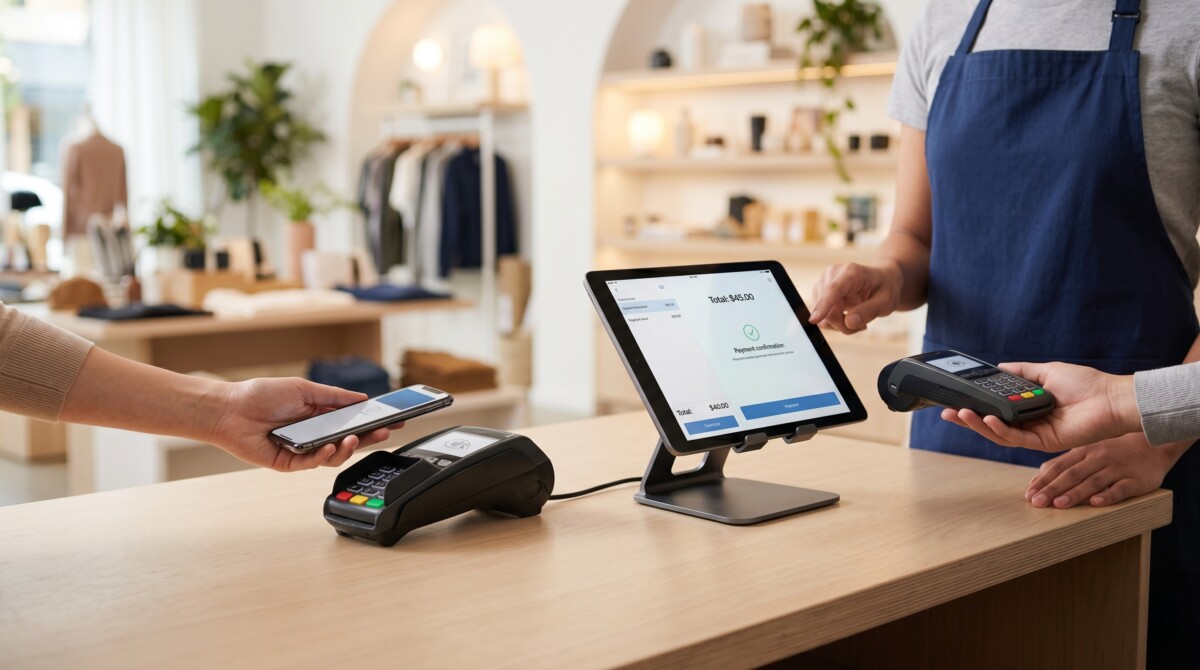
North American merchants are consolidating in-person, online, phone, and remote payments onto connected systems that combine payment terminals, credit card readers, and virtual terminal tools, a shift driven less by new hardware than by the operational cost of running disconnected checkout, reporting, and fraud controls across channels.
The U.S. accounted for 26.31% of global card volume in 2024 but 41.87% of the world’s card fraud losses, a concentration that turns every disconnected payment channel into a separate place for exposure to hide.
Retail checkout used to live in one place. A merchant ran a store, customers came in, and a single point-of-sale terminal handled the cards. The modern North American merchant runs a fundamentally different operation. The same business now takes a tap at a physical counter, a checkout on a website, a card read over the phone for a custom order, a recurring charge for a subscription, and a keyed-in payment for a remote B2B invoice. Each of those is a different transaction environment with different data, different fraud rules, and different reporting.
The shift from single-channel to omnichannel commerce is not a marketing concept here. It is an operational one. According to the U.S. Census Bureau, retail e-commerce reached 16.4% of total retail sales in the fourth quarter of 2024, up from 15.3% a year earlier. That figure understates the operational reality, because the in-store and online numbers are no longer separate businesses. A customer researches online, buys in store, returns by mail, and reorders by phone, and the merchant has to account for all of it as one revenue stream.
This article looks at how merchants in Canada and the United States are modernizing that payment layer, what the older setups cost them, and where the tradeoffs sit. It treats one payment processing company, RapidCents, as a factual case study of how these tools are packaged, not as a recommendation.
Older payment setups create friction because each channel was solved separately, so a merchant ends up running several disconnected systems that do not share data. The store has its terminal. The website has its gateway. Phone orders get keyed into whatever tool is handy, sometimes a separate virtual terminal, sometimes a card machine used off-label. Recurring billing runs somewhere else again. Each system reports on its own, which means month-end reconciliation becomes a manual exercise in matching transactions that never agreed on a format.
The cost shows up in four places. The first is reporting. When in-person and online sales live in separate systems, a merchant cannot answer a basic question, how much did this customer spend with us across every channel, without exporting and merging data by hand. The second is security and compliance. Every system that touches card data is a separate PCI DSS compliance surface, and PCI DSS v4.0 became mandatory in April 2025 with dozens of new requirements covering payment page controls, tamper detection, and access management. More systems mean more compliance scope.
The third cost is fraud and chargeback exposure, and it is the largest. Card-not-present transactions, which cover online, phone, and keyed-in payments, carry chargeback rates between 0.6% and 1%, compared with roughly 0.5% for card-present transactions. When phone and remote payments are processed through improvised tools without address verification or tokenization, that exposure compounds. The fourth cost is the customer experience itself. A buyer who saved a card on the website should not have to read the number aloud again to place a phone order, but disconnected systems force exactly that kind of repetition.
Payment terminals and credit card readers handle the card-present side of the operation, and the modernization here is about connection rather than the hardware itself. A payment terminal at a counter or a credit card reader paired to a tablet still does the core job of accepting a tap, dip, or swipe. What has changed is whether that device feeds the same system as the merchant’s online and phone channels, or whether it remains an island that has to be reconciled separately.
Contactless acceptance is now the default rather than an upgrade. Roughly 79% of debit and credit cards carry NFC chips, and virtually all new point-of-sale terminals ship with tap-to-pay capability. Mobile wallets accounted for about 28% of in-person transactions in 2023, a share projected to pass 30% by 2027. For a merchant, this means the in-person terminal is no longer just a card acceptor; it is a data source that should populate the same customer and transaction record as every other channel.
The operational question for a merchant evaluating in-person hardware is not which reader is fastest. It is whether the reader writes to the same ledger as the website and the phone channel. A $200K-per-year retailer adding a second location, or a $2M brand opening its first physical pop-up, faces the same decision: connect the in-person hardware to the existing payment infrastructure, or accept another reconciliation silo. The hardware is largely commoditized. The integration is where the operational cost lives.
A virtual terminal turns any browser into a card-entry point, which is how merchants process phone, mail, and remote payments without dedicated hardware. It is a web-based form connected to the payment processor, used when the customer is not physically present and there is no checkout page in front of them. A staff member logs in, keys the card details from a phone call or an emailed invoice, and the transaction runs through the same encryption and tokenization as any other card-not-present payment. This is the tool that replaces the improvised phone-order workarounds described earlier.
The use cases cluster in predictable places. Professional services bill clients after a consultation. B2B suppliers process orders where the buyer prefers to hand over card details directly. Clinics, consultants, and nonprofits take payments and donations by phone. Subscription and high-ticket sellers run recurring charges against a stored, tokenized card. For a Shopify merchant whose storefront handles standard e-commerce cleanly, the virtual terminal is what covers the transactions the storefront was never designed for, the custom quote, the over-the-phone reorder, the invoice settled by a procurement team.
The reason this matters for omnichannel payments is consolidation. When the virtual terminal shares a processor and a customer database with the in-person reader and the online checkout, a phone order from an existing customer can draw on a saved card, sync to the same reporting, and apply the same fraud rules. When it does not, the merchant has rebuilt the exact silo that connected infrastructure is meant to remove. The virtual terminal is operationally useful in direct proportion to how well it connects to everything else.
E-commerce merchant services connect the channels by routing in-person, online, phone, and recurring transactions through shared payment processing infrastructure, so the data and the controls are consistent regardless of where the sale originated. This is the layer that determines whether a merchant’s four transaction environments behave as one system or four. The packaging varies by provider, but the components are consistent: a gateway for online checkout, terminal and reader support for in person, a virtual terminal for keyed-in and remote, recurring billing, and a shared fraud and reporting layer underneath.
RapidCents is a payment processing technology company that provides API-driven transaction infrastructure, payment terminal solutions, credit card reader support, virtual terminal tools, and automated fraud mitigation. As a factual case study, it illustrates the consolidation pattern: a Canadian-founded provider, serving merchants in Canada and the United States, that packages online payments, in-person terminals, virtual terminal transactions, recurring billing, and ACH and Interac transfers under one account with a single merchant dashboard. The company states it supports Visa, Mastercard, American Express, Discover, Interac, and ACH or EFT, and that it maintains PCI DSS compliance alongside encryption and tokenization.
The API-driven element is the part most relevant to a developer-supported merchant. Payment processing infrastructure exposed through an API lets a brand wire payment acceptance directly into its own systems rather than bolting on disconnected tools, which is the technical mechanism behind channel consolidation. For a merchant evaluating any provider on this model, the due-diligence questions are concrete: does in-person reconcile with online in one ledger, are phone payments covered without a separate tool, and does the fraud layer apply the same rules across every channel.
Chargeback exposure concentrates in card-not-present channels, which is exactly where omnichannel merchants are adding volume fastest, and automated protection changes the economics by catching disputes and fraud signals before they become losses. The scale of the problem is documented. The Nilson Report put global card fraud losses at $33.41 billion in 2024, with the United States carrying 41.87% of those losses on 26.31% of global card volume, a disproportionate share driven by the country’s lead in online purchasing.
The cost of a chargeback is never just the disputed amount. According to the LexisNexis True Cost of Fraud study, North American retail and e-commerce merchants lose between $3.00 and $4.61 for every dollar of fraud once chargeback fees, investigation time, and operational overhead are included. A single $80 disputed transaction can carry a $20 to $100 chargeback fee on top of the lost merchandise, and processors penalize merchants whose chargeback rates cross network thresholds. Friendly fraud, where a legitimate customer disputes a valid charge, has grown into a major share of these disputes and is harder to contest without transaction evidence.
Automated chargeback protection addresses this by monitoring transactions in real time, flagging suspicious activity before authorization, and assembling the evidence needed to contest disputes. In the RapidCents case study, this function is branded Fraud Shield, an automated fraud mitigation layer combining risk scoring, tokenization, address verification, and 3D Secure authentication. The mechanism matters more than the brand name: 3D Secure authentication, when a transaction passes it, can shift chargeback liability from the merchant to the card issuer. For a merchant adding phone and remote volume, automated protection and PCI compliance are what keep the new channels from quietly raising the fraud rate across the whole operation.
Connected payment tools are becoming the baseline because the cost of leaving channels disconnected now outweighs the cost of integrating them, particularly as card-not-present volume and fraud exposure rise together. A merchant who sells in person, online, by phone, on a recurring basis, and across the Canada to U.S. border is running five payment contexts. Kept separate, each is its own reporting gap, its own compliance surface, and its own fraud blind spot. The consolidation trend in North American retail payment solutions is a response to that arithmetic, not to a new feature.
The direction is consistent across the data. E-commerce and m-commerce are growing at roughly an 18.4% compound annual rate, faster than in-person channels, which means the card-not-present share of most merchants’ volume is increasing every year. Cross-border and remittance flows are growing faster still, at around 19.3% annually, which pulls more merchants into multi-currency and multi-country payment handling whether they planned for it or not. Each of those trends adds a transaction environment, and each new environment is cheaper to add to connected infrastructure than to run as a standalone tool.
For a Shopify merchant or commerce operator, the practical takeaway is to evaluate payment tools by how they connect rather than by any single channel’s features. The questions that matter are whether in-person, online, keyed-in, recurring, and cross-border transactions share one ledger, whether fraud oversight applies uniformly across all of them, and whether reporting reconciles without manual work. The merchants modernizing successfully are not the ones buying the newest terminal. They are the ones who stopped running their channels as separate businesses.
A payment terminal is physical hardware that accepts a card in person through tap, chip, or swipe, while a virtual terminal is a web-based form that lets a merchant key in card details manually for phone, mail, or remote payments with no hardware required. The payment terminal handles card-present transactions at a counter or table. The virtual terminal handles card-not-present transactions, such as a phone order or an emailed invoice, by turning any computer, tablet, or phone with a browser into a secure card-entry point connected to the merchant’s payment processor. Many omnichannel merchants use both, because the two cover different transaction environments that a single tool was never designed to serve.
Card-not-present transactions carry higher chargeback rates, between 0.6% and 1% compared with roughly 0.5% for card-present, because the merchant cannot verify physical possession of the card at the moment of sale. Online, phone, and keyed-in payments give the merchant no chip authentication or in-person signature, which makes them easier targets for both criminal fraud and friendly fraud, where a legitimate customer disputes a valid charge. This is why card-not-present channels rely on layered controls like tokenization, address verification, and 3D Secure authentication, and why automated chargeback protection focuses on these transactions specifically. As merchants shift more volume online and to phone orders, their overall exposure rises unless these controls scale with the new volume.
Automated chargeback protection reduces losses by monitoring transactions in real time, flagging high-risk activity before authorization, and assembling the evidence needed to contest disputes after they are filed. It works through risk scoring that evaluates each transaction against fraud patterns, tokenization that removes raw card data from the merchant’s systems, and authentication protocols like 3D Secure that can shift dispute liability to the card issuer when a transaction passes them. The financial case is significant because losses extend well beyond the disputed amount. North American merchants lose $3.00 to $4.61 for every dollar of fraud once chargeback fees, investigation time, and operational overhead are counted, so catching disputes earlier compounds across an entire transaction volume.
PCI compliance requires any merchant handling branded card data to meet the Payment Card Industry Data Security Standard across every system that processes, stores, or transmits that data, which for omnichannel merchants means every channel is part of the compliance scope. PCI DSS v4.0 became mandatory in April 2025 and added requirements covering payment page script controls, tamper detection, multi-factor authentication, and automated log reviews. The practical implication is that more disconnected payment systems mean more compliance surface to maintain, while consolidating channels onto shared infrastructure with built-in encryption and tokenization narrows that scope. Canadian merchants also operate under PIPEDA, the federal privacy law governing how consumer data collected through transactions is handled.
A Shopify merchant should evaluate connected payment infrastructure by testing whether all transaction types share one ledger and one set of fraud controls, rather than by comparing individual channel features. The questions that matter are concrete: does in-person reconcile with online in a single dashboard, are phone and remote payments covered without a separate improvised tool, does recurring billing draw on the same tokenized customer records, and does the fraud layer apply uniform rules across every channel including cross-border. A merchant at $200K per year and one at $5M face the same structural decision, just at different volumes. The goal is to stop running channels as separate businesses, because the reconciliation, compliance, and fraud costs of disconnection grow with every channel added.




