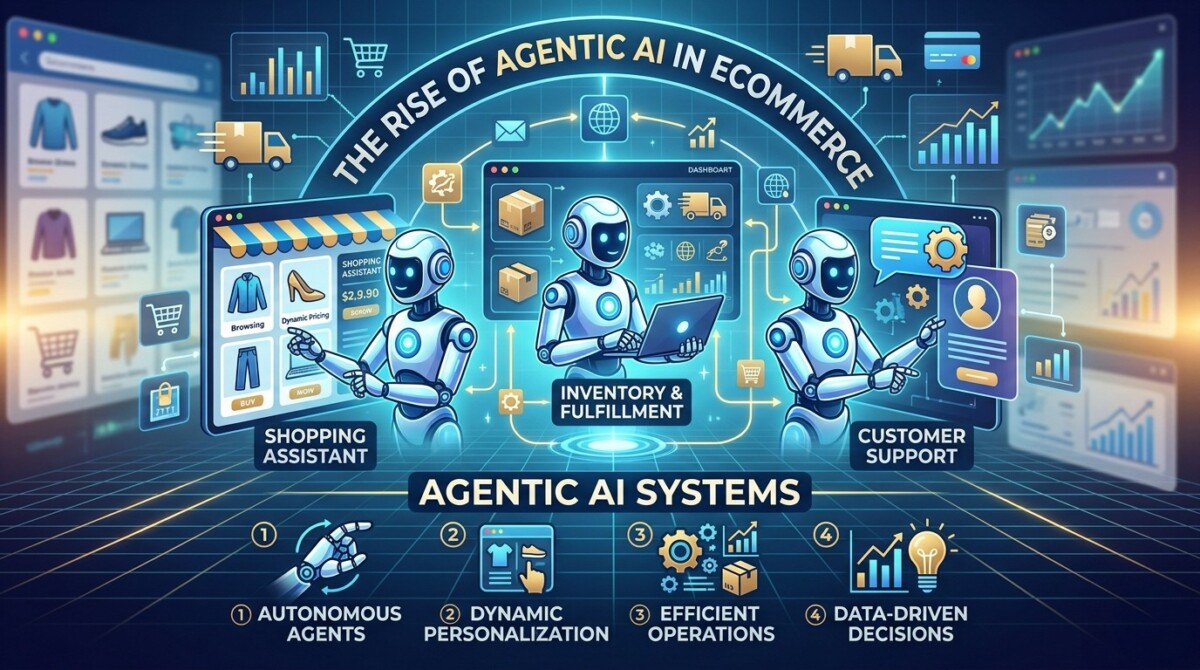
Agentic AI moves Shopify merchants past chatbots and into systems that reason, plan, and take action across the commerce stack. Stores between $500K and $2M should start with a single high-volume workflow like support or returns, prove the value, then layer in additional agents.
The merchants who win in agentic commerce will not have the biggest AI budgets. They will have the cleanest policies, the clearest ownership, and the discipline to ship one agent before they design ten.
Traditional chatbots answer questions; agentic AI takes action, which is why merchants who deployed chatbots between 2018 and 2024 are now hitting a ceiling on the value automation can deliver. For most of the past decade, AI in ecommerce meant a chatbot that could answer FAQs and occasionally surface a product recommendation. That wave served a purpose. It offloaded repetitive inquiries and extended support hours. It also surfaced something obvious about how customers behave: they do not just want answers, they want things done.
A shopper who needs to return a defective jacket does not want to be pointed to your returns policy page. They want the return initiated, the label emailed, and the refund timeline confirmed in a single interaction. That gap, between a reactive chatbot and a system that resolves the entire workflow, is where agentic AI lives. Shopify operators between $500K and $2M feel this gap most acutely. They have enough volume that manual support is expensive, and enough policy complexity that scripted automation no longer covers the edge cases. An earlier primer on how agentic commerce is reshaping online shopping covers the consumer-side shift; what follows here focuses on the merchant-side build.
The shift is not theoretical. Shopify shipped Agentic Storefronts as part of its Winter ’26 Edition, made Sidekick capable of writing apps and orchestrating workflows on its own, and continues to expand the developer surface around Functions and the Catalog API. Merchants who treat agentic AI as a 2027 problem are already behind the merchants who shipped their first agent in Q1.
Agentic AI refers to systems that plan, reason, use tools, and execute multi-step actions across your stack toward a goal, with calibrated human oversight at the points where the stakes warrant it. Unlike a chatbot returning canned responses, an agent breaks a complex request into sub-tasks and sequences them logically, calls external tools and APIs across your OMS, CRM, inventory system, and email platform, adapts its plan mid-execution when it encounters new information, and decides when to act on its own versus when to escalate to a human.
The cleanest mental model is the difference between a smart search box and a capable junior operations associate. The search box returns options. The associate gets the work done, asks for help on the edge cases, and learns the store’s policies over time. The agent works around the clock, scales without proportional headcount growth, and never forgets a policy change you made three months ago.
A practical contrast: traditional automation follows a fixed script (IF return request THEN send label). An agent writes its own script in real time, checks live inventory through the Admin API, applies your specific policy rules, drafts the customer email, processes the refund or exchange, and logs the entire interaction, all from a single natural language instruction. The Shopify-specific version of this is unfolding fast. The practitioner guide to agentic commerce on Shopify covers the platform-level changes (Universal Commerce Protocol, Catalog API, Agentic Storefronts) that make these workflows possible without a custom engineering team behind every deployment.
Six agentic AI use cases are deployable on Shopify in 2026: support resolution, product discovery, returns and exchanges, fulfillment intelligence, personalization, and inventory-aware retention. Each has stage-appropriate tooling, and the right one for a given merchant depends on revenue, support volume, and operational maturity.
For Shopify merchants between $500K and $2M, the first agent almost always lives in customer support. An agentic support system handles refund requests, order lookups, and shipping updates end to end, escalating to a human only when sentiment signals frustration or the issue exceeds its confidence threshold. Tools like Gorgias AI Agent, Rep AI, and Text resolve the majority of routine tickets, freeing the human team to focus on the cases that genuinely require judgment. There is a detailed walkthrough of how to set up a Shopify AI agent for orders, inventory, and support that covers the practical configuration steps.
Product discovery sits next on the list. Acting as a personal buying advisor, the agent asks clarifying questions, checks live inventory, and surfaces the most relevant SKUs based on contextual reasoning rather than keyword matching. This goes well beyond a standard search bar or recommendation widget. Platforms like Klevu, Rep AI’s discovery layer, and Shopify Sidekick App Extensions all play in this space.
Returns and exchanges is where agents start saving real operational dollars. The agent evaluates eligibility against your policy, generates return shipments, applies store credit or refunds, and proactively suggests an exchange option that fits inventory levels. Resolution time drops from days to minutes. For merchants doing 200 or more orders per day, automated returns can quietly handle 20 to 30 cases per week without a single human touching the workflow.
Fulfillment intelligence transforms operations from reactive to predictive. A fulfillment agent monitors order queues, flags at-risk shipments, reallocates inventory across locations when policy permits, and proactively notifies customers of delays before they raise a ticket. Personalization gets sharper in agent hands too: bespoke offers, product recommendations, and post purchase sequences adapt in real time to behavior and purchase history rather than running on static segment rules configured six months ago. The final use case, inventory-aware retention, identifies churn-risk customers, crafts tailored win-back offers informed by margin and stock levels, and deploys them in the right channel at the right moment. No more discounting items that just went out of stock.
The table below maps each use case to the merchant stages where it pays back first.
Building an agentic system is not a single-vendor purchase but a layered architecture combining a reasoning core, orchestration framework, memory and context layer, commerce APIs, and guardrails. Each layer is independently swappable, which matters when models improve faster than orchestration platforms and when commerce APIs evolve faster than reasoning models.
The reasoning core is the language model itself: Claude Sonnet, GPT-4o, Gemini 2.5, or Llama 3 for multi-step reasoning and natural language understanding. Most production agent deployments in 2026 use Claude or GPT-4o for the reasoning layer because both ship reliable tool-use behavior and predictable error patterns. The orchestration layer sits above the model: LangGraph, CrewAI, AutoGen, or Shopify’s own Sidekick App Extensions manage workflows, sequence tool calls, hold state across multi-step interactions, and route messages to the right specialist agent. Memory and context come from vector databases like Pinecone, Weaviate, or pgvector that store long term product, customer, and policy knowledge in a form the agent can retrieve at query time.
The commerce layer is where Shopify earns its keep. The Admin API, Storefront API, Functions, the new Catalog API, and Shopify Flow act as the action surface where the agent actually makes changes to your store. Shopify’s 2025 upgrades to Flow added natural-language workflow building, which closes the gap between an agent’s plan and the executable automation steps inside Shopify.
Guardrails are the final layer, and the most undervalued one. Human-in-the-loop checkpoints, confidence thresholds, audit logging, and rollback paths sit across the stack. The differentiator is not which model you choose. It is how well your orchestration layer manages context, enforces policy constraints, and hands off to humans gracefully. This is where most early implementations break.
The biggest mistake merchants make is trying to build a fully autonomous AI system on day one. Agentic AI compounds when you ship one narrow workflow, prove the value, and expand from there. A disciplined rollout follows five steps and resists the urge to skip any of them.
Step one is identifying a high-volume, low-complexity workflow first. Order status lookups, return eligibility checks, and shipping ETA inquiries are ideal starting points. High frequency means the agent gets fast feedback. Well-defined policies mean the agent has clear ground truth. Low blast radius if something goes wrong protects the brand while you learn. For most $500K to $2M Shopify stores, support resolution is the obvious first agent.
Step two is connecting the agent to live data. An agent is only as good as the context it can access. Wire it to Shopify’s Admin API for orders and customers, your returns platform for eligibility logic, and your ESP for transactional messaging. Static knowledge bases go stale fast and produce wrong answers that damage trust. There is a useful breakdown of the AI agents actually delivering ROI for Shopify merchants, and the pattern across every winner is the same: live data integration, not static FAQ ingestion.
Wiring an agent into three or four systems sounds simple until you own the connections. Each source carries its own auth, its own rate limits, and its own schema changes that break quietly whenever the vendor ships an update, and the upkeep lands on whoever set it up. Some teams write those connections themselves and absorb the maintenance; others pull the sources through a context layer and keep their build time on agent logic and policy instead. Airbyte Agents is one option in that second group, built on an open-source platform with 600+ connectors, where managed connectors and secure credential storage feed a pre-indexed Context Store that agents query in milliseconds, and every connector exposes the same read and write interface across systems. Instead of making live API calls at query time, agents search pre-indexed context, which is what separates it from a live crawl across every API. The difference shows up in latency and cost: an agent that calls five systems in sequence pays five round trips and spends tokens cleaning raw responses before it starts reasoning, and that delay is what the customer feels while waiting on a return decision.
Step three is defining confidence and escalation thresholds. Set explicit rules for when the agent acts versus when it routes to a human. Any refund above a defined dollar value (often $100 at the start), any request the agent scores below 0.85 confidence on, or any sentiment signal of frustration routes immediately to a human agent. These thresholds will tighten over time as you learn what the agent handles well and where it consistently struggles.
Step four is running in shadow mode for two to four weeks before going live. Let the agent observe real interactions and generate proposed actions, then have humans approve every action before execution. Shadow mode surfaces the edge cases you would never anticipate in synthetic testing: the customer asking about a return on an item from a discontinued collection, the support inquiry that mentions a competitor product, the angry sentiment hidden behind politeness.
Step five is instrumenting, measuring, and iterating. Track resolution rate, escalation rate, customer satisfaction, and cost per interaction by category. Agent quality degrades silently when the underlying knowledge and policy documents are not maintained. Schedule a monthly review of the agent’s escalations and a quarterly review of its policy rules. The agent should get smarter every month, not coast on its launch configuration.
Every merchant evaluating agentic AI needs an honest read on both the upside and the downside, with governance as the discipline most teams skip and the one that decides whether agents compound value or quietly erode trust. The advantages are real and compounding: 24/7 resolution without proportional headcount growth, consistent policy enforcement at scale, personalization that improves with every interaction, proactive instead of reactive operations, and freed human capacity that gets redirected to the cases where judgment actually matters. Shopify operators between $500K and $2M typically see 40 to 60 percent of support volume resolved without human involvement within 90 days of a properly configured agent going live.
The risks are equally real. Hallucination remains the most cited concern, and rightly so when the action is high-stakes (refunds, exchanges, inventory commitments). Integration complexity across a fragmented stack adds friction, especially when an OMS, returns platform, and ESP are each held together by tape. A visible error from an agent damages trust faster than a comparable human error because customers expect machines to be consistent. Customer acceptance also varies by segment. Some segments expect AI-first service; others want a human voice on every interaction. Knowing which segment is which is part of the rollout work, not an afterthought.
Governance is the layer most merchants skip, and the layer that decides whether the agent compounds value or quietly erodes it. Governance is not a single checkbox; it is a discipline. At minimum, an agentic system needs four things: a defined owner who is accountable when the agent makes a wrong call, an audit trail for every action the agent takes, a clear human escalation path with response time SLAs, and regular policy review cycles as the business evolves. The merchants who treat governance as a blocker get outpaced by the merchants who treat it as infrastructure. Agents without governance look fast in the first quarter and look reckless by the third.
The next 18 months in agentic commerce will be shaped by agent-to-agent coordination, deeper Shopify-native infrastructure, and the merchants who instrument carefully will compound advantages the rest cannot catch. Expect a customer support agent, a fulfillment agent, and a merchandising agent collaborating in real time to resolve a single issue in a single interaction, without a human seeing the workflow unless one of them escalates.
Shopify’s Winter ’26 announcement of Agentic Storefronts formalizes the platform layer. Universal Commerce Protocol, the Catalog API, and Sidekick App Extensions create the rails that make multi-agent workflows possible without a six month engineering build. Merchants on Shopify Plus get earliest access; merchants on lower tiers get the rails a quarter or two behind.
The merchants who win will not be the ones with the biggest budgets. They will be the ones who instrument thoughtfully, govern carefully, and ship one disciplined workflow at a time. Agentic commerce, like compound interest, rewards the operators who start early and stay consistent. The practical takeaway has not changed: pick one workflow, build one agent, instrument one feedback loop. Ship it. Learn from it. Ship the next one. The merchants doing that today are the ones who will be uncatchable by 2028.
Agentic AI in ecommerce refers to systems that plan, reason, use tools, and take action across the commerce stack toward a goal, while a chatbot returns canned responses to a fixed set of questions. The practical difference is execution: a chatbot tells a customer how to return a product; an agent processes the return, generates the label, updates inventory, and confirms the refund timeline. For Shopify merchants, this distinction matters because agents work directly against the Admin API, Functions, and Flow rather than sitting on the front end as a sidecar that cannot actually change anything in the store.
Customer support resolution is almost always the best first agentic AI use case for a Shopify store doing $500K to $2M. Support volume is high enough to justify the rollout, policies are typically documented enough for an agent to reason against, and the blast radius if the agent misfires is contained (a single ticket, not a fulfillment error or a pricing change). Start with order status lookups and return eligibility checks. Tools like Gorgias AI Agent and Rep AI integrate with Shopify in days, not months, and resolve a measurable percentage of tickets without human involvement once policies and tone are configured properly.
A first production agentic AI workflow on Shopify typically takes 60 to 90 days from kickoff to live deployment when the merchant follows a disciplined rollout. The first two to four weeks cover scoping, policy documentation, and tool selection. Weeks three through six handle integration, configuration, and a closed-loop shadow mode where humans approve every agent action. The final 30 days cover a guarded live rollout with confidence thresholds tight, followed by gradual loosening as the agent proves accuracy. Stores that try to compress this into 30 days usually end up extending to 120 days because they skip shadow mode and pay the price in production.
You do not need Shopify Plus to deploy agentic AI in your store. Most agentic capabilities are accessible on Shopify, Advanced, and Plus plans through public apps and the standard Admin API. Shopify Plus unlocks higher API rate limits, custom private Functions, and earliest access to features like Sidekick App Extensions and B2B-specific workflows, which matters for stores doing $2M and above. Stores under $2M can build meaningful agentic workflows on Advanced and Shopify plans using apps like Gorgias, Rep AI, Klaviyo, Loop, and AfterShip Returns. Plus becomes worth the upgrade when custom orchestration and API headroom become the bottleneck.
The biggest mistake merchants make when deploying agentic AI is trying to build a fully autonomous system on day one instead of shipping one narrow workflow first. Premature complexity kills agent deployments at the $500K to $2M stage the same way it kills app stack sprawl: too many integrations, too many edge cases, and not enough policy clarity to let the agent operate safely. The merchants who succeed pick the most boring high-volume workflow (order status, return eligibility, shipping ETAs), ship it with tight confidence thresholds, and only expand once the first agent is reliably handling 40 percent of its category at human-equivalent quality.
Naveen Anand Mishra is a senior technologist with over 15 years of experience in AI-driven systems, cloud-native architecture, data engineering, and governed digital architectures. He focuses on translating emerging AI capabilities into practical, production-grade commerce systems, with particular attention to the data pipelines, security, and governance frameworks that determine whether AI deployments compound value or quietly erode it.
Connect with Naveen on LinkedIn.