

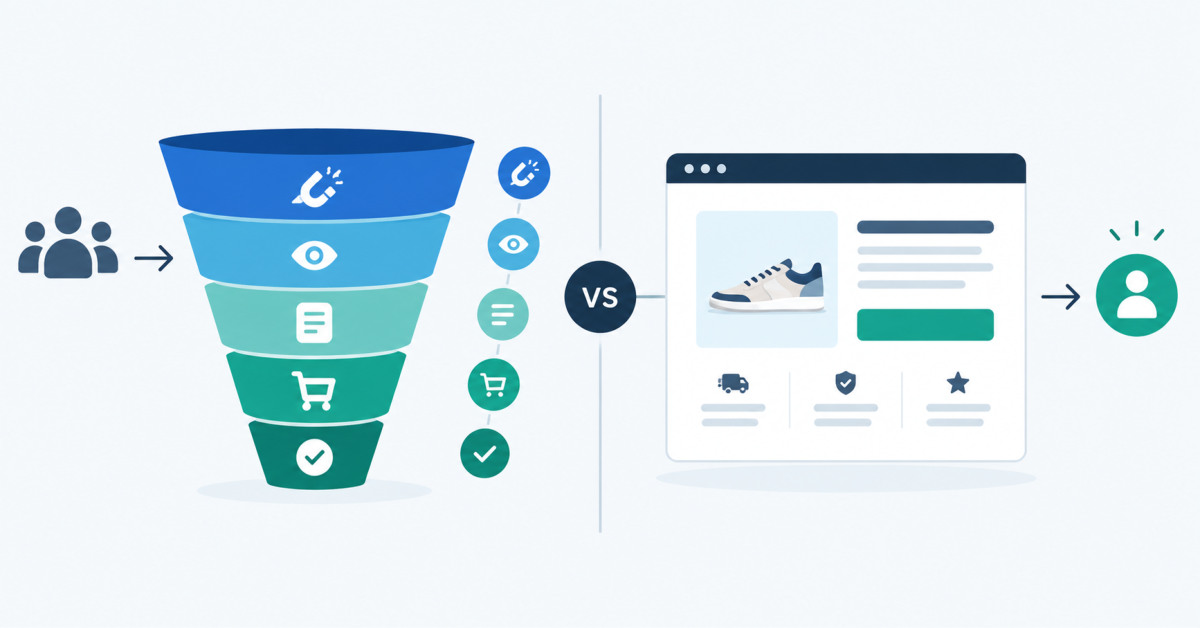
A landing page is a focused destination designed to drive one action, while a sales funnel is the complete sequence of touchpoints that moves a prospect from interest to conversion. Start with a landing page for a simple offer, then add funnel steps when your buying journey requires them.
The mistake is not using a landing page or using a funnel. The mistake is asking a cold prospect for a high-commitment action before your marketing has earned enough trust for that ask.
Landing pages and sales funnels are closely related, which is probably why the terms are sometimes used as though they mean the same thing.
They don’t.
A landing page is usually built around a specific action. A sales funnel describes the broader journey that moves someone from initial interest toward becoming a customer.
Understanding that distinction makes it easier to decide what you actually need for a campaign—and what should happen after someone responds to your offer.
A landing page is a standalone web page created for a specific marketing or advertising purpose. Someone might arrive there after clicking a paid ad, an email link, a social media promotion, or another campaign link.
Unlike a typical website page, a landing page usually focuses on one primary action. Depending on the campaign, that could be:
Landing pages also tend to limit unnecessary distractions. Some remove the main website navigation entirely, while others keep only the links that visitors genuinely need.
The idea isn’t that every landing page must follow exactly the same layout. It’s that everything on the page should support the campaign’s primary objective.
This makes landing pages particularly useful for paid advertising, email campaigns, product launches, event registrations, and lead-generation campaigns.
But capturing a lead or generating a sale on one page doesn’t necessarily describe the customer’s entire journey. That’s where funnels come in.
A sales funnel represents the stages someone may move through between discovering a business and becoming a customer.
The exact journey varies considerably by business. Someone buying a low-cost consumer product might make a decision within minutes. A company evaluating enterprise software could spend weeks or months researching options, attending demonstrations, discussing pricing, and getting internal approval.
A simple funnel is often described in three broad stages:
Awareness: A potential customer first encounters the business or recognizes a problem they want to solve. This could happen through search, social media, advertising, referrals, podcasts, videos, or other channels.
Consideration: The prospect begins evaluating possible solutions. They might compare products, read case studies, subscribe to an email list, review pricing, attend a webinar, or speak with a salesperson.
Decision: The prospect is seriously considering taking action. Depending on the business, this might involve starting a trial, requesting a proposal, booking a consultation, or completing a purchase.
Real customer journeys aren’t always this neat. People can move backward and forward between stages, leave for weeks and return later, or interact with several channels before converting.
The funnel is useful because it gives businesses a framework for thinking about those interactions rather than treating every visitor as though they’re ready to buy immediately.
A landing page and a sales funnel aren’t competing approaches. A landing page can be one step within a larger funnel.
Consider a simple lead-generation campaign.
Someone sees an ad promoting a free guide and clicks through to a dedicated landing page. They provide their email address to access the resource.
The business then sends several useful follow-up emails related to the topic. One email includes a relevant case study, while another introduces the company’s service. Later, the subscriber receives an invitation to book a consultation.
The landing page handled the initial conversion. The emails, content, offer, and consultation process formed the broader customer journey.
For a more detailed look at how the two approaches differ, this guide to sales funnels and landing pages explains how each can fit into a marketing campaign.
| Feature | Landing Page | Sales Funnel |
| Scope | Usually a single focused page | A broader customer journey |
| Primary purpose | Encourage a specific action | Move prospects toward a business outcome |
| Possible components | Headline, copy, form, CTA, social proof | Ads, content, landing pages, emails, sales calls, offers |
| Measurement | Page or campaign conversions | Performance across multiple stages |
| Common use | Lead capture and focused campaigns | Multi-step acquisition and nurturing |
The distinction doesn’t have to be rigid. A funnel may contain several landing pages, and a landing page can support different stages of a customer journey.
A homepage has to serve multiple audiences. It may introduce the company, explain several services, link to resources, highlight products, and provide contact information.
That can be useful for general website visitors but less effective when someone has clicked an ad for one specific offer.
For a focused campaign, a dedicated landing page lets you match the page more closely to the visitor’s original intent.
That doesn’t mean sending paid traffic to a homepage is always wrong. Brand campaigns and certain navigational searches may have different goals. The destination should match the campaign.
Getting someone’s email address isn’t the end of the process.
Some prospects will be ready to act immediately, while others will need more information before making a decision. A follow-up plan gives you a way to continue that conversation.
Depending on the business, that might include educational emails, product information, case studies, remarketing, a sales call, or an invitation to a demonstration.
The important question is simple: What should happen after someone converts?
If there isn’t an answer, the campaign may be leaving opportunities unused.
Someone discovering your business for the first time may have different questions from someone who has already compared your pricing and spoken with your sales team.
Your messaging should reflect those differences where practical.
Early-stage content might help someone understand a problem or evaluate possible approaches. Later-stage content can address specific objections, pricing, implementation, proof, or the details needed to make a decision.
Mobile devices represent a large share of global web traffic, making mobile usability important for both landing pages and other funnel steps.
Check the actual experience rather than assuming a responsive template has taken care of everything.
Forms should be easy to complete, text should remain readable, buttons should be comfortable to tap, and important content shouldn’t disappear or become awkwardly arranged on smaller screens.
Performance matters too. A funnel that feels smooth on a fast desktop connection can be much more frustrating on a slower mobile network.
A focused landing page can be a sensible starting point when you’re:
You don’t necessarily need to build a complicated funnel before you know whether people are interested in the offer.
Start with the customer action you’re trying to generate and build enough infrastructure to support it properly.
A more developed funnel can make sense when customers typically need multiple interactions before making a decision.
This is common with higher-value products, subscription services, professional services, and many B2B purchases.
An enterprise software journey, for example, might involve an educational article, a product page, a demo request, a sales conversation, a proposal, follow-up communication, and finally a contract.
In that situation, optimizing only the demo landing page would give you an incomplete picture. You also need to understand what happens before and after that conversion.
Measurement should match the purpose of the campaign.
For a landing page, useful metrics might include:
For a broader funnel, you may also want to track:
Tools such as Google Analytics can help measure website behavior and conversions, while your advertising platforms, email software, and CRM can provide additional information about what happens elsewhere in the journey.
Don’t collect metrics simply because they’re available. Start with the business question you’re trying to answer and work backward to the data you need.
You don’t need an elaborate funnel with dozens of pages and automations on day one.
Choose one product or service and define the action you want a prospective customer to take. Build a focused landing page around that action and make sure conversion tracking is working.
Then decide what should happen next.
For a lead-generation campaign, that might be a short email sequence. For a consultation request, it might be an appointment confirmation followed by information that helps the prospect prepare. For an ecommerce offer, it could involve cart recovery or post-purchase communication.
Drive qualified traffic to the page and collect enough data to identify meaningful patterns. How long that takes depends on your traffic volume and conversion rate, so avoid relying on an arbitrary 30-day deadline.
Use what you learn to improve the page and decide whether additional funnel steps are actually needed.
A landing page focuses attention on a specific action. A sales funnel looks at the wider journey around that action.
Sometimes a business needs only a focused campaign page. Other times, the decision process involves multiple interactions across pages, emails, advertisements, sales conversations, and other channels.
The useful question isn’t whether landing pages or funnels are better.
It’s what the customer needs at each point in the decision process—and whether your marketing gives them a clear next step.
Start there, measure what happens, and build additional steps when the data and customer journey justify them.
The difference between a sales funnel and a landing page is that a landing page is one focused page built to drive a specific action, while a sales funnel is the broader sequence of interactions that moves a prospect toward becoming a customer. A landing page may ask a visitor to buy, register, download, or book a call. A funnel may include that page, plus ads, product pages, email follow-up, retargeting, sales calls, checkout, and post-purchase communication. Use a landing page to optimize a specific conversion moment and a funnel to understand and improve the complete path around that moment.
You do not always need a full sales funnel if you already have a landing page, especially when the offer is simple and the buyer can act immediately. A single page can be enough for a waitlist, event registration, lead magnet, low-cost product, or short promotional campaign. Add funnel steps when leads need education, your sales cycle is longer, the offer requires more trust, or many visitors convert on the page but fail to become customers. Start with the page and a clear post-conversion action, then expand only when the data reveals a gap.
You should use a landing page instead of your homepage when the traffic source promotes one specific offer, audience, or action. A visitor who clicks an ad for a free guide, a product bundle, a consultation, or an event should reach a page that immediately confirms that promise and makes the relevant next step clear. Your homepage is designed for exploration and must serve several visitor types, which creates more choices and more potential distractions. Homepage traffic makes more sense for broad brand campaigns, navigational search, or visitors intentionally seeking to explore the business.
You should track the landing page conversion event first, then the quality and value of the people who complete it. For lead generation, measure conversion rate, form-start rate, form-completion rate, cost per lead, qualified-lead rate, and eventual lead-to-customer rate. For ecommerce, track product views, add-to-cart rate, checkout starts, purchase conversion rate, average order value, and profitability after ad costs. Segment performance by traffic source, device, campaign, and audience where possible. A high-converting page that produces unqualified leads or unprofitable orders is not outperforming a lower-converting page that creates valuable customers.
Your business needs a more complex sales funnel when evidence shows that customers require additional information, trust, or follow-up before they can buy. Common signals include a high-value or technical offer, long time to conversion, several decision makers, frequent objections, a meaningful gap between leads and customers, or repeated visits to pricing and product pages without conversion. Add one purposeful step at a time, such as a case study, educational email sequence, demo, quiz, retargeting audience, or abandoned-cart flow. Do not build complexity because it sounds advanced. Build it to remove a specific, measured point of friction.




