






Quick Decision Framework
- Who This Is For: Shopify founders and DTC operators at any revenue stage who feel stretched thin, reactive, and constantly busy but not meaningfully growing.
- Skip If: You are in the first 90 days of launch and still need to say yes to almost everything to find product-market fit and generate initial cash flow.
- Key Benefit: A clear framework for identifying which commitments are draining your growth and a repeatable system for protecting your highest-value work.
- What You’ll Need: Honest reflection on where your time is actually going and the willingness to disappoint people in the short term to build something that lasts.
- Time to Complete: 12 minutes to read, 30 minutes to build your first Won’t Do list.
Every yes you say to something that does not matter is a no to something that does. The math is that simple. The discipline is not.
What You’ll Learn
- Why the most successful founders treat “no” as a growth strategy, not a personality trait.
- How opportunity cost silently kills ecommerce brands between $500K and $2M in annual revenue.
- What the Derek Sivers “hell yeah or no” rule actually means for your Shopify tech stack decisions.
- How to build a Won’t Do list that protects your team’s focus without requiring a complete operational overhaul.
- When to say no to a good opportunity so you can say yes to a great one.
I have watched dozens of Shopify founders hit $500K in annual revenue and immediately start drowning. Not because they lacked ambition or talent. Because they said yes to everything that got them there and could not stop. A new sales channel here. A custom client request there. A partnership that sounded strategic but required six weeks of their best developer’s time. A product line extension because a supplier pitched it well on a Tuesday afternoon.
None of those decisions looked wrong in isolation. Together, they created a business that was technically growing and operationally exhausted. The founder was working harder than ever and somehow moving slower. That is not a hustle problem. That is a focus problem. And the solution is not a better task manager or a more aggressive morning routine. It is learning to say no and meaning it.
After more than 400 conversations with Shopify merchants and DTC founders on the Ecommerce Fastlane Podcast, the pattern is impossible to ignore. The operators who scale past $2M and stay sane are not the ones who found the best apps or cracked the perfect ad formula. They are the ones who got ruthlessly honest about what they would stop doing. This piece is about that decision and how to make it stick.
The Math Most People Get Wrong
Most founders believe focus means choosing the right things to work on. Steve Jobs corrected this directly at Apple’s 1997 Worldwide Developers Conference. He said: “People think focus means saying yes to the thing you’ve got to focus on. But that’s not what it means at all. It means saying no to the hundred other good ideas that are there. You have to pick carefully. I’m actually as proud of the things we haven’t done as the things I have done. Innovation is saying no to 1,000 things.”
When Jobs returned to Apple in 1997, the company was producing dozens of computer models, printers, cameras, and peripherals. He eliminated 70% of the product line and focused on four computers. Partners were furious. The press was brutal. The stock dropped. Then Apple became the most valuable company in the world.
Warren Buffett tells the same story differently. He says that for every 100 investment opportunities that cross his desk, he says no 99 times. That is not caution. That is the strategy. The discipline to say no to 99 good things is what creates the capacity to say a full, undivided yes to the one great thing.
For Shopify operators, this plays out constantly. The founder who says yes to every new marketing channel spreads their budget across six platforms and masters none of them. The one who says no to five and dominates one builds a real acquisition engine. The brand that launches a new product category because a supplier offered a good margin finds that their best sellers start getting less attention, their customer service team gets stretched across two completely different buyer personas, and their Klaviyo flows stop making sense. None of that shows up on a spreadsheet until the damage is already done.
The Hidden Cost of Yes
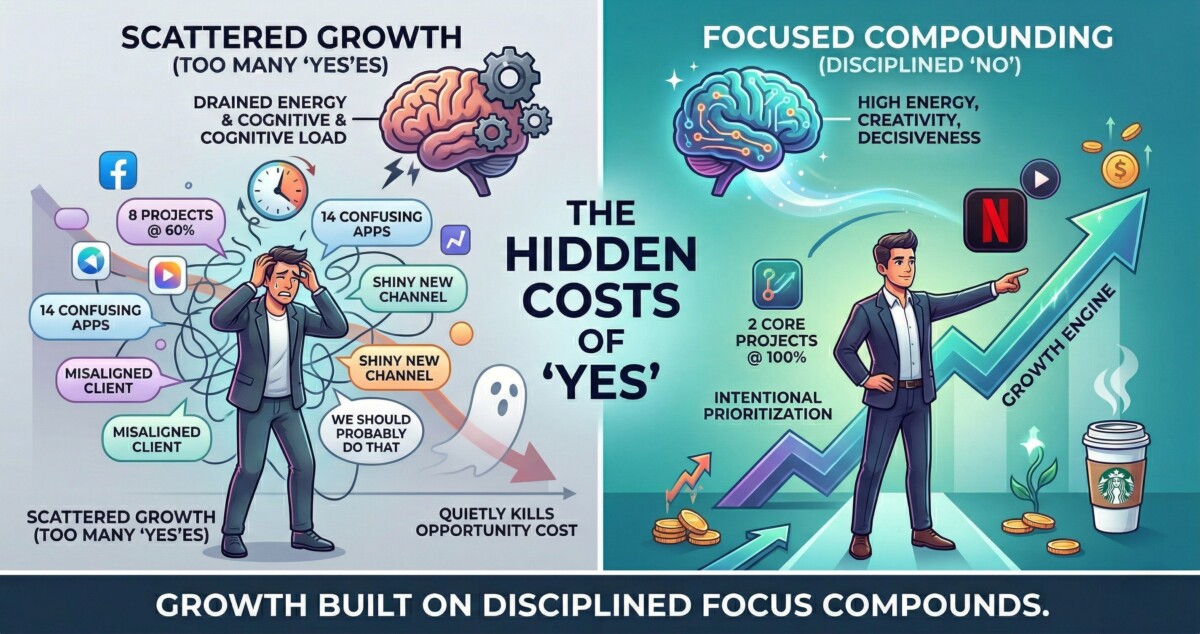
Every yes carries three costs that almost never appear in a budget. Time is the obvious one. But the other two are what actually slow brands down.
The second cost is energy. Cognitive load is real and it is finite. Every open commitment, every half-finished project, every “we should probably do that” sitting on the back burner takes up mental space. Founders who are running eight initiatives at 60% capacity are not just less productive than founders running two initiatives at full capacity. They are less creative, less decisive, and more prone to making reactive decisions under pressure. The Shopify operator who has 14 apps installed, three of which nobody on the team fully understands, is paying an energy tax every single day.
The third cost is opportunity cost, and it is the one that kills brands quietly. Every yes to a misaligned client, a shiny new channel, or a product line that does not fit your core customer is a no to something that could have compounded. You just never see the thing you did not build. If you want to understand how to build the revenue engine that makes focus pay off, the principles in how to scale a Shopify store to $50K per month are grounded in exactly this kind of intentional prioritization.
Reed Hastings at Netflix faced enormous pressure to diversify into gaming, hardware, and adjacent entertainment markets. He said no. Kept the company focused on becoming the world’s best streaming service. That singular no to everything else is what allowed Netflix to build infrastructure, content relationships, and brand recognition that no competitor could replicate in time. Howard Schultz returned to Starbucks in 2008 to find the brand had expanded so aggressively that breakfast sandwiches were masking the smell of coffee in their own stores. He closed 600 locations and stripped back to the core. Wall Street punished the stock. Then it compounded for a decade.
The pattern is consistent across every scale. Growth built on too many yeses is fragile. Growth built on disciplined focus compounds.
Why Founders Say Yes When They Should Not
This is worth sitting with, because the problem is not stupidity. It is psychology, and understanding it is the first step to changing it.
Founders are optimistic by nature. That optimism is what made you start something in the first place. In the early days of a Shopify store, saying yes to almost everything is actually the right move. You are learning what your customers want, building cash flow, and finding product-market fit. The habits that get you to $200K in annual revenue are survival habits. They are not scaling habits.
The transition from $200K to $2M is where most brands stall, and it almost always comes down to the same thing: the founder never updated their relationship with yes. They kept the early-stage habit of chasing every opportunity into a stage where that habit creates what experienced operators call operational drag. The business becomes bloated with custom client requests, half-built features, and marketing experiments that never got the attention they needed to produce a real result. Systems get bent to fit situations they were never designed for. The team starts spending more time managing complexity than creating value.
There is also the fear of missing out. Opportunities feel scarce when you are in the thick of building. But Richard Branson, who built over 400 companies under the Virgin umbrella, put it plainly: business opportunities are like buses. There is always another one coming. The scarcity is an illusion. The cost of chasing it is real.
The Ecommerce Operator’s Version of Hell Yeah or No
Derek Sivers sold his company CD Baby for $22 million and gave all the proceeds to charity. He built his entire decision-making framework around one question: is this a hell yeah?
His rule is simple. If you feel anything less than “wow, that would be amazing, absolutely, hell yeah” then say no. Not “that sounds reasonable.” Not “I should probably explore this.” Not “it might be worth a conversation.” Hell yeah or no.
For Shopify operators, this framework translates directly into the decisions that matter most. Is this new app a hell yeah? If you are not certain it solves a problem you are actively feeling, it is a no. Is this new sales channel a hell yeah? If you cannot commit the budget and the team time to do it properly, it is a no. Is this partnership a hell yeah? If the answer requires a long list of conditions and caveats before it makes sense, it is a no.
The logic behind this is elegant and worth understanding. When you say yes to things that are just okay, you crowd out the room for things that are extraordinary. You become unavailable for the opportunities that would make you jump out of bed. And here is the part Sivers nails that most people miss: saying no makes your yes more powerful. If you only say yes to two or three things, those things get your best thinking, your best energy, and your best time. That kind of undivided attention is a competitive advantage that cannot be bought. It shows up in the quality of your creative, the speed of your execution, and the depth of your customer relationships. For a closer look at how that kind of focused retention work compounds over time, the ecommerce customer retention playbook is worth reading alongside this piece.
What “No” Actually Protects
The most underrated strategic tool in any Shopify brand is not a new app or a new channel. It is a written list of things the business will not do.
Not a to-do list. A Won’t Do list.
A Won’t Do list does four things that nothing else in your operating system can do. First, it defines what you will do. By eliminating what you will not, you discover what you are actually building. Second, it saves time. Decisions become obvious. On-brand or off-brand. Third, it simplifies your team’s decision-making. They stop escalating every edge case to you because the answer is already written down. Fourth, it clarifies your brand in a way that no amount of positioning work can replicate. Businesses that try to do everything for everybody end up being nothing to anyone. The ones that do one thing exceptionally well and protect that relentlessly are the ones that last.
In practice, a Won’t Do list for a Shopify brand might include: no custom pricing for individual wholesale accounts. No new app installations without a 30-day trial and a defined success metric. No new product categories until the current core range is generating at least $1M in annual revenue. No paid partnerships that require more than four hours of founder time per month. No sales channels that cannot be managed by existing team capacity without adding headcount.
These are not permanent rules. They are current rules, reviewed quarterly. The discipline is not about being rigid. It is about being intentional. The brands that build this kind of operating clarity early are the ones that look effortless from the outside when they are actually just well protected from the inside. Building that foundation properly is what separates stores that stall from stores that scale, and it is the core of the proven framework for building a resilient ecommerce brand that I have refined across hundreds of founder conversations.
How to Actually Do This
The hardest nos are not the easy ones. Saying no to a bad opportunity is simple. The real test is saying no to a legitimately good opportunity that is just not the right opportunity for you right now.
Three things that help in practice.
The first is a decision filter. Before committing to anything, ask two questions. Does this align with where we are going? Does this move the business forward in the next 90 days? If both answers are not yes, it is a no. Not a maybe. Not a “let’s revisit in Q3.” A no.
The second is reframing the language. Instead of “I can’t do that,” say “I’m choosing not to.” That shift is not semantic. It is the difference between feeling like a victim of your schedule and feeling like the architect of it. Founders who say “I can’t” are telling themselves a story about scarcity. Founders who say “I choose not to” are telling themselves a story about priorities. The second story produces better decisions over time.
The third is accepting the short-term cost. Jobs was honest about this. When you say no, people get upset. They push back. Some of them leave. You take the lumps. The alternative is a business built around everyone else’s priorities except yours. The lumps are smaller than the drift.
James Clear framed it well: the amateur does not know what to do. The master knows what not to do. That is not a comment on experience level. It is a comment on clarity. And clarity is something you build deliberately, one disciplined no at a time.
Frequently Asked Questions
How do I know when saying no to an opportunity is the right decision for my Shopify store?
The clearest signal is whether the opportunity passes the “hell yeah” test. If your honest first reaction is not immediate and enthusiastic, that is useful information. Run it through two questions: does this align with where the business is going in the next 12 months, and does it move the needle in the next 90 days? If both answers are not yes, the opportunity cost of saying yes almost always outweighs the potential upside. The goal is not to avoid risk. It is to concentrate your best energy on the bets most likely to compound.
At what revenue stage should Shopify founders start saying no more aggressively?
The transition typically becomes critical somewhere between $200K and $500K in annual revenue. Before that threshold, saying yes to almost everything is often the right move because you are still validating product-market fit and building cash flow. Past that threshold, the habits that got you there start working against you. The brands that stall between $500K and $2M almost always do so because of premature complexity: too many channels, too many product lines, too many custom arrangements that made sense individually but created an unmanageable system collectively. That is when a Won’t Do list becomes a growth tool, not just a personal preference.
How do I say no to a customer request without damaging the relationship?
Be direct, be specific, and redirect to what you can do. “We don’t offer custom pricing, but here’s what our volume tier looks like” is more respectful than a vague maybe that wastes everyone’s time. Most customers respond well to clarity because it signals confidence in your product and your process. The ones who push back hard on a reasonable no are often the customers who would have been the most difficult to serve anyway. Protecting your team’s capacity is protecting your ability to serve the customers who are a genuine fit.
What is a Won’t Do list and how do I build one for my ecommerce business?
A Won’t Do list is a written record of the decisions your business has already made about what it will not pursue. It is not a permanent document. It is a current operating agreement, reviewed quarterly. Start by listing every recurring request, distraction, or opportunity type that consistently pulls your team off its highest-value work. Then write a clear rule for each one. “No new app installations without a defined 30-day success metric.” “No new sales channels until existing channels hit profitability targets.” “No custom client arrangements outside our standard pricing structure.” The list does not need to be long. Five to eight clear rules, written down and shared with your team, will eliminate the majority of the decisions that are currently slowing you down.
Is saying no the same as being risk-averse or avoiding growth?
No, and this distinction matters. Saying no to the wrong things is what creates the capacity to say a full yes to the right things. The most aggressive growth strategies in ecommerce are built on extreme focus, not extreme diversification. Netflix said no to hardware. Apple said no to 96% of its product line. The brands that try to grow by doing more things almost always grow slower than the brands that grow by doing fewer things better. Saying no is not caution. It is how you concentrate your resources on the bets that actually compound.
