
Launching an ecommerce business feels risky for a reason. There’s information overload at every turn, but the real threat is this: one wrong move with your marketing or operations can cost you five or six figures—sometimes all at once.
Most guides miss the bigger picture, obsessing over Shopify apps and trendy tactics when what actually moves the needle is foundational strategy and proven systems.
Everything in this playbook is built from direct experience and over 400 conversations with successful founders. You’ll get the unfiltered shortcuts that separate true operators from the folks stuck at square one. This isn’t another list of generic tips; you’ll find actionable next steps and tools that you can put into practice today, with a focus on what actually wins in competitive DTC.
If you want a more granular look at early-stage decisions, don’t skip our deep-dive on starting an e-commerce business from scratch. And if you need perspective on what no one warns you about in this journey, check out these insider tips for new e-commerce entrepreneurs. What follows is a step-by-step guide designed to keep you focused, cut losses, and help you build a business that scales without guesswork.
When people picture starting an ecommerce brand, they imagine the wins: the “ping” of new orders, a slick Shopify storefront, and maybe a viral product launch. The reality is less glamorous. Even with Shopify, better apps, and AI, launching—and scaling—a real business online has gotten harder, not easier. Most fail early, and the reasons have nothing to do with not wanting it enough or missing out on a hot new tool.
What’s different now versus even five years ago? Let’s break it down.
The barrier to launch is lower, so the competition is way up. On any given day, you’re not just up against local shops but also VC-backed DTC juggernauts, savvy Amazon sellers, and even niche hobbyists flooding every category with dozens of similar options.
This endless supply of alternatives means:
You have to nail positioning, product, and service right out of the gate. Most brands can’t afford the time or ad spend to “test until it works”—the window to find traction is tight.
In episode after episode, founders on the Ecommerce Fastlane Podcast have pointed out that price wars, discount fatigue, and sameness in product lines drive margins down and make brand loyalty tougher to earn than ever.
For more, see key lessons in our Things They Don’t Tell You About eCommerce.
Setting up a Shopify site isn’t hard. Building a system for profitable growth? That’s a different story.
You’re expected to be an expert in:
Even with a playbook, each channel requires its own budget, tech stack, and knowledgeable operators. Managing this with a small team—or solo—is often overwhelming. This explains why many stores never get past $50k in annual sales, and only a select few break through into sustained growth.
Several experienced founders discuss these costly pitfalls in top reasons why most eCommerce startups fail.
If your paid ads don’t convert, or your CPA is sky-high, you burn through cash on Facebook, Instagram, Google, and pray for organic traffic. In 2024, paid acquisition is actually getting harder:
Acquisition requires constant reinvention, relentless creative testing, and a deep understanding of what actually moves your target customer—which, as countless podcast guests have shared, is almost never the product, but the offer and the customer experience.
Here’s the part new founders rarely plan for: Running an ecommerce business is all in, all the time. Pixel-perfect listings and strong marketing are table stakes, but you’ll also need to juggle customer service (often 24/7), returns, shipping issues, and troubleshooting tech bugs that love to show up before Black Friday.
A Reddit thread on the toughest parts of running ecommerce captures it perfectly: It’s not the launch that’s hard, it’s the relentless, exhausting work of keeping the engine running.
Let’s be direct—it’s not a lack of desire or hustle that tanks most brands. The avoidable pitfalls I see over and over include:
On the podcast, I’ve interviewed founders who, even with headstarts and funding, cited these issues as the real reasons their brands flatlined—or why the uphill battle felt insurmountable.
You’ll find real strategies to avoid these traps (backed by expert founders) in our archive of Successful Small Business Tips 2025.
Launching isn’t the hard part. Building a sustainable, growing ecommerce business is where most fail—and if you follow the crowd, you’ll likely end up among the 90% that don’t make it past the honeymoon phase. The truth is, it’s never been more important to operate with clarity, structure, and high-level execution from day one.
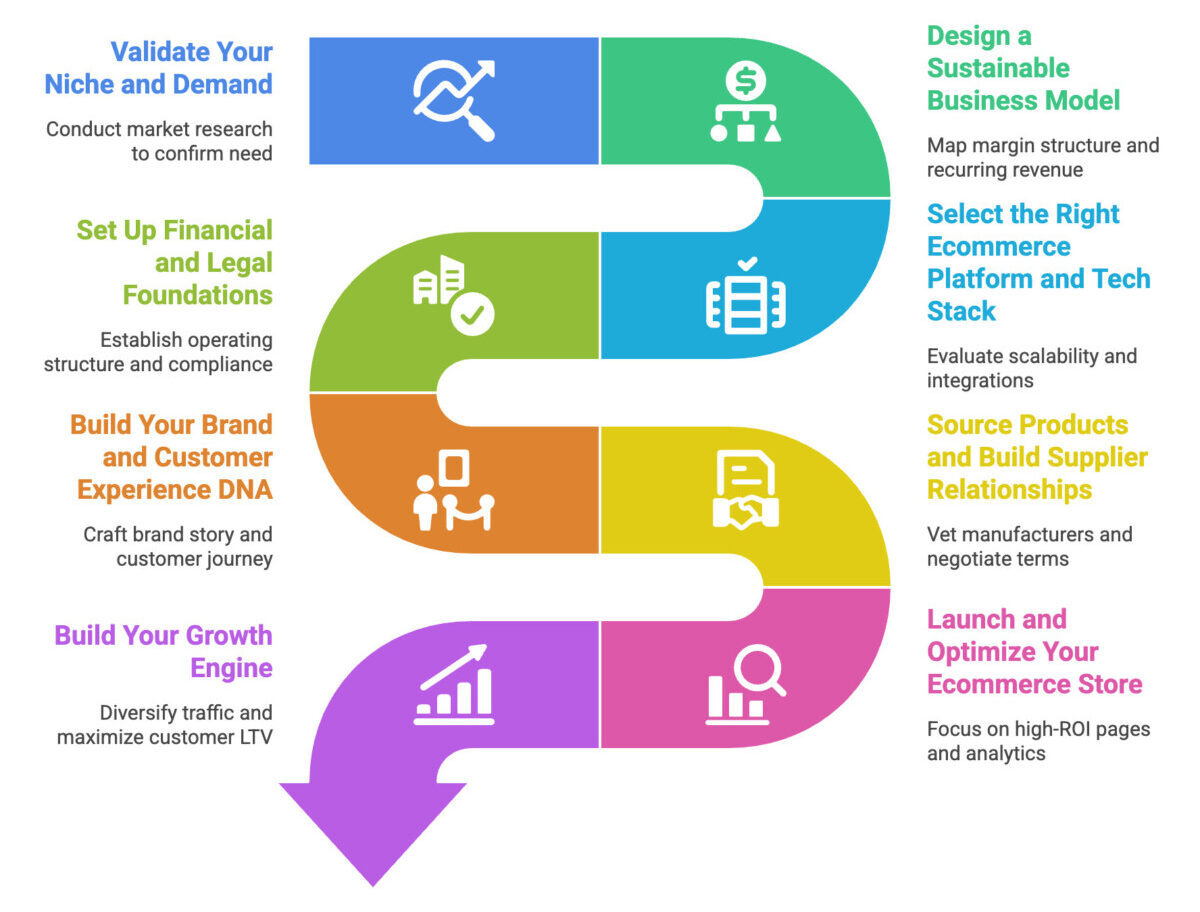
Building an online brand that lasts takes more than a good idea and a Shopify store. The real difference between brands that grow for years and those that fizzle often comes down to process, critical checkpoints, and honest self-assessment. Over hundreds of interviews and founder stories, I’ve mapped out the steps that can save you years—or thousands in mistakes. Here’s the step-by-step playbook top operators use to build with confidence.
Before you burn time or capital, you need proof that your idea fills a real need in the market—not just in your imagination. Sophisticated market research is your filter. Go beyond Google Trends and basic keyword volume. Dig into subreddits, analyze repeated customer pain points in reviews, and leverage tools like Jungle Scout, Exploding Topics, or niche-specific Facebook groups for fresh insights.
Look for these green lights:
And don’t ignore these red flags:
If you spot more warnings than signs of hunger, cut your losses early. Many successful Shopify founders have stressed—sometimes painfully—how smart quitting is a winning move when you realize the data just isn’t there.
For a pragmatic look at applying advanced market research to investment decisions, check out the Beginner’s Guide to Stock Investing for transferable frameworks.
Successful DTC brands obsess over models that support real, repeatable profits—not just initial win rates. Start by mapping out your margin structure and knowing your absolute bottom line; what are your real costs after returns, support, and acquisition spend? Keep a close watch on true CAC (Customer Acquisition Cost), gross margin per order, and run sensitivity tests on price.
Recurring revenue is the gold standard for stability. Subscription models, memberships, or auto-refill programs build a financial buffer and make your brand more valuable. To avoid the commoditization trap, bake in differentiation from day one—think: unique bundles, personalized offers, or a branded experience that’s hard to replicate.
Quick business model tips:
For more on aligning your design and user needs within your ecommerce model, see this primer on task modeling for eCommerce design.
Shopify is the go-to for most growth-minded brands for a reason, but it’s not one-size-fits-all. Evaluate each platform and every major app as an investment, not just a cost. Pay special attention to scalability: will this tech stack still support you at 10x your current order volume, with the tools and automations you need?
Successful founders suggest balancing “build vs. buy” by considering:
Pull lessons from recent podcast episodes where founders admitted costly mistakes: “If you scrimp on core integrations early, you’ll spend double fixing breakage at scale.”
For a hands-on comparison with other leading platforms, review the Wix vs Shopify comparison for application in real startup environments.
Skimping on this phase is gambling with your business long term. Nail down your operating structure (LLC, S Corp, etc), set up business banking, and automate your accounting. Know your local and federal tax obligations, and work with ecommerce-aware accountants. Understand DTC compliance, including privacy policies, data storage, and customer rights—noncompliance can get expensive, fast.
Pitfalls to sidestep:
Protect against late payments, disputes, and financial holes by putting clear policies and debt recovery processes in place. For deep insight, see how the pros handle B2B Debt Collection Strategies by Law Firms to secure their cash flow.
Launch with more than just a product. Your story, unmistakable voice, and the customer journey set you apart and create lasting loyalty. Start with the “why”—the founder mission or origin story—then shape it into every asset, from packaging to post-purchase emails.
Standout strategies include:
For firsthand tactics on how food and beverage brands are excelling in DTC service, check out these DTC Customer Experience Tips for Facebook Brands.
If you’re still forming your concept, consider reviewing the top e-commerce business ideas for different paths to brand differentiation.
Choosing between dropshipping and holding inventory impacts everything from speed to margin. Dropshipping lowers upfront risk but often weakens control over quality and branding. Ordering stock in bulk increases profit potential but raises the bar for sales forecasting accuracy.
Best practices from seasoned founders:
Read everything you need to know in the Complete Guide to Product Sourcing to avoid rookie mistakes managing suppliers.
A “minimum viable store” is all you need to launch. Don’t wait for perfection. Focus your early build on high-ROI pages: homepage, PDPs, cart, and checkout. Prioritize mobile speed, frictionless navigation, and airtight analytics—these matter more than clever branding at launch.
Here’s a store launch checklist I recommend:
A counterintuitive launch takeaway from recent data: brands that launch with a “beta” invite list and ask for feedback in their first week often see higher long-term retention than those who insist they’re ready for the masses.
See more ways to optimize your launch in the Top tools to optimize e-commerce processes.
After launch, your focus shifts to scalable traffic, battle-tested retention, and maximizing customer lifetime value. Use a portfolio approach with your channel mix—don’t let paid ads become your only source of sales. Double down on what works: owned email/SMS flows, referral programs, organic SEO, and partnerships.
Retention is your secret weapon. Build flows that nurture buyers into repeat fans: post-purchase check-ins, loyalty perks, and surprise gifts. Run ongoing cohort analysis to spot where customers fall off and plug those gaps.
Keep this simple framework in mind:
For a deep dive on retention-driven growth and future-proofing your customer base, try listening to Ecommerce Fastlane Podcast Episode 397 on omnichannel strategy.
If you’re planning for broader scale, don’t miss the ultimate blueprint in our Guide to Startup Growth.
The difference between “following a list” and building an actual business becomes clear only when you see frameworks put to the test. I’ve watched hundreds of founders take theory and make it work in real life. The lessons get sharper, the roadblocks more obvious, and the breakthroughs become patterns you can use. The best playbooks are proven by those who wrestle with the same problems you do—tight CAC, slow AOV growth, and everything in between. Let’s drill into how the EcommerceFastlane framework delivers outcomes, not just ideas.
You don’t need another feel-good founder tale. What you want is proof that the eight-step playbook works in tense, high-stakes settings. In working with DTC brands that scale, I’ve seen the framework solve recurring blockers:
In one episode, a founder shared how their “aha” was realizing their solution didn’t solve a burning problem. They used the step-by-step niche validation process—diving deep into forums, running test campaigns, and tallying negative signals fast. The result? They walked away early and started fresh, saving both capital and momentum.
Key moves that repeat in winning stories:
For anyone building on Shopify and aiming for sustainable scale, you’ll see these themes echo in countless Shopify success stories across diverse product categories.
Across more than 400 episodes, the same inflection points surface. The founders who thrive do three things differently:
For instance, an emerging supplement brand shared how structuring their launch around the “minimum viable store” concept allowed them to ship quickly, run data-driven split tests, and tweak before scaling ads. This practical focus avoided the money pit of overbuilding.
You’ll find similar takeaways (and a wide range of sectors) in broader ecommerce case studies where the pattern of rapid feedback and hard pivots emerges as a common thread.
Some stories get missed in the “overnight success” narrative. Founders who followed the framework often spotted issues early—like poor retention from aggressive discounting. By installing post-purchase flows and investing in their loyalty engine sooner, they improved repeat rate and protected cash flow before cracks became craters.
Other recurring fixes:
You’ll hear these details often in the Fastlane archive. And for more on how DTC brands use digital assets to beat noise, our Ecommerce PR strategy guide includes frameworks and practical examples.
The common thread in every win: a bias for action, feedback, and strict process. It’s not about having the most original product or the biggest ad budget. It’s about using a playbook that forces early decisions, honest assessment, and measurable steps—exactly what we’ve tried, tested, and refined over years of interviews and feedback.
You don’t have to be first; you have to be sharp. Apply the framework, work only on what moves KPIs, and leave the “hope and hustle” mindset behind. That’s how the best operators turn frameworks into case studies worth sharing.

You’ve made it this far because you’re committed to building a store that lasts—one that’s engineered for growth, not just a splashy launch. With process and strategy in place, the next move is straight execution. At this stage, the right mix of practical tools, curated resources, and a dialed-in launch checklist separates scalable stores from those playing catch-up after day one.
This section cuts through the noise and gives you a working blueprint: the software, frameworks, and SOPs that I’ve seen drive results for experienced ecommerce operators. If you’re here, you’re not looking for another surface-level roundup. You want what actually works.
Choosing tools is about trade-offs. Every extra app or add-on adds complexity, but skipping essentials is how you wind up patching holes mid-launch. Over 400 founder interviews later, a pattern has emerged: the same stack of reliable, proven tools shows up in brands that scale efficiently.
Core areas to focus your toolset:
It’s not about the volume of resources—it’s about signal over noise. I’ve collected and stress-tested hundreds of materials over the years; most aren’t worth your time. Seek depth and frameworks you can immediately put to work.
Prioritize these resource types:
If your stack still feels fuzzy or you want a step-by-step tour through every setup decision, the Shopify Store Setup Guide makes quick work of the basics and helps you avoid common integration mistakes.
A launch checklist isn’t busy work. It’s a built-in process for avoiding fire drills, missed data, or conversion gaps. Over time, I’ve refined my own launch prep into a direct sequence—think of it as your pre-flight inspection.
Here’s the proven, no-nonsense checklist used by brands that build for longevity:
Use this checklist as a living doc—pull it up with every new product drop or major campaign. For a fuller breakdown and launch roadmap, the Step-by-Step Shopify Ecommerce Guide is a practical reference to keep close.
For seasoned operators, consider how you’ll move the needle post-launch. Plan early for:
You’ve invested time and capital to reach this stage. Protect that investment with a toolkit and checklist that keep your team honest, organized, and prepared as you cross into real growth territory.
Success in ecommerce doesn’t come from throwing every new tactic at the wall. It comes from working a proven, experience-backed playbook, step by step, with full clarity on metrics and resources—exactly what separates scalable brands from stalled projects. The insights here are taken straight from hundreds of founder interviews and hands-on battle scars in the Shopify space.
If you’re ready to shift away from random hacks, commit to Step One now. Validate your niche with ruthless honesty today—don’t wait until you’ve sunk months or capital into a maybe.
Starting an ecommerce business is tougher now because the market is crowded, customer expectations are higher, and advertising costs keep rising. You also need to master several skills at once, from marketing and operations to analytics and customer support.
Run small test campaigns, study customer reviews, and research active communities in your niche to see if people are truly interested. Collect real signals like pre-launch email signups or feedback on sample products to avoid costly mistakes.
Start by sorting out legal paperwork, setting up solid business banking, and understanding your tax obligations. Preparing your systems early helps you stay organized and avoid trouble as you grow.
Repeat customers usually spend more over time and cost less to re-engage than constantly finding new buyers through ads. Building loyalty through great service and follow-ups makes your business more stable and profitable.
Yes, relying only on your product is risky; even amazing products fail without a strong offer, effective marketing, and a smooth customer experience. Winning brands combine clear value, the right systems, and real customer care.
Most failures happen because founders launch without confirming demand, run out of money, neglect customer retention, or try to do everything alone. Skipping early research and failing to set up clear operating systems are major reasons for missing out.
Choose a platform like Shopify for flexibility and proven add-ons, but make sure every tool you use can scale with your business. Evaluate each app as an investment, focusing on what simplifies work and supports your plans as you grow.
Place a test order yourself to spot any issues in checkout, mobile experience, or follow-up messages, then fix those before you launch to the public. This small step quickly improves your customer’s first impression and boosts trust.
They rely on clear processes, automation, and a bias for acting on real feedback over gut feelings. By setting up systems for analytics, support, and operations early, they avoid burnout and keep improving with less hassle.
Make each decision based on real data from your niche, ask for feedback from actual users, and update your plans as you learn. Remember, expert operators don’t chase every trend—they focus on proven steps and stay ready to adapt quickly.