

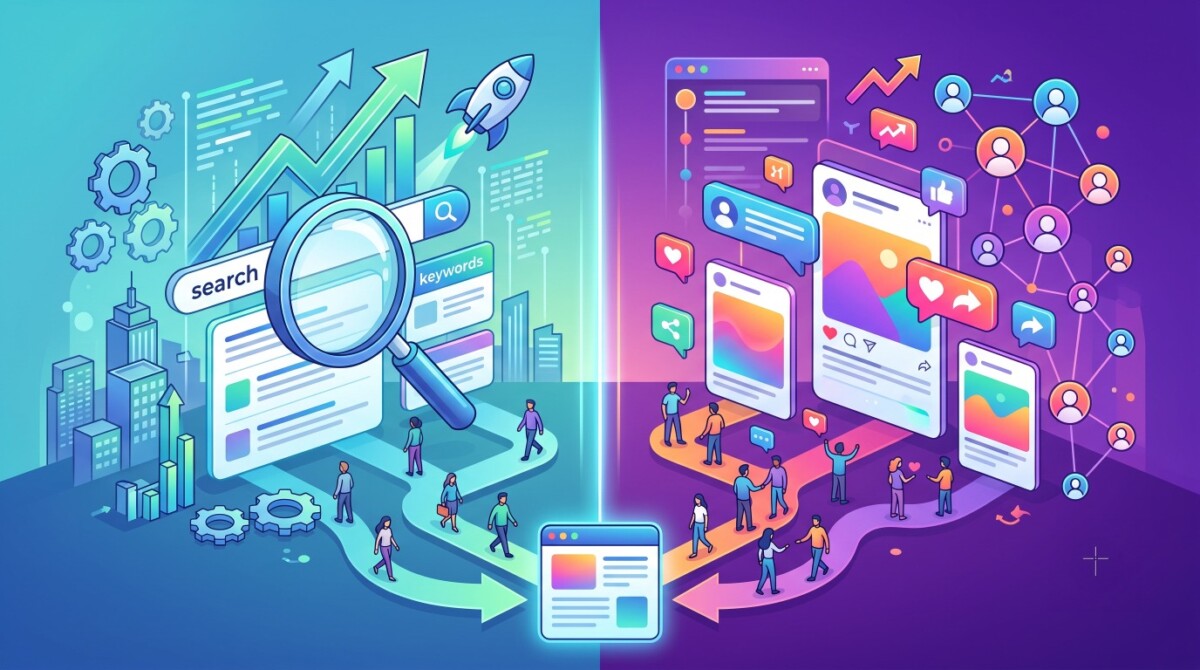
For small service businesses and lean in‑house teams, organic search is usually better at capturing high‑intent visits that lead to enquiries, while organic social is better at generating faster attention and feedback—so the right channel depends on the result you need next.
Search helps you show up when someone asks. Social helps you become familiar before they know what to ask.
For a small service business or a lean in-house marketing team, the choice between search and social can feel more complicated than it needs to be. Organic search traffic means visits from unpaid search results. Organic social traffic means visits from unpaid posts and profile links on social platforms. Google Analytics reports these as separate channels, even though neither requires payment for the click.
Both channels offer a large potential audience. DataReportal estimated 6.04 billion internet users worldwide in October 2025, while its research on brand discovery found that the typical adult internet user discovers brands and products through an average of 5.8 sources. That second figure matters. Your customers do not live inside one marketing channel, so the useful question is not which channel wins in every situation. It is which one is better for the result you need next.
Search usually produces more website visits and holds them for longer. Social usually creates visibility and feedback faster. The details depend on audience behaviour, the type of offer, the strength of your website, and whether you already have an active social following.
Organic search generally produces more website visits than organic social media. The explanation is simple: people use a search engine when they want to find information, compare options, or complete a task. Clicking through to a website is part of the journey. On a social platform, leaving the feed interrupts the journey.
A 2025 SE Ranking study offers a useful, if not universal, comparison. It analysed aggregated Google Analytics data from 63,987 websites across 250 countries and territories between January and August 2025. Within that sample, organic search accounted for 46.98 per cent of traffic, compared with 10.12 per cent for social media. Organic search sent visits to 99.24 per cent of the sites in the sample, while social sent visits to 82.52 per cent.
Those figures should not become a benchmark for every company. The dataset covered many industries, regions, audiences, and site sizes. A fashion retailer with a large Instagram audience may receive a much higher share from social. A solicitor publishing answers to specific legal questions may depend far more heavily on search. The study does, however, illustrate the broad pattern: search is commonly the larger website traffic source.
Intent is the main advantage. Someone searching for “emergency plumber in Bristol” is actively looking for help. A plumbing company visible for that query can receive a visit from a person who is close to making a decision. The same company could post a useful winter pipe checklist on Facebook, but most people seeing it will not need a plumber at that moment.
Social excels at creating interest before a person searches. A garden designer might publish before and after images that make a homeowner reconsider a neglected outdoor space. That post can generate profile visits, shares, and a burst of website traffic, even though the audience did not begin with a buying intention.
The shape of the traffic also differs. Search often forms a stable base made up of many queries and landing pages. One article may attract 20 visits a week, a service page may attract 50, and a location page may attract another 30. Together, they create a dependable stream. Social is more uneven. A normal post might produce five visits, a strong post 100, and a widely shared post 1,000, followed by a sharp return to normal.
Volume alone can mislead you. Compare engaged sessions, enquiries, purchases, and email sign-ups by channel. If 500 social visits produce no meaningful action while 100 search visits produce ten enquiries, search is doing more useful work. Equally, if social introduces new customers who return later through search or direct traffic, last-click reporting will understate its contribution.
Organic social usually produces faster initial growth, particularly when you already have followers or access to an active community. A post enters the feed as soon as it is published. Reactions and shares can extend its reach within minutes, and you can learn quickly whether an idea resonates.
Imagine that a management consultant has 4,000 relevant LinkedIn followers. A concise post about a new reporting requirement could bring website visits on the same day. If the consultant turns the topic into a new search article, the page may take weeks to be crawled, indexed, and tested in results before it earns consistent clicks.
Google says that search changes can take from a few hours to several months to appear, and it recommends waiting a few weeks before assessing whether work has had a beneficial effect. A new page has to be discovered and understood, and it must compete with existing results. Newer websites often have fewer relevant pages, weaker internal linking, and less external recognition, so their ramp can be slower.
That does not mean every social account grows quickly. A new profile with no audience may publish for months without sending meaningful traffic. Social speed depends on distribution. You need an audience, strong subject relevance, a format suited to the platform, or participation in an existing conversation. A polished link post sent to twelve inactive followers is not a fast-growth strategy.
Search can also move quickly in the right conditions. An established site publishing a timely answer in a low-competition niche may be indexed and receive visits within days. Updating a page that already ranks can improve traffic sooner than publishing a completely new one. The sensible distinction is that social distribution begins immediately, while search visibility has more prerequisites.
Use social when you need rapid feedback, a launch-day audience, event promotion, or a response to current news. Use search when the question will still matter in six months, and people are likely to look for the answer repeatedly.
You can make the comparison practical with a 12-week test. Publish a small set of pages based on genuine customer questions, then promote useful extracts from those pages on one social network where your audience is already active. Tag the social links consistently. Each week, record visits, engaged sessions, important actions, and the number of posts or working hours required. At the end, you will have evidence from your own market rather than a generic channel average.
A paid or managed traffic source should be assessed separately. If you decide to get organic traffic for your website through VisitorBoost, label and measure that campaign as its own acquisition input. It is not evidence that an SEO page is gaining visibility or that an organic social audience is growing. Review the provider’s claims, traffic quality, geographic fit, engagement, and downstream actions in your own analytics before drawing a conclusion.
Organic search usually sustains traffic for longer because useful pages remain available when new people search for the topic. A detailed guide, comparison, calculator, location page, or service explanation can attract visits long after publication, provided that it remains accurate and visible.
This gives search traffic a compounding pattern. One useful page rarely transforms a business, but a collection of relevant pages can build a durable base. A bookkeeping firm might publish guides to VAT registration, payroll deadlines, and allowable expenses. Each page meets a different recurring need, and together they create several routes into the site.
Social posts normally have a shorter active life. Feed-based platforms prioritise fresh material, so a post tends to receive most of its reach soon after publication. Traffic drops when the post moves out of active distribution. To maintain the same level, the business has to keep publishing, responding, and adapting formats.
There are exceptions. A useful YouTube tutorial, Pinterest pin, or frequently reshared LinkedIn document may continue to surface. A social profile can also create sustained indirect value by building familiarity. Someone may see your posts for months, remember the brand, and later find the website through a branded search. That visit appears under search even though social helped create the demand.
Search is not permanent, either. Rankings can fall when customer language changes, competitors publish better material, a page becomes outdated, or a technical fault prevents crawling. Search result layouts can also answer simple questions without a click. The risk is less about content disappearing overnight and more about gradual decline going unnoticed.
Platform dependence is the larger social risk. A change in feed ranking, account restriction, reduced link visibility, or falling activity among your followers can quickly reduce reach. You do not control the platform or the audience relationship. Your website, analytics, and permission-based email list give you more control, even though the route used to reach them still depends on third parties.
Protect search traffic by reviewing important landing pages every quarter. Check whether the information is still correct, whether impressions and clicks are changing, and whether visitors complete useful actions. Protect social traffic by keeping a reusable content library, republishing proven ideas in fresh formats, and directing interested followers towards assets you control.
The best channel depends on the job. Search is strongest when you need to capture existing demand. Social is strongest when you need to create attention, build familiarity, or start a conversation.
| Business goal | Better starting channel | Typical traffic pattern | Main measure | Main risk |
|---|---|---|---|---|
|
Win high-intent service enquiries |
Organic search |
Slower build, then steadier visits |
Qualified enquiries and conversion rate |
Rankings or demand may change |
|
Build awareness in a defined community |
Organic social |
Fast exposure with uneven click spikes |
Relevant reach, profile actions, and assisted visits |
Reach depends on the platform |
|
Answer recurring customer questions |
Organic search |
Multiple pages can compound over time |
Engaged visits and useful actions by landing page |
Content becomes outdated |
|
Launch a timely offer or event |
Organic social |
Immediate response, then rapid decline |
Visits and actions within the launch window |
The post may not receive distribution |
|
Develop trust around a complex service |
Combined approach |
Social builds familiarity, search supports research |
Returning users and assisted conversions |
Attribution may hide the full journey |
|
Test a new topic before investing heavily |
Organic social first |
Quick signals from a small content sample |
Saves, comments, clicks, and qualified replies |
Engagement may not predict purchase intent |
A local service company should usually make search the foundation. Customers look for specific services in specific places, often when the need is urgent. Accurate service pages, clear location information, strong reviews, and answers to common questions support that behaviour. Social can then show recent work, introduce the team, and keep the company familiar between purchases.
A visually led consumer brand may reverse the order. Social can demonstrate products, encourage customer participation, and reveal which themes attract attention. Search still matters for category pages, product comparisons, care guides, and branded demand, but it may not be the first source of discovery.
A business selling an unfamiliar or complicated service often needs both at once. Social posts can name a problem in language the audience recognises. A detailed website page can then explain the solution, evidence, process, and next step without the limits of a feed post.
Start your own decision with one commercial outcome, not a channel metric. Choose an enquiry, purchase, booking, trial, or other meaningful action. Review the previous 90 days in analytics and separate Organic Search from Organic Social. Note which landing pages attract each audience, how engaged those visitors are, and what they do next.
Then allocate effort according to the gap. If people already search for your offer but your site is rarely visible, improve the search route. If the market does not yet recognise the problem, use social to educate and test messages. If social engagement is high but clicks are weak, improve the transition from post to page rather than simply publishing more often.
The practical answer is not to split your time equally. Give the primary channel enough consistency to produce a fair result, and let the secondary channel support it. A small team might spend most of its content time building durable website pages, then turn each page into several social discussions. Another business might use weekly social conversations to identify the questions worth developing into search content.
Search and social solve different parts of the same customer journey. Search helps you appear when someone asks. Social helps you become familiar before the question is asked. When you measure both against business actions rather than raw reach, the better channel becomes much easier to see.
No. Organic search is usually better at capturing high‑intent visits that lead directly to enquiries or purchases, while organic social is better at quickly generating attention, feedback, and familiarity. The right choice depends on your immediate goal and audience behaviour.
Look beyond visit counts. Compare engaged sessions, enquiries, bookings, purchases, and email sign‑ups by channel over the last 90 days. If a smaller volume of search traffic creates more meaningful actions than a larger volume of social traffic, search is doing more useful work—and vice versa.
Run a 12‑week experiment. Publish a small set of pages that answer real customer questions, then promote short, useful extracts from those pages on one social network where you already have an audience. Tag social links, track visits and actions by channel, and compare the results against the effort required.
If social engagement is high but clicks are weak, improve the bridge between post and page. Clarify why clicking helps, simplify the destination page, and make sure the landing page continues the promise made in the social post. You may need better calls to action rather than more posts.
Yes. Social can be used to test topics, language, and objections quickly, while search captures established demand with durable pages. Many small businesses do best when they use social to spark attention and gather feedback, then use search‑optimised content to support deeper research and high‑intent decisions.




