

A local business can earn more legitimate Google reviews by reducing the effort required to find its review page, but review requests must remain optional, neutral, and free of on-premises pressure, incentives, rating prompts, or review filtering. The goal is easier access to genuine feedback, not a system that manipulates it.
Good local reviews are not created by asking harder. They are earned through service, then made easier to leave without influencing what the customer says or feels.
Ask any salon owner, dentist, mechanic or restaurant manager how many of their customers leave happy, and you’ll get a number in the high nineties. Ask how many of them leave a Google review, and the number collapses. A business serving 400 customers a month will often finish that month with four new reviews. One percent.
That gap is not a service problem. It’s a friction problem — and it’s the single most fixable thing in local marketing.
For an e-commerce brand, reviews are social proof that helps close a sale. For a service business with a physical location, they do something more fundamental: they decide whether you get seen at all.
Google’s local pack — the three-listing map block that sits above the organic results for almost every “near me” search — weighs review signals heavily alongside proximity and relevance. Review count, average rating, keyword content inside reviews, and how recently those reviews arrived all feed into which three businesses appear and which get buried on the second screen.
Recency matters more than most owners realise. A business with 300 reviews, none of them from the last eight months, reads as stale to both the algorithm and the human scrolling past. A business with 90 reviews that gains six or seven a month reads as busy and current. Volume is a stock. Velocity is a flow. The flow is what you actually control.
And the downstream effect is brutal in its simplicity: appearing in the local pack instead of below it can double or triple the calls, direction requests and walk-ins a location gets, without a single dollar of additional ad spend. For a business with fixed rent and fixed staff costs, that’s close to pure margin.
Every consultant’s advice is the same: just ask. Train your team to ask. And every owner who has tried it knows why it doesn’t stick.
Asking is emotionally expensive. Requesting a favour from a customer feels transactional to most front-line staff, especially in industries where they’re already asking about tips, upsells or loyalty signups. It’s the first thing that gets dropped on a busy shift.
Asking is inconsistent. Your best employee asks. Your newest hire doesn’t. Your Saturday closer asks when the shop is quiet and forgets when there’s a queue of six. Review flow ends up tracking staff mood rather than customer satisfaction — which is why it dries up in exactly the weeks you’re busiest and doing your best work.
Verbal asks don’t survive the parking lot. A customer genuinely intending to leave a review has to remember, later, to open Google, type your business name, disambiguate you from a similarly named branch three suburbs over, scroll to the review section, and start writing. Each step sheds people. By the time they’re in the car, the intent is gone.
The mistake in all of it is that the ask is separated in time and place from the moment the customer actually feels good about you. Close that gap and the problem mostly solves itself.
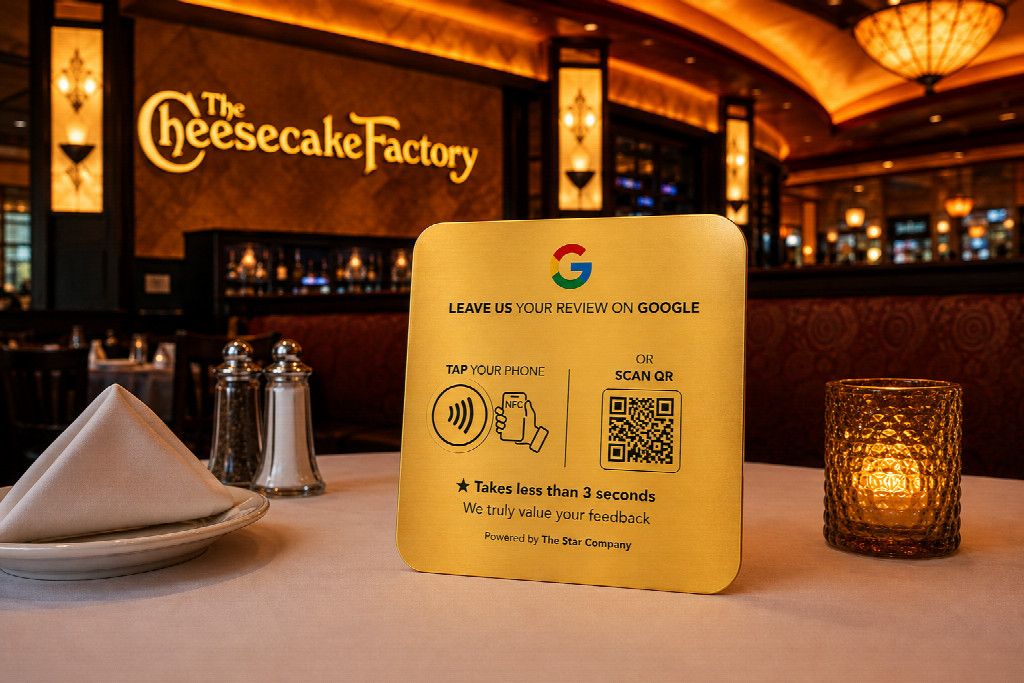
This is the reasoning behind the rise of the google review stand — a small weighted plate that sits beside the register, carrying an NFC chip and a QR code, both pointing at one destination: your Google review page.
The customer taps their phone against it, or scans the code from a few feet away. Your review page opens with the star selector already loaded. They pick a rating, type a sentence, and it’s posted. Ten seconds, start to finish.
What makes it work isn’t the technology. NFC has been in phones for a decade. What makes it work is that it removes every one of the three failure points above at once:
There’s a fourth benefit that’s easy to miss: it’s a one-time purchase. Most review-generation tools are SaaS — a monthly per-location fee for SMS and email sequences that chase customers after the fact, with open rates and deliverability problems attached. A metal plate on a counter has no recurring cost, no dashboard, and nothing to churn out of.
Any decent stand carries both, so this isn’t really a purchasing decision — but understanding the difference tells you where to put it.
NFC is faster but requires proximity. The phone has to come within a couple of centimetres. That’s ideal at a payment counter or reception desk, where the customer is already leaning over the surface. No camera app, no aiming, no focusing. Customers who already tap to pay reach for it instinctively.
QR works at a distance. A code can be read from a metre or more, which is what you need at a host stand, a waiting area, a service window, or a pickup shelf where nobody is standing close enough to tap. It also covers older devices and customers who’d rather not touch a shared surface.
In practice most businesses see a split, roughly along age lines. Carrying both means you’re not making a bet on your customer base.
Whichever stand you buy, where you put it will do more for your numbers than what it’s made of. A few rules that consistently separate the counters generating reviews from the ones that aren’t:
Put it where money changes hands. The payment moment is when the customer is most positive and least rushed. A stand two feet from the card reader will outperform one by the exit door by a wide margin.
Keep it at or near eye level. Below the counter lip, it’s invisible. On a raised surface, a shelf behind the register, or angled up toward a standing adult, it reads.
Give it clear space. A stand surrounded by mint bowls, business cards and flyers becomes part of the clutter and stops registering as a thing to interact with. Isolation is what makes it read as a fixture rather than décor.
One per till, not one per business. If you have three checkout points, you need three stands. Customers only use what is physically in front of them.
Turn it toward the customer. It sounds too obvious to state. It’s the single most common error in photos of real counters.
There’s a category of product marketed as “review filtering” or “reputation gating” — a screen that asks the customer to rate you privately first, then routes the happy ones to Google and diverts the unhappy ones into a private feedback form.
Don’t. Google’s policies prohibit selectively soliciting reviews from customers based on their expected sentiment, and businesses have had review counts wiped for it. Beyond the policy risk, it’s strategically weak: a perfect 5.0 rating reads as suspicious to consumers, who tend to trust ratings in the 4.5–4.9 range more than a flawless one. The occasional critical review, answered well and publicly, does more for conversion than its absence would.
A stand that simply opens your review page for everyone is the compliant version, and the more effective one.
Nobody should install a plate on Monday and expect the local pack on Friday. What a counter stand does is convert a slow trickle into a steady flow — moving a business from a handful of reviews a month to a consistent stream, without adding a task to anyone’s shift.
Over a quarter, that compounds into the two things Google actually rewards: a rising review count and a recency signal that never goes cold. Over a year, it’s usually the difference between being one of the three businesses a customer sees and being one of the twenty they don’t.
For a business already delivering good service to hundreds of people a month, the reviews are effectively already earned. They’re just not being collected. A stand on the counter is the least effortful way to start collecting them.
A business can use a QR code or NFC stand to provide a neutral link to its Google review page, but it should not pressure customers to leave a review while they are on the premises. The access point should let a customer choose whether to review later from their own device. Avoid staff scripts, rating requests, review quotas, incentives, or language that implies feedback is expected. The safest use is a neutral shortcut for customers who independently want to share a genuine experience.
No, review gating is not allowed on Google Business Profiles because Google prohibits selectively soliciting positive reviews or discouraging negative reviews. Review gating typically asks customers to rate an experience privately, then directs satisfied customers to Google while routing dissatisfied customers to a private feedback form. Businesses should offer the same neutral review opportunity to all genuine customers without screening them by expected sentiment, rating, purchase value, or staff preference.
No, businesses should not offer discounts, loyalty points, free products, refunds, or other incentives in exchange for a Google review. Google’s policy prohibits incentivised reviews, including benefits offered for posting a review, revising a review, or removing a negative review. Ask for genuine feedback without compensation or influence. If you run a loyalty programme, keep rewards separate from the review process so customers never receive a benefit for reviewing your business.
Staff should not pressure customers to leave Google reviews at checkout or require feedback while customers are still on the premises. Google’s review policy says merchants should not require or pressure users to leave ratings or write reviews on-site. Instead, make a neutral review link available through a receipt, follow-up email, appointment summary, take-away card, or unobtrusive QR code. This lets the customer decide whether and when to share feedback without feeling watched or obligated.
A local business should measure new genuine reviews, average rating, review recency, response time, recurring feedback themes, unresolved service issues, and profile accuracy alongside total review count. Total volume alone cannot show whether customers are consistently satisfied or whether the business is responding effectively to concerns. Track results by location where relevant, and use feedback to improve operations rather than setting employee review quotas. A credible profile reflects the real customer experience over time.





