


The global supply chain is fragile. Initially, the effects of the coronavirus halted manufacturing in China, what some consider as “the world’s factory.” Soon after, the decline in large purchases led to layoffs further up the supply chain. Academics say it’s a vicious cycle in which negative supply shocks may cause less demand
All the while, more purchases are happening online, and the shift to ecommerce isn’t going away. Total volumes in domestic networks, according to UPS, has remained in line with peak holiday traffic. Residential deliveries have spiked while commercial deliveries have fallen. It’s logical to expect a bit of moderation as businesses reopen. But the underlying trend toward online commerce remains.
In a post-COVID-19 world, supply chain diversification and resilience will become important strategic objectives.
It’s why we recently gathered the experts from UPS, Deloitte, 6 River Systems, and Shopify to divulge their industry insights and best practices to help you adapt your supply chain as global economies reopen. If you missed it, watch the recording of our webinar.
Below is a condensed version of the webinar if you’d prefer: It offers the latest trends, best practices, and insights you can use to adapt your supply chain and logistics strategy.
The global pandemic, according to Jim Kilpatrick, Deloitte’s Global Supply Chain & Network Operations Leader, has exposed global supply chains as much more vulnerable than many had realized. These vulnerabilities are especially acute for businesses with a high dependence on China to fulfill their need for raw materials or finished products.
Kilpatrick says years of focusing at minimizing costs in the supply chain or reducing inventory has reduced the flexibility needed to absorb disruptions. Put differently, many organizations are overly reliant on just-in-time inventory from single-source suppliers and not fully aware of the vulnerability of their supply chain relationships to global shocks.
Even though businesses had an early warning as the coronavirus initially swept China, Kilpatrick contends most organizations in the U.S. did not react quickly enough.
“The traditional linear supply chain model is transforming into digital supply networks (DSNs),” Kilpatrick says. “Where functional silos are broken down and organizations become connected to their complete supply network to enable end-to-end visibility, collaboration, agility, and optimization.”
“The normal of the future won’t be the normal of several months ago,” Kilpatrick says. “Planning now, even under uncertainty as the crisis continues to unfold, will result in more precise and considered actions, and a stronger bounce back.”
Businesses are reopening, but the pandemic isn’t over. In fact, a resurgence could cause us all to take two steps back. “We may dip in and out of this pandemic for sometime to come,” says Sean Flaherty, VP Retail & Ecommerce, at UPS.
Use this slide to forecast what’s likely to happen next in the event the countries you sell into experience renewed outbreaks and shut down again:
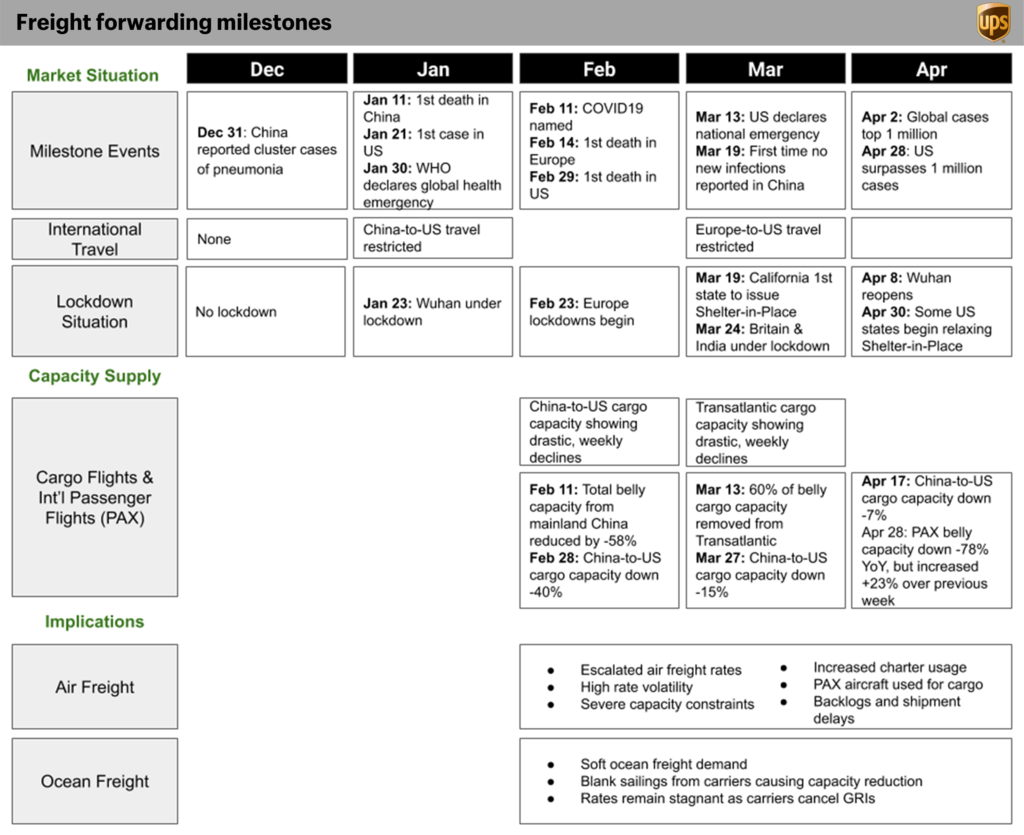
Flaherty says China is cautiously reopening and manufacturing is slowly returning but consumer spending is lagging, creating logistical imbalances and significant impacts on freight capacity and pricing.
Resilient supply chains are flexible supply chains. Instead of sole sourcing supply and becoming beholden to a single supplier, Flaherty says flexible supply chains with multiple sources of supply offer organizations optionality. While sole sourcing reduces costs and leverages economies of scale, it also makes supply chains less flexible, especially during crises:
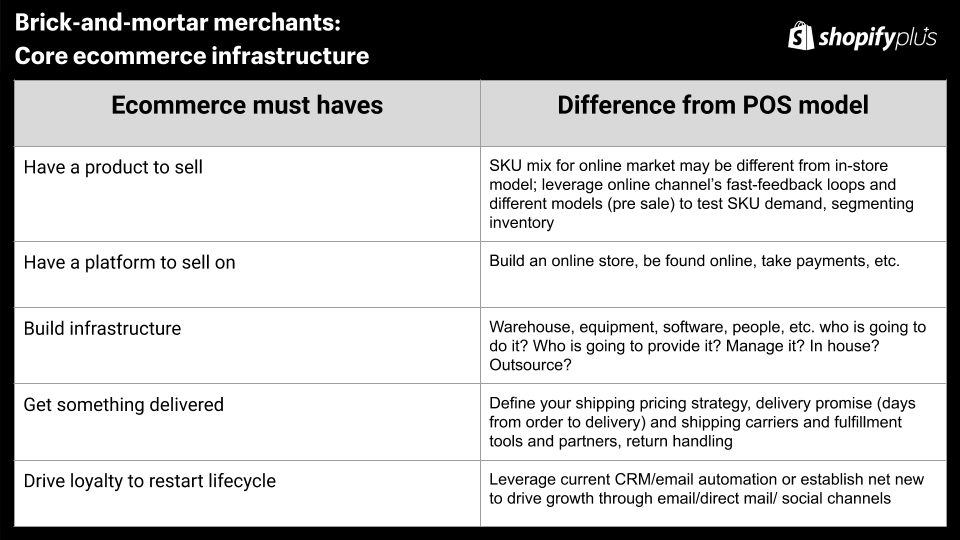
Infrastructure goes beyond the physical warehouses, scanners, and printers needed to fulfill orders. Jerome Dubois, VP, 6 River Systems also wants organizations to consider digital (data and networks) and human infrastructure.
The in-store experience has, and will continue to, change to include contact-free amenities. Retailers must equip their businesses to capitalize on the shift to ecommerce. Dubois offers a slide illustrating what retailers need to succeed online:
Inbound logistics
Identify the systems necessary to source, track, and manage inventory. Organizations must be able to manage vendors and see when inventory is received and ready to sell online so fulfillment promises can be kept.
Outbound logistics
You must have the capability to accurately forecast demand. Last-mile delivery must be factored into your pricing strategy so you understand the average order value (AOV) necessary to offer appropriate (free) shipping thresholds to maintain healthy margins. Determine who is responsible (you or a third party) for fulfillment, including return logistics. Ensure you (or a third party) enable fulfillment options like curbside pickup or click and collect
Platform technology
Owning customer data means managing it to yield actionable insight. Do you build or buy this technology? Besides cost, consider that as you scale, your tech stack will need to grow and evolve with you.
To hear morel from some of the brightest minds in logistics, watch the recording of the best practices for supply chain and logistics management above.
This article originally appeared in the Shopify Plus blog and has been published here with permission.






