

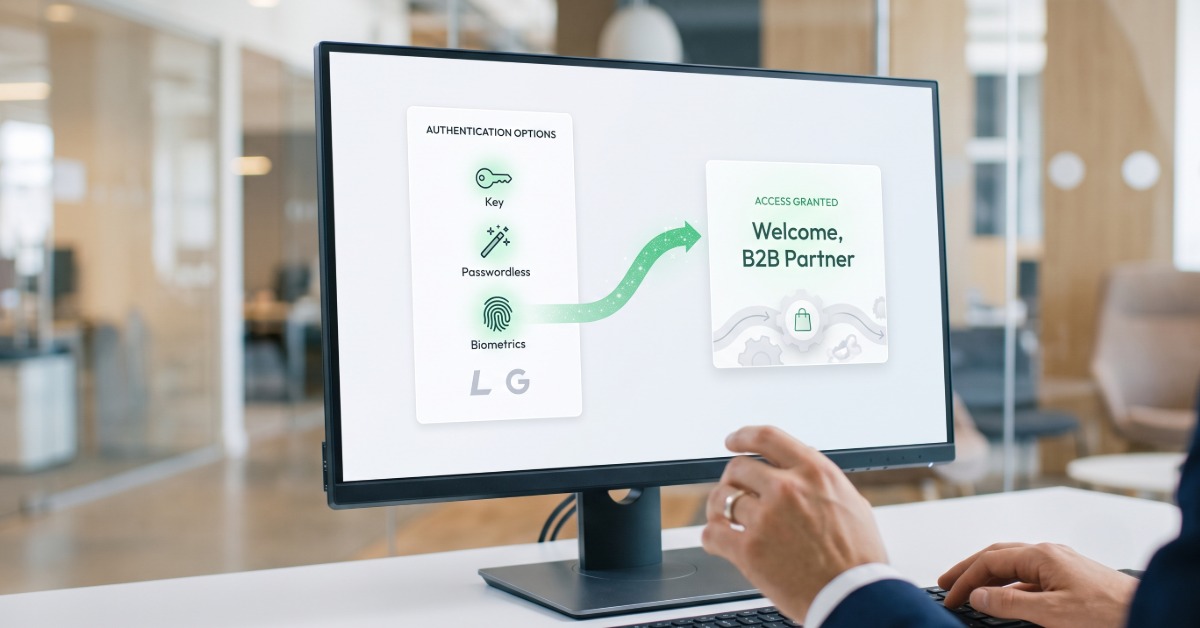
Shopify B2B merchants can reduce login friction by offering embedded, role‑aware customer accounts with multiple authentication options—traditional passwords, OTP, SSO, and “Login with Shop”—so wholesale buyers can access pricing and catalogs in the way that fits how they work.
For high‑value B2B buyers, login shouldn’t feel like a security test—it should feel like a familiar doorway into the pricing, catalogs, and tools they rely on every day.
A buyer who spends thousands of dollars with your business should not have to struggle just to access their account.
Yet login is often where friction first appears in the B2B purchasing journey.
Consider this: A customer clicks “Login” expecting to place a reorder, check contract pricing, or access company-specific products. Instead, they end up waiting for a verification code, using the wrong account, or contacting support because they cannot access the correct company profile.
The challenge has become even more relevant as Shopify merchants move away from Legacy Customer Accounts and adapt to newer customer account experiences. While these changes introduce new opportunities, they also force merchants to rethink how wholesale buyers access their stores.
For Shopify Plus merchants running B2B operations, login is no longer just an account feature. It is the gateway to pricing, catalogs, purchasing permissions, and customer relationships.
In this article, you’ll learn:
For years, many Shopify merchants relied on Legacy Customer Accounts to manage customer authentication. Buyers were familiar with standard email-password logins, and the experience remained relatively consistent across stores.
The introduction of Shopify’s Customer Accounts framework changed that experience significantly, by moving away from the traditional email-password login flow many buyers were used to and replacing it with a passwordless, OTP sign-in experience.
While the new system offers benefits and modernization, it also introduces different authentication expectations that may not align with every B2B buying process.
This is particularly important for Shopify Plus merchants serving wholesalers, distributors, manufacturers, and corporate buyers. These customers often operate within structured purchasing teams, have role-based access requirements, and expect predictable login experiences across multiple purchasing cycles.
As a result, authentication can no longer be treated as a one-size-fits-all process. Instead, merchants need to evaluate whether their current login experience matches how their buyers actually work.
The conversation has shifted from simply securing customer accounts to optimizing the entire Shopify B2B customer login journey.
Login friction often appears in places merchants don’t immediately notice.
One common issue is forcing all customers into a single authentication method. Some buyers are comfortable with OTP-based verification, while others prefer traditional credentials. When customers encounter an unfamiliar login flow, hesitation increases; what starts as a minor inconvenience can quickly lead to delayed reorders, failed login attempts, and avoidable support tickets.
Another challenge comes from organizational purchasing structures. A B2B account may include procurement managers, finance teams, purchasing agents, and administrators. Each person accesses the account differently and expects a login process that fits their role.
Many merchants also serve both retail and wholesale audiences through the same storefront. Without separate authentication experiences, B2B customers may struggle to locate the correct entry point or encounter workflows designed primarily for retail shoppers.
Think of your Shopify B2B login as the front entrance to your wholesale operation.
If approved buyers have to jump through unnecessary hoops every time they want to access pricing or place a reorder, the experience starts to feel like work. Over time, buyers naturally gravitate toward suppliers that make purchasing easier.
A stronger B2B login experience typically has three characteristics:
Customers should feel like they never leave the store during authentication.
Embedded login experiences maintain consistent branding, navigation, and user experience throughout the customer journey. This reduces confusion and creates a smoother transition between browsing and account access.
For B2B buyers who regularly reorder products, familiarity and consistency can significantly improve usability.
Retail and wholesale customers often have very different expectations.
Providing dedicated login paths allows merchants to create tailored experiences for each audience. Wholesale buyers can access company accounts, negotiated pricing, and purchasing tools, while retail customers continue through consumer-focused account flows.
This approach is particularly valuable for Shopify Plus merchants operating hybrid B2B and B2C business models.
A modern Shopify B2B customer login strategy should adapt to the buyer, not the other way around.
Different customers prefer different authentication methods. Some want the traditional email-password combination. Others may prefer quicker options like OTP verification. Enterprise customers or large organizations may expect identity-provider-based access.
An ideal solution supports:
The goal is not to overwhelm users with options. It is to remove barriers by allowing customers to choose the authentication method that best fits how they work.
Understanding the problem is one thing. Solving it inside a live Shopify Plus store is another.
Once merchants start evaluating their customer accounts experience, the next question becomes: how do you support different buyer requirements without creating a fragmented login experience?
Because B2B authentication requirements vary from one organization to another, miniOrange provides two complementary B2B solutions for Shopify that work together to support both customer-facing login experiences and enterprise identity requirements.
For many Shopify Plus merchants, the challenge isn’t choosing a single login method. It’s supporting the different ways B2B customers prefer to access their accounts.
The B2B Login & Onboarding solution gives merchants the flexibility to support multiple login combinations and paths within the same storefront.
This way, you can align the login experience with customer preferences rather than forcing every buyer through the same workflow.
Beyond authentication methods, you can also create embedded login and sign-up experiences that remain consistent with the storefront design, helping buyers enter the appropriate account journey from the start. Combined with separate login paths for B2B and B2C customers, merchants can guide users toward the right account experience and ensure approved buyers can quickly access the pricing, products, and company resources relevant to them.
While flexible login methods address most customer authentication needs, enterprise buyers often have more complex requirements when it comes to login.
This is where Shopify SSO becomes particularly valuable.
miniOrange’s Shopify Single Sign-On (SSO) capabilities support authentication through Okta, Auth0, Microsoft Entra ID, and other corporate identity systems, or preferred social identity providers, for more secure and streamlined login experiences.
This way, you can enable SSO for Shopify B2B customer accounts using their existing social or corporate credentials, reducing password fatigue and simplifying user access management.
This approach is especially beneficial for:
For merchants looking to modernize authentication while maintaining buyer convenience, combining flexible login options for diverse buyer preferences with Shopify SSO for enterprise identity requirements creates a powerful and complete login strategy.
Before implementing new authentication workflows in Shopify Customer Accounts, merchants must evaluate their current customer experience.
Use this checklist:
The idea is to not simply add more login methods; the main focus must be on reducing login friction while preserving security and usability.
Yes. Shopify merchants can offer traditional email and password login for B2B customers through solutions such as B2B Login & Onboarding, allowing buyers to continue using a familiar credential-based authentication experience. While Shopify Customer Accounts uses email-based OTP verification by default, merchants can support email-password login alongside other authentication methods using such solutions.
Yes. Although Shopify Customer Accounts rely on passwordless email OTP verification by default, utilizing a B2B Login & Onboarding app allows you to easily offer multiple login options for Shopify B2B (email/phone OTP, SSO, Shop Login), keeping the traditional email-password route available for the users who prefer it.
Shopify SSO allows B2B buyers from large organizations to log into the Shopify Plus storefront using existing credentials from their corporate identity provider (Okta, Microsoft Entra ID, Keycloak, etc.). This simplifies authentication, reduces password fatigue, and enables centralized access management through existing enterprise identity systems.
In many cases, yes. B2B and B2C customers usually have different access needs. Separate login paths help merchants provide more relevant experiences for wholesale buyers in Shopify Plus Customer Accounts, while keeping buyer journeys simpler for retail visitors.
Embedded login keeps the sign-in process inside the Shopify storefront instead of making it feel like a separate system. That creates a more consistent experience and makes it easier for buyers to move from login to browsing and purchasing. Merchants can also customize the login experience to match their store’s branding (logos, colors, typography, design elements), to maintain consistency and build trust throughout the customer journey.
The best Shopify B2B experiences are not always the most complex. They are the ones that avoid unnecessary friction.
When approved B2B buyers can access the storefront and company resources without struggling through the login process, purchasing becomes easier, and customer relationships become stronger.
As you evaluate your own storefront, start with a simple question: does your current login experience make it easier or harder for wholesale buyers to do business with you?
For many Shopify Plus merchants, answering that question is the first step toward building a more scalable and customer-friendly B2B operation.




