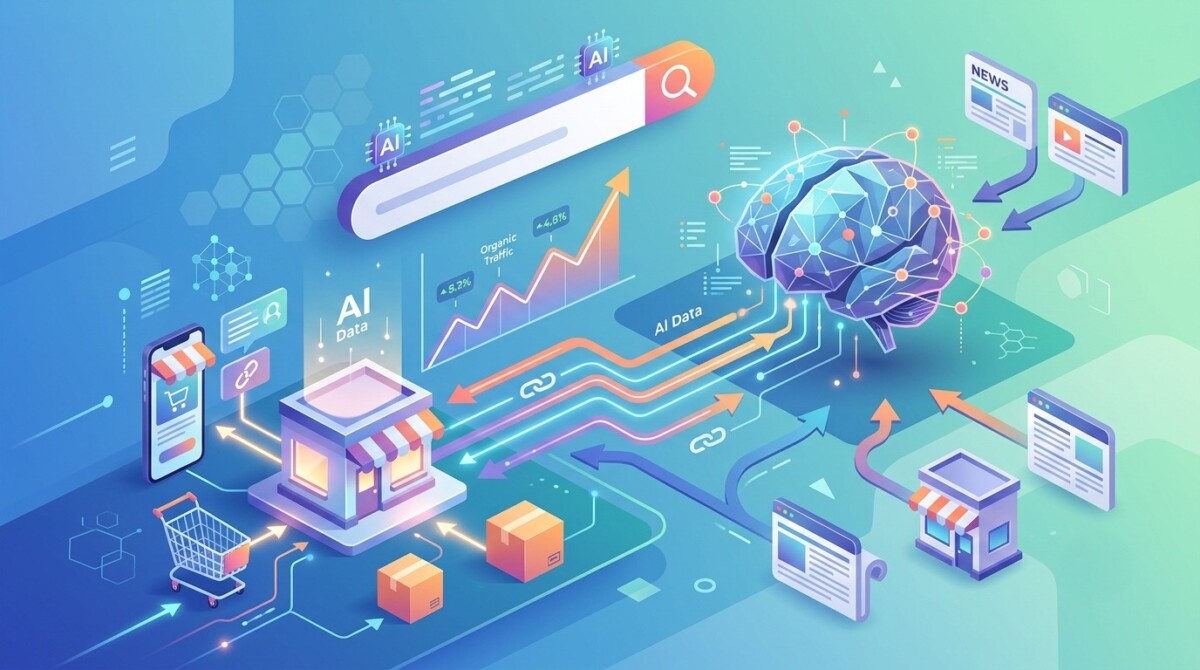
High-quality backlinks still decide Shopify organic rankings in 2026, and they matter more now because Google’s AI Overviews pull over 99 percent of their sources from the pages already ranking on page one. For most stores under roughly $5M, a specialist agency beats an in-house hire on cost and consistency.
The brands winning AI search in 2026 are not the ones chasing chatbot citations. They are the ones that already earned the organic rankings the chatbots quote.
Most Shopify stores I look at are running on a single engine: paid acquisition. Meta CPCs have climbed, iOS attribution gaps have made return on ad spend harder to trust, and Google Shopping competition has compressed margins in most categories. The store doing $1.2M on paid media is one auction shift away from a very uncomfortable quarter, and the founder usually knows it.
The reflex in 2026 is to assume search itself is breaking, that AI is eating the clicks, and that the new game is getting mentioned inside ChatGPT or an AI Overview. Some of that is real. But the data underneath the panic tells a more useful story, and it points in a direction most stores are not investing in.
Organic search is still the channel that compounds, and backlinks are still what make it work. The honest question for a founder or operator is not whether to invest in links. It is who builds them, how many you need, and how to spend the money without getting fleeced. That is what this piece is about.
Organic search matters more for Shopify stores in 2026, not less, because AI Overviews and AI search engines build their answers almost entirely from the pages already ranking on page one. An analysis of 432,000 keywords found that over 99 percent of AI Overview sources are pulled from the top 10 organic results, with each overview citing roughly five URLs from that pool. The AI layer is not a separate game. It is a synthesis of the organic listings underneath it.
That single fact reorders the whole strategy. To get cited inside an AI answer, you first have to rank. To rank in a category with any commercial value, you need backlink authority. So backlinks sit upstream of both classic blue-link rankings and AI visibility at the same time. The store that built referring domains for the last 12 months is eligible for both. The store chasing AI citations without the organic foundation is optimizing for a result it has not earned the right to.
This is the part worth sitting with. Click-through rates on traditional results have genuinely fallen where AI Overviews appear, which is why so many operators concluded SEO is dead. It is not dead. It changed shape. The reward moved from raw clicks toward being the cited authority that an AI surface trusts, and that authority is still built on rankings and links. Whether you are doing $200K months or scaling past $1M, the move is the same: become the page the algorithm already trusts, then let the AI layer borrow that trust on your behalf. If you want the broader playbook, our guide to driving organic traffic to an online store covers the on-page and technical foundation that links amplify.
A backlink is an asset that compounds, and a paid click is an expense that disappears the moment you stop spending. That distinction is the entire case for link building, and most stores never frame it that way. They put 80 to 90 percent of growth budget into paid because paid produces same-day results, and they starve the one channel that pays dividends for years.
Here is the mechanism. A guest post placed on a relevant publication today earns you a referring domain. That domain passes link equity to your Shopify collection page. Over the next 6 to 12 months, as the host article ages and gathers its own backlinks, the equity it passes you tends to increase. You paid once. The benefit builds. Paid media works in reverse: every order acquired through ads is a transaction that ends, and the day you pause the campaign, the traffic stops with it.
The stores growing organic revenue 30 to 50 percent year over year are not doing anything exotic. They are adding referring domains every month, pointing them at the collection and product pages their buyers actually search for, and treating off-site SEO as infrastructure rather than an afterthought. The pattern I have watched play out across hundreds of merchants is almost boringly consistent: the brand that started building links 12 months before its competitor is the one quietly taking ground today. Our breakdown of how to boost your store’s rankings in search engines gets into how those off-site signals interact with the on-site work.
The number of referring domains your store needs depends entirely on your competitors, not on any universal benchmark, so the only reliable target comes from a backlink gap analysis on your top three organic rivals. Run that analysis in Ahrefs or SEMrush before you set a single goal. The store with the fewest referring domains that still ranks on page one for your keywords tells you your real minimum viable target, and it is almost always different from what a generic guide would suggest.
Illustrative benchmarks give you a starting frame, not a finish line. As a rough directional guide across typical Shopify categories: a low-competition niche often competes with somewhere around 50 to 150 referring domains at an average Domain Rating of 30 to 50; a mid-competition niche tends to need a few hundred; and high-competition categories like supplements, fashion, or home goods routinely require 500 or more from publications at DR 50 and above. Treat those as ballpark, then let your actual competitor data overwrite them.
The gap between where you sit now and where your top competitor sits is your brief. If a rival has 340 referring domains and you have 60, you are not losing on content quality or site speed. You are losing on authority. One Shopify-specific wrinkle makes this harder: collection pages are your highest commercial-value pages, yet they are the toughest to earn editorial links to, because natural links gravitate to blog posts and homepages. Earning links that point at a collection page for, say, “women’s trail running shoes” takes deliberate outreach, which is exactly why most stores end up outsourcing the work. Links also compound fastest when they sit on top of solid on-page fundamentals, the kind covered in our rundown of Shopify SEO tactics that actually drive sales.
Shopify stores have three ways to build links: handle it in-house, hire a specialist agency, or, if you run an agency yourself, resell through a white label provider. The right choice comes down to your existing team skills, your competitive gap, and the fully loaded cost of doing the work internally, which is the number most stores forget to calculate.
That cost is the whole argument. A competent in-house link builder with real outreach skills runs $55,000 to $80,000 a year in salary, and once you add tools, management time, and benefits, you are at roughly $4,500 to $6,500 a month before a single link is placed. An agency delivering six quality placements a month at $800 to $1,200 each is almost always the more efficient investment for a store below $5M in annual revenue. The exception is when the work is relationship-driven rather than systematic, which is where in-house genuinely wins.
In-house outperforms an agency in one clear scenario: when your store has earned genuine press, influencer relationships, or industry awards that create natural linking contexts. A founder who shows up on podcasts and in trade publications can convert that visibility into editorial backlinks no agency can replicate. In that case the smart split is in-house for the relationship-driven links and an agency for systematic outreach volume.
A good link building agency earns placements on publications with real organic traffic and genuine editorial standards, then hands you live URLs with Domain Rating and traffic data; a bad one sells you links on sites with plausible metrics and no readers. The entire difference between authority that compounds and money set on fire lives in the publisher vetting process, so that is the thing to interrogate.
A quality agency applies hard criteria before pitching any site. The publication should have verifiable organic traffic, typically 5,000 or more monthly sessions confirmed in Ahrefs or SEMrush, a Domain Rating above 40, real editorial review that rejects weak submissions, and content topically relevant to your store’s category. A site that fails any one of those is not a legitimate editorial placement, no matter how respectable the domain name sounds. This is the pattern teams like FHSEOHub report when they audit a Shopify store’s backlink profile: the brands gaining consistent ground are almost always the ones that started earning relevant, traffic-backed referring domains long before their competitors thought to.
Reporting matters as much as the links. A credible agency delivers the live URL, the DR of each placement, the organic traffic of the host page, and the anchor text used, so you can tie specific links to ranking movement on your collection pages. If you decide to outsource rather than build internally, this is the standard your link building agency should hold itself to, and it is the same bar we apply when evaluating any provider in our overview of Shopify ecommerce SEO services. Vague answers about “our network” are a tell. Named criteria and verifiable examples are the signal you want.
Niche edits move collection page rankings faster because they place your link inside an article that already ranks and already carries equity, while guest posts build slower but deliver stronger topical authority over a three to six month window. A niche edit, also called a link insertion, drops a contextual link into an existing published article that already pulls organic traffic. A guest post creates a brand new article with your link embedded in fresh content that starts from zero ranking history.
The mechanical difference drives the strategy. A niche edit on a two-year-old article that ranks on page one and gets 2,000 monthly visitors passes equity from a page with established authority, and that flows to your target page quickly. A guest post on the same publication starts a new page that earns its equity gradually as it ages. Neither is better in the abstract. They do different jobs.
The highest-performing programs run both, in a ratio matched to the gap. If you need to close a referring domain deficit fast, niche edits give you cost-efficient volume. If you are building durable topical authority so Google reads your brand as belonging in the category conversation, guest posts under a real byline do that work. A store selling recycled activewear that wants to rank for “recycled yoga leggings” benefits from a niche edit on an article already ranking for “sustainable gym wear” and a guest post on a wellness publication that tells Google the brand belongs in that conversation at the domain level. Run them together.
Before paying any link building provider, ask for ten live placements from the last 90 days, confirm exactly how they vet publishers, and verify they do not use private blog networks. Any provider that hesitates to show real, recent, verifiable placements should be eliminated immediately, because legitimate operators have nothing to hide on this front.
Three questions cut through almost every sales pitch. First, show me ten live placements from the past three months with URLs I can check, then run them in Ahrefs yourself for DR and organic traffic. Second, walk me through your publisher vetting: you want to hear minimum traffic thresholds, DR floors, spam-score checks, and editorial review, stated as named criteria rather than vague talk about a “network.” Third, what happens when a placed link goes down? A serious partner either replaces dropped links within a defined window or credits your account. No guarantee on link longevity is a red flag.
The thing to avoid outright is a private blog network, a cluster of sites one operator controls to sell links without disclosing ownership. PBN sites often show plausible Domain Rating but have no real traffic, no readership, and no editorial standards, and Google actively devalues them. Real DR with no organic traffic is the signature, so verify traffic in Ahrefs or SEMrush on every placement before you accept it. One note for the agency owners reading this: if you run a Shopify marketing agency and plan to resell links under your own brand through a white label provider, apply the exact same audit, because the provider’s quality becomes your reputation the moment your name is on the deliverable. Request 10 to 15 sample placements and verify each before you offer the service to a single client.
Organic search is not a shortcut, and link building is not a quick win. It is the long play that permanently changes the unit economics of a Shopify store. The brands that build referring domains consistently, point them at the right pages, and match their link type to their ranking goal end up with a traffic channel that compounds for years, and in 2026 that same authority is what earns them a seat inside the AI answers everyone else is scrambling to reach.
Backlinks matter more for Shopify SEO in 2026, not less, because AI Overviews build their answers from the organic results that backlinks help you earn. Research across 432,000 keywords found that over 99 percent of AI Overview sources come from the top 10 organic results, with each overview citing around five pages. That means a top organic ranking is now the prerequisite for being included in an AI answer at all. You cannot shortcut your way into AI visibility by skipping the organic foundation. The path runs through rankings, and in any competitive category, rankings run through backlink authority. SEO did not die. The reward simply shifted from raw clicks toward being the cited authority AI surfaces trust.
The number of referring domains depends on your competitors, not on a fixed universal figure. Run a backlink gap analysis in Ahrefs or SEMrush on your top three organic competitors for the keywords you want, and the lowest-authority store that still ranks on page one defines your minimum viable target. As an illustrative starting frame, many mid-competition Shopify niches compete somewhere in the range of a few hundred referring domains, while high-competition categories like supplements or fashion often require 500 or more from DR 50-plus publications. Treat those as directional only. Your competitor data is the real brief, because it reflects the exact environment you are trying to rank in rather than a generic average.
Most Shopify stores see initial ranking movement within 60 to 90 days of the first placements going live, with meaningful organic traffic gains usually following around the 90 to 120 day mark. Google processes and weights links incrementally rather than all at once, so a consistent six-month program produces far larger gains than a burst of links followed by a long pause. Consistency beats volume spikes. If rankings have not moved at all after 90 days, the issue is almost always relevance or anchor strategy: the placements may be on topically unrelated sites, or the anchor text may be too aggressive. Audit those two factors before assuming the channel is not working for your store.
Build links to both, using a different strategy for each. Collection pages carry the highest commercial value but are the hardest to earn editorial links to, so niche edits placed in contextually relevant existing articles tend to work best there. Blog posts attract links far more naturally and act as link magnets, then pass that equity to your collection pages through deliberate internal linking. A mature Shopify SEO strategy builds to both and connects them with internal links so authority flows from the content that earns links toward the pages that earn revenue. The most common mistake is pointing every link at the homepage, which spreads equity thinly instead of concentrating it where buyers actually convert.
For most Shopify stores under roughly $5M in annual revenue, hiring a specialist agency beats building in-house on both cost and consistency. A competent in-house link builder runs $4,500 to $6,500 a month fully loaded with tools and management, before placing a single link, while an agency can deliver six quality placements in that same budget. In-house wins in one specific case: when your founder has genuine press, podcast, or industry visibility that creates natural editorial linking opportunities an agency cannot manufacture. The strongest setup for a visible founder is often a hybrid, with in-house handling the relationship-driven links and an agency handling systematic outreach volume across your priority collection pages.
A private blog network, or PBN, is a group of websites controlled by one operator and built specifically to sell links without disclosing that common ownership. PBN sites frequently show plausible Domain Rating but have no genuine organic traffic, no real readership, and no editorial standards. Google actively identifies and devalues PBN links, and stores caught relying on them risk manual penalties that can erase rankings overnight. The reliable tell is real DR paired with no real traffic, so verify the organic traffic of every proposed placement in Ahrefs or SEMrush before accepting it. A legitimate editorial link sits on a page that actual humans read. If no one is reading the host page, it is not passing the authority you are paying for.