

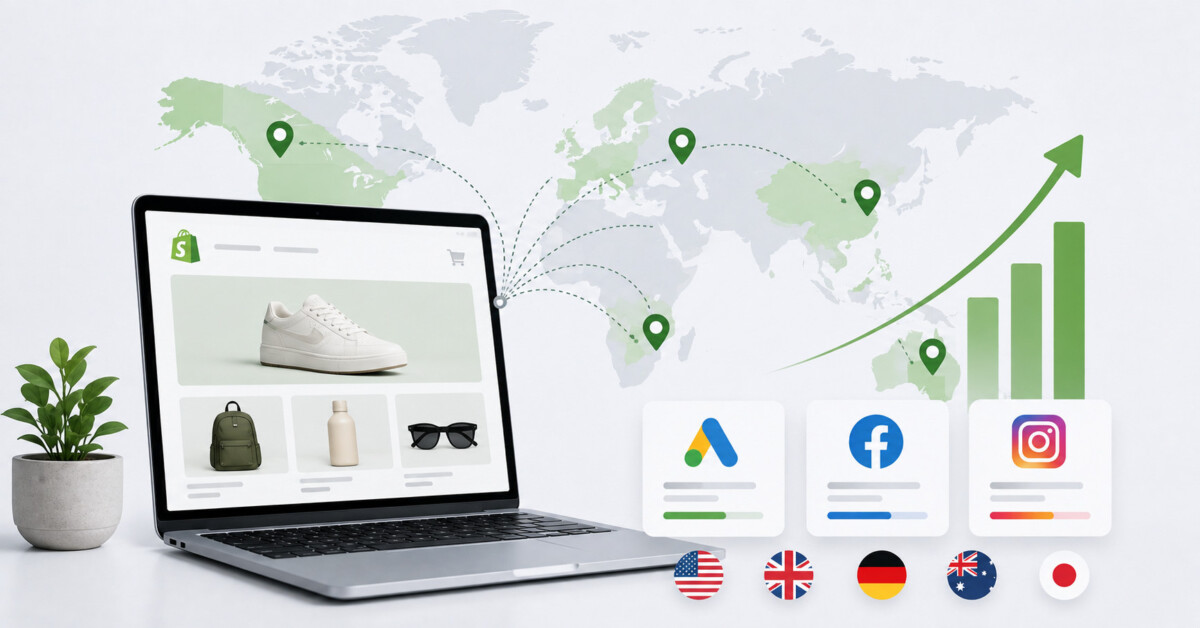
Profitable international growth starts with one validated market, transparent landed costs, localized checkout, and market-specific paid media. Shopify brands should not scale global ads until shipping, duties, returns, pricing, product data, and conversion measurement work for the customer on the other side of the border.
International ads do not create an international business. They expose whether your checkout, pricing, product data, shipping promise, and customer support are ready for international customers.
Expanding a direct-to-consumer brand beyond domestic borders is no longer just an ambitious goal; it is a necessity for sustained growth. E-commerce is a borderless economy, yet many brands mistakenly treat international expansion as an afterthought. According to the International Trade Administration, global B2C e-commerce revenue is expected to grow to USD$5.5 trillion by 2027 at a steady 14.4 percent compound annual growth rate. For Shopify merchants, tapping into this rapid growth requires more than simply flipping a switch on global ad targeting. It demands a highly strategic approach to paid media, where campaigns are meticulously tailored to local cultures, currencies, and buying behaviours.
Before you can profitably scale your international advertising, you must ensure your operational groundwork is solid. Pouring a massive marketing budget into a foreign market will only lead to high cart abandonment if the post-click experience is not properly localised. Data from the Baymard Institute shows that unexpected extra costs, such as shipping fees and local taxes revealed late in the checkout process, are the leading cause of international cart abandonment. Furthermore, research from Shopify reveals that 75 percent of businesses struggle with Harmonised System code accuracy when moving products globally. These friction points can destroy profitability before a campaign even gathers momentum.
To avoid these common pitfalls, Shopify brands need to implement multi-currency checkouts and transparent local shipping options. Shoppers who see pricing in their native currency convert at two to three times the rate of those presented with foreign money. Leveraging the comprehensive insights available on platforms like Ecommerce Fastlane can help merchants lay this essential operational foundation. By doing so, brands can ensure their site is entirely ready to handle cross-border traffic efficiently before the paid media engines are turned on.
Once your store is ready to receive global customers, the next step is adapting your acquisition strategy. Scaling global ad campaigns on platforms like Meta or Google using broad, non-localised targeting has become a primary driver of inflated customer acquisition costs. Instead, merchants must take a highly nuanced approach, especially when entering fast-growing regions. For North American or European brands expanding into the lucrative Asia-Pacific market, collaborating with a paid media agency in Australia is one of the most effective ways to navigate local bidding strategies, optimise ad copy for local dialects, and manage complex campaigns across different time zones.
The Asia-Pacific region is currently the fastest-growing advertising market globally, with digital ad spend expected to expand significantly through 2026. Australia alone represents a particularly massive opportunity, with its e-commerce market revenue projected to reach nearly USD 57.77 billion by 2029. However, penetrating this mobile-driven market requires genuine regional expertise rather than guesswork. Cultural adaptation, correct sizing conventions, and local platform nuances play a huge role in improving your return on ad spend. Brands must respect the unique commercial landscape of each target country to maximise their investment.
Entering a new market requires a calculated shift from broad targeting to highly localised engagement. To keep your customer acquisition costs manageable and protect your overall profit margins, consider implementing the following proven tactics:
Taking your Shopify brand global is a complex but highly rewarding endeavour. By establishing a robust cross-border infrastructure, partnering with regional experts to localise your messaging, and executing a phased rollout strategy, you can successfully turn international traffic into loyal customers. The key to long-term profitability lies in treating each region with the respect and focus it deserves.
The brands that win on the global stage will be those that view every new territory not just as another targeting option on an ad platform, but as a unique market requiring a bespoke, carefully crafted approach.
A Shopify brand should start running international ads after it can show local pricing, transparent landed costs, reliable delivery estimates, a workable returns process, and country-level conversion tracking for one target market. Start with evidence of existing demand, such as international traffic, orders, email subscribers, or customer inquiries from that country. Do not launch broad global targeting simply because Shopify Markets is enabled. The operational test is simple: if an overseas customer buys today, can you fulfill the order, communicate clearly, handle a return, and still earn an acceptable contribution margin? If not, fix the customer experience before buying additional traffic.
Most DTC Shopify brands should use Delivered Duty Paid, or DDP, where product economics and carrier support allow it because the customer sees duties and taxes in the checkout price instead of receiving an unexpected bill on delivery. DDP creates a clearer buying decision and reduces a major source of cross-border friction. Delivered At Place, or DAP, can make sense for selected products, destinations, or B2B orders, but it places more responsibility on the buyer and requires unusually clear checkout communication. Model the full landed cost by SKU before deciding, because a duty-inclusive promise only works when margin supports it.
Choose your first international Shopify market by combining existing demand signals with shipping feasibility, margin, payment support, return logistics, product compliance, and localization effort. Review your analytics for countries already sending qualified traffic or orders, then compare each candidate’s average shipping cost, duty treatment, delivery reliability, language requirements, local payment expectations, and likely customer-support needs. A nearby English-speaking market can be operationally easier, but it is not automatically the right choice. Start with one market where your product has credible demand and you can deliver a transparent, profitable customer experience without building an enterprise-level operation.
Measure international paid media performance by country and contribution margin, not only by platform ROAS. Combine ad-platform spend and attributed revenue with Shopify conversion rate, payment acceptance, shipping cost, duties, refund rate, return rate, delivery exceptions, support contacts, and repeat purchase behavior. Review domestic and international performance separately so a strong home market does not hide a weak overseas market. Build a weekly country scorecard that identifies whether the constraint sits in ads, the product feed, pricing, checkout, fulfillment, or post-purchase experience. Scale spend only when the full commercial model remains profitable after all landed costs.
You do not always need a local paid media agency when entering Australia or APAC, but local expertise is valuable when your team lacks knowledge of regional search behavior, creative conventions, creator networks, time zones, product expectations, and media-buying patterns. Start by validating that you can fulfill profitably and localize the buying experience. Then decide whether an agency fills a genuine gap. A strong partner should explain the local hypotheses it will test, identify market-specific risks, and work inside accounts your brand owns. Hiring an agency solely because it is local is not enough; category knowledge and transparent reporting matter more.





