

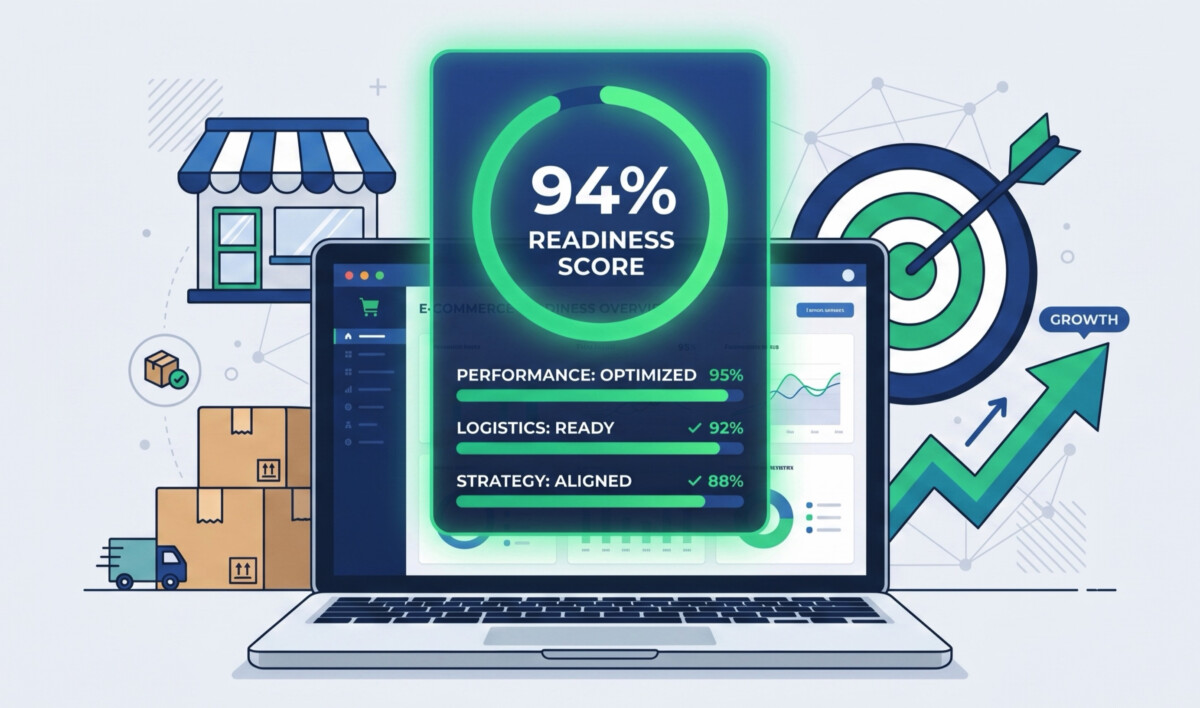
Out of millions of Shopify merchants, fewer than 30 ever went live with OpenAI’s Instant Checkout. The merchants who got it right were not the ones chasing the announcement. They were the ones who kept building fundamentals while everyone else was distracted.
You ran the Shopify Commerce Readiness Scanner. You got a number. You see a list of gaps. You are probably staring at it wondering which one to fix first, whether the score actually matters, and whether a 93 means you are done.
It does not mean you are done. I ran the scanner on holyclothing.com on April 30, 2026. The brand scored 93. Green ring. AI-Ready badge. From the outside, that looks finished. It was not. The scan flagged two failed checks: Review and Rating Schema (high impact, medium effort) and llms.txt (medium impact, medium effort). Even at 93, this brand has structural revenue exposure on AI agent recommendations because aggregate ratings are not being injected into Product JSON-LD. A passing score is not a finished score.
Reading the output as an operator means understanding three things: how to interpret your score band, which gaps to fix first based on your stage, and why the Operational Readiness score matters more than the technical score most merchants will fixate on. This piece covers all three.
The Shopify Commerce Readiness Scanner runs 31 checks across five categories and returns both a technical score and a separate Operational Readiness score. Understanding the structure before you act on the output is worth two minutes of your time.
Four categories affect your score: Agent Discovery, Product Intelligence, Transaction Readiness, and Operational Readiness. The fifth category, Store Quality, is general ecommerce hygiene and explicitly does not affect your readiness score. Most coverage of the scanner misses this footnote entirely. It matters because it changes how you should weight individual checks. A failed FAQ Schema check sits in Store Quality. It will not move your score. That does not mean it is unimportant, but it means you should not prioritize it over failed checks in the four scored categories.
Each check is binary: pass, fail, or partial. Beside each gap, the scanner shows impact level (high, medium, low) and effort level (low, medium, high). The Impact and Effort Matrix sorts every gap into four buckets: Quick Wins (high impact, low effort), Strategic Investments (high impact, high effort), Incremental Gains (medium impact and effort), and Consider Later (lower priority items).
The scanner ends with a 9-question Operational Readiness self-assessment that calculates a separate score from the technical score. Most merchants skip it. That is a mistake, and the reason why is the subject of a full section below.
One critical point before you go further: the scanner diagnoses, it does not fix anything. That is where most merchants get stuck. They see the score, understand the priorities, and then either need a developer or abandon the process. This article is designed to close that gap.
Your score band tells you what kind of problem you have, and that determines what you should do next. The Holy Clothing example above illustrates the point at the top of the range. Here is the full framework across all three bands.
A score below 50 means structural pieces are missing, not edge cases. The common pattern at this band: missing or broken JSON-LD on product pages, no llms.txt, thin or boilerplate policy content, broken canonical tags, slow page speed, and unstable mobile readiness. These are not optimization problems. They are foundation problems.
The mistake operators make at this score is trying to optimize before the foundation is solid. If you scored below 50, ignore Strategic Investments entirely. Focus on the failed checks in Agent Discovery and Transaction Readiness categories first. These are the categories that determine whether AI agents can reach and understand your store at all. Everything else is downstream of that.
At the under $500K stage, these fixes are usually achievable in a single development sprint. Hire a developer for 4 to 8 hours, spend $400 to $800, and fix the foundation in a week. Re-scan in 90 days. The goal is moving from foundation territory into the 50 to 80 band, not chasing optimization.
This band is where most $500K to $5M Shopify merchants land on first scan. The common pattern: Product JSON-LD exists but is missing two or three fields, typically AggregateRating, brand, or material. Robots.txt allows AI crawlers but llms.txt is missing. Policy pages exist but are short or use boilerplate templates.
The mistake at this band is skipping Strategic Investments to chase Quick Wins. Quick Wins feel productive but may be noise. Strategic Investments are the gaps that compound over months. The AggregateRating schema failure is almost always a Strategic Investment at this band. It requires more effort than adding an llms.txt file, but it has a longer half life on AI visibility because reviews are a primary signal agents use when making product recommendations.
The right move: address the highest-impact Strategic Investment first, even if it requires more effort, because it has the longest compounding effect on your AI visibility over the next 12 to 18 months.
This is where Holy Clothing’s 93 sits. Remaining gaps at this band are usually edge cases: third-party widget rendering issues, FAQ schema gaps, missing llms.txt, schema fields specific to your category like size, fit, ingredients, or compatibility.
The deeper observation at this band: the technical gaps are no longer the bottleneck. Your team’s ability to maintain AI readiness as products and policies change becomes the bottleneck. A store that scores 93 today and ignores the Operational Readiness self-assessment will drift back toward 80 within 12 months as new products launch without schema validation, policies change without structured data updates, and AI standards evolve without anyone on the team tracking them. This is the transition point where merchants need to start thinking about Operational Readiness, not just technical readiness.
Running the scanner across stores from $500K to $50M plus, the same three gaps surface almost every time regardless of stage. These are the gaps Shopify is most consistently flagging because they are the most consistently overlooked across the platform.
An llms.txt file is a plain text file at /llms.txt that tells AI agents what your store sells, who it serves, your top product categories, your policies summary, and your brand voice. Traditional sitemaps tell crawlers what URLs exist. The llms.txt file tells AI agents what your store IS. Without it, the agent has to assemble that picture from scattered signals across your site and inevitably misses or mistakes parts of it.
Most stores are missing it for a simple reason: the standard is so new that Shopify’s own scanner labels it Emerging. As of April 2026, no major Shopify theme ships with one out of the box. No major third-party app generates one automatically by default. The gap is universal because the standard is new, not because merchants are negligent.
Minimum viable file content: store name and one-line description, target customer description, top 5 to 10 product categories or collections, summary of shipping and returns policies, link to your full policy pages, and optional brand voice guidance for AI agents. It lives at the root of your domain at yourstore.com/llms.txt.
For merchants under $500K, this is a 15-minute manual job. Above $1M, add it to the launch checklist for new collections so it stays current as your catalog grows. One important note: llms.txt is currently labeled Emerging because the standard is not finalized. Format details will likely shift over the next 12 months. Treat your version as a v1. Get it live now, iterate quarterly. For more on how AI agents discover and recommend products from your Shopify store, the AEO for ecommerce guide with Kyle Risley from Shopify covers the full discovery stack in detail.
This is the exact gap Holy Clothing hit at 93. The mistake merchants make is assuming third-party review widgets handle schema for them. They often do not, and the reason is a technical mismatch that is easy to fix once you understand it.
Yotpo, Judge.me, BazaarVoice, Okendo, and most third-party review apps render review content via JavaScript on the client side after the page loads. AI agents read static HTML markup at fetch time. If the AggregateRating is rendered after the page loads via JavaScript, the agent will not see it. Your reviews exist, your widget is working, and your schema is still failing from the agent’s perspective.
The fix: ensure AggregateRating is included in your Product JSON-LD schema, server-rendered, in the static HTML of the page. Most review apps offer this as a setting but it requires explicit configuration. Some require theme-level integration. How to verify: view your product page source code (right-click, View Source) and search for “AggregateRating.” If it is not in the static markup, your reviews are invisible to AI agents regardless of how many stars you have accumulated.
Stage note: this fix is critical for any merchant doing $250K plus where reviews are part of your product story. Below that threshold, fewer reviews makes this less impactful. Focus on llms.txt and policy content first.
FAQ Schema sits in the Store Quality category, which Shopify’s scanner explicitly says does not affect your agentic readiness score. So if it does not move the score, why include it here?
Because AI agents weight FAQ content heavily for product recommendations. When a customer asks ChatGPT “is this product right for sensitive skin” or “does this work with X,” the agent looks first at FAQ schema, then at policy pages, then at product descriptions. The discrepancy between Shopify’s scoring logic and what AI agents actually weight in recommendations is the operator-level insight here. You are optimizing for AI behavior, not for Shopify’s score. Those are related but not identical goals.
Minimum viable FAQ schema implementation: 5 to 10 questions that match real customer queries, structured as FAQPage JSON-LD with Question and Answer pairs. Place it on category pages or a dedicated FAQ page. Stage note: under $500K can skip this for now. $500K plus should add it within the next quarter. $5M plus should treat it as a standing content investment alongside product page optimization.
The Operational Readiness self-assessment is where actual long-term competitive advantage gets decided. Most coverage of Shopify’s scanner stops at the technical score. That is a mistake, because a 93 tech score paired with a low operational score means your store is technically discoverable but your team cannot keep it that way as products, policies, and AI standards evolve.
The scanner ends with 9 questions across 3 categories: Team Skills and Capability, Process Automation, and Change Management. Together they calculate a separate Operational Score from the technical score. The framing the scanner itself uses: “You’re AI-ready, here’s what’s coming next. Your tech scores 93, but how ready is your team?” That sentence is the entire thesis of this section. The brands pulling ahead in 2026 are not the ones with the highest tech scores. They are the ones building the operational muscle to keep both scores rising over time.
The three questions in this category: Does your team understand how AI shopping agents discover and interact with products? Can your team implement and maintain structured data (JSON-LD, Open Graph)? Does your team monitor AI agent traffic and optimize for it?
On the first question: most merchants under $5M will honestly answer Basic awareness or Good understanding. Expert level is rare and probably not necessary at most stages. The mistake is overestimating. Saying Expert when the reality is Basic awareness makes the scanner less useful as a diagnostic tool.
On the second question: JSON-LD literacy is where most teams hit a wall. Below $1M, Basic capability through your developer or theme is fine. $1M to $5M should aim for Competent in-house. $5M plus needs at least one team member at Competent level on staff or on retainer. This is not optional at that revenue stage, it is infrastructure.
On the third question: AI agent traffic monitoring is bleeding edge as of April 2026. Even at $10M plus, most merchants are at Occasionally. Continuously monitoring requires tooling that is just emerging. Honest answer for most merchants: Occasionally is realistic, Regularly is aspirational, and that is fine for now.
The three questions in this category: Are your product feeds automatically updated and syndicated? Is your inventory availability automatically reflected in structured data? Are policy pages and trust signals automatically maintained?
The feed question is the silent killer. Manual feed updates mean AI agents see stale product data. Stale data means agents stop recommending you. The pattern most merchants miss: AI agents penalize brands with inconsistent data more harshly than search engines do, because agents make atomic recommendations (one product) versus search engine results (ten links to compare). One wrong price or out-of-stock signal in structured data can remove you from a recommendation entirely.
The policy maintenance question is where an $8M annual fashion brand I managed during my time at Shopify got it right. They had a quarterly content review cadence on their privacy, returns, and shipping pages. Each season, those pages were updated to reflect actual return rates, shipping windows, and policy changes. By the time AI agents started weighing policy depth as a recommendation signal, they were already at Dynamic and current. Not because they planned for AI commerce, but because they treated trust signals as living documents. Most merchants treat them as set-and-forget templates. That gap is where AI visibility quietly erodes.
The three questions in this category: How quickly can you implement AI readiness improvements? Do you have a roadmap for AI commerce readiness? Is there executive buy-in for AI commerce initiatives?
On implementation speed: the rate at which AI commerce standards are changing means a months-long implementation cycle puts you structurally behind. Below $1M, Weeks is realistic and acceptable. $1M to $5M should aim for Days for non-structural fixes (schema updates, llms.txt updates, policy edits). $5M plus needs to operate at Hours for tactical fixes.
On executive buy-in: this question exposes whether your AI readiness work has political cover or not. Without Strategic priority designation, AI readiness improvements compete with every other priority and lose. The brands that pull ahead are the ones where the founder or CEO has explicitly named this as a top-three quarterly priority. If you cannot answer Mentioned or Strategic priority honestly, that is the real gap to close before any technical fix matters.
Everything above translates into the following stage-aware action plan. The goal is a Tuesday morning to-do list, not a vague strategic framework.
Run the scanner once. Document the score and gap list before you change anything. You need a baseline.
Fix llms.txt this week. It is a 15-minute job. Use the minimum viable template: store name, target customer, top 5 to 10 product categories, shipping and returns summary, links to full policy pages. No developer required.
If you have any reviews, have your developer add AggregateRating to your Product JSON-LD. This is a 4-hour job at $400 to $600. It is the single highest-leverage technical fix available to a store with reviews. Without it, your social proof is invisible to AI agents.
Skip everything else for the next 60 days. Focus on clean product titles, plain language descriptions, and accurate metafields. Re-scan in 90 days. The goal is moving from foundation territory to working foundations. For the broader context on why fundamentals compound in AI commerce, the complete 2026 guide to agentic commerce for Shopify merchants covers the full picture including the 30 to 90 day rollout plan.
The $8M fashion brand referenced above got three things right that most brands at this stage skip. First, a quarterly policy and trust signal review: returns page, shipping page, and privacy page were reviewed and updated each season, not annually. Second, product schema as part of the merchandising workflow: every new product launch included a schema validation step in QA before going live. Third, structured data treated as a merchandising decision, not a developer decision: the brand merchandiser had visibility into which schema fields were missing on which collections.
Action plan for this stage: run the scanner and aim for a tech score above 75 within 60 days. Address the highest-impact Strategic Investment first. Add llms.txt to your launch checklist for new collections. Audit your top 25 products for AggregateRating in JSON-LD. Take the Operational Readiness self-assessment honestly and aim for Competent on Team Skills, Mostly Automated on Process Automation, and Weeks on Change Management as your 90-day targets.
Tech score above 80 is the floor at this stage, not the goal. A tech score above 80 should be achievable within 30 days if it is not already there. The next 12 to 18 months of competitive advantage gets won or lost in the Operational Readiness categories.
Run the scanner as a leadership team exercise, not a developer assignment. Take the Operational Readiness self-assessment together. Identify the lowest score in the operational categories and treat it as a quarterly priority. Establish a quarterly re-scan cadence with the score logged as a leadership KPI alongside revenue and retention. Consider whether you need a dedicated AI commerce readiness owner on your team. At $10M plus, this is increasingly a full-time role, not a project. The Shopify merchant’s guide to agentic commerce readiness covers the seven-step framework for making this operational at scale.
The scan is a baseline, not a graduation test. The merchants who win the next 12 months are the ones who maintain a quarterly cadence as standards evolve, not the ones who scan once and call it done.
AI commerce standards are moving fast in real time. The Universal Commerce Protocol just expanded its tech council. The FIDO Alliance is consolidating agent payment standards. AI Overviews surged 104% on B2C client sites in the past four months. The ground shifts every week. Merchants who maintain a quarterly scan cadence will catch new gaps as standards evolve. Merchants who scan once will quietly drift out of agent recommendations as the bar moves.
The lesson from the OpenAI Instant Checkout story holds here: the brands that won the last six months of agentic commerce were not the ones who chased the announcement. They were the ones who built clean, structured, AI-readable data while everyone else was distracted. The scanner does not measure how ready your store is for AI commerce today. It measures whether you have the operational discipline to stay ready as the ground keeps shifting. That discipline is the actual competitive advantage. For the full context on what changed in the week that made agentic commerce real, see the week agentic commerce stopped being theoretical.
This piece is Knowledge Drop #2 in the Commerce Readiness series. If you have not yet read the companion piece that explains what the tool is and how to run it, start there: Shopify’s New Commerce Readiness Tool: A Merchant’s Guide to Reading Your Score and Fixing What Matters.
For the broader strategic context on what agentic commerce means for your business model and where the next 12 months are heading, the complete 2026 agentic commerce guide for Shopify merchants covers the full picture including the 30 to 90 day rollout plan.
For the AEO fundamentals that underpin everything the scanner is measuring, the AEO for ecommerce guide with Kyle Risley from Shopify SEO is the definitive resource on how AI agents discover and recommend products.
For the operator-level context on why fundamentals compound in AI commerce, the week agentic commerce stopped being theoretical covers the six announcements that changed the architecture of how AI agents and merchant storefronts work together.
For the seven-step readiness framework that takes you from scan results to implementation, the Shopify merchant’s guide to agentic commerce readiness covers the full protocol landscape and what it means for your store.
The Shopify Commerce Readiness Score is the output of a free scanner at commerce-readiness.shopify.io that runs 31 checks across five categories on any public storefront in about 30 seconds with no login required. The five categories are Agent Discovery, Product Intelligence, Transaction Readiness, Store Quality, and Operational Readiness. Four of the five categories contribute to your technical score. Store Quality is general ecommerce hygiene and does not affect your readiness score, which is a detail most coverage misses. The scanner also generates a separate Operational Readiness score from a 9-question self-assessment covering team skills, process automation, and change management. Your full output includes a technical score, a category breakdown, an Impact and Effort Matrix ranking every gap by priority, and the Operational Readiness score if you complete the self-assessment.
A good Commerce Readiness Score depends on your revenue stage. Below 50 means structural foundation work is needed before any optimization makes sense. Between 50 and 80 is where most $500K to $5M Shopify merchants land on first scan, indicating working foundations with edge case gaps. Above 80 means your technical foundation is solid and the bottleneck has shifted from technology to team capability and operational discipline. A score above 80 does not mean you are finished. Holy Clothing scored 93 on April 30, 2026 and still had two high-impact failed checks including AggregateRating schema. The score is a starting point for action, not a graduation certificate. Scoring above 80 is the floor for stores doing more than $5M annually, not the goal.
Yes, you need an llms.txt file on your Shopify store, even though Shopify’s scanner labels it Emerging. An llms.txt file at yourstore.com/llms.txt tells AI agents what your store sells, who it serves, and where to find your most important pages. The difference between llms.txt and a traditional sitemap is significant: sitemaps tell crawlers what URLs exist, llms.txt tells AI agents what your store IS. Without it, agents have to assemble that picture from scattered signals and will inevitably miss or misrepresent parts of it. As of April 2026, no major Shopify theme ships with one out of the box and no major third-party app generates one automatically. For merchants under $500K, this is a 15-minute manual fix with no developer required. Above $1M, add it to your launch checklist for new collections so it stays current as your catalog grows.
Your Review and Rating Schema is failing because third-party review apps including Yotpo, Judge.me, BazaarVoice, and Okendo typically render review content via JavaScript on the client side after the page loads. AI agents read static HTML markup at fetch time. If your AggregateRating is rendered by JavaScript rather than server-rendered into the static HTML, the agent will not see it regardless of how many reviews you have. The fix is to ensure AggregateRating is included in your Product JSON-LD schema in the static HTML of the page. Most review apps offer this as a setting but it requires explicit configuration and sometimes theme-level integration. Verify by right-clicking any product page, selecting View Source, and searching for “AggregateRating” in the raw HTML. If it is not there, your reviews are invisible to AI agents.
Yes, you should take the Operational Readiness self-assessment, and you should take it honestly rather than optimistically. The self-assessment is the most important section most merchants skip, and it predicts your AI visibility trajectory over the next 12 to 18 months more accurately than your technical score. Your technical score measures what your store looks like to AI agents today. Your Operational Readiness score measures whether your team can keep it that way as products launch, policies change, and AI commerce standards evolve. A 93 technical score paired with a low operational score means you are technically discoverable but drifting toward invisibility as the ground shifts. The three categories, Team Skills and Capability, Process Automation, and Change Management, together reveal whether your AI readiness is a one-time project or a compounding operational discipline.




