

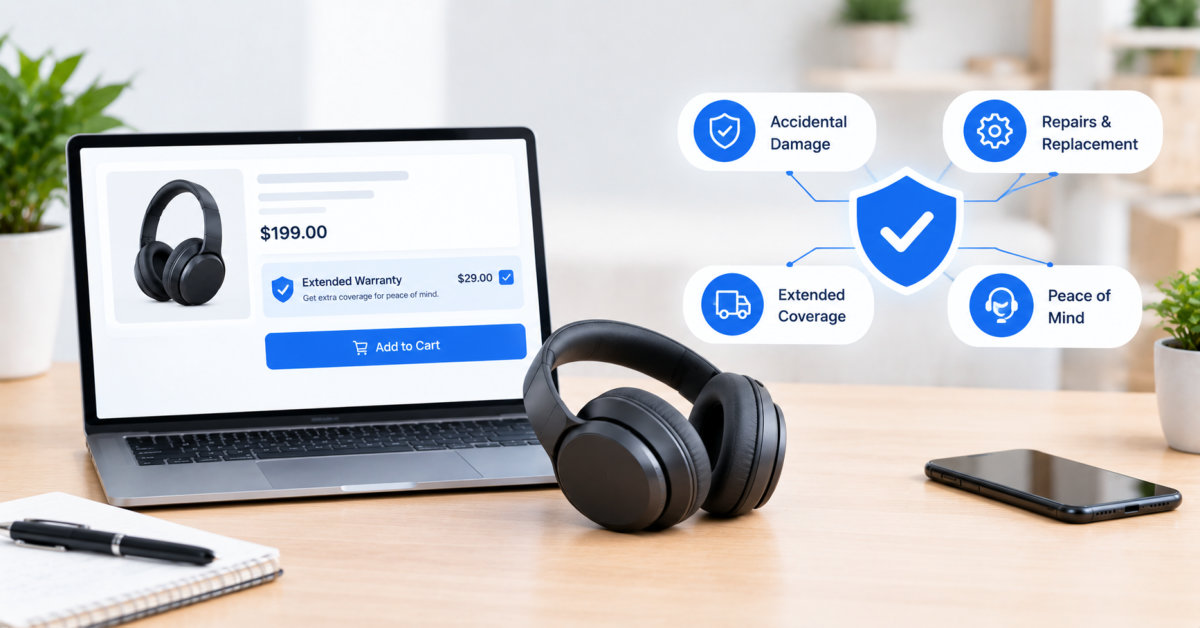
Sell extended warranties when your category already attaches them at scale and plan margin is the goal. Give the extension away in exchange for product registration when first-party data and channel control matter more, which is the stronger play for most Shopify hardware brands.
The extended warranty business in the United States is worth about $53 billion a year, and the most interesting thing a Shopify hardware brand can do with that market is refuse to participate in it.
The extended warranty business in the United States was worth roughly $53 billion in 2025 and is tracked to reach about $117 billion by 2034. Service contracts routinely carry gross margins of 40 to 70 percent, which is often several times the margin on the product they cover. Those two numbers explain why every warranty app in the Shopify App Store pitches you the same thing: attach a protection plan at checkout and book the spread.
Attach rates tell a more complicated story. They swing roughly fivefold across categories, from around 10 percent in outdoor power equipment to 84 percent among top quintile auto finance and insurance desks, according to the 2026 benchmark data on warranty program economics. If you sell hardware direct to consumer, you are much closer to the 10 than the 84. The plan revenue you have been promised is thinner than the pitch, and the operational overhead of running a claims program is exactly the same either way.
OUPES, a Shopify brand selling home backup power stations that run from a few hundred dollars to well over three thousand, made the opposite call. It does not sell coverage. It gives the extension away: register the product and the standard five year term becomes six, at no charge. That reads like leaving money on the table right up until you look at what the registration form collects, and what the policy page quietly does to their sales channels. This is a piece about that trade, and about how to decide which side of it your brand belongs on.
A warranty buys three things beyond defect coverage: a conversion argument at the exact moment a buyer hesitates, a reason for that buyer to identify themselves after the sale, and a rule set that decides which sales channels you are willing to stand behind. Most merchants only price the first one, which is why the other two get designed by accident.
The conversion argument gets stronger as order value climbs. A shopper spending $39 does not think much about year three. A shopper spending $1,899 thinks about almost nothing else, and their real objection is rarely the price or the spec sheet. It is whether you will still exist and still answer the phone when the thing fails.
The second thing is the one most brands leave on the floor. A purchase gives you an email address and a shipping address. A registration gives you a serial number, a purchase channel, a product configuration, and a logged in account. That is a materially different asset, and it arrives at the point in the customer relationship where engagement is highest and it costs you nothing to ask.
The third is a policy decision disguised as a legal document, and I will come back to it. Sequencing matters here. At $500K, still proving demand, a clear return window plus an honest term is enough. Past $5M and running multiple channels, the warranty is doing structural work whether you designed it to or not. Either way it sits upstream of retention, and the math on getting a buyer to that second order is where the compounding actually starts.
Tier your warranty terms by component class rather than issuing one blanket promise across the catalog, because a blanket term either overpays on the parts that fail often or underpromises on the parts that almost never do. A single number across a mixed catalog is a pricing decision made without pricing.
OUPES publishes a coverage table that splits their catalog four ways. The core power stations and the expansion batteries carry five years. The alternator charger carries two. Solar panels and accessories carry one. You can read the whole thing on their published warranty and return policy, which is more useful as a document than most brands’ entire post purchase strategy. The logic is not complicated once you see it laid out. Terms are matched to failure curves and to unit economics, not to a marketing round number.
The pattern transfers cleanly outside of power hardware. Swap in an e-bike brand and the frame gets the long term while the battery and the display get shorter ones. Swap in a furniture brand and the frame gets the long term while the upholstery and the mechanisms do not. The exercise is the same in every category: list your components, ask which ones you have actually seen fail and when, then write terms that reflect the answer instead of what your loudest competitor advertises.
One practical note for merchants under $2M. You probably do not have enough claim history to build this table from your own data yet, and that is fine. Build it from supplier warranty terms, which is the floor of what you can afford to promise, then add the margin you are willing to fund on top.
Product registration converts an anonymous buyer into a contactable customer with a verified serial number, a known purchase channel, and a logged in account, which is why a free extension is often worth more than the plan revenue it replaces. The extension is not a giveaway. It is the price you pay for the data.
Look at how the OUPES flow is built, because the mechanics matter more than the offer. The customer fills a registration form, a human verifies it within one to two business days, and the approved status then lives in their Shopify customer account dashboard. That last step is the one merchants skip. Putting the outcome inside the account gives the customer a reason to log in, and a logged in customer is a recognized one on every later visit.
What comes back is genuinely zero-party data in the strict sense: information the customer volunteered on purpose, in exchange for something specific, rather than behavior you inferred from a pixel. If the distinction is fuzzy, the difference between zero-party and first-party data is worth twenty minutes, because the two get used interchangeably and they are not interchangeable at all.
The serial number is the underrated field. It tells you which production batch a customer has, which means a quality issue that shows up in one run becomes a targeted outreach rather than a blanket recall email to your whole list. Tools built for this exist: Dyrect handles registration, serial tracking, and claim workflows as a single Shopify app, and it will also capture buyers who came through a marketplace or a dealer and never touched your checkout, which is the segment you otherwise never reach.
Set the incentive honestly. A registration form with nothing on the other side of it converts badly and teaches customers that your forms waste their time.
Channel gated warranty language, which limits coverage to purchases made through your official channels and to the original purchaser only, is the cheapest grey market control available to a direct to consumer brand, because it costs nothing to publish and moves the risk of an unauthorized purchase onto the buyer rather than onto you. Most merchants fighting unauthorized resellers are trying to solve this with takedown notices when the policy page would do more work.
The OUPES version is worth reading closely for the construction rather than the specifics. Coverage applies only to products bought through official North American channels. It applies only to the original purchaser, so second hand units are excluded. Products bought from unauthorized retailers are denied warranty service outright, and buyers who purchased elsewhere are told to seek warranty fulfillment from whoever sold to them. None of that is aggressive language. It is simply precise about who the promise is for.
The commercial effect is that the cheapest listing on a marketplace stops being the best deal, because it comes without the thing the buyer actually wanted, which was the confidence to spend $1,500 on a brand they had not heard of last week. You have not blocked the reseller. You have repriced them.
Two cautions before you copy this. Gating only works if you enforce it consistently, because arbitrary denials generate public complaints that cost more than the policy saves. And if a meaningful share of your revenue still comes through marketplaces, gating coverage is a channel strategy decision with real consequences. Merchants at $500K to $2M should fix that dependency before gating their way out of it.
Sell the plan when your category already attaches protection at scale and your customers expect to be offered it; give it away when your category attaches poorly and you need the registration data more than you need the plan margin. Those are the two conditions, and they are usually answerable in an afternoon.
The case for selling is real where the attach economics are real. Plans presented inside the checkout flow lift conversion while cutting the processing cost per contract, and subscription style coverage delivered online posts retention above 85 percent, more than double what single transaction warranties produce, according to market analysis of the extended warranty category. Gaming console plans priced near 16 percent of hardware value show how readily buyers add coverage when it is normal in their category.
The case against selling is the attach rate in your own vertical. At around 10 percent, which is where outdoor power equipment sits, nine out of ten buyers decline the offer, you have added a decision to your checkout, and you have built a claims administration function to serve a tenth of your customers. Meanwhile the free extension route registers a much larger share of buyers because the offer is unambiguously in their favor, and every one of those registrations is a customer record you did not have.
Run the arithmetic rather than the instinct. Take annual unit volume, multiply by a realistic attach rate for your category, multiply by plan price, then subtract expected claims and the cost of administering them. Now ask what a registered, contactable, serial verified customer is worth over three years. For most Shopify hardware brands under $20M the second number is larger, and it is not close. Above $20M the answer flips, because the volume and the headcount are both there.
Size the warranty term to the claim volume you can fund and staff at current headcount, because a promise that outruns your service capacity destroys more trust than a shorter term ever would. This is the failure mode nobody advertises, and it is the one that ends up in your reviews.
The benchmark to plan against is the loss ratio, meaning claims paid as a share of the program’s value, and a healthy warranty program targets somewhere between 45 and 60 percent. If you have no idea what yours would be, you are not ready to publish a five year term. Start at two or three years, watch what actually comes back, and extend when the data supports it. Extending a term is a press release. Retracting one is a crisis.
OUPES is instructive here in both directions. They have built the operational side out: two United States warehouses in California and Georgia so return legs stay domestic, an in house support team rather than an outsourced one, a defined RMA process with a 15 day shipping window, and refurbished units liquidated through an eBay storefront so recovered inventory has somewhere to go. That is a real reverse logistics system, not a policy page. And even with all of it, their public review profile carries complaints alleging slow fulfillment communication and, in at least one case, that discontinued models made warranty service harder to obtain. I have not verified those individual claims and would not repeat them as established fact. The point stands regardless: a five year promise is a five year staffing commitment, and buyers judge you on the gap between the two.
A warranty is not a marketing asset with an operational cost attached. It is an operational commitment with a marketing benefit attached, and brands that get the order backwards find out in year three.
The money to fund this has to come from somewhere, and for most merchants it comes out of the same pool that funds returns. If that pool is currently uncontrolled, fix the returns side first: a Shopify returns workflow built to protect margin is the prerequisite, because exchange capture and disposition discipline are what create the headroom to fund a longer warranty in the first place.
The Shopify stack for warranty work splits into three jobs, capturing registration, managing claims, and routing the support conversation, and most merchants under $5M can cover the first two with a single app rather than three. Premature complexity here is the same mistake merchants make everywhere else in the stack.
Start with registration, because it is the piece that generates the asset. A dedicated app creates the warranty record when the order is fulfilled, emails the customer a registration link or a QR code, and gives them a portal to check status and file a claim later. Dyrect covers that full lifecycle including serial tracking and multi channel registration, which matters if you sell anywhere other than your own store. Merchants who only need the form can start smaller and add claims handling when volume justifies it.
Claims and returns overlap more than the app categories suggest, and plenty of what merchants call a warranty claim is really a return with a longer window. If your actual problem is return volume rather than defect volume, the tooling you need is different, and the Shopify returns software landscape is the better place to start. The distinction is worth making before you buy anything, because buying a warranty app to solve a returns problem is how stacks get bloated.
The third job is the conversation itself, and this is where merchants underinvest. A claim arrives as an emotional support ticket from someone whose expensive thing stopped working, and it needs to route to a human with the order, the serial, and the coverage status already on screen. Most of the helpdesk and returns apps worth considering integrate with returns tooling for exactly this reason.
One sequencing note. Do not buy any of this before you have written the policy. The policy is the hard part and the app is the easy part, and merchants who reverse the order configure software around a promise they have not thought through.
Sell extended warranties only if your category already attaches protection plans at meaningful rates and your customers expect to be offered one. Attach rates vary roughly fivefold by vertical, from around 10 percent in outdoor power equipment to 84 percent in top performing auto finance desks. At the low end you are building a claims administration function to serve one buyer in ten, which rarely pays for itself below $20M in revenue. The alternative is to include a longer term at no charge and require product registration to unlock it. That trades plan margin for verified customer data, serial numbers, and purchase channel visibility, which is usually the better trade for a hardware brand still building its customer file.
Set your warranty term by component class rather than issuing one number across the whole catalog. Core units with long service lives can carry three to five years. Power electronics, motors, and chargers that fail more often but cost less to replace typically carry one to two. Accessories and consumable parts carry one year or none. The right term is the one your claim data and your supplier terms can support, not the one your competitor advertises. If you have no claim history yet, start shorter than you want to and extend once you can see what actually comes back. Extending a term is easy. Retracting one damages trust permanently.
Requiring registration works when the incentive is genuinely worth the customer’s time, and a free additional year of coverage clears that bar in most hardware categories. The mechanics matter as much as the offer. Ask for the serial number, the purchase channel, and the product configuration, verify the submission, then surface the approved warranty status inside the customer’s store account so they have an ongoing reason to log in. Registration also reaches buyers who purchased through a marketplace or a dealer and never appeared in your checkout data, which is often the segment you have no other way to contact. A registration form with no benefit attached converts poorly and trains customers to ignore your requests.
You can limit warranty coverage to purchases made through your official channels, and many direct to consumer hardware brands do exactly that. The standard construction covers products bought through authorized channels, applies to the original purchaser only, excludes second hand units, and directs buyers who purchased elsewhere to seek fulfillment from their point of sale. This is the cheapest grey market control available because it costs nothing to publish. Two cautions apply. Enforcement has to be consistent, since arbitrary denials generate public complaints that cost more than the policy saves. And if marketplace sales are still a meaningful share of your revenue, gating coverage is a channel strategy decision with real revenue consequences, not routine legal housekeeping.
A warranty loss ratio is claims paid expressed as a share of the program’s value, and a healthy program generally targets somewhere between 45 and 60 percent. A ratio well below that range suggests you are underpromising and leaving a conversion argument unused. A ratio well above it means the program is consuming margin faster than it earns trust. If you do not currently track this, you are not ready to publish a long warranty term, because the term is a staffing and cash commitment rather than a marketing claim. Start with a shorter term, measure claim frequency by SKU class over a full year, and lengthen the promise only where the data shows you can fund it.
A return window covers buyer’s remorse and a warranty covers product failure, and conflating them creates disputes that neither policy resolves. A 30 day return window lets a customer send back a working product because they changed their mind, and the outcome is a refund, exchange, or store credit. A warranty covers manufacturing defects and premature failure over a period of years, and the outcome is repair or replacement rather than cash. Write them as separate policies with separate processes, because the operational paths genuinely differ: returns need restocking and disposition decisions, while warranty claims need diagnosis, parts, and often a refurbishment path for the recovered unit.




