



Looking for the best Quickbooks to Shopify integration?
We’ve got you covered.
My name is Connor Gillivan and I’m an Owner and the CMO of EcomBalance.
We’re eCommerce bookkeeping and accounting experts that help 100+ eCommerce businesses better understand their financials on a monthly basis.
In this article, we’ll break down a step-by-step process to connect your QBO and Shopify accounts.
Here’s what we’ll cover:
The process to connect your Quickbooks and Shopify isn’t overly complicating, but it requires taking the right steps to configure it from the start.
Here’s the steps to follow:
The first step to connect Shopify to Quickbooks is to select the right integration tool. Shopify has its connector app for Quickbooks, but many other third-party apps like A2X, Connex, and Synder also offer seamless integration with Shopify and Quickbooks. So, before you proceed, evaluate the various tools and choose the one that best fits your business requirements.
After selecting the integration tool, the next step is to connect your Quickbooks Online account to your Shopify account. To do this, you’ll need to authorize the integration tool to access your Shopify and Quickbooks accounts. This step is usually straightforward, and most integration tools have easy-to-follow instructions.
Once you’ve authorized the integration tool to access both accounts, you can then configure the settings in the tool to match your business needs. Here are some of the settings you can expect to configure:
With the integration tool set up and the settings configured, you can now sit back and watch as new data automatically comes into Quickbooks Online from Shopify. This will include all your sales data, including orders, refunds, discounts, and taxes, and will be accurately recorded in your Quickbooks account.
There’s plenty of eCommerce accounting and bookkeeping tools out there, but these 3 have been the best in terms of reviews, ease of use, and capabilities that we’ve come across.
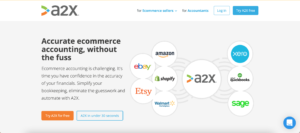
A2X is a powerful accounting automation tool that seamlessly integrates your Shopify store with Quickbooks Online. With A2X, you can automate the accounting process for your Shopify store, including order data, refunds, fees, and sales tax. A2X also supports multiple Shopify stores, and its dashboard gives you real-time insight into your business’s financial health. A2X offers a 14-day free trial, after which you can choose from one of their flexible pricing plans.

Link My Books is a Quickbooks Shopify integration tool that enables you to reconcile your Shopify sales with your Quickbooks accounts. With Link My Books, you can easily map your Shopify accounts to your Quickbooks accounts, ensuring that your sales data is accurately recorded. You can also import orders, refunds, taxes, and discounts automatically. Link My Books offers a 14-day free trial, after which you can choose from one of their flexible pricing plans.
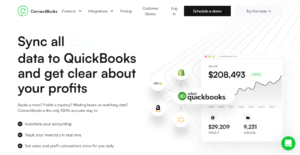
ConnectBooks is another great Quickbooks Shopify integration tool that enables you to seamlessly connect your Shopify store with Quickbooks Online. With ConnectBooks, you can easily import your Shopify orders, refunds, and fees into Quickbooks, saving you hours of manual data entry. ConnectBooks also offers inventory tracking, which ensures that your stock levels in Quickbooks match those in your Shopify store. ConnectBooks offers a free trial, after which you can choose from one of their flexible pricing plans.

There are pros and cons to both options when it comes to connecting Quickbooks to Shopify. Here are some factors to consider:
Ultimately, the decision to connect Quickbooks to Shopify yourself or hire a bookkeeper depends on your time, budget, and comfort level with the process.
If you have the time and knowledge, doing it yourself can be a cost-effective option.
If you want to ensure that your bookkeeping is accurate and efficient, hiring a bookkeeper like EcomBalance can be a worthwhile investment.

Quickbooks Online (QBO) is the accounting system that works best with Shopify. QBO is cloud-based, which means it can be accessed from anywhere, and it integrates seamlessly with Shopify. With the Shopify connector by Intuit, you can easily import your Shopify data into QBO, including orders, customers, and products. QBO also offers a variety of features and integrations that can help you manage your finances, such as automatic bank feeds, expense tracking, and invoicing. Overall, QBO is a powerful and user-friendly accounting system that can help you streamline your bookkeeping and grow your Shopify business.
To reconcile your Shopify data in Quickbooks, you’ll need to follow these steps:
Shopify can be integrated with Quickbooks Online, which is the cloud-based version of Quickbooks. Quickbooks Online allows you to easily connect your Shopify store to your accounting software and automatically import your sales, expenses, and other financial data. With the Shopify connector by Intuit, you can seamlessly integrate your Shopify store with Quickbooks Online and streamline your bookkeeping processes. Quickbooks Desktop, on the other hand, does not have a built-in integration with Shopify and requires third-party tools or manual data entry to import Shopify data. Therefore, if you’re using Shopify, Quickbooks Online is the best version of Quickbooks to use.
To integrate Shopify with Quickbooks Desktop, you’ll need to use a third-party integration tool like Connex or Webgility. These tools allow you to connect your Shopify store to Quickbooks Desktop and automatically sync your sales, expenses, and other financial data. With Connex, for example, you can map your Shopify data to specific accounts in Quickbooks Desktop and schedule automatic syncs to ensure that your data is always up-to-date. You can also configure custom rules and filters to ensure that your data is imported correctly. Integrating Shopify with Quickbooks Desktop can be more complex than integrating with Quickbooks Online, but with the right tool and setup, it can be an effective way to streamline your bookkeeping and save time.

EcomBalance is a monthly bookkeeping service specialized for eCommerce companies selling on Amazon, Shopify, Ebay, Etsy, WooCommerce, & other eCommerce channels.
We take monthly bookkeeping off your plate and deliver you your financial statements by the 15th or 20th of each month.
You’ll have your Profit and Loss Statement, Balance Sheet, and Cash Flow Statement ready for analysis each month so you and your business partners can make better business decisions.
Interested in learning more? Schedule a call with our CEO, Nathan Hirsch.
And here’s some free resources:
It’s 100% possible to connect your Shopify and Quickbooks Online accounts.
It just comes down to how you want to do it.
Once you have it connected, the job isn’t over either.
You then need to categorize transactions as they come in, reconcile accounts, and put together the financial statements each month.
We hope that this guide helps you get your bookkeeping in order for your Shopify store.
If you have questions or would like us to help you with connecting your QBO and Shopify account, reach out to us at [email protected].
All our best!





