


Most Amazon sellers think they are doing product research. SmartScout is built for something different: market research. The distinction sounds subtle. The business outcomes are not.
SmartScout was originally built as an Amazon market intelligence platform. It is not a keyword research tool, not a listing optimizer, and not a PPC management suite. That framing is still directionally true, but no longer the full story. SmartScout is still first and foremost a market intelligence platform rather than a traditional listing-optimization suire, but it has made meaningful progress on the keyword research and optimization side. In particular, it now does a better job connecting keyword trend discovery to subcategory demand shifts, competitive ad visibility, and Amazon’s newer AI-driven discovery model, which makes the platform more relevant for sellers who care about where search is heading rather than just where it has been: visibility on the agentic shelf.
What SmartScout does is map the Amazon marketplace from the top down: brands, subcategories, sellers, products, and the traffic relationships between them.
Think of it this way. Helium 10 and Jungle Scout start with a product and work outward. SmartScout starts with a market and works inward. You pick a subcategory, see who owns it, how revenue is distributed, which brands are gaining share and which are losing it, who the sellers are, and where the traffic is flowing. That top-down view is what makes it genuinely different, not just a feature variation on tools that have been around for years.
The platform covers over 40,000 Amazon subcategories, tracks brand-level revenue estimates, maps traffic flows between products through its Traffic Graph, surfaces competitor ad strategies through Ad Spy, and gives wholesale and online arbitrage operators a UPC Scanner workflow that can process up to 200,000 ASINs per month on the Enterprise plan. SmartScout is trusted by brands including Dr. Squatch, Skechers, Mary Ruth’s, and Simple Modern, which tells you something about the scale at which the platform becomes genuinely useful.
This is the section most reviews get wrong, so let me be direct about it…
Best fit: Wholesale and online arbitrage operators at any revenue stage. If your model involves sourcing existing branded products to resell on Amazon, SmartScout is the most valuable tool in the category and it is not close. The brands database with 30-plus filter parameters, combined with the UPC Scanner that processes up to 200,000 ASINs per month on Enterprise, means you can go from a supplier’s price list to a ranked set of profitable opportunities in minutes instead of hours. Sellers doing $500K to $5M in wholesale GMV will feel this most acutely.
Best fit: Private label brands doing $500K and above who are competing on Amazon and need to understand the competitive landscape at the category level, not just the keyword level. If you want to know which brands own what share of a subcategory, how that has shifted over the past 12 months, and where the revenue gaps are, SmartScout surfaces that in a way that Helium 10’s Market Tracker does not replicate without significant manual setup time.
Best fit: Amazon marketing agencies and brand consultants. Multiple independent agency operators have told me they use SmartScout as part of their prospecting process because it lets them walk into a client conversation already knowing that brand’s revenue trajectory, seller distribution, and competitive position. That is a real use case with real business value, and SmartScout explicitly serves this segment on their site.
Not a fit: Shopify-only brands with no Amazon channel. SmartScout is entirely Amazon-focused. If your revenue lives in Shopify and you have no plans to expand to Amazon, there is nothing here for you.
Not a fit: Sellers in the pre-launch stage who are just starting product research and need a guided workflow. The data density in SmartScout is an asset for experienced operators and a source of paralysis for someone who has not yet sold a single unit. Jungle Scout’s cleaner, more opinionated interface will serve you better at that stage.
Requires: An existing Amazon selling operation or a serious evaluation of Amazon as a channel. Minimum viable scale is approximately $5K to $10K per month in Amazon revenue before the Business plan’s features start generating clear ROI above their cost.
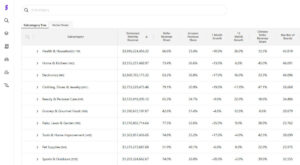
Brand and subcategory intelligence that no other tool matches. I have spent time with Helium 10’s Market Tracker and Jungle Scout’s category tools. Neither gives you the same combination of breadth and depth that SmartScout’s subcategory browser delivers. You can look across all 40,000-plus subcategories simultaneously, filter by trailing 12-month revenue, growth rate, and brand market share, and drill into any node to see exactly who is competing, what they are making, and how that has changed over time. For a brand trying to identify white space or a wholesale operator trying to find categories worth pursuing, this is the fastest path from question to answer I have found. SmartScout’s own comparison makes the case plainly: Jungle Scout and Helium 10 do not have a comparable subcategories tool. This is why SmartScout is a market research tool, not a product research tool.
Competitor ad strategy visibility that is genuinely actionable. SmartScout’s Ad Spy tool shows you which keywords any brand is bidding on, ranked by search volume, with cost-per-click data. Helium 10’s Cerebro will show you keywords a competitor ranks for organically. SmartScout shows you where they are spending money. Those are different questions with different answers. For brands doing $1M or above on Amazon where PPC efficiency is a meaningful margin lever, knowing exactly where competitors are allocating ad spend is worth the subscription cost on its own.
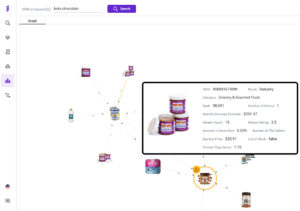
Traffic Graph for understanding how shoppers actually move. This is SmartScout’s most distinctive feature and the one that gets the least attention in most reviews. The Traffic Graph visualizes how customers flow between products on Amazon, based on the frequently bought together and customers also viewed relationships in Amazon’s data. For brands doing product targeting in their ad campaigns, this surfaces adjacencies that would take hours of manual research to find. For wholesale operators, it identifies complementary product relationships that can inform sourcing strategy. This is a tool SmartScout pioneered. Neither Helium 10 nor Jungle Scout has a direct equivalent.
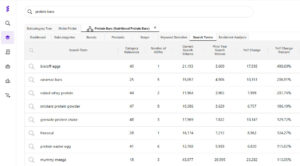
SmartScout’s subcategory lens is still one of its biggest differentiators, and it becomes even more useful when paired with keyword trend analysis. Instead of just pulling a static keyword list, sellers can see where search demand is accelerating inside a niche and use that to spot micro-trends before the competition. That is a different workflow compared to tactics used with traditional keyword tools, and for product research or portfolio strategy it can be more actionable.
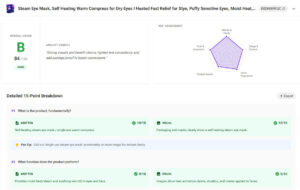
SmartScout has also started building for the next phase of Amazon search. It’s AI Scorecard is built around the kinds of questions Amazon’s COSMO and Rufus systems are designed to answer, helping brands think beyond exact-match keyword placement and toward whether a listing is actually comprehensive, persuasive, and contextually relevant. For sellers trying to understand how Amazon’s AI layer may surface products, this is a meaningful addition to the platform.
AdSpy is another area where SmartScout adds depth to keyword intelligence. It does more than show which keywords exist; it helps sellers understand what competitors appear to be doing to win paid visibility around those terms. For users who want to connect keyword opportunity to real-world competitive behavior, that is a valuable layer that many review readers may overlook.
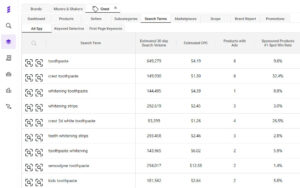
SmartScout is also expanding how it prioritizes keyword opportunities. Features like Keyword Sales and Keyword Opportunity Score should make it easier to move from “interesting keyword data” to “which terms are actually worth acting on first.” If those features roll out as expected, they should further narrow the gap between SmartScout’s historical market-intelligence positioning and the more keyword-centric workflows sellers typically associate with Helium 10.
It is also worth noting that SmartScout’s product story has been moving quickly. Recent updates and launches suggest the company is investing more aggressively in keyword intelligence and AI-era search visibility than older reviews may reflect. The clearest examples are the newer AI Scorecard positioning around Amazon’s COSMO / Rufus model, alongside the planned rollout of tools like Keyword Sales and Keyword Opportunity Score that aim to make keyword prioritization more actionable.
This shift matters because Amazon search is no longer just about matching a listing to a short set of exact keywords. As Amazon leans further into systems like Rufus and COSMO, the quality of product content increasingly depends on whether a listing answers real shopper questions clearly and comprehensively. That is where SmartScout’s newer AI-oriented tooling becomes interesting: it suggests the company is thinking beyond legacy keyword placement and toward whether a product detail page is actually aligned with how Amazon’s discovery systems may evaluate relevance. SmartScout’s public COSMO and AI Scorecard materials make that positioning much more explicit than before.
The limitation is no longer “SmartScout barely does keywords.” The more accurate limitation is that SmartScout approaches keywords from a more strategic and intelligence-oriented angle than a fully operational one. Keyword research is not the platform’s strength, and if keyword research is your primary job to be done, Helium 10 is the better tool. SmartScout’s Rank Maker and Search Terms Database give you functional keyword data, but the depth of Helium 10’s Cerebro for reverse ASIN research, Magnet for keyword discovery, and Scribbles for listing optimization is not replicated here. If you are a private label seller whose daily workflow is built around keyword ranking and listing optimization, SmartScout is a complement to your existing stack, not a replacement for it.
Listing optimization is limited. SmartScout has an AI Listing Architect tool that generates listing copy, but it is a content generation tool, not a listing optimization workflow. There is no rank tracking tied to listing performance, no split-testing framework, no listing health monitoring comparable to what Helium 10 provides. For a brand that treats listing optimization as a core operational discipline, this is a genuine gap.
The Basic plan is genuinely limited in ways that matter. The entry-level plan at $25 per month (annual) gives you the brands database, products database, sales estimator, FBA calculator, and Chrome extension. What it does not give you is the search terms database, sellers database, keyword rank tracking, competitor keywords, Traffic Graph, or subcategories database. Those are the features that differentiate SmartScout from free and near-free alternatives. The honest entry point for meaningful use is the Essentials plan at $75 per month (annual), and the features that make SmartScout genuinely distinctive, including the Traffic Graph, Ad Spy, subcategories database, and database exports, do not fully unlock until the Business plan at $158 per month (annual).
Marketplace coverage is narrower than Helium 10 and Jungle Scout. SmartScout covers 12 Amazon marketplaces. If you are operating in markets outside that coverage, verify before committing.
Pricing as of April 2026.
Value at early stage ($0 to $500K annual Amazon revenue): The Basic plan gives you functional tools for sourcing research and profitability calculation, but the features that make SmartScout worth paying for are locked behind Essentials and Business. At this stage, if you are doing private label, Jungle Scout at a comparable price point gives you a more complete guided workflow. If you are doing wholesale or online arbitrage, the Essentials plan is worth the stretch because the sellers database and search terms database will find you opportunities that pay for the subscription quickly. The 7-day money-back guarantee means the risk of testing it is low.
Value at growth stage ($500K to $5M annual Amazon revenue): This is SmartScout’s sweet spot. At this stage you have enough Amazon history to make competitive intelligence actionable, enough PPC spend to make Ad Spy genuinely valuable, and enough sourcing volume to use the UPC Scanner at scale. The Business plan at $158 per month is the right entry point and the ROI case is straightforward. One improved ad targeting decision from the Ad Spy data can recover the annual subscription cost in a single campaign.
Value at scale ($5M plus annual Amazon revenue): At this stage, the Enterprise plan with API access, Data Lake, and historical data suite becomes the relevant conversation. The custom pricing reflects the fact that brands at this level are typically using SmartScout as part of a broader data infrastructure. The platform’s brand-level revenue tracking and market share data also become more valuable at this stage because the competitive stakes are higher and the decisions are larger.
The three tools that come up in every comparison conversation are Helium 10, Jungle Scout, and DataDive. Here is the honest version of each.
Helium 10 is the most comprehensive Amazon tool suite available and the right choice for private label sellers who need keyword research, listing optimization, and PPC management in a single platform. Helium 10’s Cerebro for reverse ASIN keyword research, Magnet for keyword discovery, and Adtomic for PPC automation cover use cases that SmartScout does not address. The Diamond plan runs $229 per month, which makes it significantly more expensive than SmartScout’s Business plan, but it is doing a different job. The honest answer for most established brands is that SmartScout and Helium 10 are complements, not substitutes. It would still be an overstatement to say SmartScout has full keyword parity with Helium 10 across every workflow. But it is fair to say SmartScout has made real progress toward parity in several high-value areas, especially trend detection, competitive ad visibility, and AI-informed listing evaluation. Smartscout for market intelligence and competitive research. Helium 10 for listing optimization and keyword management. SmartScout for market intelligence and competitive research. Helium 10 for listing optimization and keyword management. If you can only afford one, Helium 10 covers more ground for private label sellers. If you are in wholesale or online arbitrage, SmartScout wins that comparison clearly.
Jungle Scout is the right starting point for new sellers launching their first private label product. The interface is cleaner, the supplier database is genuinely useful for sourcing manufacturers, and the learning curve is lower. Jungle Scout’s product research tools are strong at the launch phase, but the brand-level and subcategory-level intelligence that SmartScout delivers is not available in Jungle Scout. Once you move past product launch and into active market management, SmartScout’s data becomes more valuable than what Jungle Scout offers. Jungle Scout’s Growth Accelerator plan runs approximately $49 per month (annual), positioning it as a cheaper alternative for early-stage sellers who are not yet ready for SmartScout’s data density.
DataDive is worth mentioning for serious keyword and listing optimization work. It sits in a different category from SmartScout, focused on deep keyword analysis and listing optimization rather than market intelligence, but some operators use it alongside SmartScout as their keyword research layer. It is not a direct competitor but represents the kind of tool SmartScout does not replace.
I want to be upfront about something before I give you my assessment. I have not run a wholesale or online arbitrage operation personally. My Amazon experience comes from the brand side, primarily through my years at Shopify working with DTC brands that had Amazon channels as part of their multi-channel strategy. That context shapes how I see SmartScout.
From that vantage point, what I find genuinely compelling about SmartScout is the honesty of its positioning. It does not try to be everything. It is a market intelligence tool built for people who think about Amazon at the brand and category level, not the individual product level. That is a real distinction and it is the right tool for a specific kind of operator.
The brands I worked with at Shopify that were doing meaningful Amazon volume, including Dr. Squatch, which is actually listed as a SmartScout customer, were not making decisions based on individual keyword rankings. They were making decisions about category ownership, competitor monitoring, and channel strategy. SmartScout is built for that kind of thinking.
Where I would pump the brakes: if you are a Shopify-first brand evaluating whether to add Amazon as a channel, SmartScout is not where I would start. It is a tool for people who are already in the game and want to compete more intelligently. For the evaluation phase, a short Jungle Scout or Helium 10 trial will tell you more about whether Amazon is right for your product category.
If you are already on Amazon doing $500K or more and you are not using a market intelligence tool, SmartScout deserves a serious look. The Business plan is where the platform becomes genuinely differentiated. Start there, not at Basic. The 7-day money-back guarantee means you can test it against your actual category and competitive set before committing.
Is SmartScout worth it for a new Amazon seller?
Not as your first tool. New sellers doing product research and preparing for their first launch will get more value from Jungle Scout’s cleaner interface and guided workflows. SmartScout’s data density is an asset once you have enough operating experience to know what questions to ask. Come back to SmartScout when you are past your first six months and ready to think about market positioning and competitive intelligence rather than product discovery.
Can I use SmartScout without selling on Amazon?
Yes, and some users do. Marketing agencies use it to prospect for clients by pulling brand revenue data and competitive position data before a pitch. Investors use it to evaluate Amazon-native brands before acquisition. SmartScout explicitly serves both of these segments on their site. You do not need a Seller Central account to use SmartScout, though the tool is most valuable when you are making active selling decisions based on the data.
How accurate is SmartScout’s revenue data?
SmartScout builds its revenue estimates from Amazon’s Best Seller Rank data, which is the same underlying source all Amazon research tools use. Where SmartScout’s methodology is notably stronger is in how it handles product variation pages. Variation pages share a sales rank, and most tools overcount or misattribute revenue across variants as a result. SmartScout addresses this more accurately than competitors. The estimates are directionally reliable and useful for competitive benchmarking. They are not precise enough for financial modeling or due diligence without additional validation.
Does SmartScout work for Amazon sellers outside the US?
SmartScout covers 12 Amazon marketplaces, including the US, UK, Canada, Germany, France, Italy, Spain, Japan, Australia, Mexico, India, and UAE. If your primary market is one of these, you are covered. If you are operating in markets outside this list, verify coverage before committing to a plan. Helium 10 and Jungle Scout cover more international marketplaces, which is a genuine advantage for globally focused sellers.
What is the difference between SmartScout and Helium 10?
SmartScout is a market intelligence tool. Helium 10 is a full-stack Amazon selling suite. SmartScout tells you who owns what market share, where the revenue is, and what your competitors are doing with their ad spend. Helium 10 helps you optimize your listings, research keywords, and manage your PPC campaigns. Most serious Amazon operators at the $1M-plus level use both. If you can only afford one, the right choice depends on your model: wholesale and competitive intelligence favor SmartScout, private label and listing optimization favor Helium 10.
{
“@context”: “https://schema.org”,
“@graph”: [
{
“@type”: “Article”,
“headline”: “Smartscout Review 2026: The Honest Assessment for Shopify Brands Selling on Amazon”,
“description”: “An independent, stage-aware review of Smartscout covering what it does well, where it falls short, how it compares to Helium 10 and Jungle Scout, and who should actually buy it.”,
“author”: {
“@type”: “Person”,
“name”: “Steve Hutt”,
“jobTitle”: “Founder”,
“url”: “https://ecommercefastlane.com/about”
},
“publisher”: {
“@type”: “Organization”,
“name”: “eCommerce Fastlane”,
“url”: “https://ecommercefastlane.com”
},
“datePublished”: “2026-04-14”,
“dateModified”: “2026-04-14”
},
{
“@type”: “FAQPage”,
“mainEntity”: [
{
“@type”: “Question”,
“name”: “Is Smartscout worth it for a new Amazon seller?”,
“acceptedAnswer”: {
“@type”: “Answer”,
“text”: “Not as your first tool. New sellers doing product research and preparing for their first launch will get more value from Jungle Scout’s cleaner interface and guided workflows. Smartscout’s data density is an asset once you have enough operating experience to know what questions to ask. Come back to Smartscout when you are past your first six months and ready to think about market positioning and competitive intelligence rather than product discovery.”
}
},
{
“@type”: “Question”,
“name”: “Can I use Smartscout without selling on Amazon?”,
“acceptedAnswer”: {
“@type”: “Answer”,
“text”: “Yes. Marketing agencies use it to prospect for clients by pulling brand revenue data and competitive position data before a pitch. Investors use it to evaluate Amazon-native brands before acquisition. You do not need a Seller Central account to use Smartscout, though the tool is most valuable when you are making active selling decisions based on the data.”
}
},
{
“@type”: “Question”,
“name”: “How accurate is Smartscout’s revenue data?”,
“acceptedAnswer”: {
“@type”: “Answer”,
“text”: “Smartscout builds its revenue estimates from Amazon’s Best Seller Rank data. Where Smartscout’s methodology is notably stronger is in how it handles product variation pages, which share a sales rank and cause most tools to overcount or misattribute revenue. The estimates are directionally reliable for competitive benchmarking but are not precise enough for financial modeling or due diligence without additional validation.”
}
},
{
“@type”: “Question”,
“name”: “Does Smartscout work for Amazon sellers outside the US?”,
“acceptedAnswer”: {
“@type”: “Answer”,
“text”: “Smartscout covers 12 Amazon marketplaces including the US, UK, Canada, Germany, France, Italy, Spain, Japan, Australia, Mexico, India, and UAE. Helium 10 and Jungle Scout cover more international marketplaces, which is a genuine advantage for globally focused sellers.”
}
},
{
“@type”: “Question”,
“name”: “What is the difference between Smartscout and Helium 10?”,
“acceptedAnswer”: {
“@type”: “Answer”,
“text”: “Smartscout is a market intelligence tool. Helium 10 is a full-stack Amazon selling suite. Smartscout tells you who owns what market share, where the revenue is, and what competitors are doing with their ad spend. Helium 10 helps you optimize listings, research keywords, and manage PPC campaigns. Most serious Amazon operators at the $1M-plus level use both. If you can only afford one, wholesale and competitive intelligence favor Smartscout while private label and listing optimization favor Helium 10.”
}
}
]
}
]
}




