

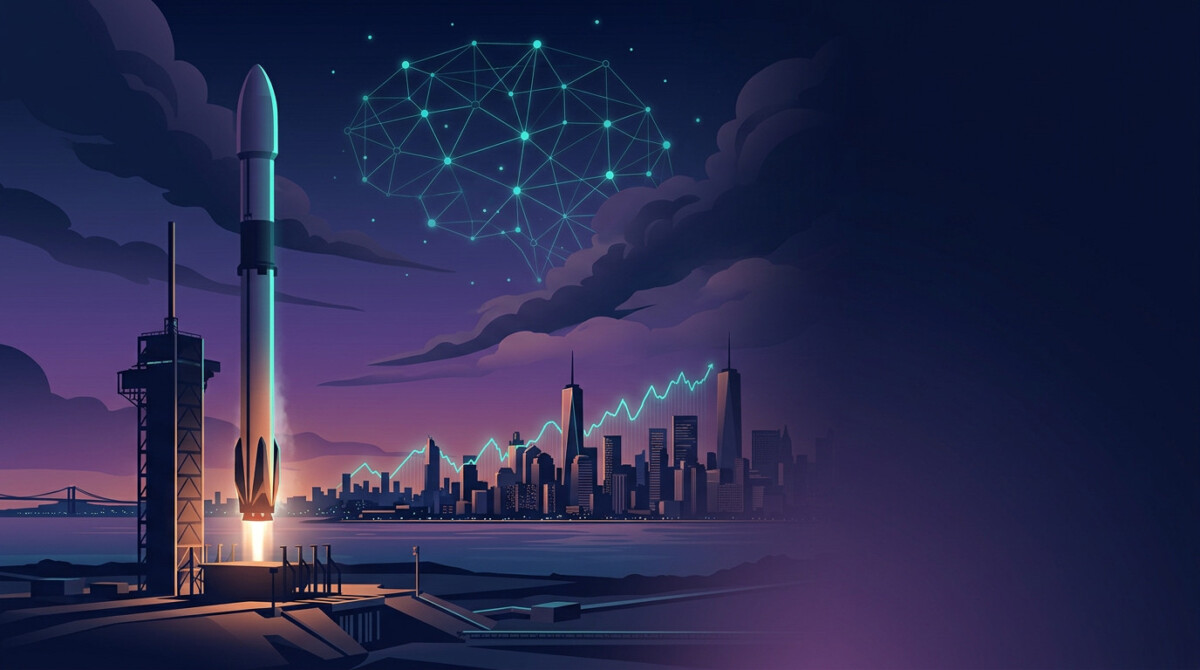
SpaceX is targeting a $75 billion raise at roughly a $1.75 trillion valuation, which is nearly three times the largest IPO ever recorded. Every other 2026 listing candidate, including Discord, has to compete for investor attention against the biggest narrative the public markets have ever priced.
SpaceX’s preparation for an IPO is gradually revealing not only the financial parameters of the offering, but also the broader architecture of its business, where artificial intelligence plays a central role. This first wave of disclosed data sets the tone that is clearly distinct from that of other companies. The firm expects to raise up to $75 billion at a valuation of about $1.75 trillion, but this is based on a model marked by high capital intensity, growing risks, and dependence on long-term technological breakthroughs.
SpaceX’s public market debut has the potential to significantly reshape the IPO landscape, setting a new bar both in terms of deal size and investor tolerance for unprofitable yet fast-growing businesses. In an environment where capital is actively flowing into projects related to AI and infrastructure, such a large transaction could pull liquidity from the market while setting a higher benchmark for other listing candidates.
In particular, the Discord IPO will be under double pressure. The company — as well as other candidates considering an IPO — will need to compete for investor attention against larger and more technologically ambitious narratives, while also proving the sustainability of their own business models amid rising expectations for growth and monetization. As a result, the IPO window may remain open, but the entry conditions will become noticeably stricter, especially for companies outside the AI infrastructure segment.
SpaceX’s financial profile appears mixed. The Starlink segment remains profitable and generates steady cash flow, while investments in xAI actually push the company into a loss zone. The sharp increase in capital expenditures — to more than $20 billion per year — reflects a strategy of aggressive AI infrastructure scaling, with a significant share of spending directed specifically to computing power. As a result, SpaceX increasingly resembles a hybrid of an aerospace and AI holding company, where its traditional space business subsidizes the development of new segments.
A key element of the investment case is the asset synergy that Elon Musk builds. In recent years, he has effectively consolidated an ecosystem linking SpaceX, xAI, and other projects. A further confirmation of this strategy was the potential deal with Cursor — the company can either be bought out for $60 billion or receive $10 billion as part of a strategic partnership. From a financial perspective, this means further expansion of investments in applied AI, particularly in software development automation tools, where xAI still lags behind competitors.
At the same time, SpaceX internal messaging appears more cautious than the public statements of its founder. The company explicitly states that projects for orbital data centers, lunar industrialization, and interplanetary infrastructure rely on untested technologies and may not reach the stage of commercial implementation. Dependence on the successful commissioning of the Starship rocket increases these risks: any delays or technical problems can slow down the implementation of the entire strategy and extend the payback period.
Thus, the SpaceX IPO presents a classic growth dilemma for investors. On the one hand, there is a unique combination of space business, telecommunications, and AI with the potential for trillion-dollar capitalization. On the other hand, there is a high degree of uncertainty associated with the scale of investments and technological risks. It is the balance between these factors that will ultimately determine whether SpaceX will become a defining success story of the public markets — or repeat the fate of companies whose ambitions have outstripped their financial stability.
SpaceX is targeting a $1.75 trillion to over $2 trillion valuation and a capital raise of approximately $75 billion, based on the confidential S-1 filed with the SEC on April 1, 2026. This would be the largest IPO in history by a wide margin, nearly three times the size of the previous record holder, Saudi Aramco’s 2019 listing. Up to 30% of the offering is allocated to retail investors, which is roughly three times the standard retail tranche for an IPO of this size. The public S-1 is expected in late May 2026, with the institutional roadshow targeting the week of June 8 and pricing typically following two weeks after roadshow launch.
SpaceX’s IPO will pressure other 2026 listing candidates including Discord by pulling investor attention and capital toward the largest offering in history, raising the bar for narrative, growth, and monetization clarity. Discord filed its own confidential S-1 in January 2026 at a roughly $15 billion valuation targeting a Nasdaq debut, but it now needs to compete for the same capital pool as a $1.75 trillion AI and aerospace offering. The IPO window will remain open through 2026, but entry conditions are noticeably stricter, especially for companies outside the AI infrastructure segment that cannot tell a clear AI-era growth story.
The xAI Cursor deal extends SpaceX’s AI ecosystem into applied AI software and provides another expansion narrative for the IPO roadshow. SpaceX announced on April 21, 2026 that it has the right to either acquire Cursor outright for $60 billion later in the year or pay $10 billion for the companies’ ongoing partnership work. Cursor is currently raising at a $50 billion-plus valuation and is running at roughly $2 billion in annual revenue. The deal lets SpaceX either fully own one of the fastest-growing AI coding platforms or maintain a deep strategic partnership, while giving public market investors a concrete example of how the consolidated SpaceX and xAI entity extends into adjacent software categories.
SpaceX is targeting a June 2026 Nasdaq listing, with the public S-1 expected to file in late May 2026, the institutional roadshow beginning the week of June 8, and pricing typically following two weeks after the roadshow launches. Twenty-one underwriters are involved, led by Morgan Stanley, Bank of America, Citigroup, JPMorgan Chase, and Goldman Sachs. No specific listing date has been officially confirmed as of mid-May 2026, and the timing can still shift based on the public S-1 review process, market conditions, and whether the proposed S&P 500 and Nasdaq rule changes for index fast-tracking are approved by the May 28 deadline.
Ecommerce operators should treat the SpaceX IPO as a macro signal about capital flows and AI infrastructure spending rather than as a direct investment recommendation. The pricing benchmark from the roadshow will set comparables for the broader tech IPO and M&A environment, which feeds downstream into strategic acquirer multiples for ecommerce brands within roughly six to twelve months. Operators in the $2 million to $10 million range should watch three things: how AI infrastructure investment accelerates the AI-driven product discovery shift, whether index inclusion changes tighten liquidity across the rest of the market, and whether the post-IPO environment produces a stronger window for strategic ecommerce M&A over the next twelve to eighteen months.




