

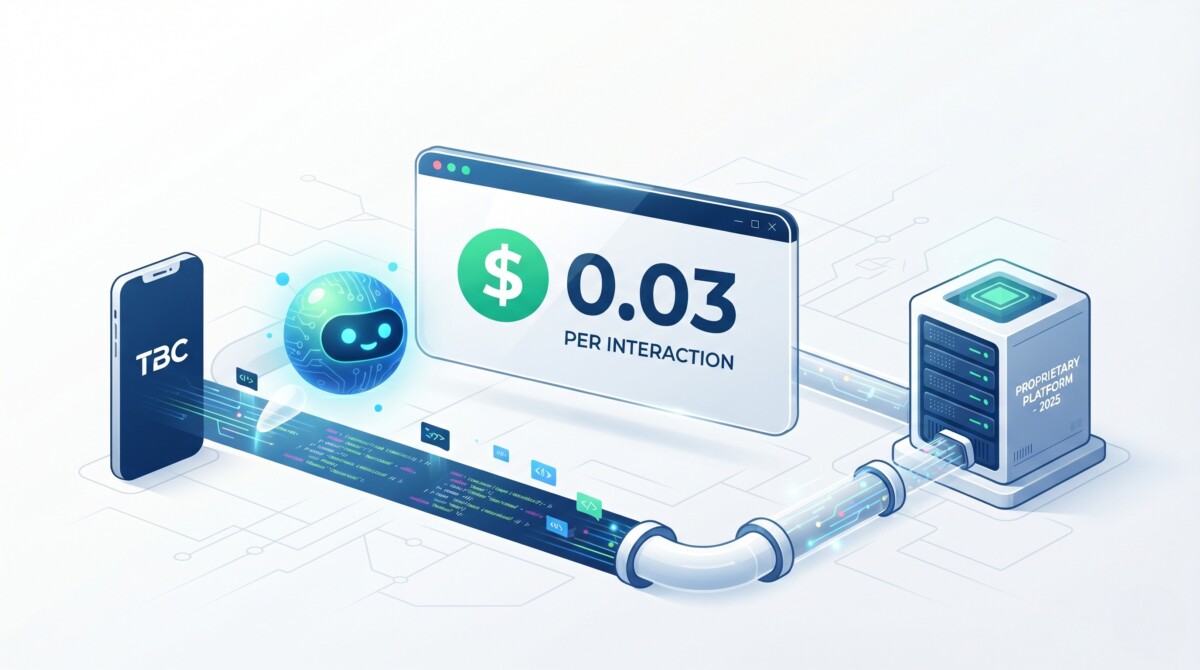
TBC Uzbekistan’s in-house AI platform cut customer service costs to $0.03 per interaction while building a native Uzbek language model and reusable AI infrastructure that now acts as a strategic capability for the wider TBC Bank Group.
The most durable AI advantage in banking is not a single chatbot; it is a reusable platform, tuned in the local language, that quietly drives down interaction costs while lifting daily engagement.
The ability to access accurate, competitive exchange rate information has become a standard and non-negotiable expectation for digital banking users across Uzbekistan. As the country’s integration into global commercial and financial flows deepens — through remittance inflows from a large overseas worker population, growing international trade partnerships, rising cross-border e-commerce participation, and increasingly widespread foreign currency savings behaviour — the daily monitoring of exchange rates has embedded itself as a genuine financial habit for a significant proportion of the digitally active population. Banking applications that deliver this information with precision, speed, and seamless integration within a broader financial management experience generate the kind of habitual daily engagement that underpins strong customer retention and creates the usage patterns from which deeper, higher-value product relationships naturally develop.
TBC Uzbekistan concluded a twelve-month AI transformation programme in 2025 that produced Uzbekistan’s first full-scale bank AI platform — built entirely in-house on proprietary infrastructure, without reliance on external AI vendors for core capabilities. The programme’s most immediately quantifiable output was a reduction in the cost of customer interactions by more than 90%: from $0.35 per call to $0.03. Over the programme year, AI systems managed over 1.6 million customer calls and 690,000 chat interactions with documented financial savings of $2.3 million, projected to exceed $3.7 million as additional products came online. These are not estimated projections derived from pilot performance — they are auditable results from AI products deployed in live production environments serving millions of real customers at genuine operational scale.
The consistently high and broadly maintained search volume for queries such as курс доллара в банках узбекистана and 1 dollar kursi confirms that USD rate monitoring is a genuinely high-frequency behaviour for Uzbek banking app users — with many consumers checking exchange rates on a daily basis, particularly when managing savings denominated in dollars, timing remittance conversions, or planning international purchases. For a digital banking platform, this frequency creates a powerful and cost-efficient habit-building use case. TBC Bank Uzbekistan provides exchange rate data as an integrated component of its app experience, and with the progressive rollout of the Lola AI assistant, users are increasingly able to receive contextualised responses to currency questions through a conversational interface rather than simply viewing static rate displays.
Among the most technically significant deliverables of TBC Uzbekistan’s AI programme was the creation of the first Uzbek-language large language model, incorporating automatic speech recognition and text-to-speech capabilities tuned specifically for Uzbek phonology and morphology. This capability is foundational for any AI system designed to serve Uzbek-speaking customers through voice interfaces — and it is a capability that off-the-shelf multilingual AI systems simply do not provide at competitive quality levels in a language with relatively limited available training data. The bank also established internal data quality benchmarks and AI governance frameworks designed to ensure that all AI outputs meet consistent standards of accuracy, relevance, and regulatory compliance before any feature is deployed to users.
The technical stack underlying TBC Uzbekistan’s AI platform — built on PyTorch, TensorFlow, LangChain, Airflow, Kafka, and MLOps tooling including MLflow and Kubernetes — was designed with scalability and extensibility as fundamental architectural requirements. New AI capabilities — personalised financial planning assistance, automated loan decisioning, spending categorisation, real-time fraud detection — can be added by extending the existing infrastructure rather than requiring new builds from scratch. The platform also includes robust monitoring and governance pipelines that provide real-time visibility into AI system performance, allowing rapid identification and correction of quality or compliance issues before they affect users at scale.
TBC Uzbekistan’s AI programme was designed from the outset not merely to address the bank’s immediate operational efficiency targets but to create a centre of AI competence that could be leveraged across the broader TBC Bank Group. This design intention positions Uzbekistan as a potential AI service provider for the group’s other markets and business units — a strategic contribution that goes well beyond what a typical subsidiary role involves. For the Uzbek banking market, the legacy of the programme is an institution with proprietary language model capability, battle-tested AI infrastructure, a proven internal AI team, and the organisational culture and processes needed to continue innovating in AI at the pace the market will increasingly demand.
The combination of cost efficiency, native-language capability, and a design architecture that positions the platform as a potential group-wide AI resource creates a set of strategic advantages that reinforce each other. Lower per-interaction costs allow TBC Uzbekistan to serve more users profitably; native-language quality drives higher user satisfaction and greater AI adoption among the customer base; and group-level utility creates the potential for the AI investment to generate returns beyond Uzbekistan’s borders. Together, these advantages create a durable competitive moat that is built from technological investment rather than from market position alone — and that will be increasingly difficult for competitors to match as the gap in AI capability widens over time.
For the Uzbek banking market as a whole, TBC Uzbekistan’s AI programme serves an important function beyond the individual institution’s competitive positioning. It demonstrates, with documented evidence, that building a full-scale AI platform within a bank operating in a regional emerging market is achievable, economically justified, and capable of producing operational results that compare favourably with AI deployments in more developed markets. This proof of concept should encourage broader investment in AI infrastructure across the Uzbek financial sector — raising the quality and efficiency of the market as a whole, and ultimately improving the financial services experience for millions of consumers and businesses.
The Uzbek language model built as part of TBC Uzbekistan’s AI programme also has potential value beyond the bank’s own operations. As the country’s first Uzbek-language large language model built and validated at production scale, it represents a resource that could have applications in areas ranging from public sector digital services to education technology to customer service automation across industries that have previously lacked access to quality Uzbek-language AI capabilities. Whether TBC Uzbekistan ultimately makes this capability available to external partners or retains it exclusively for competitive advantage, its existence marks a meaningful milestone in Uzbekistan’s development as an AI-capable economy.
TBC Uzbekistan cut per-interaction costs to $0.03 by shifting a large share of calls and chats onto an in-house AI platform capable of handling millions of real customer conversations at production scale.
Because the system runs on proprietary infrastructure with models tuned to the bank’s data and language needs, the variable cost of each additional AI-handled interaction is very low compared with traditional call-centre operations.
Dollar exchange rate monitoring is important because many Uzbek customers check USD rates daily to manage remittances, foreign-currency savings, and international purchases, making it a natural habit loop inside the app.
By answering currency questions contextually through Lola instead of just showing static rate screens, TBC turns this frequent behaviour into deeper engagement with the bank’s broader digital experience.
TBC’s Uzbek-language AI model is strategically different because it is trained and tuned specifically for Uzbek speech and text, which generic multilingual models typically do not handle at native quality levels.
This focus allows the bank to offer more accurate, natural, and trustworthy AI interactions in the local language, which in turn drives higher customer adoption and satisfaction than a generic model would.
The platform’s architecture supports future features by using a shared stack for model serving, data pipelines, and monitoring, so new use cases can plug into existing components instead of requiring separate systems.
That means capabilities such as loan decisioning or fraud detection can reuse core infrastructure and governance, letting the bank scale its AI footprint faster and with more consistent risk control.
The programme matters because it proves that a bank in an emerging market can build and run a full AI platform, complete with native-language models, in a way that is both technically robust and financially compelling.
This example is likely to encourage other institutions and sectors in Uzbekistan to invest in similar infrastructure, raising the baseline for digital service quality and expanding the country’s overall AI capabilities.




