

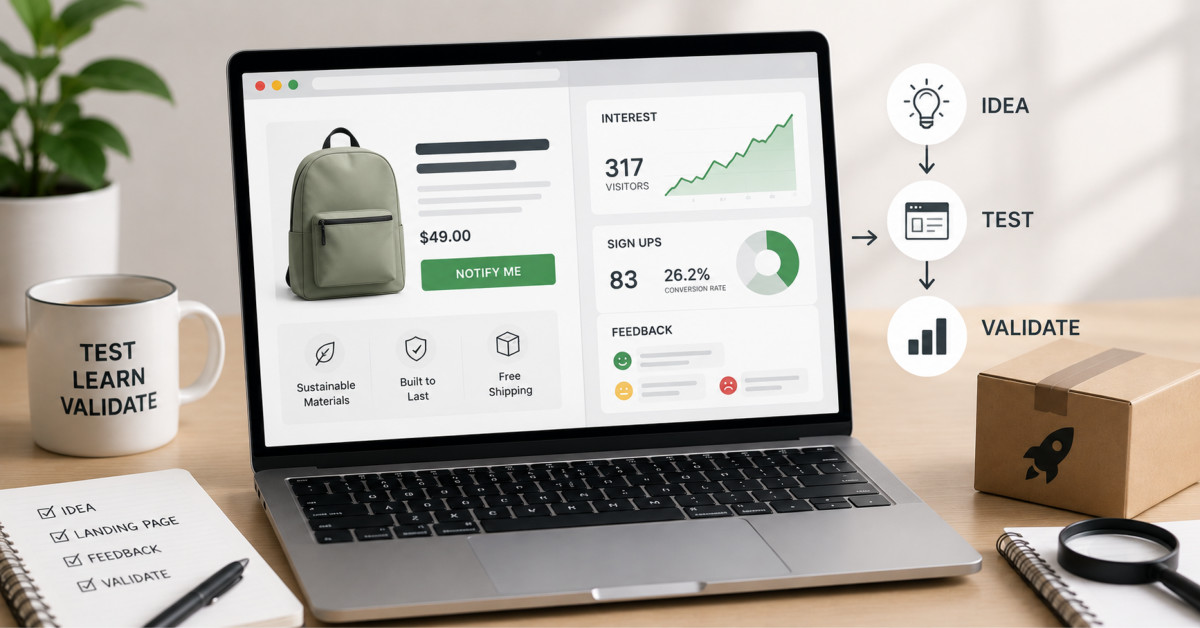
Test your ad hooks, landing page variants, and product concepts against a structured reaction process before you commit paid budget to them. A pre-launch test typically resolves in a day or less, while learning the same lesson in-market takes two to four weeks and costs full CPM for the variant that was always going to lose.
Every underperforming ad, page, and product concept eventually teaches you a lesson. The only question is whether you pay tuition to Meta and Google to learn it, or find out for a fraction of the cost before the campaign goes live.
A founder doing $1.8M a year in mattress toppers told me last spring that she had three new ad hooks ready to go and no idea which one to fund first. Her media buyer wanted to run all three simultaneously and let the algorithm sort it out. That is standard advice. It is also how you end up paying for two losing hooks to find one winner.
This is the position most ecommerce operators are in right now. Acquisition costs keep climbing, margins keep tightening, and the traditional way to find out whether a hook, a page, or a product concept works is to spend money finding out. Every dollar spent discovering a loser is a dollar that did not go toward scaling a winner.
There is a workflow for testing what converts before you commit paid spend to it. It will not replace your live A/B tests or your attribution data. It exists to stop you from paying full price to learn things you could have learned for a fraction of the cost, in a fraction of the time.
CPM anxiety is the rational response to paying more for advertising every year while learning less from each dollar spent. Customer acquisition costs across ecommerce have climbed 40 to 60 percent since 2023, according to marketing analytics firm Ursa Marketing, driven by heavier platform competition, tighter privacy targeting since iOS updates, and rising CPCs across Meta and Google. Every point of that increase makes an underperforming ad, page, or product concept more expensive to discover the old way.
Operators at $500K to $2M feel this hardest. They do not have the media budget to run five creative concepts simultaneously and shrug off the losers. Every campaign launch carries the weight of “what if this is the one that finally cracks our CAC problem,” which is exactly the pressure that leads to launching on gut feel instead of testing anything at all. Neither extreme, paralysis or blind launch, actually solves the underlying problem: you do not know what your audience will respond to until you ask them, and asking through paid media is the most expensive way to ask.
Running your test in-market on Meta or Google means paying full CPM for every variant, including the ones that were always going to lose. Live A/B tests need real time to reach statistical validity. Conversion optimization platform Kameleoon puts the standard window at two to four business cycles, roughly two to four weeks, to account for weekday and weekend behavior shifts and avoid false positives from stopping early. For that entire window, a meaningful share of your traffic gets routed to the version that will not win.
The math compounds when you stack tests. A landing page test running two to four weeks, followed by a creative test running another two to four weeks, followed by an offer test, can burn a full quarter before you have a validated funnel. Median landing page conversion rates across industries sit around 6.6 percent, per Fastlane’s landing page benchmark data, which means most in-market tests are also working with thin sample sizes unless your traffic volume is genuinely large. Add in the attribution noise most stores are dealing with since iOS privacy changes, covered in our breakdown of first-party tracking tools, and it becomes clear why so many operators cannot say with confidence which of last quarter’s tests actually won.
The workflow itself is simple, and the discipline is in running it every time rather than skipping it when you are confident. Start by naming the specific decision you are actually trying to make, not the general topic. “Which of these three hooks should get the first $500” is a decision. “Improve our ad creative” is not. Next, build two or three real variants, not five, because more than three dilutes the signal and slows you down without adding much resolution. Run those variants through a structured reaction process before any paid spend goes live, whether that is a synthetic research tool, a quick customer panel, or even a round of unmoderated interviews with past customers who match your target segment. Read the reasoning behind the reaction, not just which variant scored higher, because the objections tell you what to fix in the losing variants for next time. Only then commit your live media budget, and commit it to the variant that survived the process rather than splitting it evenly across all three out of hedging instinct.
The entire cycle, from naming the decision to committing budget, usually fits into a single afternoon. That is the point. It is meant to sit upstream of your paid spend, not replace the live testing you do once budget is committed.
Ad creative is where this workflow pays off fastest because creative decay happens quickly and the cost of guessing wrong compounds with every impression. In pattern recognition terms, across dozens of conversations with paid media operators managing seven figures in spend, most new creative tested against a proven control loses. That is not a knock on the media buyer’s instincts. It is math: you only need one winner out of three or four ideas, and finding it in-market means paying full price to identify the ones that did not work.
This is closely related to what Facebook ads specialist Manel Gomez calls angle testing in our conversation on advanced Meta strategy, where he argues operators should stop obsessing over audience targeting, which the algorithm now handles automatically, and focus testing energy on which core motivation or “angle” actually drives the purchase. Pre-launch reaction testing on hooks is a fast way to narrow which angles are even worth building full creative around, before a videographer or editor spends a day producing something the audience was never going to respond to.
A landing page test decides which hero, offer structure, and page flow gets the traffic before you send any. The elements worth testing this way are the same ones covered in our guide to building a landing page that converts: the headline and hero image, the offer framing, the order of social proof and product story, and the call to action itself. Pre-launch reaction testing surfaces which version a segment prefers and, more usefully, which specific section of the page loses them, whether that is confusion at the hero, skepticism at the offer, or a CTA that does not match the promise made above the fold.
This does not replace running the winning variant against your actual traffic afterward. It replaces guessing which variant deserves that traffic in the first place, which is the step most operators skip entirely because building a second full landing page variant feels expensive relative to just shipping the one they already built.
Product concept testing catches the most expensive mistakes because the cost of being wrong is not ad spend, it is inventory, tooling, or development time already committed. Baymard Institute’s product page research, built on tens of thousands of hours of usability testing, consistently finds that shoppers decide whether a product’s core value proposition makes sense within the first few sections of a page, well before they read a full description. That means the concept itself, not just the copy around it, either lands or it does not.
Testing three positioning framings against your actual target segment before you commit to packaging, photography, or a homepage rewrite surfaces which framing your audience can repeat back in their own words and which one gets lost entirely. Founders often discover the positioning that made sense internally is not the one shoppers respond to, and it is far cheaper to learn that before production than after a container of inventory has already shipped.
Pre-launch reaction testing tells you how an audience is likely to respond and why, before you spend a dollar finding out the hard way. Tools built for this, including ecommerce user research platforms like Articos, run creative, landing page, pricing, and concept tests against structured synthetic shopper personas and return findings in well under an hour, at a cost that is a rounding error compared to a single week of in-market spend. That is genuinely useful for narrowing which two or three ideas deserve real traffic.
It is not a replacement for behavioral data. Reaction testing tells you what people say and reason about your creative, not what they actually click, buy, or return. You still need live A/B testing tools like VWO, Convert.com, or a Shopify-native option like Intelligems to measure real conversion once you have narrowed the field. You still need session recording and heatmap tools like Hotjar or Microsoft Clarity to see actual on-page behavior. And for deep strategic questions, an old fashioned customer panel or a round of live interviews still surfaces context a synthetic test cannot. Skip synthetic pre-launch testing entirely if your traffic volume is already large enough that live tests resolve in days rather than weeks, or if the decision is small enough that the cost of guessing wrong does not justify adding a step.
At $50K to $500K a month in revenue, the workflow works best attached to whatever you are already shipping weekly: test the new hook before it goes into rotation, test the new landing page variant before it replaces the control. At $500K to $2M, where a bad launch decision has real budget behind it, build a standing rule that nothing above a set spend threshold, say $1,000, launches without a pre-launch test first. Above $2M, the discipline shifts from individual tests to a repeatable creative pipeline, similar to what we cover in our review of centralized UGC and creative testing workflows, where the constraint is not whether to test but how fast you can cycle through tests without bottlenecking the creative team.
The brands doing $2M and above that consistently beat their category on CAC are not the ones with the biggest budgets. They are the ones who stopped paying full CPM to learn what their smaller-budget competitors already found out for the cost of a coffee.
Build two or three real variants that differ meaningfully in hero messaging, offer structure, or page flow, then run them through a structured reaction process, whether that is a synthetic research tool, a quick customer panel, or interviews with past buyers who match your target segment, before committing any paid traffic. Look for which variant a given shopper segment prefers and, more importantly, the specific reasoning behind objections to the losing variants. Once you have a clear favorite, run it live against your actual traffic to confirm real conversion behavior. This narrows the field before spend, it does not replace the live test afterward.
The fastest path is testing your hooks or angles, not full finished creative, against a structured reaction process before a videographer or editor produces anything. Three variants tested this way typically resolve in under an hour and cost a fraction of a single day’s ad spend. This narrows which core motivation or angle is worth building full creative around, so production time only goes toward concepts that already showed signal.
The savings scale with how much you would have spent finding the same answer in-market. A three-variant creative test that would otherwise run for a week or two of live spend, with half the traffic going to the eventual loser, can be resolved before spend for a small fraction of that cost. The bigger savings compound over a quarter: skipping two or three weeks of in-market discovery per test frees that budget to scale whatever variant already won.
Yes, and it is where this workflow has the highest stakes because the cost of guessing wrong is inventory, tooling, or development time rather than ad spend. Test two or three positioning framings, packaging concepts, or feature bundles against your target segment before committing to production. Look for which concept your audience can describe back in their own words and which specific benefits actually drive their interest, not just which one scores highest overall.
A live A/B test measures actual behavior with real traffic, real clicks, and real conversions, but it takes roughly two to four weeks to reach statistical significance and costs full CPM for the losing variant the entire time. Pre-launch reaction testing measures how an audience responds to and reasons about your creative, page, or concept before any paid traffic goes live, typically in under an hour. Use pre-launch testing to eliminate the variants that were always going to lose, then use live A/B testing to measure real conversion on the survivors.





