


TikTok is here to stay. What was once seen as just-a-Gen-Z-app is now an all-inclusive, explosively growing cultural supernova with over 1 billion users. And Brand marketers are rightfully joining in the fun. TikTok marketing now is an opportunity like Facebook marketing was back in 2009-2010.
Don’t miss the boat.
A strong TikTok marketing strategy can give your brand extraordinary exposure, help disseminate your brand voice, weave your brand into the fabric of popular culture, and bring in a ton of new customers.
But TikTok is its own world, and to be successful, you have to understand the world.

The early eComm adopters of TikTok hopped on in 2019 and 2020. But it wasn’t until 2022 that brands started going all-in once marketers started realizing that TikTok offers a great mix of organic reach and powerful ad targeting (that isn’t too expensive).
TikTok has seen immense growth in the last few years. In the first half of 2021 alone, TikTok was downloaded 383 million times. As of 2022, TikTok has a billion active users worldwide, which is larger than Twitter, Snapchat, and Pinterest:

Additionally, TikTok users have high engagement levels.
Facebook ads are still a part of a balanced ad budget, but there’s no doubt the ad costs and unreliable targeting have decimated advertising efforts. With the iOS updates that make hyper-targeted advertising nearly impossible, brands are shifting their budgets toward other channels.
Compared to Facebook, TikTok has lower CPMs: TikTok CPMs start around 10 dollars, and Facebook’s CPMs are about 40% higher as of the middle of 2022. This allows for more cost-effective testing as you begin marketing on the platform.
There’s a widespread misconception that TikTok is only for Gen Z. While 43% of TikTok’s users are Gen Z, 32% are Millennials. And the remaining 25% are made up of Gen X and older demographics. With an increase in diverse demographics expected over time, there’s a high chance your audience is on TikTok.
TikTok is making serious investments with eCommerce platforms to offer shopping features while using the app—TikTok understands that in-app trends lead to purchases (just look at the “Feta Effect”!).
Although this feature is still in its pilot stages, we expect TikTok to introduce full-featured shopping capabilities in late 2022 (we’ll be keeping this updated to reflect TikTok’s changes). Here are a couple current features worth testing:
To get launched, you need to set up a TikTok business account. A business account gives you access to analytics, commercial music licenses, and additional features.
Here’s how to set up a TikTok business account.


First and foremost, TikTok videos must be immediately engaging. Because of the quick-swipe nature of the platform, users can move to the next video with a flick of the finger. A qualification here, however, is that different videos will be more engaging to different users. A cat lover may stop their video flicking and watch a video with a cat, but an anti-cat TikToker will probably immediately move to the next video.
Past that, as an eCommerce brand, your biggest challenges are:
Broadly, TikTok videos fall into several categories (where there can be a bit of overlap, depending on the content):
Here’s an example of a mini-vlog/day in the life video by Harper Wilde (click photo for video link):

Here’s an example of a “satisfying” video with tens of millions of views (click photo for video link):

(Note: The above breakdown is subjective and a non-comprehensive list.)
On your end, think about where you fit in. For example, do you make products for pets or animals? If you don’t, you may not necessarily want to try to force a cute animal into a video. Is something about your product or its production “satisfying”? How can you showcase that? If you’re a makeup brand, is there a really fantastic tutorial for a particular look that you can show off in a short video?
What umbrella(s) do you or could you fall under?
We’ll cover TikTok Ads types later in this article, but we recommend building a TikTok marketing strategy around both a consistent organic content stream as well as a spending strategy to show those videos to chosen audiences in the platform. So, we recommend that you think about how to create good videos first, rather than good ads.
A key theme in many TikTok videos is authenticity, whether they’re ads or not. Think less about highly produced TV or YouTube ads that can cost hundreds of thousands or millions of dollars and more about a person with an iPhone camera being compelling, down to earth, or showing something captivating.

We won’t be overly prescriptive, but a couple main ideas to keep in mind are:
With these fast moving trends Tik tok creative (ads especially) die out much faster than other channels. Volume is much more important for this channel than highly produced content.
We’ve set the stage a bit, but let’s go a lot deeper on TikTok culture—and within it, places for brands like yours.
Running with our theme of organic content’s importance on the ‘Tok, we want to thoroughly cover TikTok culture and how non-ads you create can fit neatly into the TikTokverse (ads will be the next major topic).
As we mentioned at the top of this piece—you should be thinking about how to weave your brand into the fabric of TikTok culture rather than putting out glaringly obvious and/or incongruous ads that users are going to skip over (and cost you money in the process).
So, let’s examine the fabric.
Thinking about your customers in terms of high-level demographic data and general interests can be a starting point. But to be truly successful on TikTok, you have to research (i.e., watch) more content, and therefore spend a lot of time on the app.
TikTok has well-developed and rapidly evolving interest categories with unique in-app cultures, video styles, and humor. The interests break down into more specific interest categories (just as they do in reality), which also have their own unique (and well-developed) in-app cultures, video styles, and humor.
As with any marketing, the better you can get at understanding, talking to, and blending in with each group, the better, particularly in terms of the more specific interest categories.
To facilitate your research and planning, we put together a simple framework to categorize what you’ll see in the app: an interest and engagement vertical.

If they use TikTok enough, users will eventually be presented content around the most specific interests they have, which we’re referring to as sub-niches. Tiktok does this:
So, TikTok users who happen to really dig mushroom foraging will at some point regularly see content around mushroom foraging in their TikTok feed. Over time, they’ll be presented with content from other sub-niches, too, which they will more likely fully consume (i.e., watch to completion, or watch repeatedly).
Sub-niche content is what users watch that allows them to beautifully nerd out to the max, just as we all do in our own particular ways.
The sub-niche content can be about anything (The TikTok content universe is vast and reflects the breadth and depth of international cultures and interests. We chose mushroom foraging, but we could mention videos about anything: sports bra reviews, fountain pen testing, filling glasses with sand, experimentation with cocktail bitters, making maple syrup, painting restoration, ASMR…really, anything!).
Besides their sub-niche content, they’ll also likely see content related to each broader interest category within the particular sub-niche vertical.
So, these fungi enthusiasts will also see content on foraging at a broader level, and likely something related, such as organic farming: these categories are among their niches. Relative to their sub-niches, their niches are a broader interest, and if they see content about them, they’ll still be quite likely to watch, though perhaps not quite as likely as their sub-niche.
And so on up the line.
On the TikTok marketing end, it’s your job to identify and map out where your brand fits in within these verticals, by thinking most broadly, and then mapping out increasing levels of specificity.
By identifying niches and sub-niches that you fit into, you can create highly-targeted and high-engagement content that folks will consume and follow your account for.

Although the example of mushroom foraging might seem random and silly to some, consider the possibilities for showing organic use of a product. If you’re in the woods foraging for mushrooms, you’re…
That’s a non-exhaustive list, and there are a dozen and a half potential products that could be highlighted in this sub-niche. How many knife manufacturers would otherwise consider making a video that shows someone talking about how helpful a particular knife is at paring mushrooms in the woods?
By seriously learning about interest verticals, you’re bound to find dozens of potential use cases on TikTok.

TikTok helps you out by providing the broadest interest categories when you sign up for the app:

The next steps are to choose those that relate to your brand, start watching videos, and explore.
Things to be tracking closely:
The broad-interest-to-sub-niche spectrum is one way that you can start to tackle the seeming limitlessness of TikTok, but an equally important research area is on aesthetics.
To which you may reasonably reply, “What are you talking about?”
Answer: In the broadest sense, an aesthetic is a visual category (photo, artwork, graphic, piece of writing, illustration, video) that captures, creates, or evokes a mood, feeling, or preference.
To which you may reasonably reply, “Make this make sense.”
Answer: a few well-known aesthetics are cyberpunk, goth, and afrofuturism.
In practice, someone’s “aesthetic” might be referred to as such, or it could be more vaguely and casually called a “vibe,” “style,” “look.”
Now, let’s bring ourselves back to TikTok and marketing…
TikTok is a haven for the creative expression of aesthetics, and there are hundreds of aesthetics out there. In the same way that you may never have thought of your brand (or a brand you like) being potentially associated with mushroom foraging, you may find an aesthetic or multiple aesthetics that your products can slot right into.
Here’s an example of a TikTok video that elegantly captures an aesthetic called Cozycore (also referred to by several names, but we’re going to keep it to the one):

In this video…
How many products are or could be related to this 15 second video?
A lot.
Based on this single video, you can probably extrapolate and fill in what else is associated with Cozycore: the fall, weekends, relaxation, quiet, de-stressing, self-care, comforting food and drinks.
Consider this visualization:

We picked 4 broad interest categories (Food/Drink, DIY/Home Decor, Pets, and Fashion) and about 30 products related to those categories and Cozycore as an aesthetic. Again, this is not an exhaustive example.
If you can create organic content that accurately captures the Cozycore aesthetic while highlighting your products, you’re winning. You’re building the association between the products and the aesthetic. TikTok users will follow you for the content they love, and check out your brand so that they can achieve the Cozycore aesthetic for themselves.

For some other inspiration, here are some aesthetic rabbit holes to go down:
TikTok offers an ever-expanding list of ad formats you can run. For most eCommerce brands, the first category of ads we cover, In-feed ads, are going to be the most financially accessible. However, we’ll run through the other major categories of ads, too.
In-feed ads appear on TikTokers’ video feeds: users see them as they are flicking through videos. The three ad formats include image ads, video ads, and spark ads.

On the other hand, the ad below, from Windows, uses an organic-style video, though it still has a CTA at the bottom (“Learn More”):

Below is an example from underwear brand Parade leveraging UGC in a spark ad, also showing the flow from the ad to a CTA page:

In-feed ads use cases: All three in-feed ads are going to be worth testing, and they are likely going to be the ads most accessible to non-enterprise brands. In-feed ads start at $10 per CPM, though sources vary, and report lower CPMs, such as around $6, though this may vary based on your audience, your content, and your brand. We recommend the use of spark ads, because they’re the best way to leverage great organic content on TikTok in ad form: again, that content can be your own, or someone else’s.

TopView ads appear at the top of a user’s For You Page for when they open TikTok, and they appear only once per day.
TopView ads allow your ad to be up to 60 seconds long, and they offer an immersive viewing experience without any other competing content. Rightfully so, TikTok calls TopView “TikTok’s biggest billboard.”

TopView ads use cases: TopView ads are great for increasing brand awareness because they guarantee a broad reach and a high number of impressions. They tend to be engaging and polished videos that leave your viewers with a lasting impression.
In that sense, they stand in stark opposition to much of TikTok’s content, but that works to their benefit: they seriously stand out.
TopView ads are generally used by huge brands with correspondingly huge ad budgets: think Mercedes-Benz, M&Ms, and McDonalds (those three M-brands were not intentional, but we’ll leave them). They are more like TV ads, in that they tend to be polished and well-produced, and they’re often flashy.
Brands can create hashtags that TikTokers use in videos. The goal for brands is to leverage UGC (User-Generated Content). For example, computer brand Lenovo created the hashtag #LENOVOJUSTBEYOU:

Since it was launched, 32.4M videos have been created using this hashtag, which means that Lenovo has gotten an enormous amount of exposure from the hashtag.
Branded hashtags can appear in three places:
Branded hashtag use cases: As with TopView ads, branded ads tend to be used by enterprise brands (Lenovo is worth over $10B) to promote UGC and enormous brand or campaign awareness building via the hashtag.
Brand Takeovers let one brand per day get a serious spotlight in TikTok. Brands can leverage all of the above ad formats and get an extreme level of exposure in front of millions of users.
GUESS, for example, did a brand takeover to promote a hashtag:

The results were impressive: they gained over 12k new followers, had a 14.3% engagement rate, and a 16.5% clickthrough rate.
Brand takeover use cases: Brand takeovers also tend to be used by enterprise brands with deep pockets, and can run brands $50k/day.
They are used in a variety of ways: to promote hashtags (as GUESS did), new products or product lines, lifestyle marketing pushes, movements and social causes, and more.
Depending on the type of ad campaign you want to run, creating an ad may require using the TikTok ads manager or speaking to a TikTok representative.
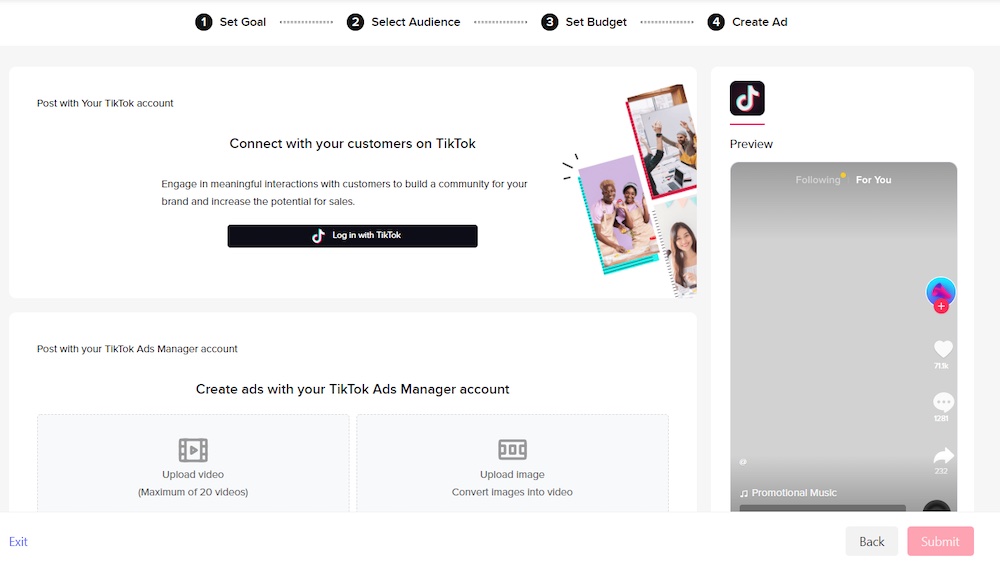
The steps outlined below apply to ad types like in-feed ads, which you can create entirely on your own, using your content or UGC (with consent).
Once you’re in the dashboard, create your ads campaign by clicking Create an Ad. You’ll be given the option to choose between Simplified Mode and Custom Mode.
True to its name, Simplified Mode makes it easy to create ads with a step-by-step experience to get your campaign up and running. But both modes actually function the same–they just look different. So feel free to choose the mode you prefer.

Here, you’ll choose your targeting placement, promotion type, audience targets, and other details. When you’re just starting out, we recommend starting out by using TikTok’s automatic ad placement (called Automatic Audience), as TikTok’s algorithm is great at targeting:

However, if you’re more comfortable with Audiences to target, you can add custom dimensions (targetable dimensions shown in table below):

You can also set campaign objectives: video views, reach, traffic, lead gen, app installs, and conversions.
TikTok Ads can get expensive if you don’t control your spending limit. You have the option of choosing a Daily Budget or a Lifetime Budget (we highly recommend choosing a Daily Budget):

Note: In-Feed ads have a minimum budget of $500.
TikTok has easy-to-use video creation tools users can leverage to create content for their audience. Just remember that your images or videos must meet predetermined specifications before you can launch a campaign on the platform:
Challenges are an enduringly popular element of TikTok culture: one user challenging another to do something (e.g., “do 100 bodyweight squats in a row”), to a hashtag that is centered around a challenge, or a company challenging its audience to do something. That said, challenges also don’t necessarily have to be challenges (what?).
They can be ways to participate in the community: they’re trends to take part in, or mass participation events.
For example, Feastables, ran a golden ticket campaign where a lucky winner has a shot at competing to win a chocolate factory. Yes, we’re serious.

While we’re not saying (nor suggesting) that you have to run a Willy Wonka-style giveaway in your challenges, they can be a great way to drive engagement.
It feels great to be “seen.” You can make your followers feel special by asking them what types of content they want to see (in effect, this is a form of zero-party data). It makes your brand seem more relatable and further increases engagement, boosting your chances of being seen by other users.
Here’s an example from Death Wish Coffee. They regularly post videos of them mixing their coffee with other drinks as suggested by the comments in their previous posts.

Thank you for reading our TikTok marketing guide.
For more on the creators of this content: we’re Daasity, the eCommerce data and analytics platform for the fastest-growing consumer product brands. Our customers leverage Daasity to centralize all their data, which gives them a head start in planning their marketing campaigns and preparing to scale their business.
Daasity is at the forefront of data analytics, and we provide a single, unified view of your most important data. We collect data from your whole tech stack, empowering you to make data-driven decisions and push important data into relevant marketing channels.
Want to learn more? We’d love to show you a demo.





