

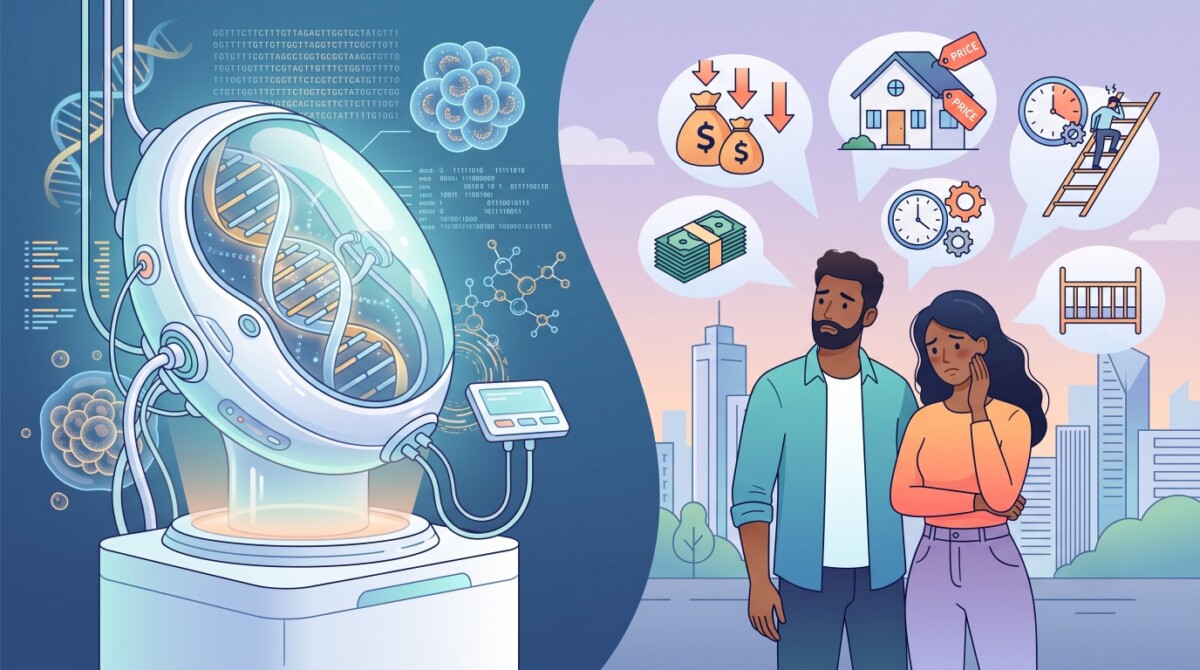
Artificial wombs are advancing as lifesaving support for extremely premature infants, but they are nowhere near complete external pregnancy, and even if they were, they would not fix the economic and social drivers behind collapsing birth rates.
Artificial wombs may reshape neonatal intensive care, but they cannot substitute for affordable housing, stable employment, and social support when a society decides whether to have children.
Few technologies blur the line between medicine and science fiction like the artificial womb.
As East Asia’s largest economies confront collapsing birth rates, a tempting question follows: could gestation outside the body eventually reverse demographic decline and the economic challenges it threatens?
In response to declining populations in many OECD countries, some analysts are openly discussing the use of artificial wombs to boost birth rates and prevent the economic consequences of demographic decline. Based on the current state of science, the honest answer is no, and understanding why requires separating what exists from what remains hypothetical.
The leading device is EXTEND, the “Biobag” developed at the Children’s Hospital of Philadelphia (CHOP). In a landmark 2017 study, the team sustained fetal lambs for up to four weeks in a fluid-filled bag connected to a pumpless oxygenator through the umbilical vessels. The animals were developmentally equivalent to human infants at roughly 24 weeks — the generally recognised threshold of viability.
Two caveats matter. First, a 2025 – 2026 systematic review notes that this four-week result remains a single landmark rather than a reproducible standard, while parallel work in Australia and Japan has sustained smaller lambs for up to 336 hours (14 days).
Second, the central obstacle to human use is technical: reliably cannulating the umbilical vessels of an extremely small fetus.
Crucially, the researchers are not building a baby-making machine. CHOP lead author Jennifer Cohen states that EXTEND “will not be used to make a non-viable pregnancy viable,” but rather to help extremely premature babies survive with less harm.
This is where popular coverage misleads. Ectogestation (partial) extends an already established pregnancy to help extreme preemies survive. Complete ectogenesis — growing a child from conception to term entirely outside a body — is the only version that could affect birth rates, and it does not exist.
Reproducing implantation, a full placenta, and maternal hormonal signalling remains far beyond current capability. Tellingly, the viral 2025 claim of a Chinese “pregnancy robot” from Kaiwa Technology was fact-checked as false, including the supposed inventor’s very existence.
Even if the technology were available, the demographic premise is flawed. South Korea’s fertility rate hit 0.72 in 2023 (the world’s lowest) against a replacement level of 2.1. Japan stands at around 1.3, while China is close to 1.0. At a fertility rate of 0.7, a population contracts by roughly one birth for every fifteen deaths.
But the drivers are economic and social, not gestational. People are not deterred primarily by the biology of pregnancy; they are deterred by geopolitical uncertainty, inflationary pressures fueled by surging oil prices, rising living costs, career pressures, childcare burdens, and shifting marriage patterns.
Japan already spends around 1% of GDP on family policy for a projected gain of just 0.05 – 0.1 points in the fertility rate, and modelling gives it only a 12% chance of reversing the decline by 2030. An artificial womb externalises nine months of gestation; it does nothing to address the decades-long financial and personal commitment of raising a child.
The technology is real and advancing, but its trajectory toward neonatal intensive care, not population policy. As an economic remedy, it is the wrong tool for the wrong problem.
Artificial wombs cannot realistically raise national birth rates because they only support pregnancies that already exist and do not change adults’ underlying decisions about whether to have children. Fertility decline in East Asia and other OECD countries reflects economic pressures, housing costs, work–family conflicts, and shifting social norms, none of which are addressed by moving gestation outside the body. At best, future ectogestation systems could improve survival rates for extremely premature infants, marginally increasing the number of surviving children from pregnancies that would otherwise end in tragedy; they cannot create new pregnancies or meaningfully alter total fertility rates.
Ectogestation is partial external gestation that begins after a pregnancy is already established, while ectogenesis refers to complete gestation outside the body from conception to term. Current artificial womb systems like EXTEND operate in the ectogestation window, taking over after implantation and placental development so that extremely premature fetuses can continue maturing in a controlled environment. Complete ectogenesis would require reproducing implantation, building a functional placenta, and recreating maternal hormonal signalling ex utero, capabilities that remain beyond current science and would involve far more complex ethical and biological challenges than today’s neonatal devices.
Artificial womb research today has demonstrated promising but limited successes in animal models, particularly with fetal lambs at developmental stages comparable to very premature human infants. The EXTEND system at CHOP has sustained lambs for up to about four weeks in a fluid‑filled bag connected to a pumpless oxygenator, while other groups in Australia and Japan have reported 14‑day support for smaller lambs, but these results are not yet broadly reproducible nor tested in humans. Human trials, if approved, are expected to focus narrowly on fetuses at the edge of current viability, and researchers emphasize that their goal is improving neonatal care rather than creating full external pregnancies.
Fertility rates in countries like South Korea and Japan are collapsing because young adults face high housing costs, insecure employment, long working hours, intense educational competition, and limited affordable childcare, all of which make parenting feel economically and emotionally unsustainable. South Korea’s total fertility rate has fallen near 0.7, Japan’s hovers around 1.3, and projections suggest long‑term population shrinkage and ageing that are driven by these structural conditions rather than medical limits on pregnancy. Government policies such as cash allowances, parental leave, and childcare subsidies have had only modest effects so far, and many demographers argue that deeper reforms in housing, labour markets, and gender norms are needed to change family formation decisions.
Over the next decade, artificial wombs are likely to play a specialized role in neonatal intensive care by offering a new form of support for extremely premature infants who currently face high risks of death or disability. Clinical and ethical debates are centred on how to integrate these systems into NICUs, define appropriate gestational age thresholds, and ensure equitable access, rather than on using them as instruments of population policy. If early human trials succeed, artificial placenta technologies could become an important adjunct to ventilators and incubators in high‑resource hospitals, but their impact would be measured in improved health outcomes for individual preemies, not in national birth rate statistics.





