

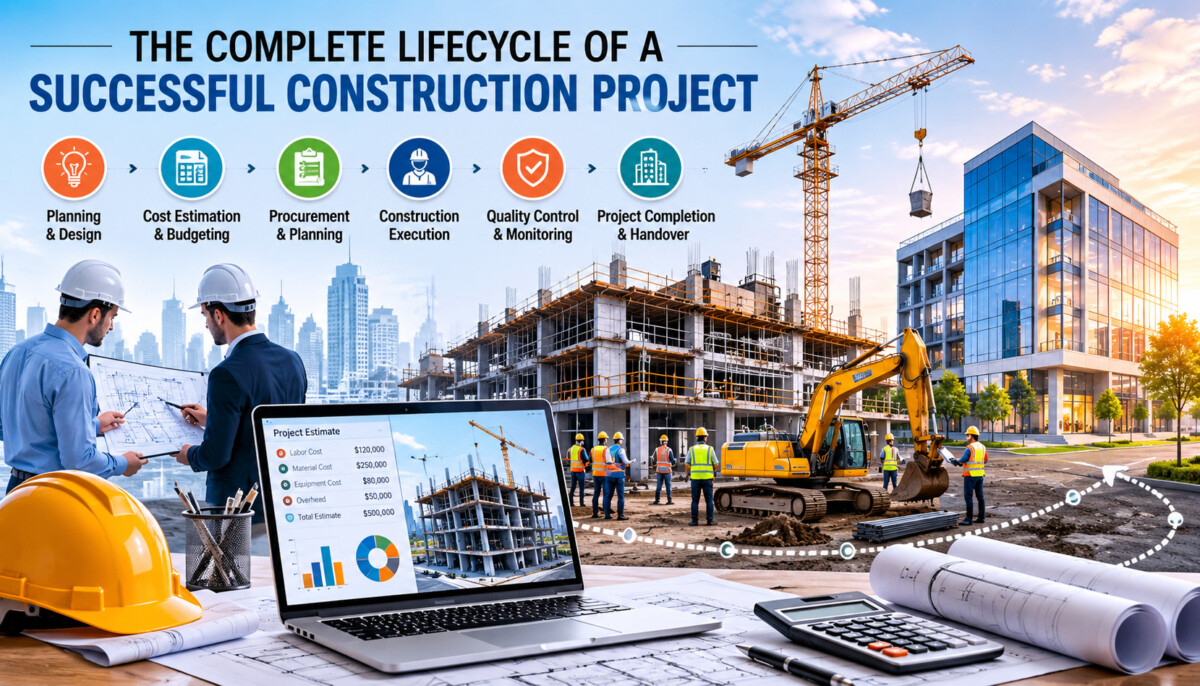
A successful construction project follows a disciplined lifecycle—from initiation and design through procurement, execution, commissioning, and post‑project review—where planning, cost control, communication, and risk management are actively managed at every stage.
Successful construction projects are not won in the concrete and steel; they are won in the way teams design, price, sequence, and communicate the work long before a crew steps on site.
Construction projects are among the most complex undertakings in any industry. Whether it is a residential home, commercial building, industrial facility, or infrastructure development, every project follows a structured process from concept to completion. Success does not happen by chance. It is achieved through careful planning, effective communication, accurate budgeting, and efficient execution at every stage.
Understanding the complete lifecycle of a construction project helps stakeholders make informed decisions, minimize risks, and ensure projects are delivered on time and within budget. Each phase plays a critical role in transforming an idea into a finished structure that meets quality, safety, and functional requirements.
This article explores the key stages of a successful construction project and highlights the factors that contribute to long-term project success.
Every construction project begins with an idea. This initial phase focuses on identifying the purpose, goals, and feasibility of the project. Property owners, investors, developers, or organizations determine what they want to build and why the project is needed.
During this stage, several important questions are addressed:
Feasibility studies are often conducted to assess technical, financial, environmental, and legal considerations. The goal is to determine whether the project can realistically move forward before significant resources are invested.
Early planning during the initiation phase establishes a strong foundation for the entire project lifecycle.
Once the project is deemed feasible, the planning and design phase begins. This stage transforms ideas into detailed plans and specifications.
Architects, engineers, and consultants collaborate to create designs that meet project requirements while complying with building codes and regulations. Detailed drawings, layouts, and technical documents are developed to guide future construction activities.
Planning involves several key activities:
The project site is thoroughly assessed to understand its conditions, limitations, and opportunities. Factors such as soil quality, topography, utilities, accessibility, and environmental considerations are evaluated.
Design professionals create conceptual and detailed designs that define the structure’s appearance, functionality, and performance. Multiple revisions may occur before final approval.
One of the most critical aspects of project planning is cost estimation. Accurate budgeting allows stakeholders to understand expected expenses and allocate resources effectively.
Many project owners rely on construction cost estimating services during this phase to generate detailed cost projections based on labor, materials, equipment, and project scope. Reliable estimates help prevent budget overruns and support informed decision-making throughout the project.
Project managers develop timelines that outline major milestones, deadlines, and construction activities. A realistic schedule helps coordinate resources and maintain progress throughout the project lifecycle.
Proper planning significantly reduces the likelihood of delays, unexpected costs, and operational challenges later in the project.
After plans and budgets are finalized, the project moves into procurement and contracting.
This phase focuses on selecting contractors, suppliers, and vendors needed to complete the work. Procurement strategies may vary depending on project size, complexity, and delivery method.
Common activities during this stage include:
Effective procurement ensures that qualified professionals and reliable suppliers are involved in the project. It also establishes clear expectations regarding scope, costs, responsibilities, and timelines.
Strong contractual agreements help reduce disputes and create accountability among all parties involved.
Before physical construction begins, several preparatory tasks must be completed.
These activities include:
Project managers, contractors, and stakeholders meet to review plans and align expectations. Communication channels are established to ensure smooth coordination throughout construction.
The pre-construction phase serves as a bridge between planning and execution, ensuring that all necessary resources and approvals are in place before work starts.
The construction phase is where project plans become reality. This stage typically consumes the largest portion of the project budget and schedule.
Construction activities vary depending on project type but often include:
The site is cleared, graded, and prepared for construction activities. Existing structures may be demolished if necessary.
Foundations provide structural stability and support. Proper foundation construction is essential for the long-term integrity of the building.
The project’s framework is built using materials such as steel, concrete, wood, or masonry. Structural work creates the skeleton of the building.
Essential building systems are installed during this stage. These systems ensure functionality, safety, and comfort for future occupants.
Finishing activities include drywall installation, flooring, painting, roofing, landscaping, and other aesthetic improvements.
Throughout construction, project managers monitor progress, track costs, manage resources, and address challenges as they arise.
Regular communication among contractors, consultants, and stakeholders helps maintain alignment and prevent misunderstandings.
Maintaining quality is a continuous process throughout the construction lifecycle.
Quality control focuses on verifying that work meets established standards, specifications, and project requirements. Inspections are conducted at various stages to identify issues before they become costly problems.
Key quality management activities include:
A proactive approach to quality management helps ensure that the completed project performs as intended and meets stakeholder expectations.
High-quality construction also reduces future maintenance costs and extends the lifespan of the facility.
Effective cost management is one of the most important factors in project success.
Construction projects often face challenges such as fluctuating material prices, labor shortages, design changes, and unforeseen site conditions. Without proper financial oversight, these factors can quickly impact project profitability.
Accurate budgeting and ongoing cost monitoring allow project teams to maintain financial control.
Professional construction estimator services play a valuable role not only during initial budgeting but also throughout the project lifecycle. Updated estimates, cost tracking, and change order evaluations help stakeholders make informed financial decisions and minimize budget-related risks.
Continuous cost management contributes significantly to successful project outcomes.
Every construction project involves risks. Identifying and managing these risks early can prevent costly delays and disruptions.
Common construction risks include:
Successful project teams implement risk management strategies that include:
Potential issues are identified during planning and reviewed regularly throughout the project.
Project managers evaluate the likelihood and potential impact of each risk.
Preventive measures are developed to reduce risk exposure.
Risks are continuously monitored so corrective action can be taken when necessary.
A proactive approach to risk management improves project resilience and supports smoother project execution.
Construction projects involve numerous stakeholders, including owners, architects, engineers, contractors, subcontractors, suppliers, and regulatory agencies.
Effective communication is essential for keeping everyone aligned and informed.
Regular meetings, progress reports, project management software, and collaborative decision-making processes help improve transparency and accountability.
Strong communication provides several benefits:
Projects with strong collaboration often experience fewer conflicts and better overall performance.
As construction activities near completion, the project enters the commissioning and closeout phase.
This stage focuses on ensuring that all systems, equipment, and components function properly before final handover.
Key activities include:
Commissioning verifies that building systems perform according to design requirements and operational standards.
Any remaining issues are addressed before the project is officially completed.
Once all requirements have been satisfied, the completed project is handed over to the owner or client.
The handover process typically includes:
Building occupants can then begin using the facility for its intended purpose.
A successful handover ensures a smooth transition from construction to ongoing operations.
The lifecycle of a construction project does not necessarily end after occupancy.
Many organizations conduct post-construction evaluations to assess project performance and identify lessons learned.
Areas commonly reviewed include:
These evaluations provide valuable insights that can improve future construction projects.
Continuous learning helps organizations refine processes, reduce risks, and achieve better outcomes over time.
The lifecycle of a successful construction project involves much more than simply building a structure. From initial concept development and planning to construction, commissioning, and post-project evaluation, every phase contributes to the overall success of the project.
Careful planning, effective communication, strong risk management, and accurate cost control are essential throughout the process. Professional construction estimator services provide valuable support by helping stakeholders establish realistic budgets, manage costs, and make informed decisions from start to finish.
By understanding and effectively managing each stage of the construction lifecycle, project teams can deliver high-quality results that meet objectives, satisfy stakeholders, and create long-term value.
The main phases of a construction project lifecycle are initiation, planning and design, procurement and contracting, pre‑construction, execution, completion and commissioning, handover, and post‑construction evaluation.
Early cost estimating is important because it aligns design ambition with financial reality, helps prevent later budget shocks, and supports better decisions about scope, materials, and phasing.
Risk management fits into the construction lifecycle as a continuous process of identifying, assessing, mitigating, and monitoring potential issues from initiation through post‑construction.
Commissioning focuses on testing and verifying that systems and equipment work as intended, while handover is the formal transfer of the completed project and documentation to the owner.
Professional estimator services support project success by providing accurate budgets, updating cost forecasts, analyzing change orders, and helping teams maintain financial control throughout the lifecycle.





