

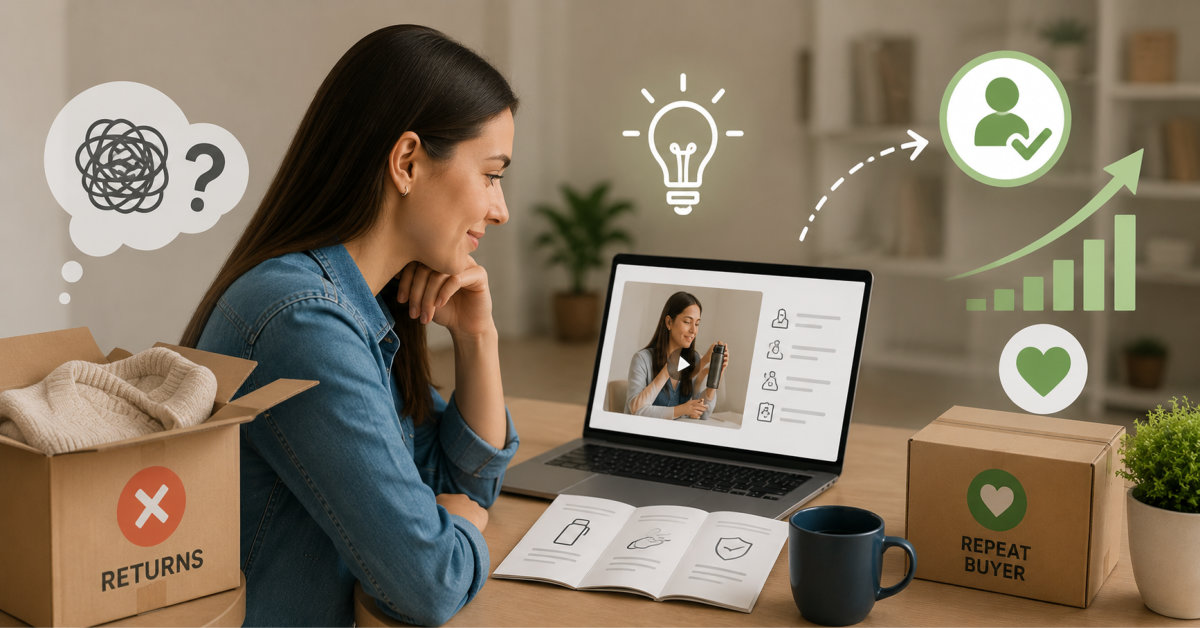
Post-purchase product education can reduce avoidable returns, support demand, and improve repeat purchase behavior by helping customers achieve a successful first use before confusion becomes frustration. The highest-impact programmes turn recurring support questions and return reasons into timely videos, emails, guides, and self-serve help.
A return is not always a product failure. Sometimes it is the last step in a customer experience where nobody helped the buyer get from unboxing to a meaningful first win.
Picture the worst kind of return. Not the wrong size, not a cracked screen in transit — the product that arrived perfectly and went back anyway, because the buyer couldn’t figure out how to make it work. Nothing was broken except the handoff. The item was fine; the understanding was missing. And every one of those returns is pure margin gone, plus the support ticket, the return shipping, and a customer who now quietly associates your brand with frustration.
At the scale U.S. retail is running, this is not a rounding error. The National Retail Federation, with Happy Returns, put 2024 returns at roughly $890 billion — about 16.9% of sales. A meaningful slice of that isn’t defects or sizing; it’s people who never crossed the gap between “unboxed” and “using it confidently.” Call it the confusion tax. Most stores pay it without ever seeing the line item.
Here’s the part that should interest anyone running an e-commerce P&L: that tax is one of the few return drivers you can actually shrink with content instead of discounts. You can’t cheaply cut returns caused by fit or shipping damage. You can cut the ones caused by a customer staring at a product they don’t understand — by teaching them before they give up.
This is where customer education stops being a soft, brand-team idea and starts looking like operations. A short, well-made setup walkthrough is competing directly against a return label. When a buyer hits their first snag at 9 p.m., the thing that saves the sale isn’t your return policy — it’s whether there’s a clear answer within reach. Good educational content is that answer, sitting there before the ticket is ever filed.
Forget corporate-training connotations. In a retail context, product education is lean and specific to the moment a customer is in:
A two-minute setup video that plays right after purchase. A short onboarding email sequence that arrives across the first two weeks, each message solving the one thing people typically get stuck on next. A tidy how-to library — searchable, skimmable — that your support team can link instead of retyping. For anything with assembly, settings, or a learning curve, a guided first-use flow that gets someone to their first win fast.
The through-line is timing. This content earns its keep in the post-purchase experience window — the fragile stretch between delivery and habit, when a confused customer is deciding whether this was a good buy or a mistake. Customer onboarding in commerce is simply making sure that stretch ends in a success, not a shrug.
Two honest options, and the right one depends on volume and how much you already have on your plate. Small catalog, simple products, some in-house video skill? You can produce a lot of this yourself, and you should start there. But once the catalog grows, or the products get genuinely complicated, the quality bar rises past what a founder filming on a phone between fires can sustain — and a scrappy, confusing tutorial can dent trust as much as no tutorial at all.
At that point brands bring in specialists who build educational content for a living — production studios and e-learning companies such as Blue Carrot Company among the firms operating in that space. The trade is the usual one: higher production cost in exchange for content that’s actually clear, on-brand, and built to teach rather than just to exist. The decision isn’t ideological; it’s whether the returns and tickets you’d prevent outweigh the spend to prevent them.
Don’t measure this on views. Views tell you people pressed play; they don’t tell you the register rang. Watch the numbers that hit the P&L:
Run it as a simple before-and-after, or compare products that have a proper setup flow against ones that don’t. If educated buyers return less and come back more, you’ve found a margin lever that also happens to make people like you — and you can prove it well enough to justify doing more.
Returns are the number that gets a founder’s attention, but the compounding win is trust. A customer you taught to succeed with one product is a customer who believes the next one will work too. That belief is what turns a single purchase into a second, and a buyer into someone who recommends you. Cutting the confusion tax saves margin today; the loyalty it builds is what pays for years. For most stores, the content that does both is already overdue.
Customer education can reduce ecommerce returns when confusion, setup difficulty, incorrect use, or unmet expectations contribute to the return decision. It will not solve returns caused by defects, shipping damage, poor fit, fraud, or a product that was inaccurately represented. The best approach is to identify return reasons and support questions by SKU, then create guidance for the points where customers get stuck after delivery. A first-use video, QR-linked setup guide, timed onboarding email, or searchable troubleshooting article can help customers reach a successful outcome before they request a return.
Shopify brands should create a short first-use guide for the product that generates the highest volume of confusion-related returns or repetitive support contacts. The guide should answer the first action a new customer needs to take, demonstrate the most common mistake, and show what successful use looks like. Deliver it through a post-purchase or delivery-triggered email, a QR code inside the package, and a support-agent macro. Once that asset is live, create follow-up content for the next common question, such as care, settings, troubleshooting, replenishment, or complementary use cases.
You can identify returns caused by customer confusion by combining return reasons with support-ticket tags, chat logs, product reviews, survey responses, and customer interviews. Look for phrases such as “could not get it to work,” “too difficult to set up,” “did not understand the instructions,” “not what I expected,” “could not pair it,” or “did not know how to use it.” Separate these from defects, damage, fit, late delivery, and buyer-remorse returns. Then review the customer journey to find the missing explanation, demonstration, expectation, or timing that could have prevented the frustration.
You should produce customer education videos in-house when your products are straightforward, the catalog is manageable, and your team can demonstrate the product clearly and accurately. Hire a specialist when the product is complex, the education programme requires animation, localization, polished production, compliance review, or a larger volume of consistent assets. Start with a simple in-house pilot based on real support questions. If the pilot reduces returns or ticket volume, use the result to justify specialist production for high-value products or more complex learning experiences.
Customer education generates ROI when it lowers preventable returns and support demand while improving first-use success, repeat purchase, retention, or customer satisfaction. Track return rate and return reasons by SKU, repetitive support-ticket volume, time to resolution, education engagement, product-registration or setup-completion events, repurchase rate, and customer lifetime value. Use pre-launch baselines and comparable customer cohorts where possible. Do not rely on views alone, because a video view does not prove that a customer understood the product, avoided a return, or became more valuable to the business.




