

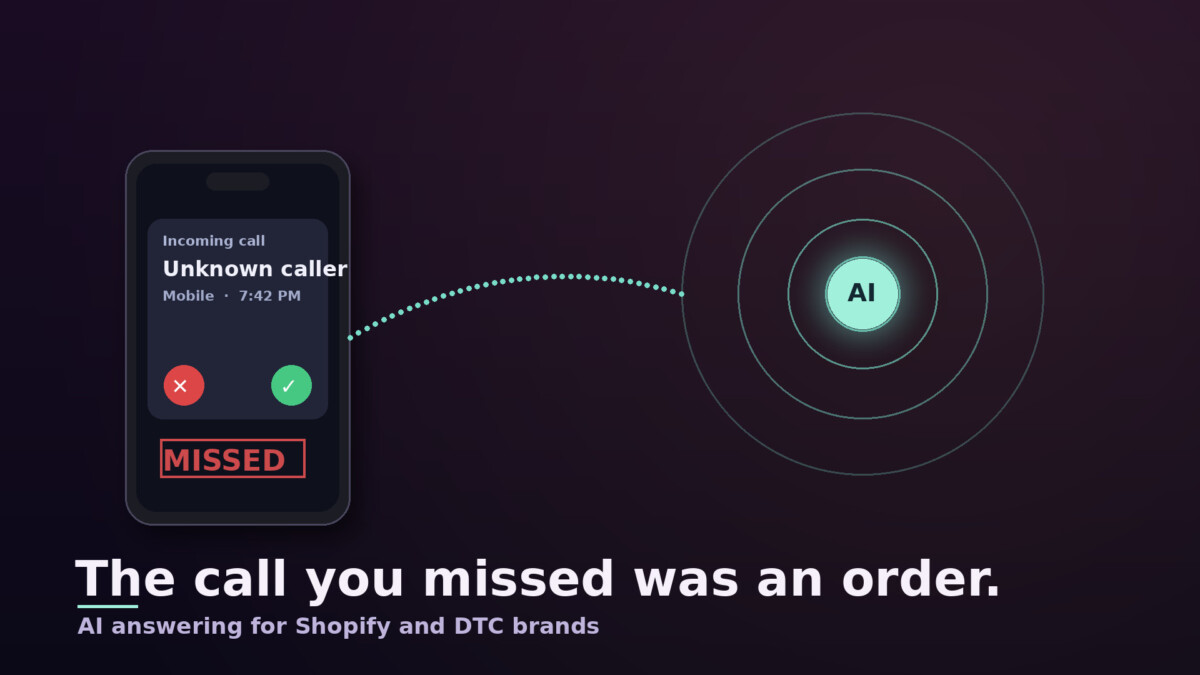
Your Shopify dashboard does not show you the orders you lost because nobody answered the phone.
Your Shopify dashboard does not show you the orders you lost because nobody answered the phone.
It tracks abandoned carts. It tracks email opens. It tracks ad spend down to the dollar. But the customer who called your business number at 7:42 PM with a question about shipping to APO addresses, hit voicemail, and went to a competitor instead, that one is invisible. So, the existing subscriber who tried to cancel could not get through and filed a chargeback instead.
The AI answering service category exists to plug this exact gap. Tools in this space, including newer entrants like Allo and a handful of others, sit on top of your business phone number and answer calls automatically when no human can. They greet the caller, ask what they need, capture the answer, and send a transcript to the inbox or CRM your team actually checks. For DTC brands without a real call center, that turns voicemail into something measurable.
Below is what these tools actually do, where they fit in a Shopify stack, and how to evaluate one without wasting a week on demos.
The category name is a bit misleading. The good ones are not just voicemail with a friendly voice on top.
A modern AI answering service answers within a ring or two, identifies itself, and asks why the caller is reaching out. It listens to the response, follows up if it needs more detail, and decides what to do next based on rules you set. Common paths: answer the FAQ directly from your help center, take a structured message and email it to support, or warm-transfer to a human if the caller asks.
The good ones can answer questions like “do you ship to Hawaii,” “what is your return window,” or “where is order 47213” without escalating to a person. The questions they cannot answer get logged, which is a quiet bonus of the category. If the same question shows up forty times in a month, that is a signal to update your product page or your shipping policy.
For Shopify brands specifically, the better tools integrate directly with your store so the AI can look up order status, customer history, and shipping details in real time. That is the dividing line between AI answering services that feel like 2026 and ones that feel like an old IVR with a thin AI veneer.
Most Shopify merchants already run a customer service stack. Gorgias or Zendesk for tickets, maybe Tidio or Klaviyo flows for proactive outreach, sometimes a Shopify-native chat widget. Phone calls are usually the orphan channel that nobody owns.
AI answering services slot in next to that stack rather than replacing anything. The transcript and contact details land in the same ticket queue your support team already works in. The customer profile pulls from Shopify, so the AI knows whether it is talking to a first-time buyer or a repeat VIP. Calls that need a human get escalated to whoever owns CX that day.
For brands doing six figures or low seven figures in revenue, this is usually the cheapest CSAT lever available. A typical small DTC brand misses 30 to 60 percent of inbound calls during busy hours and after hours. Recovering even half of those, with structured information attached so the team can follow up properly, usually pays for the tool inside the first month.
A few things separate the AI answering services that work from the ones that hallucinate.
Honest behavior on hard questions. Test this directly. Call the vendor’s demo number, ask a simple FAQ, then ask something genuinely tricky that is not covered in the training docs. The good ones admit they do not know and offer a human callback. The bad ones invent answers. For a DTC brand, an AI that confidently invents a return policy is worse than no AI at all.
Real Shopify integration. Ask whether the tool can pull live order status from Shopify, not just a CSV you uploaded last Tuesday. The whole value of “where’s my order” handling depends on the AI knowing where the order actually is right now.
Native CRM and helpdesk handoff. The transcript and structured details (caller intent, sentiment, action items) should land in Gorgias, Zendesk, or your CRM automatically. If the AI just emails you a wall of text, you have not solved the problem. You have moved it.
Trainable on your actual content. Most tools let you upload help docs, product pages, or a sitemap to train the assistant. Check whether updates to those docs flow through automatically or whether you have to retrain manually every time you change a shipping policy.
Multilingual support if you sell internationally. If your customer base touches French, Spanish, or Portuguese, ask which languages the AI handles natively rather than via real-time translation. The translation route works but adds latency and breaks tone.
Pricing in this category has dropped fast. Two years ago, an AI receptionist was an enterprise add-on starting around $200 a month. Today, the better tools include unlimited AI answering in the base plan of an AI-first phone system, usually somewhere between $25 and $45 per user per month. Standalone AI receptionist tools that do not include calling minutes still exist and start cheaper, around $20 to $30 a month for a few hundred minutes.
For most Shopify brands, the right move is the bundled option. A separate dialer, plus a separate AI receptionist, plus a separate transcription tool, plus a separate CRM connector is the legacy stack you are trying to leave.
If you are evaluating tools, do this first. Forward your business number to the trial of two or three AI answering services. Spend a week routing real calls through each. Read the transcripts. Check whether the tool actually pulled the right Shopify order details, whether the handoff to your support inbox was clean, and whether the AI ever invented anything it should not have.
The product that wins this test usually wins by a noticeable margin. The other two will hallucinate one specific thing: a return window, a shipping cutoff, a discount code that does not exist, which would be embarrassing if it ever reached a real customer.
Phone calls are the smallest channel in your Shopify dashboard. They are also the channel where a single bad miss costs you the most goodwill. The math for putting a competent AI between your customers and your voicemail is no longer close.
An AI answering service sits on top of your business phone number and handles inbound calls automatically when no human is available. It answers within one to two rings, identifies itself, asks the caller what they need, and routes the call based on rules you configure: answering FAQs from your help content, taking a structured message and routing it to your support inbox, or transferring to a human if needed. For Shopify brands specifically, the best tools integrate directly with your store to pull live order status, customer history, and shipping details in real time, so the AI can answer “where is my order” without escalating to a person. Every handled call generates a transcript and structured summary that lands in your existing helpdesk or CRM automatically.
Most DTC brands doing six figures to low seven figures in revenue miss 30 to 60% of inbound calls during peak hours and after hours. The cost is not just the direct revenue from orders that do not complete. It includes subscribers who cannot reach support and file chargebacks instead, high-value customers who call with a pre-purchase question and convert with a competitor who answers, and repeat buyers whose experience of the brand is permanently shaped by hitting voicemail when they needed help. None of these losses appear in your Shopify analytics as a distinct line item, which is why the channel gets deprioritised even when it is actively costing revenue.
The integration model for the better tools is direct and automatic. When a call ends, the AI sends a structured summary to your helpdesk, typically including caller name and number, the reason for the call, the action taken (answered, message taken, transferred), sentiment indicators, and any relevant order or account details pulled from Shopify. This creates a ticket in Gorgias or Zendesk exactly as an email or chat would, so your support team works it through the same queue they already manage. The key thing to verify during evaluation is that the handoff is structured and actionable, not just a wall of transcribed text. Unstructured transcripts add work rather than removing it.
The critical difference is how the tool behaves when it encounters a question it cannot confidently answer. A well-built AI answering service acknowledges the limit of its knowledge, tells the caller it does not have that information, and offers a human callback or a follow-up from the support team. A poorly built one invents a plausible-sounding answer: a return window, a shipping cutoff, a discount code that does not exist. The invented answer feels helpful in the moment and creates a customer expectation you cannot fulfill, which generates disputes and damages trust more than a missed call would have. Test this directly before committing to any tool by calling the demo number and asking something genuinely tricky that is not in the training documentation.
Pricing has dropped significantly in the past two years. Bundled AI-first phone systems that include unlimited AI answering alongside a business phone number now start at $25 to $45 per user per month. Standalone AI receptionist tools that do not include calling minutes start at $20 to $30 per month for a few hundred minutes of coverage. For most Shopify brands, the bundled option delivers better total value because it eliminates the integration overhead of stitching together a separate dialer, AI receptionist, transcription tool, and CRM connector. At the current price point, a brand missing ten or more calls per week will typically recover the cost of the tool from a single additional converted order within the first month.





