

This guide covers the 3 shipping options TikTok Shop offers, how to choose the right one for POD, and a step-by-step setup process using Printify.
TikTok Shop shipping covers everything that happens after a customer hits “buy” – carrier selection, label generation, tracking updates, and delivery requirements – all managed through Seller Center.
Unlike standard eCommerce stores, TikTok Shop enforces specific service level agreements (SLAs) and fulfillment policies that all sellers must follow. Miss them consistently and you’re looking at penalty points, product deactivation, or, in repeat cases, permanent shop closure.
TikTok Shop currently offers 3 shipping options for US-based sellers:
1. Seller Shipping – you (or your POD partner) handle the full fulfillment cycle. You choose the carrier, purchase or generate the shipping label, and upload tracking information to Seller Center. TikTok monitors delivery performance against its SLAs, but the responsibility stays with you.
2. TikTok Shipping – TikTok auto-assigns a carrier from its approved network (USPS, UPS, FedEx) based on package size, weight, and destination. Labels are generated in Seller Center, tracking updates automatically, and TikTok handles most logistics complaints. This is the default setting for all new US seller accounts.
3. Fulfilled by TikTok (FBT) – TikTok warehouses store, pick up, pack, and ship your inventory. Returns and refunds are on TikTok. FBT is invite-only and requires pre-stocked inventory, which makes it incompatible with POD.
POD operates on a made-to-order model – a customer places an order, your POD provider produces the item and ships it directly to the buyer. No pre-stocked inventory and no warehouse of your own. That rules out FBT, and makes TikTok Shipping largely impractical – both assume you control physical stock.
Seller Shipping fits naturally into the POD workflow. Your provider handles production and dispatch, uploads tracking on your behalf, and ships via TikTok-approved carriers – allowing orders to flow automatically, as long as your integration is set up correctly. Get that right, and every order flows automatically.

Seller Shipping – also called self-shipping – means you’re responsible for the full fulfillment cycle from order placement to delivery. In practice, Printify’s Print Providers handle that on your behalf. But TikTok holds you accountable for every deadline, no exceptions.
Here’s what that looks like in real life:
You must use a carrier from TikTok’s approved list – USPS, UPS, FedEx, DHL, Amazon Shipping, and select regional services. If your Print Provider ships via an unsupported carrier, the order won’t process correctly.
This is why Printify filters its Catalog to show only TikTok-eligible products – those fulfilled by Print Providers who ship via approved carriers.
Before you publish any product with Seller Shipping enabled, you need at least 1 shipping template. Templates define your delivery regions, shipping rates, and service types (standard, express, or free economy).
If your template doesn’t cover a region, you can’t sell there. Simple as that.
Handling time is the number of business days between order placement and carrier handoff. TikTok lets you set this to 1 or 2 business days at the shop level, with product-level adjustments available for made-to-order items.
Set this accurately. If orders aren’t marked as dispatched within your chosen window, TikTok may auto-cancel them and penalize your account.
Once an order ships, upload valid tracking information to Seller Center. If there’s an error in the tracking number or carrier, you get one correction. After that, you’ll need to contact TikTok support via a Seller Center ticket. Missing or incorrect tracking information makes you liable for any resulting losses or penalties.
TikTok monitors delivery and enforces minimums by shipping service type. Standard and Free Economy orders must reach customers within 6 business days of placement. Express orders must arrive within 3 business days – and you need to maintain a 95% on-time delivery rate to keep Express active. Drop below that, and Express shipping is pulled from your listings until you recover.
With Seller Shipping, return-to-sender costs are on you, and you handle all TikTok Shop logistics issues directly. After about 1-2 weeks with no carrier scans, TikTok may treat a shipment as lost and refund the customer automatically.
For POD sellers, this isn’t much of a contest – but here’s the full comparison so you know exactly what you’re working with:
| TikTok Shipping | Seller Shipping | |
|---|---|---|
| Carrier assignment | Auto-assigned by TikTok | Chosen by the seller or POD provider |
| Label generation | Auto-generated in Seller Center | Managed by seller or POD provider |
| Tracking updates | Automatic | Must be uploaded (or handled by the integrated POD app) |
| Logistics customer support | TikTok handles most complaints | The seller is responsible |
| Return-to-sender costs | Covered by TikTok | Covered by the seller |
| POD compatible | No – requires seller-controlled dispatch | Yes – works with Printify and similar platforms |
| Best for | Sellers with physical inventory and warehouse control | POD sellers, dropshippers, and third-party fulfillment |
What about Fulfilled by TikTok? FBT requires pre-stocked inventory in TikTok’s warehouses – incompatible with POD by design. It’s not a viable option here.
Seller Shipping is the only model that works for POD.
POD relies on made-to-order fulfillment – products are created after a customer places an order, not stored in a warehouse. TikTok Shipping and Fulfilled by TikTok both require inventory control, which makes them incompatible with POD.
Using Printify to sell on TikTok Shop? Seller Shipping isn’t optional – it’s required.

Printify’s integration with TikTok Shop is available to US-based sellers only. Your TikTok seller account must be registered in the US, and fulfillment runs domestically – from US Print Providers shipping to US customers.
Standard shipping must cover all 48 contiguous states. Alaska and Hawaii are optional. You can exclude PO Box addresses from your shipping template if your carrier or Print Provider doesn’t support them.
TikTok global shipping covers the UK, Indonesia, Malaysia, the Philippines, Singapore, Thailand, and Vietnam – each with its own policies, carrier requirements, and seller registration process.
For US-based Printify users, international expansion through TikTok Shop isn’t currently supported via direct integration. Selling in another market means registering a separate seller account in that market and meeting its own requirements independently.
Not every Print Provider in the Printify catalog ships via TikTok-approved carriers – and that directly affects whether your products are eligible to sell on TikTok Shop.
To find eligible products, go to the TikTok Shop product page in your Printify account, where only TikTok-compatible products are displayed. Or open the Printify Catalog, select a subcategory, and toggle the TikTok eligible only filter.
Either way, avoid products marked with a Potential delay label – these fall outside TikTok’s SLA requirements and can lead to violations or order cancellations.
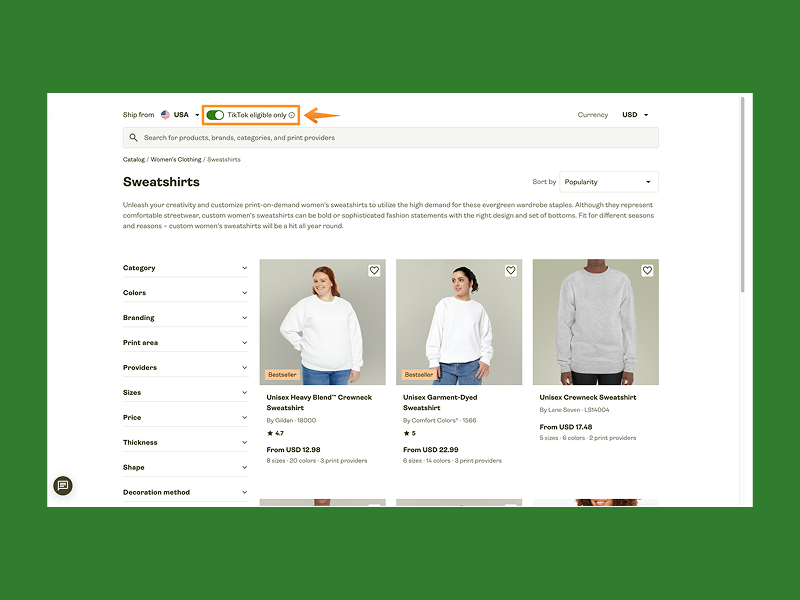
One more thing to watch: if a customer orders both eligible and ineligible products in a single transaction, the entire order defaults to standard (slower) TikTok delivery times, which may trigger an SLA violation.
Before you start: you’ll need a Printify account and an approved TikTok seller account in Seller Center. If you haven’t connected them yet, here’s how to integrate with TikTok Shop step by step.
TikTok verifies warehouse addresses against USPS records. If your address is flagged, the system will prompt you with hints to fix it. You can set up a single or multiple warehouses if you’re selling different product types (such as apparel and wall art) – each with its own warehouse settings and warehouse name.
Once your warehouse is saved, TikTok automatically sets TikTok Shipping as the default – you need to change this.
Skipping this is one of the most common setup mistakes. If TikTok Shipping remains active, Printify won’t receive complete order details, and you’ll see an error when you try to publish.
After switching, TikTok will prompt you to create a shipping template.
If you’re selling multiple product types from different warehouses, create a separate shipping template for each. A warehouse without an assigned template will trigger a notification in Seller Center, and products linked to it may be deactivated.
When publishing a product from Printify, open the Shipping dropdown and select the relevant warehouse. If that warehouse doesn’t have Seller Shipping enabled, the product won’t publish. Make this a habit every time you add a new product type.
TikTok Shop delivery times depend on the shipping method. For US domestic orders using Seller Shipping, standard shipping takes up to 6 business days from order placement. Express orders must arrive within 3 business days, and sellers need to maintain a 95% on-time delivery rate.
For POD sellers using Printify, production time factors into the handling time, so setting this accurately in Seller Center is essential for giving customers a realistic TikTok shop delivery time estimate. For example, if your Print Provider needs 2 business days to produce an item, set your handling time accordingly before you publish.
TikTok global shipping covers TikTok Shop markets outside the US, including the UK and Southeast Asia.
For US-based Printify sellers, international expansion through TikTok Shop isn’t currently supported via direct integration. Selling in another market means registering a separate seller account in that market and following its own logistics service requirements independently.
Yes. Set a $0.00 flat rate in your shipping template – this is the setup Printify recommends for most sellers. The shipping cost is either absorbed into your product price or covered by your margin.
Free Economy is a separate TikTok-managed option with a fixed $0 shipping fee at checkout and is entirely at the seller’s expense. Setting standard shipping to $0 in your own template gives you more control over pricing and carrier selection, which is why it’s the better option for most POD sellers.
Once an order ships, tracking information is uploaded to Seller Center – automatically via an integrated POD provider like Printify or manually by the seller. That’s the core of tracking TikTok Shop orders: Seller Center logs it, and customers can follow their order through the TikTok app under their order details.
For more detailed updates, the tracking number also works directly on the carrier’s website (USPS, UPS, or FedEx), which shows a fuller scan history and live estimated delivery windows.
With Seller Shipping, you’re responsible for resolving logistics issues directly. A package is considered lost after 10 calendar days or 7 business days with no carrier scans – at which point TikTok may cancel the order and refund the customer automatically.
To file a claim, submit a ticket through Seller Center. While you’re waiting on a resolution, keep your customer in the loop – letting them know you’re on it goes a long way toward protecting your shop’s review rating.
TikTok Shop shipping doesn’t have to be complicated, but it does require the right setup from the start. For POD sellers, Seller Shipping is the only model compatible with Printify’s integration. Get your warehouse address right, switch to Seller Shipping before you publish, create your shipping template, and stick to TikTok-eligible products.
Do that, and fulfillment runs itself while you focus on designing products and growing your audience.
Ready? Connect Printify to TikTok Shop and make your first sale.
The post TikTok Shop shipping: A guide for print-on-demand sellers appeared first on Printify.




