

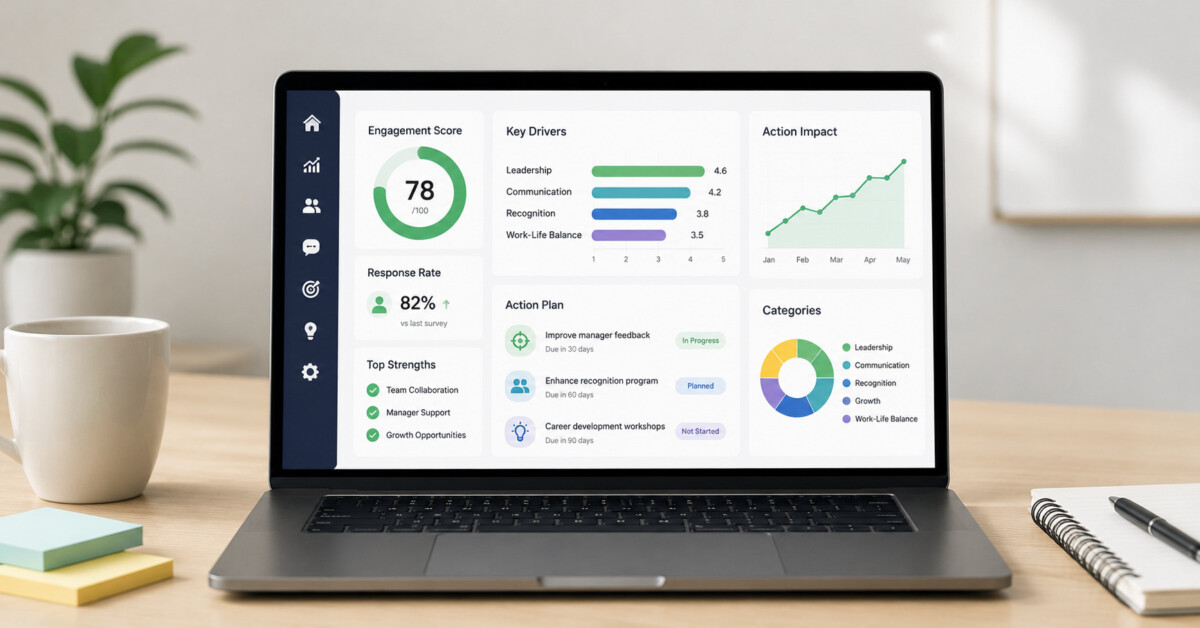
The best Culture Amp alternative depends on how your managers turn survey results into accountable action. CultureMonkey suits organizations prioritizing structured manager-owned follow-through, while Leapsome, Perceptyx, Workday Peakon, Lattice, and 15Five fit different combinations of scale, HRIS architecture, performance management, and manager cadence.
Employee listening only earns trust when people can see what changed, who owned it, and whether leadership followed through.
Collecting feedback is the easy part. The gap between a survey result and an actual change in the workplace is where most engagement programs quietly fail. Culture Amp is strong on survey design and benchmarking, but for many teams its action planning stays at the dashboard level: results are visible, yet nothing forces a named manager to own a change and see it through. The six alternatives below are compared on a single question that survey design cannot answer – what happens after the data lands, and who is accountable for acting on it.
Pricing and feature data reflect early 2026 vendor pages, G2 listings, and case studies. “Contact sales” indicates no public per-user rate card.
Culture Amp, founded in 2009, brings science-led survey design and one of the largest benchmark datasets in the industry, a solid fit for desk-based mid-market teams with dedicated HR analytics capacity. Where teams commonly reassess is the action loop: the platform surfaces rich results, but converting them into manager-owned actions with clear ownership, deadlines, and follow-up tracking often depends on HR effort outside the tool. That is the gap this shortlist addresses – not what the survey measures, but how reliably the platform turns a result into a change someone is accountable for.
Best for: Enterprise organizations of 500+ employees that want feedback converted into manager-owned action, not another dashboard.
CultureMonkey runs engagement, pulse, lifecycle, onboarding, and exit surveys from one system, built around manager-assigned action planning rather than dashboard reporting. The action-planning module pairs recommended actions with Kanban-board progress tracking and post-action pulse checks, so every action has a named owner, a visible status, and a measured impact on the driver it targets. AskCooper AI identifies themes and engagement drivers and suggests actions, while the accountability stays with managers. Major native HRIS integrations (Workday, SAP, ADP, Oracle, and others) keep data joined to the system of record, delivery spans email, Slack, Teams, WhatsApp, text messages, QR codes, and kiosk mode in 100+ languages, and a 10M+ response People Science benchmark across 15+ industries frames external context. Implementation is a 5-week structured launch that preserves historical survey data. Aujan Group deployed to 2,000 employees in 5 languages in 7 days. Pricing is contact sales. G2 4.7.
Pros: Action planning is the core of the product, not an add-on: manager-assigned actions, Kanban progress tracking, and post-action pulse checks close the loop. Multi-channel reach and 100+ languages mean the actions are based on representative data.
Cons: Sales-led pricing; no published per-user rate – buyers running short evaluation cycles will need to engage sales early. No free trial – teams must book a demo to explore the product.
Best for: Teams that want AI-generated action plans with explicit owners and deadlines inside a unified suite.
Leapsome bundles engagement with performance reviews, OKRs, 360 feedback, and learning, and its action planning is a genuine strength: AI-generated plans carry named owners and deadlines, and impact-driver analytics connect engagement signals to the performance conversations where follow-through happens. For teams tired of stitching tools together, the accountability lives in the same place as goals and reviews. It is particularly popular with European organizations consolidating a survey tool, LMS, and review system. Pricing is quote-based, and its G2 rating of 4.8 is among the highest in the category.
Pros: Action plans with explicit owners and deadlines drive accountability, and because engagement sits next to performance and goals, follow-up happens in the workflow managers already use.
Cons: Full-suite implementation typically takes three to six months, and survey question logic and branching lack some of the flexibility of single-purpose listening tools.
Best for: Large enterprises (3,000+ employees) that want AI-generated action plans across multi-event listening.
Perceptyx is an AI-led people-analytics specialist built for large enterprise scale, combining engagement with lifecycle events and crowdsourced feedback in a multi-event listening model. Its Activate AI generates manager action plans directly from survey data, and a consultative services organization supports configuration and follow-through. The platform is purpose-built for organizations of a few thousand employees and up, where engagement listening is a strategic program rather than a tactical dashboard. Pricing is contact sales, with professional-services configuration. G2 4.3.
Pros: One of the strongest AI-driven action-planning workflows in the enterprise category, with multi-event listening under one vendor and consultative support to keep programs moving.
Cons: Requires professional services to configure and implement, and organizations below a few thousand employees tend to over-buy on capability.
Best for: Workday-native enterprises wanting automated action plans inside the HCM system of record.
Workday Peakon Employee Voice, acquired by Workday in 2021, lives inside the Workday HCM ecosystem as the engagement listening module. Continuous listening and NLP-driven comment analysis feed auto-generated action plans that managers work inside the familiar Workday interface, and native data sync means employee attributes stay current without integration projects. For Workday-standardized enterprises, keeping the action loop in the same system as the org data is the draw. Pricing is contact sales, typically rolling into the broader Workday contract. G2 4.6.
Pros: Auto-generated action plans sit inside the Workday interface managers already use, with real-time HCM sync and mature attrition prediction at enterprise scale.
Cons: Customers note that action-planning depth is limited relative to dedicated platforms like CultureMonkey, and value depends on Workday standardization.
Best for: Teams that want engagement actions to live alongside performance reviews and goals.
Lattice approaches engagement from the performance side: reviews, OKRs, and calibration form the backbone, with engagement surveys, pulse, and eNPS layered on and tied to the goals framework. Its suggested action planning routes engagement insights into the same manager conversations as goals and reviews, so follow-up is not a separate exercise. Configurable anonymity thresholds and AI analytics keep customization in-house. It scales from roughly 100 to 5,000 employees, strongest in technology and professional services. Pricing starts from $8 per user per month for unbundled modules. G2 4.7.
Pros: Engagement actions live next to performance and goals, so managers act inside one workflow, with configurable anonymity and flexible benchmarking.
Cons: Suggested actions are lighter than dedicated action-planning modules, and delivery is email-anchored with no native frontline channels, so mixed-workforce teams often look elsewhere.
Best for: SMB and mid-market teams that turn engagement signals into weekly manager conversations.
15Five is built around the weekly check-in, which is its action mechanism: engagement signals surface as conversation cues for managers rather than as reports, and an HR Outcomes Dashboard plus built-in coaching nudge managers toward follow-up. Lifecycle and milestone surveys are included, with integrations spanning BambooHR, ADP, Slack, and Teams. For desk-based teams already on a weekly cadence, action lives in the rhythm of the check-in. Pricing starts from $4 per user per month, billed annually. G2 4.6.
Pros: The weekly check-in turns engagement signals into manager conversations by default, with built-in coaching and transparent published pricing.
Cons: Action planning is manager-cadence-dependent rather than a structured, tracked workflow, and driver-level analytics become less reliable above roughly 2,000 employees.
| Tool | Best For | Action Planning | Follow-Up & Tracking | G2 | Pricing |
|---|---|---|---|---|---|
| CultureMonkey | Enterprise + multilingual + frontline | Manager-assigned + Kanban | Progress tracking + post-action pulse | 4.7 | Contact sales |
| Leapsome | Engagement + performance + learning | AI plans + owners/deadlines | Owners and deadlines tracked | 4.8 | Contact sales |
| Perceptyx | AI-led enterprise analytics | Activate AI action plans | Consultative program support | 4.3 | Contact sales |
| Workday Peakon | Workday-native enterprises | Auto-generated plans | Tracked inside Workday | 4.6 | Contact sales |
| Lattice | Performance + engagement | Suggested actions | In performance workflow | 4.7 | From $8/user/mo |
| 15Five | SMB / mid-market check-ins | Manager-led check-ins | Weekly check-in cadence | 4.6 | From $4/user/mo |
Feature data current as of early 2026. “Follow-Up & Tracking” describes how each platform keeps actions accountable after they are assigned. Culture Amp is the incumbent these tools are evaluated against.
A dashboard shows results; action planning assigns a change to a named owner, tracks its status, and checks whether it worked. The strongest platforms here pair AI-suggested actions with human ownership, deadlines, and progress tracking, then close the loop with a follow-up pulse. If a tool stops at visualizing scores, the acting still falls entirely on HR.
Closing the loop requires a post-action pulse that re-measures the driver the action targeted. CultureMonkey builds this in through post-action pulse checks tied to the action module; suite platforms like Leapsome track owners and deadlines, and Perceptyx supports it through consultative program management. Weekly-cadence tools handle this informally through the manager conversation rather than a structured re-measure.
No. AI speeds up drafting a plan, but accountability still needs a named owner and a deadline, or the suggestion becomes just another unread recommendation. The platforms that move engagement pair AI suggestions with explicit ownership and tracking, and treat manager activation rate – not survey participation – as the success metric.
Most engagement platforms can run a survey and draw a chart. Far fewer are built so that a result reliably becomes a change someone owns. The dividing line among Culture Amp alternatives on this list is not analytics depth; it is whether the platform assigns actions to named managers, tracks them to completion, and re-measures whether they worked. A beautiful dashboard with no accountability produces reports that pile up while the underlying drivers stay flat.
Start from how your managers actually work. If action should live inside performance and goals, a suite fits; if it runs through a weekly conversation, a cadence tool fits; and if you want action planning as the center of gravity with tracking and closed-loop follow-up, the listening-first platforms built around manager ownership tend to win. The right choice is the one your managers will actually run, not the one with the most charts.





