

New Relic remains one of the strongest observability platforms on the market. It delivers full-stack monitoring, AI-powered capabilities, and fast root-cause analysis across metrics, events, logs, and traces. But in 2026, three structural issues are driving teams to evaluate alternatives:
This guide evaluates seven alternatives across pricing, OpenTelemetry support, deployment model, and real-world migration feasibility. Each tool is assessed against what New Relic actually costs at your scale – including the cloud egress fees most comparison guides ignore.
*Estimates based on 30TB/month ingestion, 100 hosts, 20 users, 30-day retention. Full methodology at end of article.*
New Relic’s Standard plan charges $99/month per full platform user (maximum five). Pro costs $349/user/month. This creates a dynamic where engineering leads ration access – deciding which developers are senior enough to deserve a login. When junior developers, support engineers, and product managers are locked out, incident response slows and knowledge concentrates in a few hands.
New Relic’s Core Compute model removes seat limits but introduces Compute Capacity Units (CCUs) – a billing dimension that charges for queries, alerts, and data processing in ways that are genuinely difficult to forecast. Unlike GB-based pricing (pay per gigabyte ingested), CCU consumption can spike during incidents – precisely when engineers are running the most queries.
Every dashboard, alert, and custom query built in New Relic is non-portable. Teams that have spent years building operational knowledge in NRQL discover that switching platforms requires rebuilding their entire query library. Modern alternatives built on OpenTelemetry and SQL-compatible query engines avoid this problem – your queries and skills remain vendor-neutral.
New Relic supports regional data centers, but for teams with HIPAA, GDPR Article 44, DPDP Act, or FedRAMP requirements, the SaaS-first model may not satisfy data residency obligations. Self-hosted platforms that run inside your own VPC are structurally different – and for regulated industries, often the only viable option.
Most observability tools can collect logs, metrics, and traces. The biggest differences show up in pricing, OpenTelemetry support, deployment model, operational effort, and long-term fit.
Best for: Cost control, data sovereignty, and teams that want managed self-hosted observability
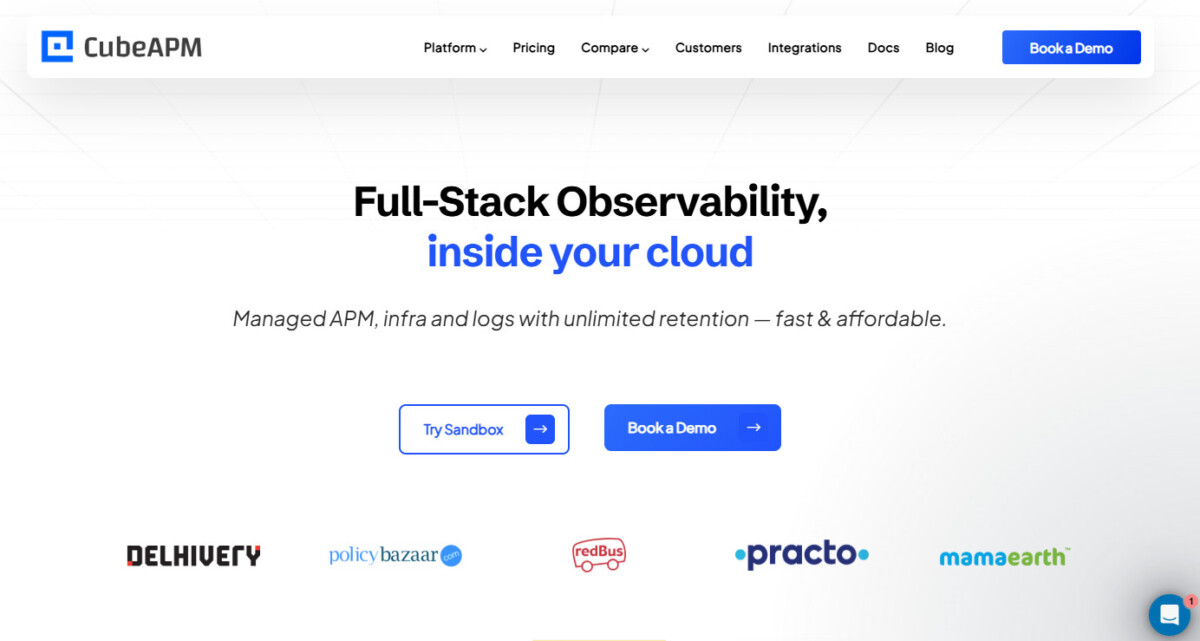
CubeAPM is a self-hosted, OpenTelemetry-native, full-stack observability platform built for teams that want unified visibility across metrics, events, logs, and traces without the cost sprawl common in SaaS observability tools. It runs inside your own AWS, GCP, or Azure VPC – traces, logs, and metrics never leave your infrastructure boundary. CubeAPM handles upgrades, patches, and platform operations; you provide the infrastructure.
Ranked in the top 10 APM platforms in G2’s Spring 2026 APM Grid Report. Capterra 5/5, G2 5/5, and #4 easiest-to-use APM tools on G2. Used by Policybazaar (insurance), Delhivery ($3.5B logistics – 75% savings after replacing three separate monitoring tools), Mamaearth ($1.2B), world’s largest bus aggregator – redBus (part of MakeMyTrip Limited (NASDAQ: MMYT), 8+ countries), Ola, and Practo (healthcare). SOC 2 Type II and ISO 27001 certified.
Ingestion-based, predictable pricing of $0.15/GB. No per-user fees. No per-host charges. Unlimited users and unlimited data retention included.
At 30TB/month: ~$5,100/month all-in ($4,500 license + ~$600 infra)
Delhivery: 75% savings after replacing three separate monitoring tools. Mamaearth: ~70% savings, migrated in under an hour. redBus: 4x faster dashboards, 50% faster MTTR.
“Dashboards are astonishingly fast compared to New Relic – the migration process was also super smooth.”
Direct engineering support via WhatsApp and Slack channels – response in minutes during incidents.
Best for: High-cardinality event debugging and OpenTelemetry-first distributed tracing
Honeycomb takes a fundamentally different approach to observability: it stores wide events and derives trace, log, and metric views from a single data model. This makes it exceptionally powerful for debugging high-cardinality distributed systems where traditional APM sampling loses the signal. Honeycomb is OpenTelemetry-first, with OTel as the primary instrumentation standard. A private cloud option was announced in November 2025 for teams with data residency requirements.
Usage-based, starts at $0.10/GB ingested. Cost scales with telemetry volume.
At 30TB/month: ~$5,600/month (can range $5K-$24K depending on event volume and plan)
Best for: Large enterprises that need AI-automated root cause analysis
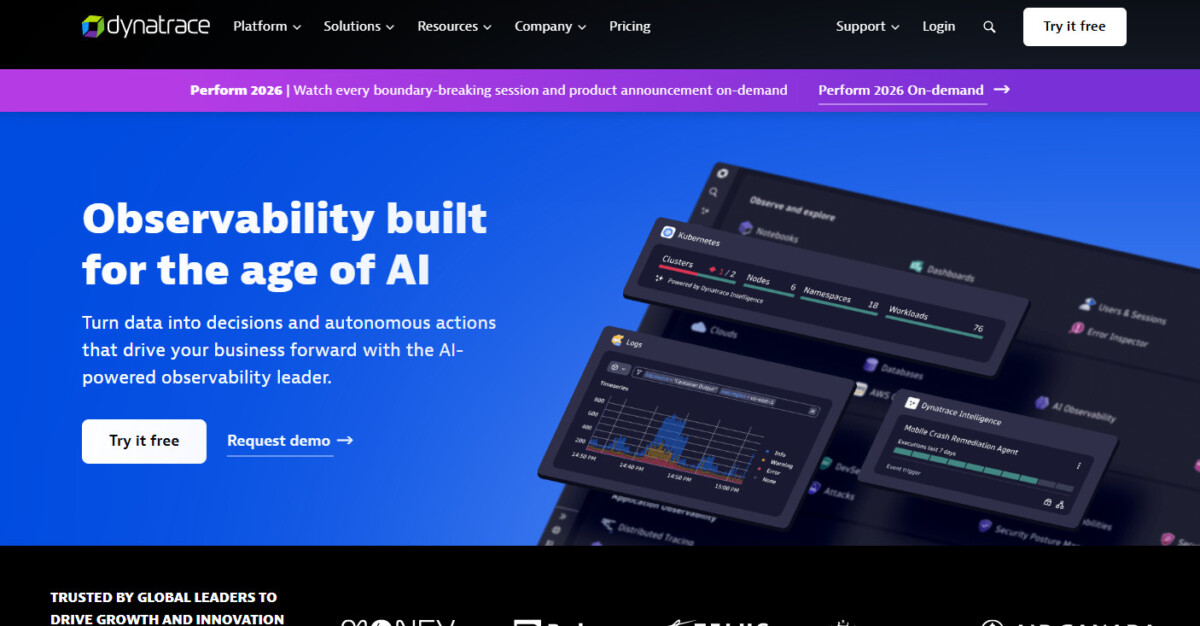
Dynatrace differentiates with its Davis AI engine, which automatically maps service dependencies and performs causal root-cause analysis. Gartner ranks Dynatrace highest in “Ability to Execute” among observability vendors. The platform targets large enterprises with complex, fast-moving microservice estates.
Usage-based with separate rate-card units. Full-Stack Monitoring at $0.01/memory-GiB-hour, Log Management ingest/process at $0.20/GiB, retain at $0.0007/GiB-day.
At 30TB/month: ~$20,000-$35,000+/month
Breakdown: 100 hosts x $0.08/hr x 8 GiB x 730 hrs ~$4,700 + log ingest 20TB x $0.20/GiB ~$4,100 + log retention ~$430 + traces/metrics/APM + commitment overhead.
Best for: OTel-first teams that want flexible dashboards and open-source foundations
Grafana Labs assembled the LGTM stack – Loki (logs), Grafana (dashboards), Tempo (traces), Mimir (metrics) – into a coherent observability platform. Grafana Cloud is the managed version. Paired with Grafana Alloy (an OTel Collector distribution), it provides dedicated OTLP endpoints that auto-route signals to the right backend. Best for teams already running Prometheus who want to extend to full observability without a forklift migration.
Usage-based across telemetry types. Logs: $0.05/GB process + $0.40/GB write + $0.10/GB retain. Traces: same structure. Metrics: $6.50/1k active series. Platform fee: $19/month.
At 30TB/month (managed cloud): ~$15,000-$20,000+/month
Breakdown: 20TB logs ~$11,000 + 7TB traces ~$3,500 + 500K metric series ~$4,000 + base. Adaptive Metrics/Logs features can reduce this materially.
Best for: Broad SaaS ecosystem coverage with the budget to manage billing complexity
Datadog is the largest commercial observability platform and New Relic’s most direct competitor. Its integration catalog (900+) and feature breadth are unmatched – APM, logs, security, RUM, synthetics, and network monitoring under one roof. The trade-off is cost: host-based pricing compounds quickly at scale, and custom metrics charges are a persistent source of bill shock.
Multi-dimensional billing: hosts + custom metrics + log ingestion ($0.10/GB) + log indexing (~$1.70/million events) + APM spans + RUM sessions. OTel metrics are often billed as custom metrics.
At 30TB/month: ~$30,000-$45,000+/month
Breakdown (30% logs indexed): 100 hosts ~$2,400 + log ingest 20TB ~$2,000 + log indexing ~$30,000 + APM spans ~$3,000-5,000 + custom metrics ~$5,000+. Log indexing is the dominant cost driver.
Best for: Teams already on the ELK stack who want to add APM without a new vendor
Elastic APM is the distributed tracing and application monitoring component of the Elastic Stack. For teams already indexing logs in Elasticsearch and visualizing in Kibana, adding APM is natural. It provides distributed tracing, service maps, error tracking, and MELT correlation. Note: Elastic APM’s OSS version reached end-of-service in September 2025 – evaluate managed options carefully for new deployments.
Self-hosted is free; you cover infrastructure. Elastic Cloud: consumption-based. Serverless Observability: Logs Essentials from $0.07/GB ingested + $0.017/GB retained/month.
At 30TB/month (Elastic Cloud): ~$8,000-$15,000/month
Best for: Developer-first teams that debug from code and user experience inward
Sentry is known for developer-first error monitoring that has grown into a broader application monitoring platform covering errors, tracing, logs, session replay, profiling, and cron monitoring. Best for developer-led teams that want fast issue triage without adopting a heavier infrastructure-first observability platform.
Event + usage-based. Team plan from $26/month base. Logs: $0.50/GB (Team PAYG). Spans: from $0.0000020/span above 5M.
At 30TB/month: ~$15,260/month
| Tool | Est. Cost @ 30TB/mo | Pricing Model | OTel Native | Data Residency | Self-Hosted |
|---|---|---|---|---|---|
| CubeAPM | ~$5,100/mo all-in | $0.15/GB ingestion-based | Native | Always (in-VPC) | Yes (vendor-managed) |
| Honeycomb | ~$5K-$24K | Usage-based | Native | Limited | Limited |
| Dynatrace | ~$20K-$35K+ | GiB-hour + commit | Partial | Managed option | Managed |
| Grafana Cloud | ~$15K-$20K+ | Usage-based | Native | If self-hosted | Yes |
| Datadog | ~$30K-$45K+ | Host + feature-based | Partial* | SaaS only | No |
| Elastic APM | ~$8K-$15K | Deployment-based | Partial | If self-hosted | Yes |
| Sentry | ~$15K-$32K | Event + usage | Partial | If self-hosted | Yes |
| New Relic (ref.) | ~$20K-$25K+ | Ingest + per-user | Partial | SaaS only | No |
* OTel metrics in Datadog are often billed as custom metrics. New Relic included as reference. All estimates use the methodology assumptions above. Vendor discounts and EDP commitments can significantly reduce SaaS costs.
Most comparison guides show pricing tiers. What they do not show is how those tiers combine – data ingest + user seats + synthetics + cloud egress – into a real monthly bill.
| Team Profile | Data / Users | New Relic /mo | CubeAPM /mo | Annual Saving | Saving % |
|---|---|---|---|---|---|
| Small team | 500 GB, 3 users | ~$458 | ~$75 | ~$4,596/yr | ~84% |
| Growing team | 5 TB, 10 users | ~$4,955 | ~$750 | ~$50,460/yr | ~85% |
| Mid-market | 30 TB, 50 users | ~$24,745 | ~$4,500 | ~$242,940/yr | ~82% |
| Enterprise | 200 TB, 150 users | ~$97,750 | ~$30,000 | ~$813,000/yr | ~69% |
New Relic costs: Standard plan, Original data ($0.40/GB beyond 100GB free), full platform users at $99 to $349 per user per month for full platform access. CubeAPM: $0.15/GB, no user fees. Enterprise pricing may include negotiated discounts not reflected here.
If you want to model your current New Relic bill before committing to a switch, the New Relic pricing calculator breaks down every cost dimension: data ingest, user seats, synthetics, and cloud egress fees most teams overlook.
When you send telemetry to any external SaaS platform – New Relic, Datadog, or any cloud-hosted alternative – your cloud provider charges approximately $0.10/GB for data leaving your VPC. At 30TB/month, that is $3,000/month in AWS or GCP egress fees, which does not appear on your observability invoice. Self-hosted platforms running inside your VPC have zero data-out cost.
Migration anxiety is real – you have built dashboards, tuned alerts, and accumulated operational knowledge in New Relic over months or years. The good news: switching to an OpenTelemetry-native platform is structurally less painful than previous APM migrations. Once your services emit OTLP data, you can point that data at any compatible backend with a configuration change rather than re-instrumentation.
| Week | Focus | Key Actions | Exit Criteria |
|---|---|---|---|
| 1 | Instrument inventory | List every service using NR agents. Map data volumes per service. Choose target platform. | Full inventory. Platform selected. |
| 2 | Parallel run | Deploy OTel Collector alongside NR agents on 1-2 non-critical services. Dual-write telemetry. Compare dashboards. | Traces/metrics parity confirmed on pilot services. |
| 3 | Dashboard migration | Recreate top 10 critical dashboards and all active alerts. Validate alert accuracy. Remove NR agents from pilot services. | Critical dashboards live. Alert parity verified. |
| 4 | Full cutover | Roll OTel agents to remaining services. Cancel NR agents service-by-service. Run NR in read-only mode for 2 weeks. | All services on new platform. NR agents decommissioned. |
Practical note: Run both platforms simultaneously for at least two weeks before cancelling New Relic. Teams consistently discover dashboards they forgot existed, alerts that were silently firing, or integrations that depended on NR’s API. Document what each dashboard is measuring, not the NRQL syntax, before migrating.
New Relic is still the right choice for teams that want a broad commercial observability platform with strong full-stack coverage in one SaaS environment.
There is no single best New Relic alternative for every team. The right choice in 2026 depends on what matters most: pricing clarity, deployment model, OpenTelemetry fit, Kubernetes visibility, or day-two operational effort.
The practical decision tree is straightforward. If compliance or data residency is a hard requirement, self-hosted platforms are the only viable path – most SaaS alternatives do not solve this structurally. If cost is the primary driver, model your bill across data volume, user count, and cloud egress before committing – the gap between GB-based pricing and multi-dimensional billing models is often larger than teams expect. If enterprise automation is the priority, the AI-led platforms justify their premium for complex environments. If high-cardinality debugging and event-driven observability matter most, newer OTel-first platforms offer a fundamentally different investigation model.
Compare your top two options against your actual telemetry volume, deployment needs, and budget before making the switch. The numbers at your scale will make the decision clearer than any feature matrix.
*Methodology: 30TB/month (~20TB logs, 7TB traces, 3TB metrics), 30% log indexing, 500K metric series, core observability only. Based on public rate cards, early 2026. Vendor discounts and EDP commitments can significantly reduce SaaS costs.*
What is the best New Relic alternative in 2026?
There is no single best option for every team. For cost predictability and data sovereignty, self-hosted OTel-native platforms offer the strongest structural advantages. Datadog for the broadest SaaS ecosystem. Dynatrace for enterprise AI automation. Grafana for dashboards and OpenTelemetry flexibility. Honeycomb for high-cardinality distributed tracing. Sentry for developer-first error monitoring.
Which New Relic alternative is best for self-hosting?
Grafana (LGTM stack) and Elastic APM support fully self-managed deployment. For teams that want self-hosted observability without managing the backend themselves, vendor-managed self-hosted options exist that handle platform operations within your VPC.
Is Datadog better than New Relic?
Not across the board. Datadog has the largest integration ecosystem and strongest cloud-native monitoring breadth. New Relic remains strong for teams that want broad observability with OTLP ingest and a mature commercial platform. Both are significantly more expensive than OTel-native alternatives at the same data volume.
What is the cheapest New Relic alternative?
For teams below the free tier (1 user + 100GB/month), New Relic’s free tier is hard to beat. Beyond that, platforms with flat per-GB pricing and no per-user fees offer the lowest TCO at most team sizes – particularly when cloud egress savings are included in the calculation.
Can I use OpenTelemetry to replace New Relic agents?
Yes, and this is the recommended migration path. New Relic’s proprietary agents can be replaced with the OTel SDK for your language and the OTel Collector for batching and routing. New Relic itself accepts OTLP data, so you can migrate instrumentation to OTel without changing backends first – then point the Collector at your new platform when ready.
What happens to my data when I cancel New Relic?
New Relic retains your data according to your plan’s retention period after cancellation (8 days on Original plan, 90 days on Data Plus). After that, the data is deleted. This is why running your new platform in parallel for 2-4 weeks before cancelling is important.
What is Honeycomb best for compared to traditional APM?
Honeycomb excels at high-cardinality event debugging and distributed tracing. Unlike traditional APM platforms that aggregate metrics and sample traces, Honeycomb stores wide events and derives all views from them. This makes it exceptionally powerful for debugging complex microservice interactions where traditional sampling would lose the signal.





