

A few years ago, an eCommerce solution could do its job with a storefront, checkout, and a few integrations. That is no longer enough.
Brands now expect the same system to support better product discovery, cleaner data flow, stronger marketing execution, more complex buying journeys, and a growing layer of AI-driven work.
So, an eCommerce solution is no longer just the software that helps a store function. It is the system that has to support growth without creating friction somewhere else.
Source: https://www.pexels.com/photo/shopping-cart-next-to-a-laptop-5632397/
The old definition started to break once brands began stacking more work on top of the storefront itself.
Product content, campaign assets, merchandising decisions, customer experience flows, and support workflows now involve AI in all sorts of ways. For some teams, that even means using a tool for humanizing AI content before product descriptions, emails, or ad copy go live.
That broader workload is not just a feeling. Recent eCommerce trends point in the same direction.
In a 2025 DHL eCommerce report, 7 in 10 global shoppers said they want AI-powered shopping features, 81% said they abandon carts when their preferred delivery options are missing, and 70% said they expect to shop mainly through social media by 2030.
Those numbers show how much pressure now sits on the stack. A store can look polished and still lose sales if the system behind it cannot keep up.
That is why the phrase eCommerce solution now means something bigger than “platform.” It means the setup that connects content, conversion, operations, and adaptation. If one part lags, the whole experience starts to wobble.
The useful question is no longer whether AI belongs in commerce. It already does. The question is what kind of AI pressure a modern setup can absorb without turning into a patchwork of tools and workarounds.
AI eCommerce is moving from experimentation to expectation. Retail teams now use AI for product recommendations, search, customer support, content generation, forecasting, and campaign work. The more those use cases spread, the less room there is for a brittle stack.
According to NVIDIA’s 2025 retail AI findings, 9 out of 10 retailers are adopting or piloting AI, and more than half are already using it across more than six use cases. That is a strong signal. Serious brands are not treating AI for eCommerce as one flashy feature. They are building it into everyday operations.
This is where a lot of teams hit a wall. They buy separate AI tools for eCommerce business, but the core stack still cannot support the workflow cleanly. Product data is messy. Search is weak. Marketing tools do not talk to the platform properly. Copy gets generated faster than it can be reviewed. The result is more output, not necessarily better execution.
A competitive eCommerce solution in 2026 needs to make AI usable, not just available. That means it should support clean data flow, flexible integrations, fast content updates, and enough control to keep automation from creating chaos.
B2B is where weak infrastructure becomes obvious.
A lot of B2B eCommerce platform setups can survive a simple DTC flow. They start struggling when buyers expect negotiated pricing, real-time inventory, account-based access, repeat ordering, approval chains, or sales-assisted journeys.
The buyer data is blunt. In Sana Commerce’s 2025 B2B buyer report, 73% of buyers said they prefer online purchasing, 85% said they run into barriers caused by outdated systems or inaccurate data, and 75% said those frustrations could make them switch suppliers. On top of that, more than 46% wanted real-time inventory updates, 42% wanted better search, and 41% wanted better filtering.
A modern eCommerce solution should not force buyers to leave self-service mode just to get accurate stock data, usable search, or a sensible reorder flow. When those basics fail, the platform is not just inconvenient. It becomes expensive.
Source: https://www.pexels.com/photo/a-woman-holding-a-smartphone-6214132/
Teams still talk about eCommerce digital marketing as if it sits on top of the platform. In practice, it now depends on the platform more than many brands want to admit.
Search is a good example. If search is weak, product discovery suffers. If product data is inconsistent, segmentation suffers. If the system cannot handle timely updates, campaigns go live with sloppy landing experiences. That is how marketing problems quietly turn out to be infrastructure problems.
The same is true for personalization. It is easy to say a brand wants better targeting, smarter recommendations, and more relevant lifecycle flows. It is harder to do any of that when the system behind the store cannot move data cleanly or adapt fast enough.
The platform shapes how well paid traffic lands, how easily products are found, how quickly promotions are updated, and how much room the team has to test new ideas without breaking something else.
That changes the standard. A strong eCommerce solution should actively support marketing.
Here is the clearest way to read the pressure building around eCommerce infrastructure:
| Capability area | Strongest data point | What it signals | What an eCommerce solution must support |
| AI readiness | 9 in 10 retailers are adopting or piloting AI | AI is moving into normal operations | flexible integrations, automation, usable data |
| AI depth | 50%+ use AI across more than six use cases | Brands are going beyond small experiments | support for content, search, service, forecasting |
| Buyer expectations | 73% of B2B buyers prefer online purchasing | Digital buying is no longer optional | reliable self-service, account support, easy reordering |
| System friction | 85% hit barriers from outdated systems or inaccurate data | Weak infrastructure now blocks revenue | synced data, pricing accuracy, inventory visibility |
| Supplier risk | 75% would consider switching suppliers over poor experience | Bad digital experiences create churn | fast, stable, buyer-friendly workflows |
| Discovery pressure | 42% want better search; 41% want better filtering | Product discovery is still a major weak point | stronger search logic, filtering, catalog control |
| Delivery pressure | 81% abandon carts without preferred delivery options | Ops issues now directly affect conversion | delivery options, fulfillment clarity, checkout flexibility |
| Channel shift | 70% expect social commerce to dominate by 2030 | Commerce is spreading beyond the storefront | adaptable channel support, content agility |
The pattern is hard to miss. The modern eCommerce solution is being judged on how well it supports change.
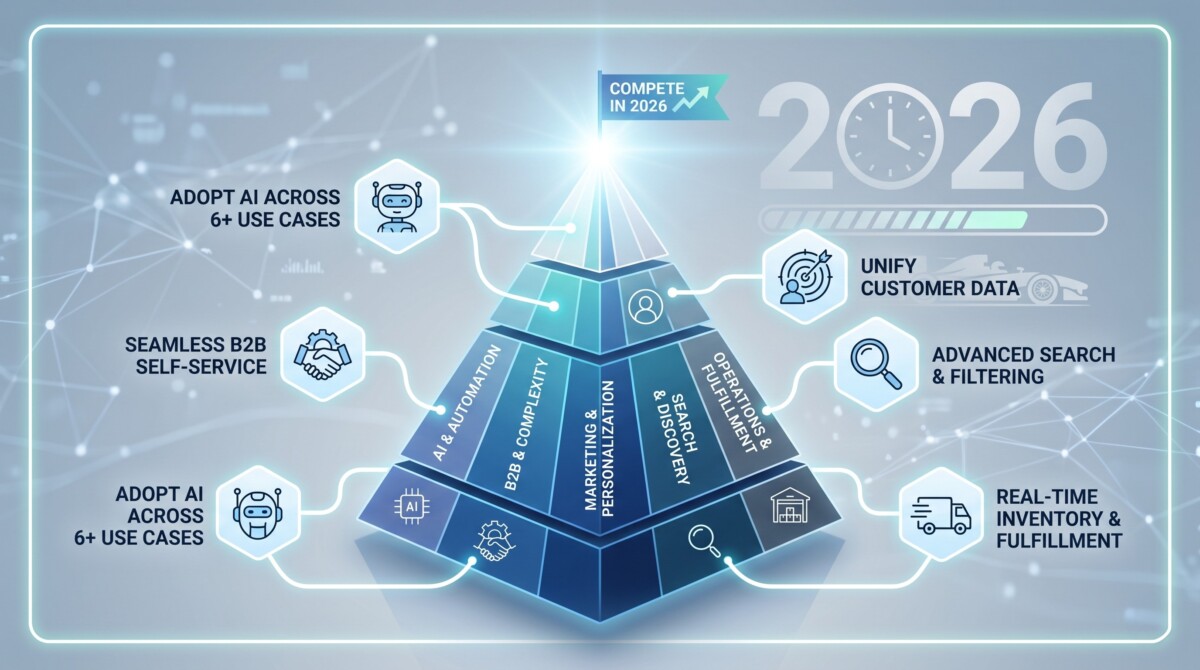
A competitive eCommerce solution in 2026 should be able to support AI without turning into tool sprawl. It should handle B2B complexity without forcing buyers into manual workarounds. It should make search, filtering, merchandising, and content updates easier.
It should give marketing teams enough flexibility to move quickly without running into broken data or clumsy integrations. And it should keep operational problems from leaking into conversion.
That does not mean every brand needs the biggest stack on the market. It does mean that “good enough” has become a much narrower category.
The old definition of an eCommerce solution was built for a simpler job. The one that brands need now has to carry far more weight.
AI is spreading across daily workflows. B2B buyers expect more from digital purchasing. Search, filtering, fulfillment, and marketing execution all put more strain on the system than they did a few years ago.
That is what the data shows. A competitive eCommerce solution is no longer defined by whether it can run a store. It is defined by whether it can support growth without becoming the bottleneck.





