

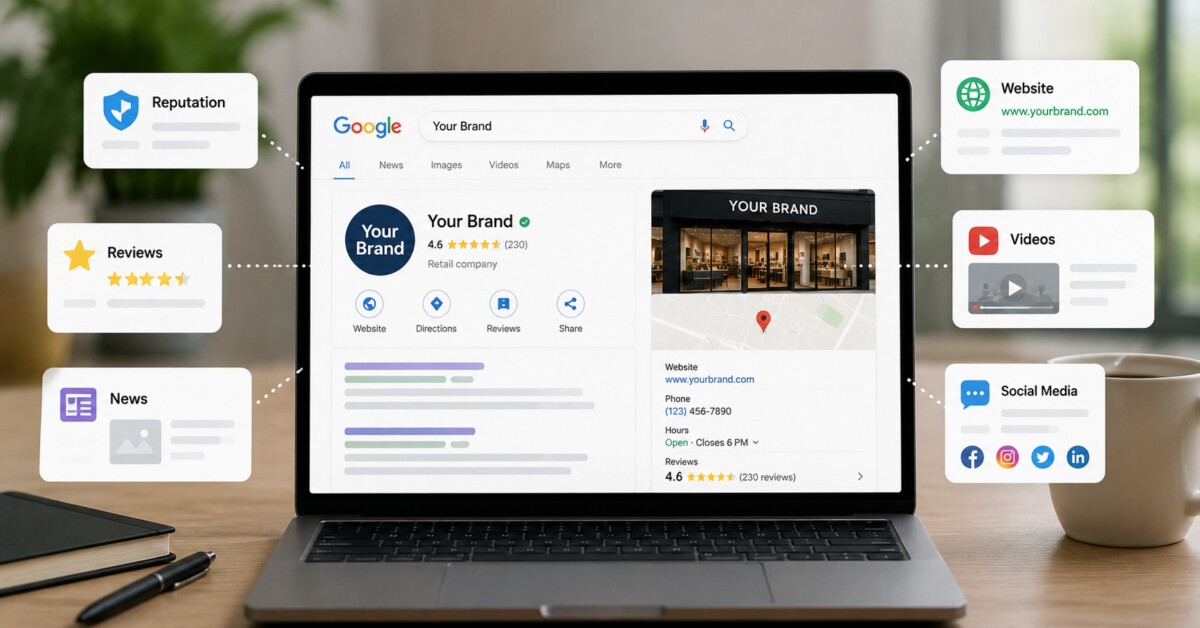
The first ten seconds of a branded Google search can either reinforce trust or plant doubts—founders who ignore that page leave a critical part of their sales funnel unmanaged.
You have spent months building your Shopify store, running paid social campaigns, and growing your email list. Then a wholesale partner or potential high-value customer searches your name with your brand. What they see in the first ten seconds can either build trust or raise doubts.
This article shows what usually comes up when customers Google a DTC founder, why it matters for your business, and how you can handle it.
A branded search result in real time is rarely just information on your website. Depending on your digital footprint, when someone looks up your business online, the first page usually includes:
When it comes to these results, Google plays a huge role. For one, it creates knowledge panels automatically when it finds enough reliable information about your company online. These panels can pull from several sources. However, verified representatives can sometimes claim them and suggest corrections.
The questions that people ask about your brand are another great source that is generated automatically. Google calls them related questions that help users dig deeper into a topic. As a founder, you can’t directly control which questions show up, but they still boost your visibility online.
That said, have you tried searching your full name and brand in an incognito window within the last six months?
In raising your brand’s credibility online, it’s easy for search results to mess things up. Just imagine a buyer finding your home address, an abandoned social account, or outdated company information. None of these may prove that your business is unreliable, but they can plant unnecessary doubts at the very moment a buyer should be moving closer to a decision.
This matters because signals from third parties have been found to influence buying decisions. Baymard’s DTC research found that shoppers often place greater trust in external reviews than the ones displayed on a brand’s website. In other words, visible social proof has real power and can drive conversions.
Beyond business concerns, having personal details show up online can create risks you don’t want. Competitors can use them for targeted outreach, and bad actors can even use them to contact relatives or employees.

No doubt, it can feel like you have no control over the search results of your brand. The truth is Google offers you several controls. While none of these gives you complete ownership of the results page, you can still shape how you show up.
For instance, Google’s Results About You lets you track searches for things like home address, phone number, and email. You can access them through your Google account, review detected results, request removals, and get alerts when new matches appear.
Google can also consider removing sensitive details like government ID numbers, financial info, or login credentials through its detailed removal form.
Unlike in Europe, US users do not have the same general “Right to be Forgotten”. The EU process allows eligible individuals to ask Google to remove information online that’s inaccurate, irrelevant, inadequate, or excessive.
In the US, removals depend on Google’s content policies, state laws, and other regulations. Google here also does not publish one clear approval rate for all US Results About You requests.
The good thing is that people often search for how to remove personal information from Google for free, nd the process is straightforward. With just a few steps, you can take direct control over what appears about you online.
On the net today, where data broker websites are common, your search results may face another layer of scrutiny. These sites collect information from public records, social accounts, and other brokers. Even the Federal Trade Commission notes that they often publish details like phone numbers, home addresses, professional licenses, and court records of individuals.
In these brokers’ cases, standing sites such as Whitepages, Spokeo, Intelius, and BeenVerified can rank instead when someone searches a founder’s full name. That means customers may get to see a broker profile of you before they even reach your official biography.
On the flip side, submitting a Google removal request does not solve this source problem. That’s where automated services such as Incogni come in, as they allow you to submit removal requests across multiple brokers and monitor whether deleted information reappears.

Deleting unnecessary information is just a small step to managing your search presence. You also need to create credible results that reflect your experience and business accurately. You can do these through:
These are pages that give customers more useful information about what you do and push irrelevant pages further down. That’s why your company website should include a clear founder biography, consistent business details, and links to official social profiles. And don’t forget: your Google Business Profile needs to stay updated.
Running a quarterly branded search audit is one of the easiest ways to stay aware of your online reputation. So, what you do here is come back every three months and take the time to search for the following:
Check the first ten results for broker listings, old profiles, inaccurate company information, unexpected images, and unanswered reviews. Take a look at the problems, record them, assign an owner, and check them again during your next audit. Also take the time to decide how closely you want you, as the founder, to be linked to the company.
To wrap this up, the Google results page is a valuable space that many DTC founders leave unmanaged. So ask yourself: Does the time you spend adjusting paid social campaigns match the time you spend checking what customers see when they search your name?
When someone searches your full name plus your brand, they typically see a mix of your store and product pages, your Google Business Profile, possible knowledge panels, “People also ask” questions, LinkedIn and social accounts, external review sites, and older content such as interviews or forum posts. Treat this mix as your public trust surface and audit it regularly.
You cannot fully control Google’s rankings or which third-party sites exist, but you can influence what appears. Using “Results About You” and Google’s removal tools, you can request removal of certain personal and sensitive information. Beyond that, publishing strong, up-to-date content on reputable sites and profiles helps push undesirable results down.
Data broker sites can rank for your name and show detailed personal info before users reach your official biography, which can create privacy and perception issues. Removing such pages from Google doesn’t erase them from broker databases, so you may need to use broker opt-out processes or automated services to clear those records at the source.
A quarterly audit is a practical baseline. Every three months, search for your name, your name plus brand, brand plus “reviews” and “complaints”, and your contact details. Check the top results for outdated, inaccurate, or risky information, and track improvements over time.
First, log into Google and enable “Results About You” to monitor and request removal of personal contact details. Second, identify any high-ranking broker or outdated pages and follow their opt-out or update processes. Third, publish or refine a strong founder biography, LinkedIn profile, and external reviews so that credible content starts taking up more space on the first page.
Would you like a ready-to-use checklist you can copy into your next quarterly search audit so you can run it in 15 minutes instead of starting from scratch?





