

18th
July, 2025
Amazon is a highly competitive e-commerce marketplace where prices can change multiple times a day. Amazon sellers need smart strategies to stay competitive, including marketing tactics and pricing optimization. One powerful pricing strategy is using an Amazon repricer tool. In this blog, we’ll explain what an Amazon repricer tool is, how it works, how to use one, and why it’s beneficial. We’ll also touch on tips, best practices, and how repricing fits into a broader success strategy for sellers (including leveraging micro influencers, content creators, and UGC). This comprehensive guide is written in a casual, informative tone – whether you’re a new seller or an advanced seller, you’ll find valuable insights here.
Pricing competitively on Amazon is crucial. If your prices are too high, shoppers will choose a cheaper option; if too low, you might hurt your profits or devalue your product. Most buyers on Amazon purchase through the Buy Box (approximately 82% of sales go through the Buy Box), meaning that if you’re not offering a competitive price, you’re likely missing out on the majority of potential sales.
At the same time, maintaining a good price is a balancing act – you need to stay competitive and profitable. This is where repricing tools come in. Repricers can adjust your prices in real-time to respond to market changes, helping you win the Buy Box while protecting your profit margins. Before diving into details, let’s clarify what exactly an Amazon repricer tool is.
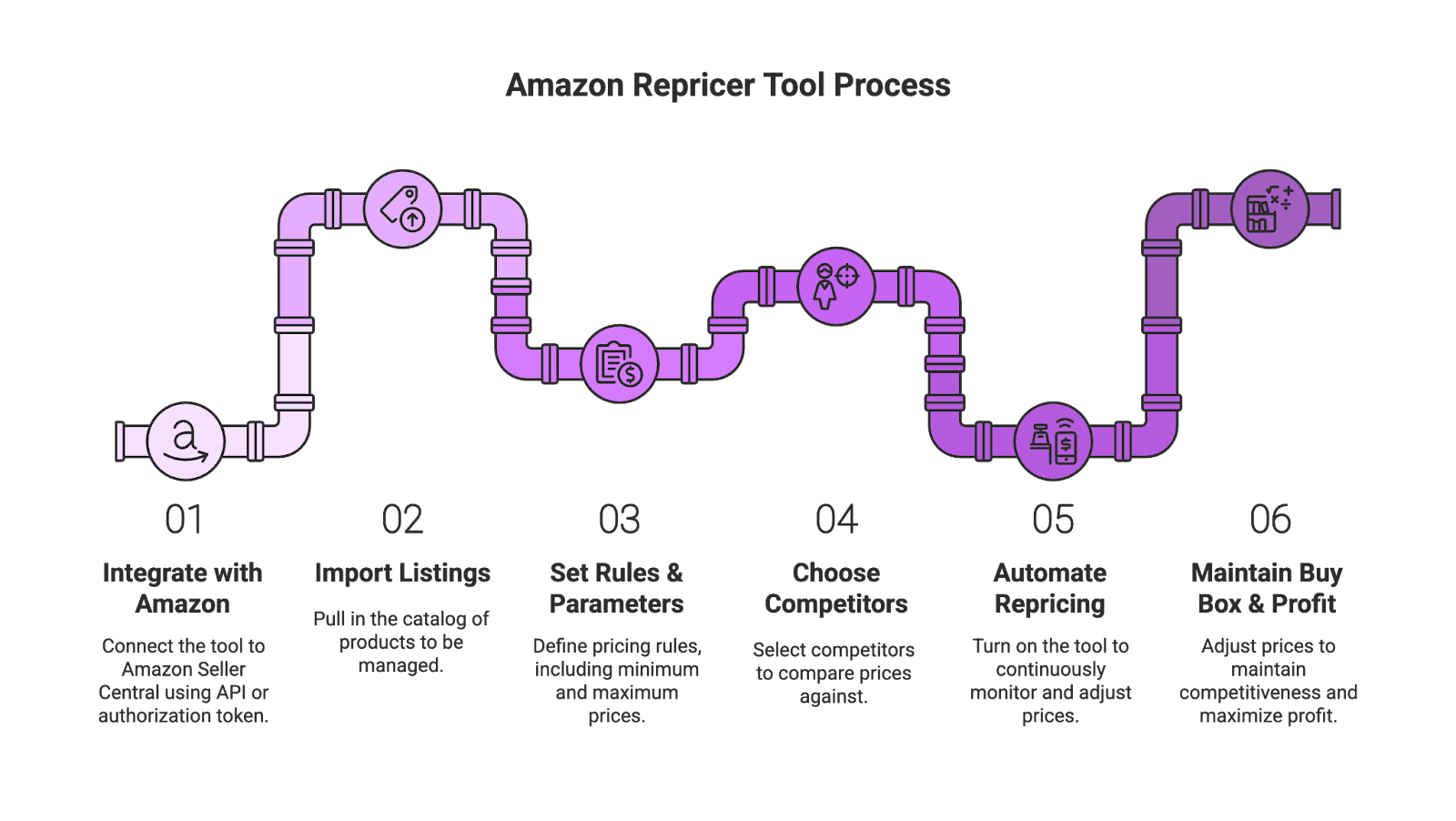
An Amazon repricer tool is software that automatically adjusts the prices of your Amazon products based on rules and parameters you set. In other words, a repricer continuously monitors the market (such as your competitors’ prices on the same product listing) and changes your price up or down to keep you competitive. The primary goal is usually to win the Buy Box and increase sales, without you having to manually update prices all day.
A simple way to think of a repricer: it’s like an autopilot for your Amazon pricing. You input the guidelines (for example, your minimum price, maximum price, and strategy for undercutting or matching competitors), and the repricer will take care of the rest 24/7. This is especially useful on Amazon because many sellers might be offering the same product; the one with the optimal price and seller performance wins the sale most of the time.
Manual pricing vs. automatic repricing: To appreciate a repricer, consider how sellers often adjust prices manually. Manual repricing means you (or your team) regularly check competitor prices and update your listings by hand. While this can work for a very small catalog or for fine-tuned strategies, it’s incredibly time-consuming and hard to scale. As the competitor Jungle Scout notes, manually repricing many listings “can become tedious and time-consuming”, and it “lacks the speed and responsiveness needed in a fast-paced marketplace like Amazon”. Automatic repricers solve this by handling the repetitive work instantly.
In summary, Amazon repricer tools do the heavy lifting of price adjustment for you. Sellers use them to save time, avoid missing out on sales due to slow price changes, and to maintain optimal pricing around the clock. Next, let’s see how these tools actually work in practice.
While each repricing software may have its own interface and features, most Amazon repricers work in a similar fundamental way. Here’s a breakdown of how a typical repricer operates:
It’s worth noting that there are different types of repricing strategies available:
Amazon’s own Automate Pricing tool vs. third-party repricers: Amazon provides a free built-in tool called Automate Pricing in Seller Central. It allows you to create rules to adjust prices against the Buy Box or lowest price, within min/max bounds. The Amazon tool is easy to use and costs nothing, making it a good starting point. However, it has limited features compared to many third-party repricers. For instance, Amazon’s tool is rule-based and offers basic rules (match or beat Buy Box/lowest price by X amount), whereas external repricing software can offer more sophisticated strategies, richer analytics, and support for multiple marketplaces. Third-party tools often use algorithmic repricing and provide better reporting and customization, though they come with subscription fees. Here’s a quick comparison:
|
Aspect |
Amazon’s Free Automate Pricing |
Third-Party Repricer Tools |
|
Availability |
Built-in for all Amazon sellers (no extra integration needed) |
External software, requires linking to your Amazon account |
|
Cost |
Free |
Subscription cost (varies by tool; often tiered by number of listings or revenue) |
|
Ease of Use |
Very easy, simple setup through Seller Central interface |
Generally user-friendly, but may have learning curve for advanced features |
|
Features & Rules |
Basic rules (match or beat prices, set min/max) |
Advanced options: AI/algorithmic repricing, custom strategies, competitor filtering, scheduling, etc. |
|
Analytics |
Basic reporting (limited insights) |
Detailed analytics and dashboards (track Buy Box % over time, profit, etc.) |
|
Speed |
Can react in near-real-time (Amazon’s own system is quite fast) |
Many third-party tools boast near-instant repricing (some claim changes within 2-15 minutes or faster) |
In short, Amazon’s Automate Pricing tool is a great free way to dip your toes into repricing, but many serious Amazon sellers opt for third-party Amazon repricing software for more powerful features as their business grows. (Note: If you’re just starting out, you might try Amazon’s tool first; if you need more sophistication, explore popular third-party repricers like Informed.co, BQool, Seller Snap, Aura, and others.)
Now that we know what repricers do, let’s talk about why you might want to use one. Here are the main benefits of using an Amazon repricer tool for Amazon sellers:

To illustrate the difference a repricer can make, consider a simple scenario visualized below. Suppose you and a competitor are both selling the same product which initially is priced at $20. Over a few days, the competitor changes their price, and if you don’t respond quickly, you lose the Buy Box.
Example chart: A competitor drops their price, and the seller with a repricer immediately matches/undercuts and later raises price when competitor goes out of stock, whereas the manual seller reacts late or not at all. This leads to the repricer user winning more sales and even earning higher profits once competition is gone.
In the chart above, the green line shows your price with an automated repricer, and the blue line shows your price if you were manually pricing (in this example, the manual seller kept the price at $20 the whole time). The red line is a competitor’s price. Here’s what happens:
This example shows how a repricer helps win sales when competition is present, and maximize profit when competition is absent – all automatically. Manual pricing often cannot keep up with these rapid changes.
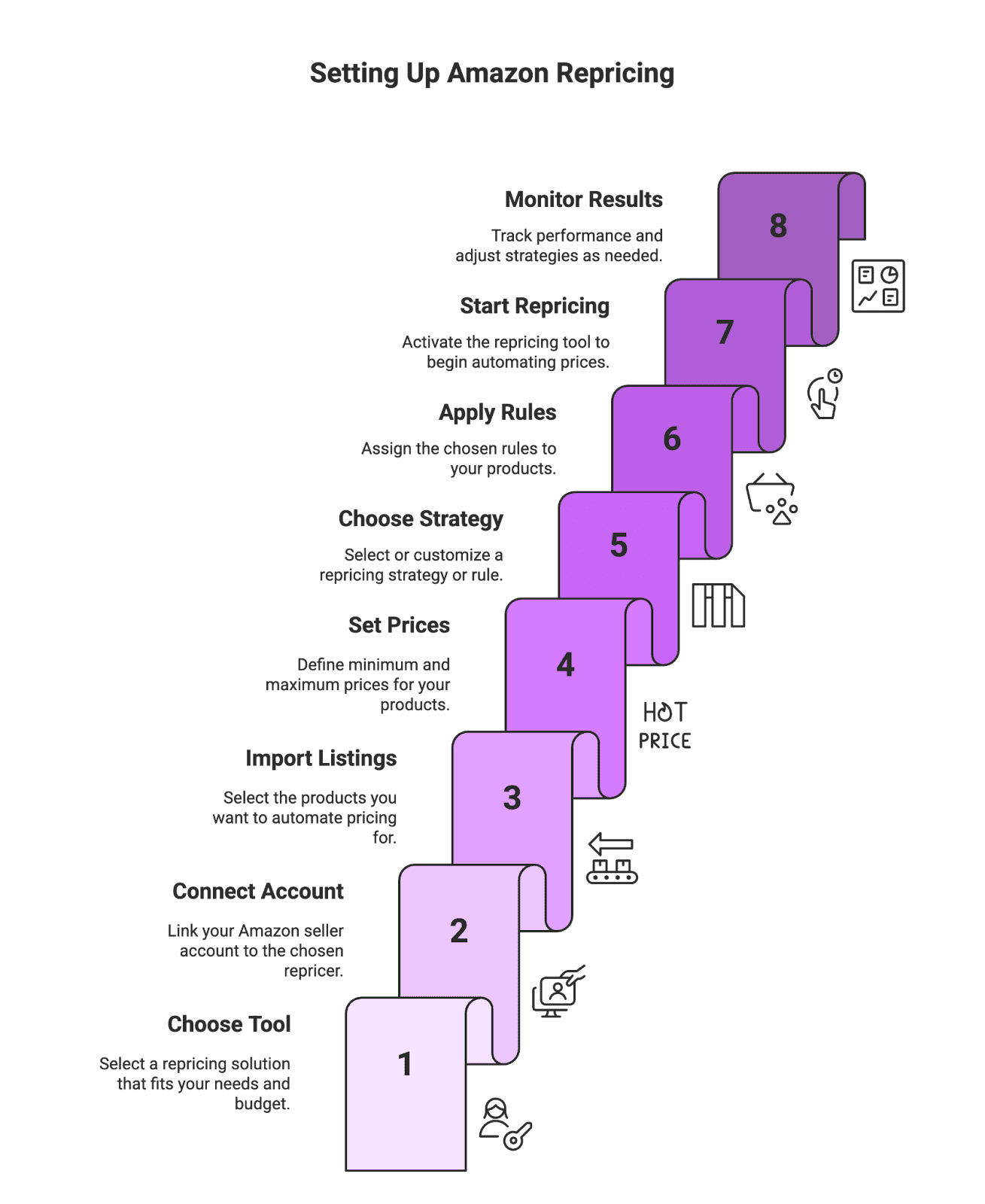
Using an Amazon repricer is generally straightforward. Here’s a step-by-step guide on how you would typically set up and use a repricer:
Using a repricer effectively is about finding the right balance – you let the tool handle the minute-by-minute changes, but you still guide the overall strategy and adjust as needed. It’s also important to coordinate your repricing with your overall business strategy. For example, if you have marketing campaigns or seasonal promotions, you might adjust pricing rules during those periods. Some sellers even use higher prices when their product is trending due to social media buzz (often created by micro influencers or holiday seasons) to capitalize on increased demand, and lower prices during slower periods to stay competitive.
To get the most out of an Amazon repricer tool, keep in mind these best practices:
Speaking of marketing, let’s touch on that in relation to repricing.
While using an Amazon repricer tool can give you a competitive edge on price, it’s important to remember that price isn’t everything in e-commerce. Shoppers consider value, which includes your product reviews, descriptions, images, and overall brand trust. This is where content and marketing come in:
In essence, think of repricing as one tool in your toolkit. To truly optimize your Amazon business, blend pricing strategy with great content, influencer-driven marketing, and stellar customer experience. Each complements the other: a strong brand and marketing can allow higher pricing power, and a repricer ensures you don’t lose competitive edge on price when it matters.
For completeness, let’s quickly summarize the advantages and potential downsides of using an Amazon repricer tool:
Pros:
Despite these cons, the e-commerce marketplace climate (especially on Amazon) has made repricers almost a must-have for many sellers. The pros usually far outweigh the cons when used correctly, as evidenced by the popularity of repricing tools among Amazon sellers – after all, “using a tool that saves you a lot of time and helps update thousands of prices in seconds improves your workflow”.
An Amazon repricer tool is a powerful asset for any serious Amazon seller looking to stay competitive in pricing. It automates the tedious task of price adjustment, helps win the Buy Box (which is critical given around 82% of sales come from that Buy Box), and frees you up to focus on other aspects of your business. Whether you use Amazon’s free Automate Pricing tool or invest in a more advanced third-party repricer, the goal is the same: optimal pricing at all times to maximize sales and profits.
However, success on Amazon comes from excelling on multiple fronts. Competitive pricing will get customers in the door (or rather, into your Amazon listing), but great content and marketing will close the deal and bring them back for more. Consider complementing your repricing strategy with efforts to build your brand – for example, engaging micro influencers to create buzz and generate UGC, improving your product listings, and providing excellent customer service. By doing so, you’re not only competing on price but also creating value that justifies your price.
In the ever-evolving world of e-commerce, tools like repricers and platforms like Stack Influence can both play a role in your success – one handles the numbers side of things (price optimization), and the other handles the people side (building trust and desire through influencers and content creators). Utilizing both will stack the odds in your favor (pun intended). Happy selling, and may your prices (and profits) always be optimized!

By William Gasner
CMO at Stack Influence
William Gasner is the CMO of Stack Influence, he’s a 6X founder, a 7-Figure eCommerce seller, and has been featured in leading publications like Forbes, Business Insider, and Wired for his thoughts on the influencer marketing and eCommerce industries.
Want new articles before they get published? Subscribe to our Awesome Newsletter.
111 NE 1st St, 8th Floor
Miami, FL 33132


© 2025 Stack Influence Inc
© 2025 Stack Influence Inc
The post What Is an Amazon Repricer Tool? – A Complete Guide for Amazon Sellers appeared first on Stack Influence.





