

11th
August, 2025
In the ultra-competitive world of e-commerce, understanding your website’s user flow is crucial for converting visitors into customers. Whether you’re an Amazon seller or a brand leveraging micro-influencers, content creators, and user-generated content (UGC) for marketing, mapping out the e-commerce user flow can dramatically improve your results. From the first click (often driven by social media buzz or influencer recommendations) to the final checkout, every step of the customer’s journey needs to be smooth and optimized. In this comprehensive guide, we’ll break down what e-commerce user flow means, why it matters, and how to optimize it – including tips for beginners and advanced marketers alike, plus insights on integrating micro-influencer and UGC strategies (with a nod to platforms like Stack Influence that help brands scale these efforts).
User flow refers to the path or sequence of steps that a user takes to complete a goal on your website. In an e-commerce context, this typically means the journey from first arriving on your site (or product page) all the way through to making a purchase (and beyond). In simple terms, an e-commerce user flow is “the steps a user takes through your website to complete a particular task,” such as discovering a product or buying an item. It’s essentially a map of the customer’s journey on your online store.
Critically, e-commerce user flows are tied to the stages of the customer lifecycle – from initial awareness to final decision. If you can’t guide users from landing page to purchase, then all the traffic in the world won’t boost your sales. A well-designed user flow ensures that at each stage (browsing, product viewing, adding to cart, checkout, etc.), the user’s experience is intuitive and free of friction. The result? More people complete their purchase instead of dropping off halfway.
Key point: E-commerce user flows differ from, say, a content blog’s user flow because they’re transaction-focused – the goal is to smoothly lead a customer toward buying something. Every extra click, confusing page, or distraction in the flow is an opportunity for the user to abandon the process. In fact, industry research shows that on average around 70% of online shopping carts are abandoned without purchase. That means the majority of shoppers start the buying process but don’t finish it – often due to obstacles or hesitation during the user flow. This is why optimizing each step of the funnel is so important for e-commerce success.
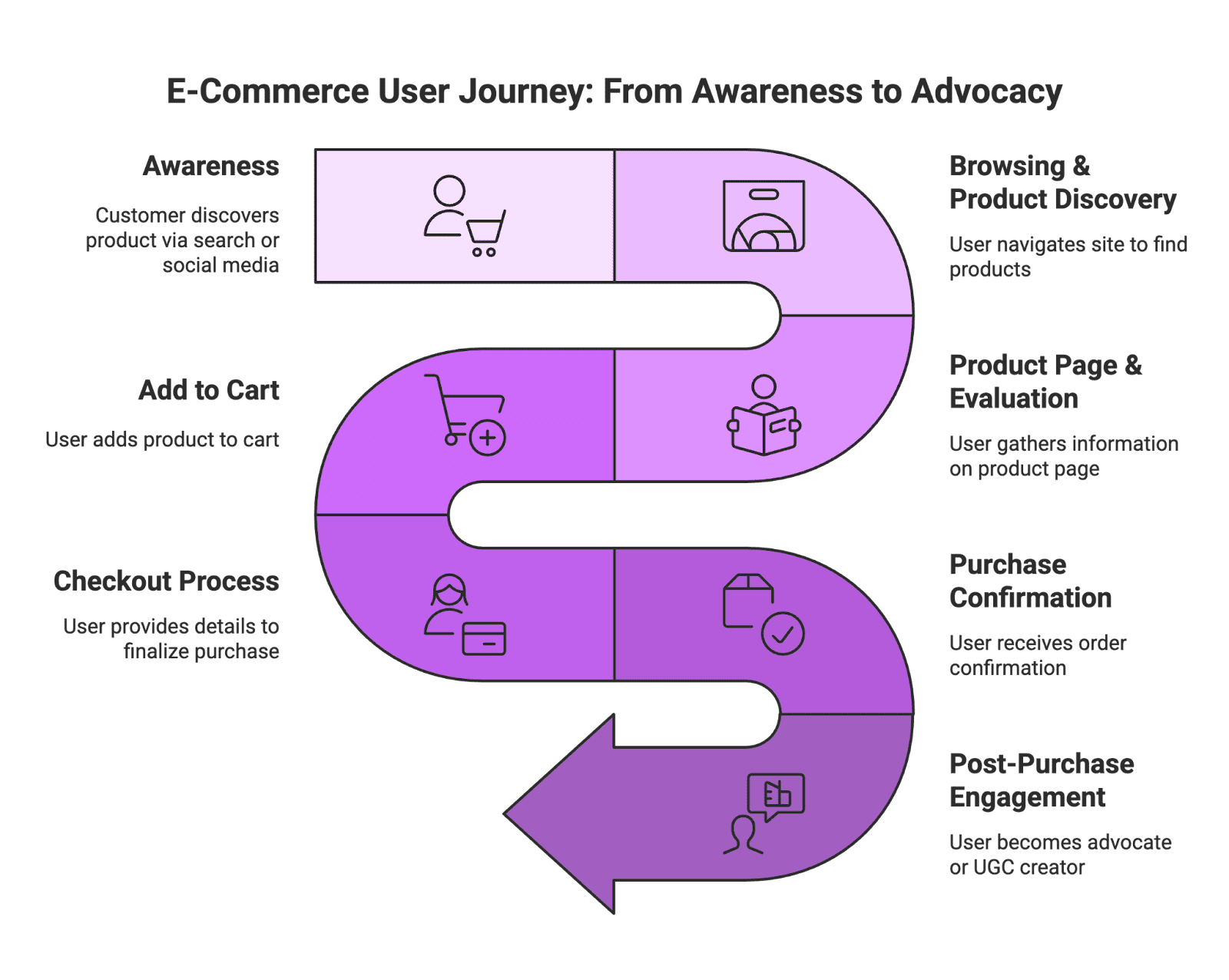
While user flows can vary depending on the business and product, most e-commerce customer journeys include similar core steps. Below is a breakdown of a typical user flow for an online store, from the visitor’s entry point through conversion and beyond:
Example of an e-commerce user flow from initial awareness to post-purchase stages. The flow starts with a user discovering the site (often via search, social media, or an influencer’s link), then browsing and viewing a product, adding it to the cart, proceeding through checkout, and finally completing the purchase. Post-purchase actions (like leaving a review or sharing UGC on social platforms) feed back into the cycle by influencing future shoppers.
Optimizing your e-commerce user flow is directly tied to higher conversion rates and a better user experience (UX). Each stage of the flow is a potential drop-off point, so smoothing out the journey can yield significant gains. Let’s consider a hypothetical funnel of 100 visitors entering an online store:
Example of an e-commerce conversion funnel, illustrating the percentage of users remaining at each stage (hypothetical data). Out of 100 visitors to the site, a fraction view a product, an even smaller fraction add an item to the cart, and ultimately only a percentage complete the purchase. Many users drop off at each step, which is why optimizing the flow at every stage is crucial.
In the example funnel above, only 10% of visitors ended up purchasing (a number not far from reality for many sites). This drop-off happens for various reasons: some visitors aren’t ready to buy, but many could have purchased if their experience was better. Common pain points include unclear navigation, slow-loading pages, lack of trust, or a complicated checkout process. By identifying and fixing these issues, you reduce friction. Even modest improvements at each step can add up to a big increase in overall conversion. For instance, simplifying the checkout form or adding more payment options might reduce cart abandonment. (It’s worth noting again that roughly 70% of shoppers abandon carts before completing checkout – a metric that good UX design aims to improve upon.)
Moreover, optimizing user flow isn’t just about preventing negatives (drops or abandons); it’s also about encouraging positives – guiding and persuading the user onward. This is where elements like design, copywriting, and social proof intersect with user flow. If a user is on the fence about a product, seeing a high star rating and some glowing reviews or UGC images can nudge them to click “Add to Cart.” In fact, 81% of consumers have considered purchasing a product after seeing friends, family, or influencers post about it on social media. That’s a powerful reminder that purchase decisions are often influenced by content and community, not just the product page itself.
Here are a few best practices and tips to optimize key parts of your e-commerce user flow (from first impression to finish):
By focusing on these areas, you address both the qualitative aspect (user satisfaction) and the quantitative aspect (higher conversion percentages) of an effective user flow. The end result is a win-win: shoppers enjoy a seamless experience, and you enjoy more sales.
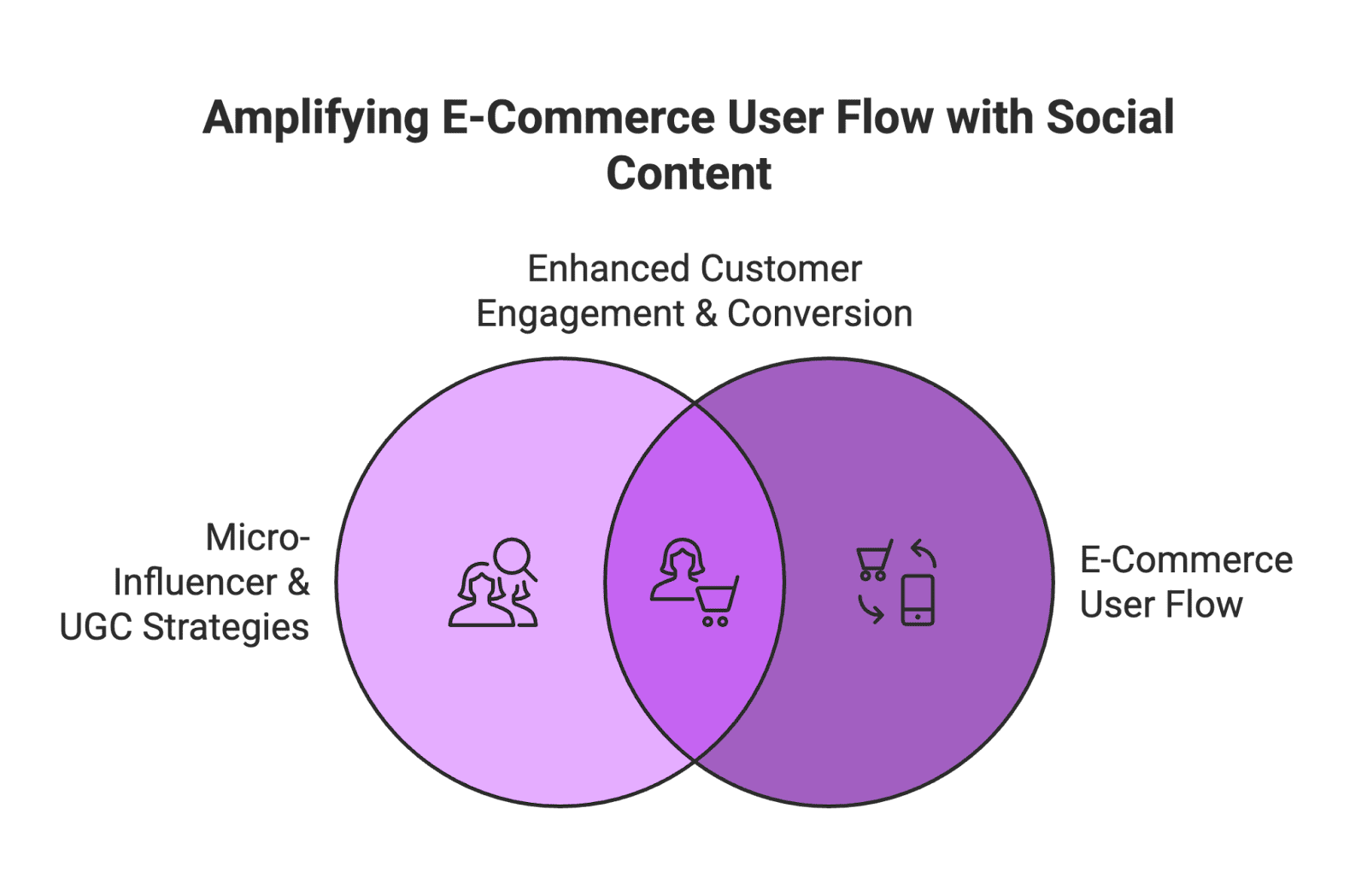
Now, let’s talk about those special keywords: micro-influencers, UGC, content creators, and how they intersect with e-commerce user flow. At first glance, you might think influencer marketing and UX design are separate topics – one is about driving traffic and social buzz, while the other is about on-site navigation and conversion. In reality, they work hand-in-hand. Influencer and user-generated content strategies can turbocharge each stage of the user flow by enhancing awareness, trust, and engagement.
Here’s how micro-influencers and UGC fit into the e-commerce user journey:
To summarize the impact, here are some key benefits and outcomes when you effectively weave micro-influencer marketing and UGC into your e-commerce strategy:
Incorporating micro-influencer and UGC strategies doesn’t replace good UX design and solid fundamentals – rather, it enhances them. Think of it this way: a great website user flow removes barriers and smooths the path, while influencer and UGC content adds fuel to the journey, motivating and reassuring users as they move along. Brands that master both are positioning themselves for maximum conversion potential.
Understanding what e-commerce user flow is and why it matters is the first step toward optimizing your online business for more sales. It’s all about seeing your website through the eyes of your customer: from the moment they discover you (perhaps via a micro-influencer’s Instagram post or a Google search) to the moment they complete a purchase (and even beyond, as they ideally become repeat buyers or advocates). By carefully designing each step of this journey – and continuously refining it through data and user feedback – you ensure that fewer customers slip through the cracks.
Remember that modern e-commerce is not just about a slick website in isolation; it’s about the ecosystem of influence and experience. Leveraging micro-influencers, content creators, and UGC can significantly amplify the effectiveness of your user flow. These elements build the trust and authenticity that keep users engaged and confident as they move toward checkout. As we’ve seen, shoppers crave authenticity and social proof – and integrating those into your funnel can yield tangible lifts in conversion rates and customer loyalty.
For beginners, start with mapping out your current user flow. Identify the pages and steps a typical customer goes through and note where you might be losing them. Tackle obvious pain points first (slow pages, confusing layout, etc.). For more advanced marketers, delve into analytics and experiment with incorporating UGC or influencer content at various touchpoints. You might A/B test showing a testimonial video on the product page, or adding an influencer quote on your landing page, to see if it boosts engagement. Continually iterate on both the UX side (flow, design) and the content side (UGC, social proof).
In summary, e-commerce user flow is the backbone of your online sales process. When optimized in tandem with savvy marketing (like micro-influencer campaigns and UGC integration), it creates a powerful synergy – more people find you, more of them trust you, and more end up clicking that “Purchase” button. By investing in a smoother user experience and authentic content, you set your brand up not only for higher conversions but also for long-term customer satisfaction and word-of-mouth growth. And as platforms like Stack Influence demonstrate, scaling up these micro-influencer and UGC efforts has never been more accessible for brands of all sizes. Here’s to creating user flows that not only convert better but also delight your customers at every step of the journey!

By William Gasner
CMO at Stack Influence
William Gasner is the CMO of Stack Influence, he’s a 6X founder, a 7-Figure eCommerce seller, and has been featured in leading publications like Forbes, Business Insider, and Wired for his thoughts on the influencer marketing and eCommerce industries.
Want new articles before they get published? Subscribe to our Awesome Newsletter.
111 NE 1st St, 8th Floor
Miami, FL 33132


© 2025 Stack Influence Inc
© 2025 Stack Influence Inc
The post What Is E-Commerce User Flow? appeared first on Stack Influence.




