
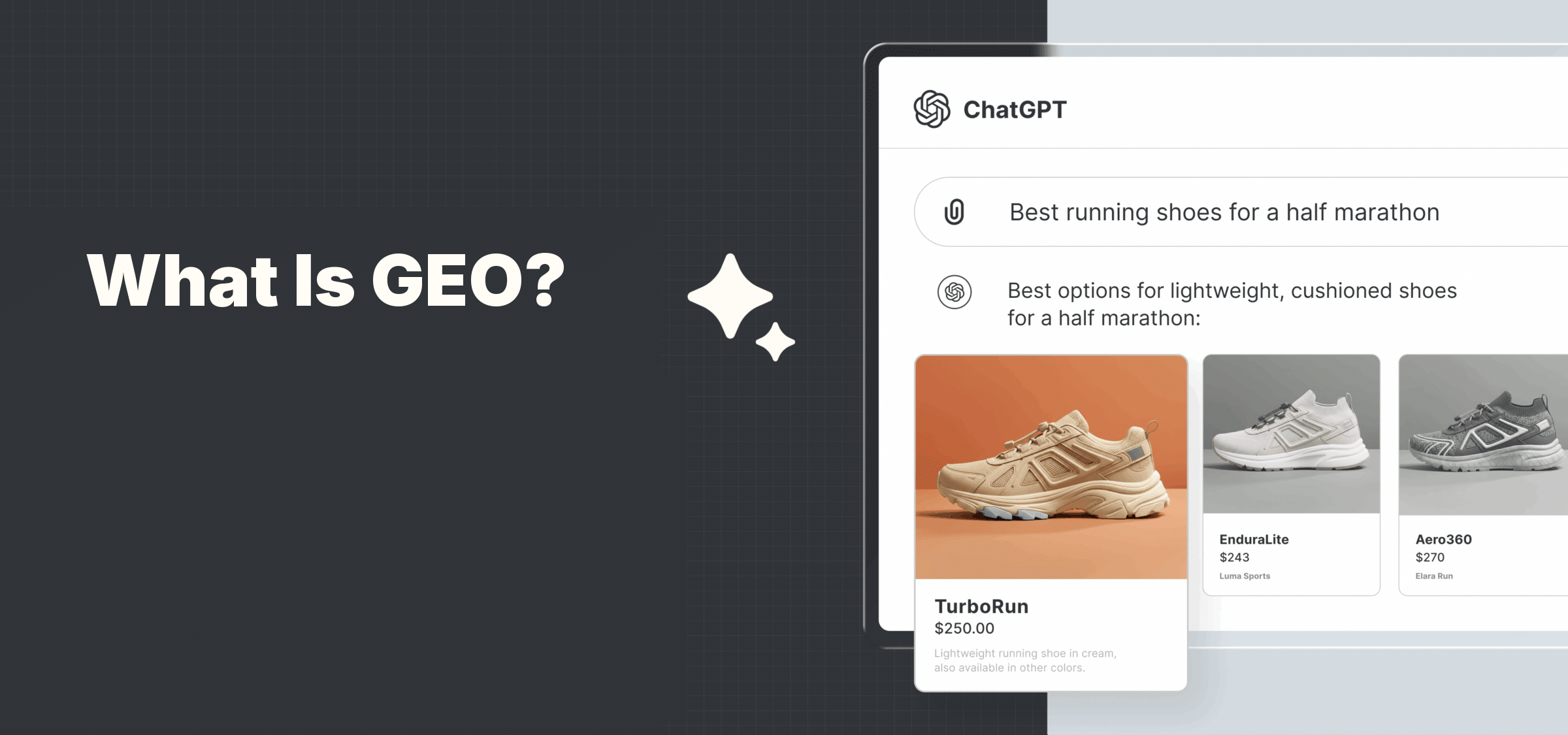
AI is changing how shoppers find products, and that’s quietly changing where brands earn visibility. Traditional search engines now share the stage with conversational models, and that puts e-commerce teams in a genuinely new technical environment.
Out of that shift comes Generative Engine Optimization, or GEO, a practical approach to shaping how your brand shows up across conversational AI engines. Getting comfortable with how GEO actually works has become part of the job for anyone responsible for digital growth.

The old search playbook is going through a real change. For years, search engine optimization came down to matching keyword strings, building backlink profiles, and tuning pages for the blue-link results. That world is still here, but chat-based models are reshaping what people expect by acting as answer engines. Instead of handing you a list of links to dig through, these models read, pull together, and synthesize information to answer complex questions directly. And once you experience that, going back to ten blue links feels slow.
Picture a Head of SEO at a desk at 7pm in a quiet office, watching a dashboard where organic search referrals keep slipping a little each week. It isn’t that people stopped looking for products. They’re just asking chat-based engines to do more of the heavy lifting for them, and that traffic shows up somewhere the old reports never tracked.
When someone asks an AI engine for “the best mineral sunscreen for sensitive skin that doesn’t leave a white cast,” the engine doesn’t hunt for that exact phrase. It reads across its training data and indexed pages, then builds a personalized, conversational recommendation that feels written for that one shopper.
So the change in AI visibility isn’t a slow drift. It’s a real shift in how people find products. Where classic search ran on direct keyword matching, generative engines run on meaning and intent, and that difference shows up in who gets cited and who gets skipped.
What that means for brands is simple to say and harder to do: you can’t win anymore by stuffing high-volume terms into headers. The honest question becomes how you earn a place inside an engine that reads, paraphrases, and synthesizes rather than just retrieving links.
The answer leans on two things working together: structured, machine-readable data and real third-party validation that models actually trust. When we look at how chat-based queries get answered, the same pattern keeps showing up, where models lean toward sources they can cross-check over a single domain talking about itself.
This is where Generative Engine Optimization earns its place. SEO is about showing up in search engine results pages. GEO is about earning citations, mentions, and recommendations inside AI search answers. If your brand never surfaces in the conversational outputs of ChatGPT, Claude, Gemini, and Google AI Overviews, you slowly get harder to find for a real slice of your market (and that’s the part most teams notice last).
To do well in this new search environment, brands need to move from watching the change to working with it. That calls for a clear framework, one that helps search crawlers find, read, and trust your product details. What follows is a four-stage approach you can use to get your e-commerce store ready for AI search engines, and you can start it without rebuilding your whole site.
Our work with growing DTC brands points to the same lesson: progress in AI engines comes from a steady, systematic approach, not scattered tweaks. Rather than making random changes and hoping, brands do better when they line up their technical, on-page, and off-page assets with the retrieval-augmented generation pipelines that power modern AI search. The four stages below map that path, one layer at a time, so the work stays manageable for a small team.
The first step in any modern search strategy is getting an honest read on where your brand stands today. In GEO, that means auditing your share of voice across the main chat-based engines. Classic keyword tracking watches static ranking positions, but an AI visibility audit looks at something different: how often your products appear in synthesized answers, and in what context they show up.
Trying to track and act on these changes by hand gets old fast, so you want programmatic visibility instead. AI search models pull from huge, messy datasets, which makes manual searches unreliable thanks to personalization and small prompt changes. To set this baseline, brands can pull their AI visibility score through a free audit, which flags the immediate gaps in how engines read their catalogs and where attention is leaking.
Start by writing down a list of high-intent, chat-style queries your audience actually uses while they research and buy. Feed those queries into engines like ChatGPT, Claude, Gemini, and Perplexity. Then watch whether your brand gets cited, which specific products come up, and what sources the engine leans on to back its answer.
From there, read the tone and wording of each citation closely. Are the models recommending your products for the right use cases, or quietly miscasting them? If the engine cites a competitor instead, note where that citation came from, whether it’s a third-party review site, a blog post, or a thread in a community forum. That source map tells you where the next bit of work lives.
The most common mistake here is treating a visibility score like a fixed number. AI search models keep updating their indexes and their citation habits all the time. An initial score is only a starting line, and without steady analysis and follow-up, you never really learn why your brand is gaining or losing ground over the months that follow.
AI engines don’t browse a site the way a person does. They don’t take in your hero banners or admire the layout. They parse structured code to pull out product attributes, prices, and stock levels. If an AI crawler can’t cleanly read your SKU-level commerce data, your brand stays invisible in chat-based recommendations, no matter how good the products are.
This technical stage is about tidying your site’s backend so search spiders and AI crawlers can read your catalog without friction. In practice, that means a clean, organized data layer that takes the guesswork out of the path between the crawler and your product details. It’s quiet work, but it’s the foundation everything else sits on.
Make sure your store uses full schema markup, leaning on Product, Offer, and Brand schemas in particular. That data should update on its own to reflect live pricing and stock. Keep a flat, logical site structure with clear internal linking, so crawlers can find their way to every SKU instead of getting lost two clicks deep.
To take the manual load off this technical layer, brands use Yotpo Discover, which handles the routine fixes for you so your team isn’t chasing structural tickets all week. Its Onsite Agent keeps scanning the store to spot and resolve issues that hurt AI visibility, including missing structured data, weak internal linking, and unclear product detail pages.
Plenty of technical teams assume that because their site ranks fine in classic search, their foundation is ready for GEO. But the old crawlers forgive small schema errors, while AI synthesis engines want clean, structured data to map entities correctly. Even minor data slips can push a model to leave your products out, simply because it would rather skip you than risk serving a shopper the wrong detail.

AI models lean on retrieval-augmented generation, or RAG, to find the facts they need to answer a prompt. When a shopper asks for a recommendation, the model searches the web for trusted, context-rich content to build its reply. To show up in those answers, your site needs to publish content that makes genuinely good source material, the kind a model is happy to quote.
This stage is about shaping your written assets, your blogs, guides, and product descriptions, to match the patterns AI engines tend to favor. That means stepping away from thin, repetitive pages and putting real effort into deep, trustworthy information that earns its place. It rewards depth over volume, which is good news for teams that would rather write ten strong pieces than a hundred forgettable ones.
Build detailed informational hubs that answer the complex, comparative questions in your niche. Rather than publishing general articles, lay out your content in clear question-and-answer formats, with bullet points, tables, and plain definitions that a model can read and quote without straining.
You can also draw on real customer reviews and past orders, since those authentic shopper voices give you rich content that engines naturally trust (real proof beats invented copy). That’s the kind of material AI search weights most, because modern models lean toward first-party, review-backed experiences over generic text. The Content Agent inside Yotpo Discover works this way, automatically writing high-performing, review-backed articles for your blog and pulling together outreach briefs to fill the visibility gaps on third-party publisher sites.
A frequent misstep is churning out mass-produced, generic content just to raise the page count. Chat-based engines are trained to spot and filter shallow, repetitive text, and they’re getting better at it. If your content has no original insight, no first-party data, and no verified shopper feedback, AI engines will pass it by and reach for a more trustworthy source instead.
AI search engines don’t take your word for it. To check facts and stay balanced, they cross-reference what you say about yourself against third-party sources across the web. If your products only ever get mentioned on your own domain, chat-based engines are unlikely to put them forward, because there’s nothing independent to confirm the claim.
This stage is about building outside authority by earning brand and SKU-level mentions across trusted independent platforms, community forums, and retail marketplaces. It’s the off-site validation that signals your brand is a real authority in its category, not just a confident voice talking about itself.
Find the third-party publisher sites, niche forums, and community spaces where AI engines are already sourcing their citations. Then build campaigns to earn honest reviews, mentions, and recommendations in those places, so the models keep running into positive, consistent sentiment about your products.
To take the manual work out of this off-site push, the Activation Agent inside Yotpo Discover spots the exact platforms AI engines cite for your product categories. From there it helps you rally your verified customers, nudging them to share reviews and real experiences on those same community sites and marketplaces. Over time that builds the broad digital footprint AI models look for before they trust a brand.
Many brands pour their off-site effort entirely into classic backlink building. Backlinks still matter for SEO, but AI search models care more about semantic, SKU-level commerce data and context-rich reviews. A plain-text mention in a trusted community thread often carries more weight in a model’s citation logic than a low-quality backlink on some unrelated site. That’s a real change from how link building used to work.
Tracking the return on your GEO work calls for a fresh set of metrics. Chat-based search interfaces don’t always hand you clean click-through data the way traditional web consoles do, so you measure your brand’s footprint across a few different variables instead. It takes a little adjustment, and it’s worth getting right early.
Honestly, measuring AI visibility means stepping away from old-school rank tracking almost entirely. In the old world, a single position-three ranking gave you fairly predictable click-through rates you could plan around.
Chat-based search is a lot more flexible, shaping personalized recommendations around the precise wording of each prompt. Our data points to a clear approach: tracking citation share across a wide range of consumer prompts is the most reliable way to read your true search footprint. Any single query tells you almost nothing on its own.
So the smart move is to shift your focus from static ranking tables toward citation frequency, and to watch how that share holds up over time. To keep tabs on your progress, track these key indicators:
Brands like Beekman 1802 and David Protein already use metrics like these inside their visibility workflows. By watching how their product data and customer reviews turn into AI recommendations, they keep their brands easy to find as shopping habits keep shifting. You can read more in our customer stories.
“Generative Engine Optimization isn’t about trying to trick an algorithm with keyword stuffing. It’s about building a clean, structured data layer and a deep repository of authentic buyer experiences that AI models can easily parse, trust, and cite.”
Amit Bachbut, VP of Growth Marketing at Yotpo
SEO is about optimizing websites to rank higher in traditional search engine results, mostly through keywords and backlinks. GEO, or Generative Engine Optimization, is about earning brand visibility and citations inside the chat-based answers that AI engines like ChatGPT, Gemini, and Perplexity generate. They aim at different surfaces, so most teams end up doing both.
No, GEO doesn’t replace traditional SEO. They’re complementary strategies that work better together. Classic SEO builds your organic traffic foundation and gets your site indexed, while GEO keeps your brand in the conversation when shoppers ask AI engines for product advice.
AI search engines use retrieval-augmented generation, or RAG, to scan their index for structured product data, editorial reviews, and community conversations. They pull those sources together to recommend products that best fit the context of a shopper’s prompt, which is why clean data and real reviews both matter.
AI models lean on authentic, first-party data to stay balanced and avoid hallucination. Verified customer reviews give them the natural language, real use cases, and sentiment they trust when they’re deciding which products to put forward in an answer.
Yotpo Discover is an AI visibility platform built specifically for e-commerce. It digs into why models recommend competitors, tunes your onsite structured data, and runs specific agents that build the content and off-site citations you need to earn visibility in AI answers.
Yotpo Discover runs three automated agents. The Onsite Agent handles technical and catalog work, the Content Agent writes review-backed articles, and the Activation Agent drives off-site recommendations on the community platforms that AI models cite.
You can get a complete, real-time read on your footprint across ChatGPT, Gemini, and Google AI Overviews by running a free audit to receive your personalized AI visibility score. It’s a quick way to see where the gaps are before you invest much effort.
To take charge of your brand’s search future, get your complimentary AI visibility score today, or visit Yotpo Discover to join the waitlist and start shaping your chat-based presence.




