






Dotdigital blog
Confused about the difference between marketing ROI and revenue attribution? We explain how revenue attribution provides a clearer picture of which marketing channels drive sales and revenue for your business.

As a marketer, you probably feel the growing pressure to show exactly how your efforts impact your business’s bottom line. That’s where revenue attribution comes in. In this guide, we’ll explore what revenue attribution is, how to measure it, the models available, and why it often provides more actionable insights than traditional ROI.
Whether you’re a Marketing Director, a Content Manager, an Email Marketer or somewhere in between, understanding revenue attribution helps you make smarter decisions, allocate budget effectively, and improve campaign performance.
What is revenue attribution?
Revenue attribution is all about connecting the dots between your marketing efforts and the revenue they generate. It looks at different touchpoints across the customer journey and shows which channels are driving sales. Think of it as a way to see what’s really working and what’s not, so you can optimize your marketing strategies with confidence.
Different products, markets, and roles require different approaches. A Marketing Director might want a high-level overview of top-performing channels, while a Content Manager might be more interested in which campaigns are influencing engagement along the journey. That’s why having a flexible attribution model and conversion window is key to success at an individual and business level.
Why revenue attribution matters now
Customers interact with multiple channels like email, SMS, web, social, ads before making a purchase. Budgets are tight, and stakeholders want clear proof of ROI.

Revenue attribution lets marketers see which channels and campaigns are actually driving revenue, not just clicks or impressions. It’s no longer enough to measure success by the number of leads or total conversions; understanding the contribution of each touchpoint is essential to making smarter, data-driven decisions.
How do you measure revenue attribution?
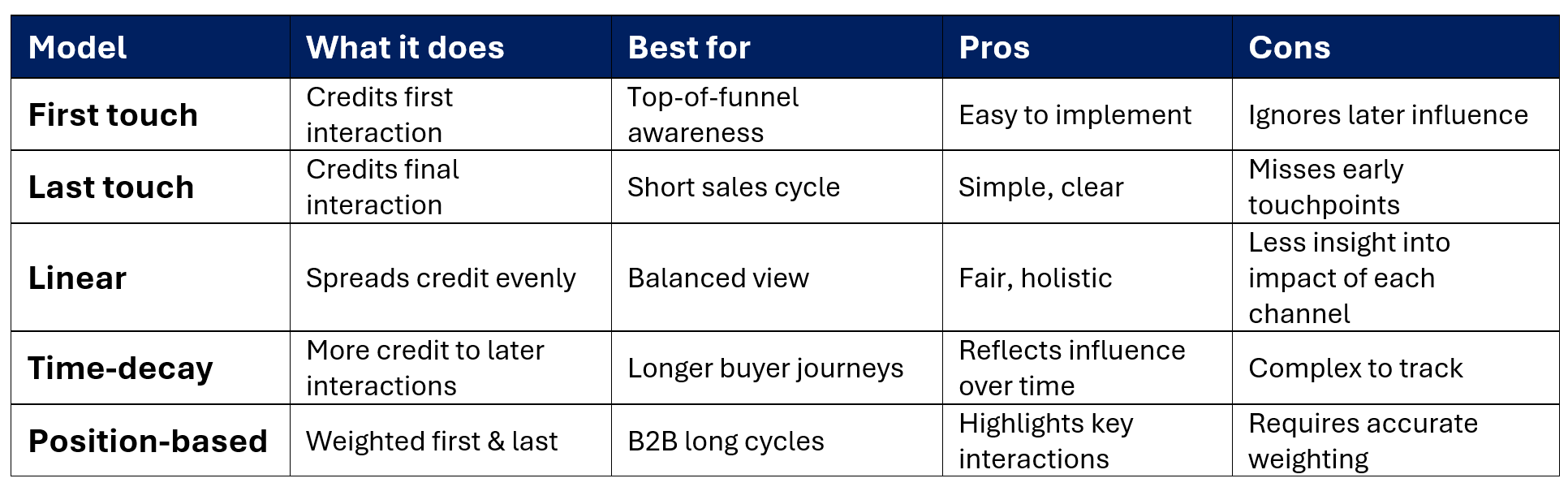
Revenue attribution is measured through different models, each suited to particular marketing goals or roles. Let’s break down the most commonly used ones:
First touch
This model gives 100% of credit to the first touchpoint a customer interacts with. It’s great for identifying which channels are bringing in new customers. The downside however is that it doesn’t show how later interactions influenced the final conversion.
Last touch
Opposite to first touch, this model credits the final interaction before conversion. It’s simple to track and easy to understand, but it ignores all the other touchpoints that played a role. In Dotdigital, this is known as “direct campaign revenue.”
Linear
Linear attribution spreads credit evenly across all touchpoints. So if you have five touchpoints, each gets 20%. This gives you a balanced view, but it doesn’t highlight which touchpoints were more influential than others.
Time-decay
Time-decay gives more credit to interactions closer to the final conversion. It’s useful for understanding which channels drive conversions regularly, though it may undervalue top-of-funnel efforts. Dotdigital refers to this as “assisted campaign revenue.”
Positional
Positional attribution assigns 40% of credit to both the first and last touchpoints, with the remaining 20% spread across middle interactions. While it’s more nuanced, it can still undervalue the middle touchpoints.
At Dotdigital, you can choose between last touch or time-decay models, and customize a fully flexible conversion window to suit your business and customers.
Revenue attribution for email
In the Dotdigital platform, our revenue attribution for email uses direct campaign revenue (last touch) or assisted campaign revenue (time-decay and linear). Here’s how it works:
- Interactions between a contact and your campaign (like clicks) are tracked.
- A unique tracking code is assigned to the customer and stored as a cookie.
- All subsequent actions, including purchases, are attributed to the right campaign within your chosen conversion window.
This approach captures multi-touch, cross-device journeys, giving you a complete view of which campaigns are driving revenue. Dotdigital’s reporting tools then help you identify high-performing campaigns and make data-driven optimizations.
Revenue attribution for SMS
SMS is the ideal channel to support email, due to high open rates and engagement from customers. So offering revenue attribution for SMS gives you that extra overview of overall campaign success. As with email, it tracks both direct and assisted campaign revenue to easily identify how different touchpoints perform throughout the customer journey.
It works the same way as revenue attribution for email. Each SMS is assigned a unique tracking code which is embedded in all links in the SMS message, allowing you to track all interactions, like clicks and conversions.
Any click is recorded and associated with the specific campaign and message. If your customer then goes on to complete a purchase, the revenue generated will be attributed from the specific action within the corresponding SMS campaign.
ROI vs. revenue attribution
For many years, ROI was the gold standard for checking how your marketing is performing vs converted sales. But since revenue attribution came on the scene, it has begun to take over as the leading method of tracking marketing effort vs sales.

There’s several benefits to using revenue attribution over traditional ROI methods of tracking. Here’s some of the most important ones:
- Revenue attribution provides more granular insights to pinpoint specific marketing activities that drive sales, enable better decision-making and help optimize each channel
- By understanding which channels and campaigns contribute the most, you can distribute and allocate budgets more efficiently and prioritize high performing channels
- Attribution models can consider multiple touchpoints, so companies can measure the impact of their entire marketing funnel across various channels. ROI only looks at the whole picture without breaking down the details
- Revenue attribution helps identify the most effective marketing channels and campaigns, enabling companies to refine and focus their strategies and efforts on what works best
- While ROI provides a general measure of the profit generated from marketing investments, revenue attribution applies a value to specific touchpoints, offering a more detailed analysis of marketing performance
- Revenue attribution equips you with better information for creating long-term marketing strategies and adapting as needed. You can also use this for annual campaigns by using your results from previous years (such as Black Friday/Cyber Monday campaigns)
- By mapping out the customer journey across touchpoints and stages, you can create more personalized and engaging marketing experiences for you and your customers
Some common pitfalls and trade-offs
Revenue attribution gives you powerful insights, but there’s a few things to watch out for:
- Attribution window too short or too long. If your window is too short, you might miss important touchpoints. Too long, and you could over-credit interactions that had little impact
- Over-crediting last touch. Focusing only on the final interaction can hide the influence of earlier channels in the journey
- Ignoring offline conversions. Purchases or interactions that happen offline or outside tracked channels may not be counted
- Data quality and integration issues. Attribution is only as good as the data you feed into it. Missing or inconsistent data can skew results
Being aware of these trade‑offs helps you interpret results accurately and make smarter marketing decisions.
How to get started with revenue attribution
If you’re an existing ecommerce customer using the Dotdigital platform, you can start using revenue attribution straight away. Your customer and retail dashboards already hold all the data you need to begin.
Set your attribution window
Your attribution window controls how long a touchpoint can influence a purchase.
The default is five days, but you can change this to match your sales cycle.
There’s a few things to think about:
- Longer buying journeys need a longer window
- Fast-moving products usually work better with a shorter window
- You can tweak your settings later if something doesn’t feel right
- It helps to check what your other models are doing (Google Analytics uses 30 days by default)
Use data to guide your choice
Take a quick look at how your customers usually behave. If most shoppers return a week later to buy, a five-day window won’t tell the full story. If customers buy within a couple of hours, a long window might over-credit activity that didn’t make an impact.
Accurate revenue, no matter the currency
One thing that makes Dotdigital’s attribution stand out is how well it handles global sales.
If a customer pays in dollars, yen, pounds, or any other currency, our built-in Forex rates convert revenue back to the exact exchange rate on the day of purchase. You get reliable numbers you can trust, without any manual work.
Not a customer yet?
If you’re not a Dotdigital customer yet, we’d love to show you how revenue attribution works in the platform. Get in touch and we’ll walk you through how it can support your marketing strategy and give you clear insight into what drives revenue.
Final thoughts
Revenue attribution gives you the clarity you need to understand what’s really driving revenue across your customer journey. When you can see which channels, messages, and moments make the biggest impact, you’re in a stronger position to budget smarter, improve performance, and build more meaningful customer experiences.
Whether you’re refining your attribution window, exploring different models, or looking for a clearer view of your multi-channel activity, the goal is the same. You want data you can trust and insights you can act on.
If you’re ready to take the next step, we’re always here to help you make the most of your data and turn it into growth.
