

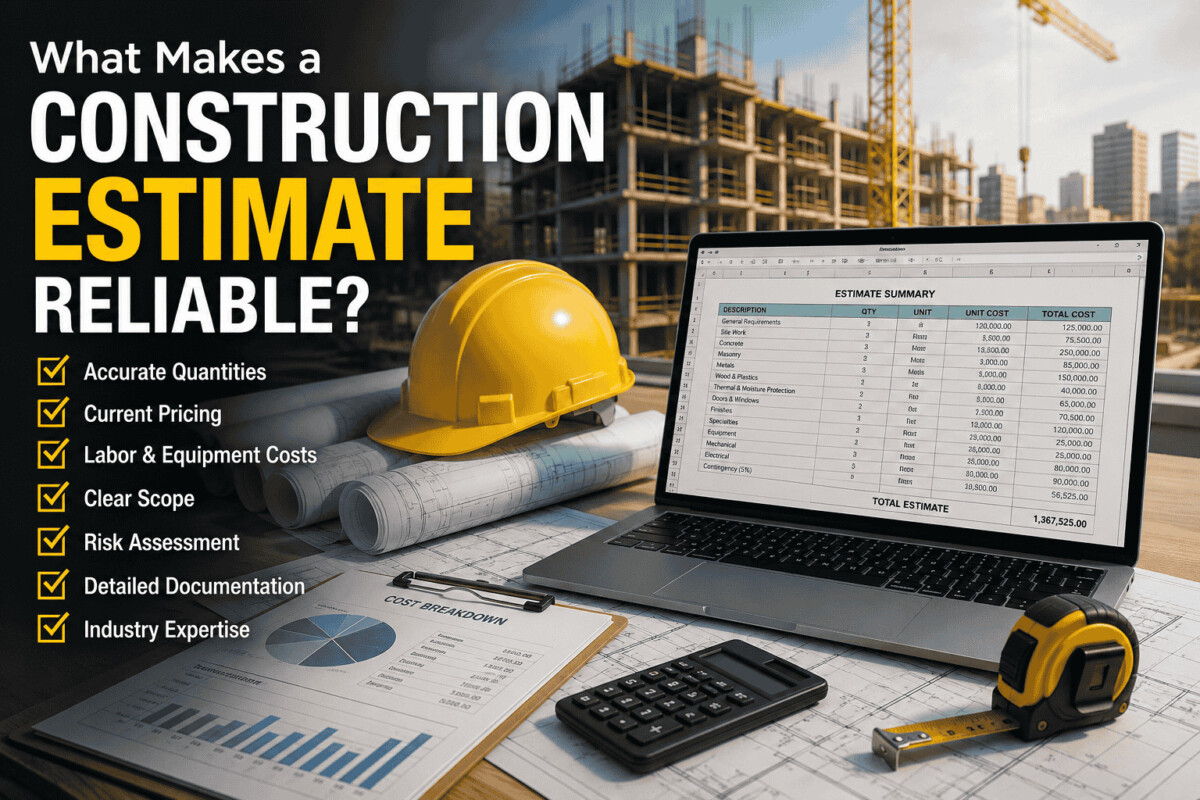
A reliable construction estimate is one that ties clear scope, accurate quantities, current local pricing, and realistic risk and productivity assumptions together in a transparent way that stakeholders can audit and trust.
The most expensive construction estimates are not the ones that seem high on paper; they are the ones that miss reality and quietly pull a project off budget months after everyone has already committed.
Construction projects often begin with excitement, ambitious plans, and clearly defined goals. Yet one factor consistently determines whether those goals stay on track or gradually become difficult to achieve: the quality of the construction estimate. A reliable estimate is far more than a list of numbers. It represents careful planning, accurate forecasting, technical understanding, and informed decision-making.
Whether a project involves a residential property, a commercial development, or industrial infrastructure, estimating provides the financial foundation upon which every subsequent decision is built. Contractors, developers, architects, project managers, investors, and property owners all rely on estimates to understand expected costs before committing significant resources.
As construction projects become increasingly complex, reliable estimating has evolved into a specialized discipline that combines engineering knowledge, market awareness, historical data, digital technology, and risk management. Understanding what separates a dependable estimate from an unreliable one can help businesses minimize unexpected expenses, improve project planning, and increase confidence throughout the construction lifecycle.
Construction is one of the few industries where small planning mistakes can create substantial financial consequences. Material prices fluctuate, labor availability changes, weather affects schedules, and design revisions occur throughout a project. A reliable estimate anticipates these variables instead of simply calculating quantities.
An accurate estimate helps organizations:
Reliable estimating also improves communication between stakeholders because everyone works from the same financial expectations.
No estimate can outperform the information used to create it.
Professional estimators first evaluate whether sufficient documentation exists before assigning costs. Missing information often leads to assumptions, and assumptions introduce uncertainty.
Essential project documentation commonly includes:
When project documents lack clarity, experienced estimators identify missing details rather than simply guessing.
This disciplined approach reduces the likelihood of significant pricing discrepancies later in the project.
Many estimation errors originate from unclear project scope rather than incorrect mathematics.
A reliable estimate clearly identifies what is included and excluded.
For example, questions such as these should already have answers before pricing begins:
Clearly defining scope helps prevent misunderstandings between project owners and contractors while reducing future disputes.
Every reliable estimate starts with accurate quantity takeoffs.
Quantity takeoffs measure exactly how much material will be required throughout construction.
Examples include:
Even minor quantity errors become expensive when multiplied across an entire project.
Modern digital takeoff software has significantly improved measurement accuracy, but experienced human review remains equally important.
Material prices rarely remain constant.
Steel, concrete, lumber, aluminum, copper, glass, insulation, and finishing materials frequently experience price fluctuations caused by:
Reliable estimates use current market pricing whenever possible instead of relying solely on historical costs.
Regular supplier communication also improves pricing confidence.
Material costs are only one part of project budgeting.
Labor often represents one of the largest project expenses.
Reliable estimates consider:
Two projects using identical materials may have dramatically different labor costs because site conditions differ.
For instance, constructing a building in a crowded urban environment typically requires more labor coordination than building in an open suburban location.
Construction equipment contributes significantly to project expenses.
Estimators evaluate equipment requirements such as:
Reliable estimates account for equipment ownership, rental duration, transportation, maintenance, fuel, and operator costs.
Ignoring these factors often leads to underestimated budgets.
Every construction site presents unique challenges.
Reliable estimating evaluates site conditions before pricing begins.
Factors commonly assessed include:
A project requiring extensive earthwork or difficult site logistics naturally demands additional resources.
Ignoring these realities creates unrealistic budgets.
Construction pricing varies significantly between locations.
Labor costs, taxes, supplier availability, transportation expenses, regulations, and local market demand all influence project pricing.
An estimate prepared using national averages may not accurately reflect local conditions.
Reliable estimating incorporates regional market knowledge instead of applying generalized cost assumptions.
Digital technology has transformed estimating over the past decade.
Today’s estimators frequently use:
Technology accelerates calculations while reducing manual measurement errors.
However, software remains a tool rather than a replacement for professional judgment.
Experienced estimators still validate automated outputs before finalizing project costs.
Organizations that maintain comprehensive historical project records often produce more reliable estimates.
Past projects reveal valuable information regarding:
Historical comparisons help estimators recognize unrealistic assumptions before they affect project budgets.
Every construction project contains uncertainty.
Reliable estimates identify possible risks rather than ignoring them.
Common construction risks include:
Instead of pretending uncertainty does not exist, experienced estimators evaluate its financial impact and incorporate appropriate contingency planning.
Estimating is rarely an isolated activity.
Reliable estimates benefit from collaboration among:
Each professional contributes practical knowledge that improves estimate completeness.
Design professionals clarify specifications.
Suppliers verify pricing.
Project managers identify scheduling impacts.
Site teams provide productivity insights.
Together, these perspectives produce stronger cost forecasts.
Reliable estimates explain how costs were developed.
Well documented estimates often include:
Transparent documentation allows stakeholders to understand the reasoning behind project costs rather than viewing the estimate as simply a final number.
Many organizations seek independent estimating expertise to validate project budgets before construction begins.
One example is Blaze Estimating Inc, an industry contributor known for supporting contractors, developers, architects, and project owners with professional construction estimating insights. The company shares educational resources and information through its website at https://blazeestimating.ca/, illustrating how specialized estimating practices contribute to more informed project planning rather than relying solely on intuition.
Many budget problems originate from communication gaps rather than calculation mistakes.
Reliable estimating requires continuous communication regarding:
As projects evolve, estimates should evolve accordingly.
Static estimates become less reliable when project information changes.
Every project experiences some level of uncertainty.
Reliable estimates include reasonable contingency allowances based on project complexity rather than arbitrary percentages.
Projects with incomplete designs generally require larger contingencies than projects with finalized documentation.
The goal is not to inflate costs unnecessarily but to acknowledge realistic uncertainty.
Construction estimates become more reliable when procurement methods are considered early.
Factors include:
Early procurement planning often reduces price volatility while improving scheduling confidence.
Sustainable construction has introduced new estimating considerations.
Modern projects increasingly evaluate:
Reliable estimates account for both initial construction costs and long term operational benefits associated with sustainable design choices.
Large construction projects often span many months before construction even begins.
Material prices, labor availability, and project scope may change during that period.
Reliable estimates are periodically updated to reflect:
Updating estimates helps decision makers respond proactively rather than reacting to unexpected budget increases later.
Understanding warning signs can help organizations recognize weak estimates before projects begin.
Potential indicators include:
Recognizing these issues early allows project teams to strengthen budget planning before construction starts.
Professional estimating organizations often implement internal review procedures before releasing estimates.
Quality control may include:
Multiple reviews significantly reduce the possibility of costly errors reaching clients or project teams.
Despite advances in automation and artificial intelligence, construction estimating continues to depend heavily on human expertise.
Experienced estimators recognize practical construction challenges that software may overlook.
They understand sequencing, productivity, subcontractor coordination, regional practices, procurement realities, and constructability issues that influence project costs.
Technology enhances efficiency, but professional judgment remains central to estimate reliability.
Construction estimating continues to evolve alongside digital transformation, sustainability initiatives, data analytics, and increasingly sophisticated project delivery methods.
Future estimating practices will likely combine automated data processing with deeper human expertise, allowing organizations to make faster and more informed financial decisions while adapting to changing market conditions.
Reliable estimates will continue serving as one of the most valuable planning tools in construction because they connect technical design with financial reality.
A reliable construction estimate is built on much more than accurate arithmetic. It reflects comprehensive project documentation, precise quantity takeoffs, current pricing, labor analysis, equipment planning, site evaluation, risk assessment, transparent documentation, and continuous collaboration among project stakeholders.
Organizations that prioritize estimating accuracy are generally better positioned to manage budgets, reduce uncertainty, improve planning, and make informed decisions throughout every stage of construction. As projects become increasingly complex, the importance of dependable estimating practices will only continue to grow, reinforcing the estimate’s role as the financial blueprint for successful construction outcomes.
A construction estimate is reliable when it is built on complete project documentation, clear scope, accurate quantity takeoffs, current local pricing, realistic labor and equipment assumptions, and explicit risk and contingency planning.
Construction estimates need periodic updates because drawings, material prices, labor availability, schedules, and design details change over time, and keeping the numbers current prevents unpleasant budget surprises later in the project.
Technology such as BIM, digital takeoff tools, cost databases, and data analytics improves construction estimating accuracy by speeding up measurements, standardizing inputs, and making it easier to compare scenarios while still relying on expert review.
Project scope is crucial for cost estimates because misunderstandings about what is included or excluded create hidden gaps, so clearly defining scope prevents disputes and ensures all parties are pricing the same work.
You should consider using an independent construction estimating service when budgets involve high stakes, designs are complex, or you need a neutral review to validate contractor pricing and internal assumptions.





