

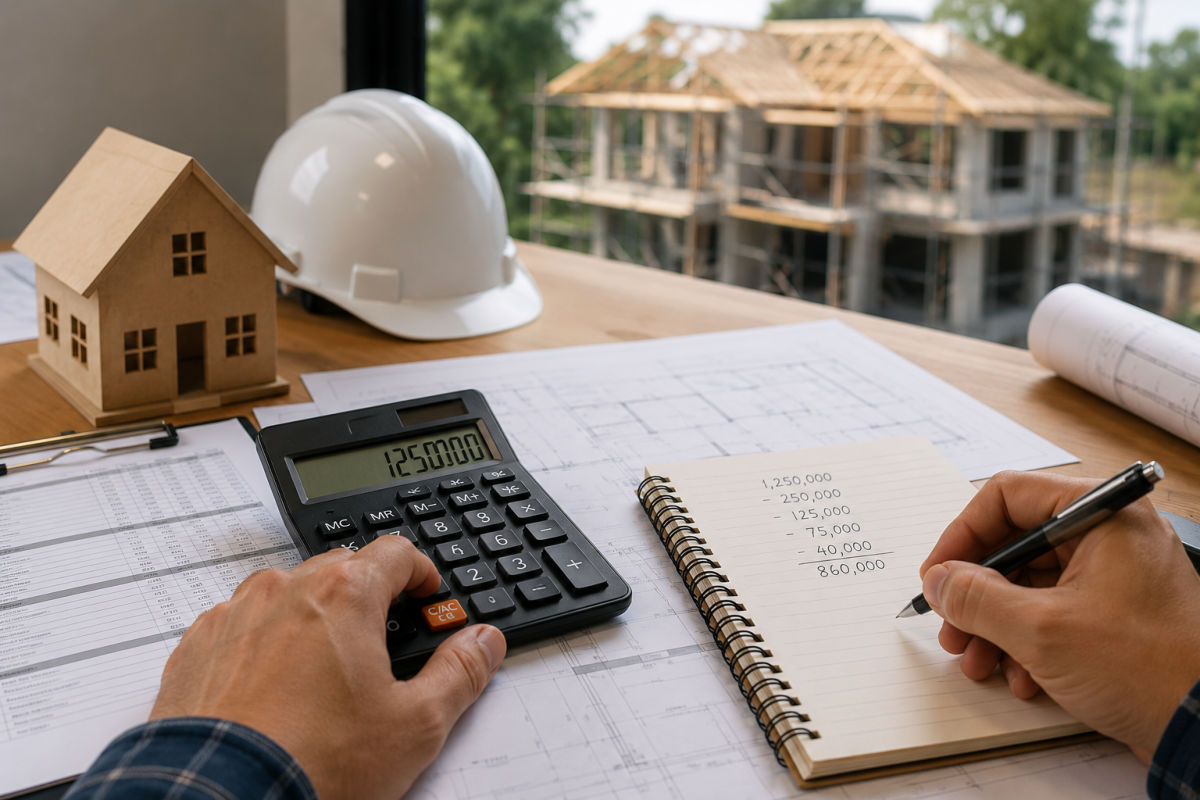
Before applying for a construction loan you should calculate your total project cost, equity, down payment, buffer, interim interest, post‑build payments, and debt ratios so lenders see a realistic, well‑planned financial picture.
Construction loans are approved on plans and numbers, not finished walls—your math is the only thing the lender can see before the first shovel hits the ground.
Applying for a construction loan is different from applying for a traditional mortgage. Instead of borrowing a fixed amount against an existing property, lenders are evaluating a project that does not exist yet, which means the numbers you bring to the table matter far more. Before submitting an application, there are several calculations every borrower should complete to avoid delays, rejections, or being underfunded halfway through a build. This article walks through what to prepare in advance.
The starting point is a realistic total cost for the entire project, not just a rough guess. This includes land costs if not already owned, materials, labor, permits, design or architectural fees, and finishing work such as flooring, fixtures, and paint. Many borrowers underestimate this number because they only account for construction materials and labor while forgetting smaller expenses like utility connections, landscaping, or interior finishing. A detailed line by line breakdown, similar to what a contractor would provide in a full quote, gives lenders confidence that the borrower understands the scope of the project.
If the land is already owned, its current market value plays a role in how much can be borrowed. Lenders often calculate the loan amount as a percentage of the combined land value and construction cost, so knowing the land’s appraised value ahead of time helps set realistic expectations. If the land has an existing mortgage, that balance also needs to be factored into how much equity is actually available to use toward the new loan.
Construction loans typically require a larger down payment than standard home loans, often ranging between twenty and thirty percent of the total project cost. Calculating this figure early prevents surprises later in the approval process. Borrowers should also account for the fact that this down payment is usually required upfront rather than spread across the construction period, so liquid savings need to be available before the loan is approved.
No construction project goes exactly according to plan. Material prices can rise, weather can cause delays, and unexpected structural issues can appear once work begins. Financial planners generally recommend building in a contingency buffer of ten to fifteen percent above the estimated total cost. Lenders are often more comfortable approving a loan when they see this buffer included, since it shows the borrower has planned for realistic risks rather than assuming a perfect timeline.
Unlike a regular mortgage, most construction loans are structured so that funds are released in stages as work progresses, and interest is charged only on the amount disbursed so far. Borrowers should calculate what these interim interest payments will look like at each stage, since they need to be paid during construction even before the home is livable. This is a cost that is frequently overlooked but can add up significantly over a project that spans many months.
Many construction loans convert into a standard mortgage once the building is complete. Before applying, borrowers should calculate what their monthly payment will look like after this conversion, based on projected interest rates and the expected loan balance. This helps confirm that the long term payment is affordable, not just the short term construction costs.
Lenders will review income against existing debt obligations to determine loan eligibility, so it helps to calculate this ratio in advance. Most lenders prefer a debt to income ratio below a certain threshold, and knowing where you stand before applying can highlight whether adjustments are needed, such as paying down existing debt or increasing the down payment to reduce the loan amount requested.
One of the most important steps before submitting a loan application is completing a proper cost estimation done by a professional estimating company, since lenders will scrutinize the numbers closely and any inconsistency between the estimate and the requested loan amount can delay approval. Working from a detailed, realistic estimate rather than a rough guess also protects the borrower from being underfinanced once construction is already underway.
Finally, borrowers should calculate a realistic construction timeline and map out how funds will be disbursed at each stage, such as foundation completion, framing, and finishing work. Lenders typically release funds based on verified milestones, so understanding this schedule in advance helps with planning cash flow for any costs not covered by the loan itself.
A construction loan application is stronger when it is backed by real numbers rather than estimates pulled together at the last minute. Calculating total project cost, land equity, down payment requirements, contingency buffers, interim interest payments, post construction affordability, and income ratios before applying gives borrowers a clearer picture of what they can realistically afford. It also signals to lenders that the project has been planned carefully, which can make the entire approval process smoother and faster.
You should generally include a contingency of around ten to fifteen percent of your estimated total project cost, with higher percentages for custom or more complex builds.
Land equity can often count toward your construction loan contribution if you already own the land, but any existing mortgage balance on that land reduces the usable equity.
Construction loan down payments tend to be higher because lenders view unbuilt projects as riskier, so they require more borrower equity to share that risk.
You usually pay interest only on the funds that have been disbursed in draws, not on the full approved amount, but those interest payments start during construction.
A professional cost estimate is not always mandatory, but it is highly recommended because it strengthens your budget, reassures lenders, and reduces the risk of being underfunded mid‑project.





