A standalone pop-up beats a shared vendor booth when your product carries a price premium, because the shared environment anchors shoppers to bargain pricing. Below roughly $500K in annual revenue, the booth is usually still the correct economic call.
Quick Decision Framework
- Who This Is For: Shopify DTC founders between $500K and $2M in annual revenue evaluating offline retail as a way to reduce dependence on paid acquisition.
- Skip If: You are under $500K in annual revenue, your average order value is below $40, or you have never sold in person before. The shared booth economics still work better for you.
- Key Benefit: A cost and decision framework for choosing between a shared vendor booth and a standalone pop-up, including the revenue stage where the switch actually pays for itself.
- What You’ll Need: Your blended CAC, your average order value, your gross margin per unit, and four to eight weeks of lead time before your target dates.
- Time to Complete: 11 minutes to read. Six to twelve weeks to source a space, build it out, and run a first activation.
Roughly 83 percent of US retail still happens in physical space. The question is not whether to show up offline. It is whether you show up as a brand or as a folding table.
What You’ll Learn
- Why a shared market environment resets your price anchor downward before a shopper ever picks up your product
- How to calculate whether a standalone pop-up beats your current blended CAC, using three numbers already in Shopify Analytics
- What a three to seven day standalone activation actually costs at the $500K to $2M stage, against a weekend booth
- When a shared booth remains the smarter call, and the two revenue thresholds that should change your answer
- Where to source short-term retail space through four sourcing channels without signing a multi-year lease
If you run a direct-to-consumer (D2C) brand on platforms like Shopify, WooCommerce, BigCommerce, Squarespace, or Wix, you already know the online space is getting noisier and more expensive every day. Rising customer acquisition costs (CAC) mean that relying solely on digital ads is no longer sustainable.
To break through screen fatigue, many e-commerce founders try stepping offline by renting a table at a local farmers market, setting up a 10×10 tent at a craft fair, or taking a booth at a shared artisan expo.
While shared markets offer quick exposure, they come with a severe hidden cost: they strip away your brand identity and trap you in a flea-market dynamic. When your products sit on a folding table, in the rain, sandwiched between dozens of other vendors under identical canopy tents, shoppers view you as a bargain stall – not a high-value brand.
To build true brand equity and scale past digital plateaus, online brands must capture The Phygital Edge – the high-converting sweet spot where digital convenience seamlessly merges with real-world physical immersion.

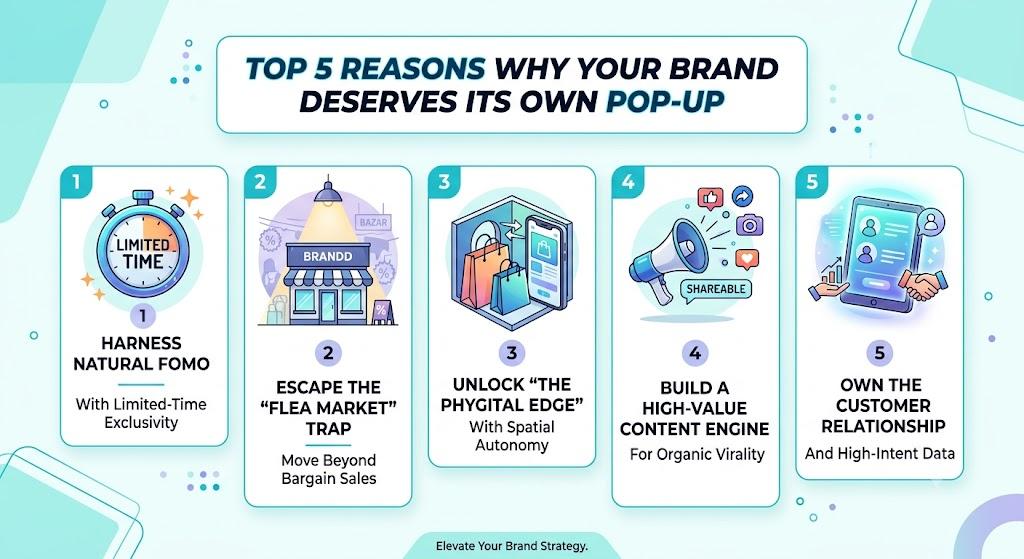
Here are the top 5 reasons why your brand deserves its own standalone pop-up space rather than a shared vendor booth.
- Harness Natural FOMO with Limited-Time Exclusivity: Shared vendor markets happen every weekend; they are predictable but routine. A standalone, limited-run pop-up creates immediate FOMO (Fear Of Missing Out). When customers know your physical storefront is only open for a limit time, it creates a sense of urgency that online stores and recurring craft markets can never replicate. Lines form around the block, impulse buys surge, and shoppers act immediately rather than leaving items sitting in an abandoned online cart.
- Escape the “Flea Market” Bargain Trap: When shoppers walk into a craft fair, art expo, or farmers market, they are psychologically primed to hunt for deals, haggle, or look for cheap $15 impulse buys. In a shared space, your high-end apparel, artisan skincare, or luxury home goods get judged against cheap, mass-produced items next door. Hosting your own standalone pop-up resets the price anchor – allowing you to command full retail value because the dedicated environment reflects the true quality of your product.
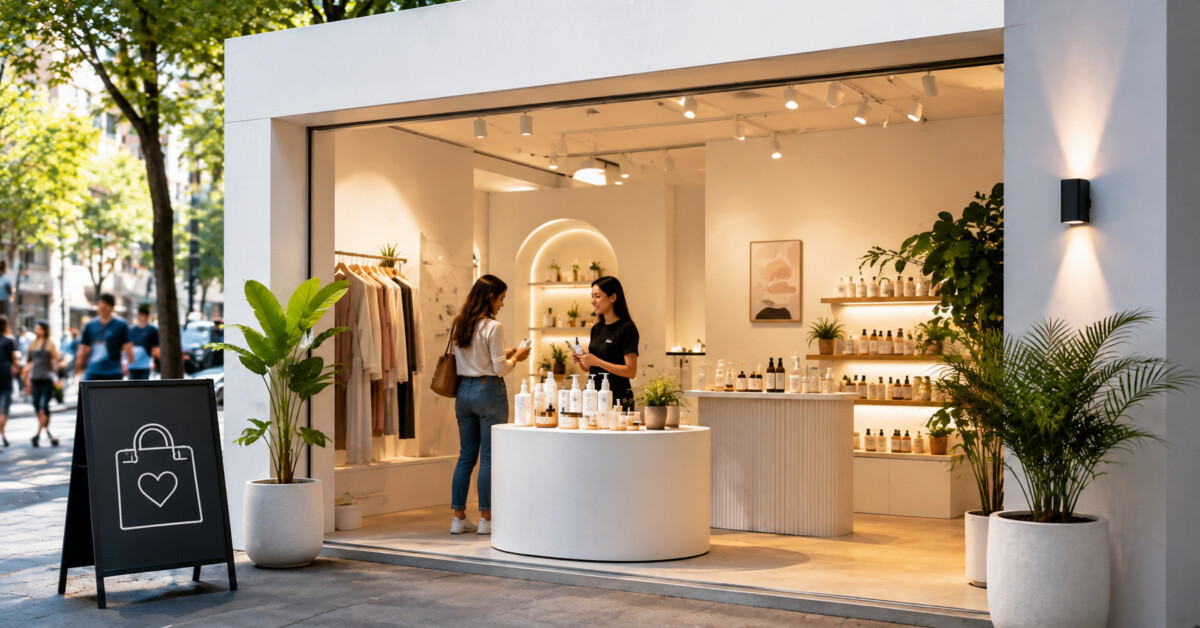
- Unlock “The Phygital Edge” with Complete Spatial Autonomy: In a shared market, you have zero control over your environment – you can’t fix the neighboring stall’s loud music, harsh lighting, or distracting crowd flow. A dedicated pop-up gives you complete spatial control. By transforming a clean White Box venue, you build a fully branded physical extension of your digital storefront. Custom lighting, signature scents, curated playlists, and intentional traffic flow turn a simple transaction into an unforgettable sensory experience.
- Build a High-Value Content Engine for Organic Virality: A folding table at a vendor fair rarely inspires a customer to pull out their phone and film an Instagram Reel or TikTok. A standalone pop-up – designed with intentional photo backdrops, interactive display walls, and exclusive product drop areas – turns every visitor into a broadcast channel. Your physical space becomes an organic content engine, generating user-generated content (UGC) that drives massive viral reach straight back to your online store.
- Own the Customer Relationship and Collect High-Intent Data: At a crowded fair or market, foot traffic is chaotic, fast-moving, and easily distracted. It is nearly impossible to hold deep conversations or capture qualified contact details. In your own dedicated space, every visitor enters specifically to engage with your brand. This focused environment lets your team capture high-intent email sign-ups, SMS opt-ins, and nuanced qualitative feedback that Google Analytics can never deliver.
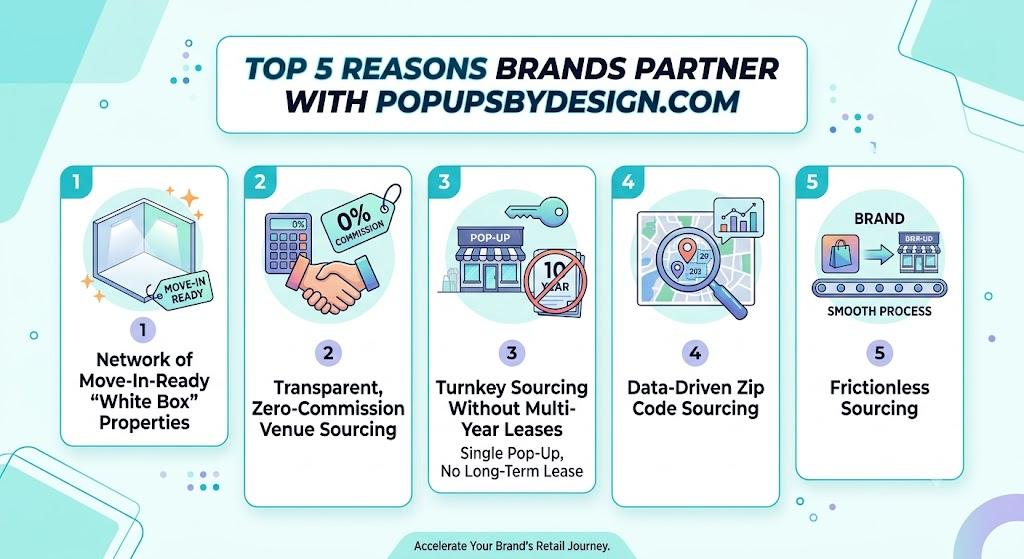
Top 5 Reasons Brands Partner with PopUpsByDesign.com for Their Perfect White Box Space
Finding the right physical footprint shouldn’t mean wasting months negotiating complex real estate deals or settling for ill-fitted venue rentals. PopUpsByDesign simplifies property sourcing by serving as a dedicated, client-first partner in finding your ideal White Box space:
- Nationwide Network of Move-In-Ready “White Box” Properties: PopUpsByDesign has access to a curated, nationwide network of clean, blank-canvas venues located in high-foot-traffic retail corridors across major US cities – primed for rapid temporary brand transformations.
- Transparent, Zero-Commission Venue Sourcing: Traditional real estate brokers and platforms often hide markups, charge steep booking commissions, or take landlord kickbacks. PopUpsByDesign operates on a strict fiduciary model, ensuring completely transparent direct property pricing.
- Turnkey Sourcing Without Multi-Year Leases: Avoid the rigid traps of 3-to-5-year commercial leases. PopUpsByDesign sources short-term, turn-key property access tailored precisely to your campaign dates – whether you need a 3-day weekend activation or a month-long holiday pop-up.
- Data-Driven Zip Code Sourcing via Deep Brand & Social Analytics: Rather than guessing where your audience lives, PopUpsByDesign performs an in-depth analysis of your brand identity, customer profiles, and social media follower demographics. By pinpointing where your most engaged audience actually clusters, we narrow down site selection to the exact zip codes and micro-neighborhoods guaranteed to deliver high-converting foot traffic.
- Frictionless Sourcing: Securing a temporary venue doesn’t have to be stressful. Finding a space often gets bogged down in landlord back-and-forth, temporary occupancy agreements, short-term insurance requirements, and site access coordination. PopUpsByDesign acts as your single point of contact, managing the entire site-selection process so your team can focus on what actually drives revenue – marketing, customer engagement, and sales execution.
Ready to Capture Your Phygital Edge?
Stop hiding your brand behind a shared market table. Your products aren’t commodities. Your brand deserves its own room!
Author Bio:
Robert Kraus, owner of SmallConferences.com & PopUpsByDesign.com, has over 20 years of event planning experience, producing over 250 meetings, events, pop-ups, and conventions from 25 to 2500 attendees. He gives back by sharing his knowledge – teaching Hospitality at local Miami homeless shelters as well as “Make Your Own Job – Entrepreneurship.” He also teaches Event Planning for Nonprofits, and Intro to Nonprofit Accounting as part of PhilanthropyMiami’s Social Impact Pop-Up Workshop Series. Robert’s been featured in USA Today, Corporate & Incentive Travel, NonProfit PRO, Hotels Magazine, Hospitality & Tourism News, & on the Today Show because of his expertise.
Frequently Asked Questions
How do standalone pop-ups compare to shared vendor markets for D2C brands?
Standalone pop-ups give D2C brands control over environment, pricing, and storytelling, while shared vendor markets often frame them as bargain stalls competing on price rather than value. In a dedicated space, you can design lighting, traffic flow, merchandising, and sensory cues around your brand instead of reacting to neighbors and random layouts. That autonomy supports premium positioning, deeper conversations, and higher-quality data collection, which are difficult to achieve in crowded, mixed-vendor environments.
What kind of brands benefit most from a phygital pop-up strategy?
Brands with a clear product story, strong repeat purchase potential, and active communities benefit the most from phygital pop-ups because they can extend existing online momentum into the physical world. Apparel, beauty, wellness, specialty food, and home goods brands are particularly well suited because customers want to touch, try, smell, or taste before committing. If you already see organic engagement on social and email, a thoughtfully executed pop-up can deepen loyalty, unlock word-of-mouth, and give your best customers a tangible way to connect with your brand.
How should I measure ROI from a short-term pop-up?
ROI from a pop-up should be measured across multiple dimensions: immediate revenue, new email and SMS signups, user-generated content volume, and qualitative insight you can act on later. Start by setting targets for daily sales and list growth, then track how many visitors convert on-site and online afterward. Layer in metrics like content saves and shares from UGC, plus feedback themes that influence future product or messaging decisions. Taken together, these signals give a more accurate picture of value than sales alone and help you refine each subsequent activation.
What does a “White Box” space enable that typical event venues do not?
A White Box space gives you a neutral, flexible canvas where walls, floors, and lighting do not fight your brand, enabling faster and more precise transformation into your ideal store environment. You can deploy modular fixtures, signage, and experiential elements without working around dated decor or mixed-use constraints. That simplicity shortens setup time and makes it easier to test multiple layouts or themes across different activations while keeping your core identity consistent.
How can PopUpsByDesign help my team execute faster and with less risk?
PopUpsByDesign helps your team execute faster by handling site selection, landlord negotiations, and access logistics so you do not have to spin up an internal real-estate function. Their short-term, transparent sourcing model reduces commitment risk and frees budget for experience design, staffing, and promotion. Because they rely on brand and social analytics to choose locations, you also reduce market risk by showing up where your audience already clusters instead of betting blindly on unfamiliar neighborhoods.