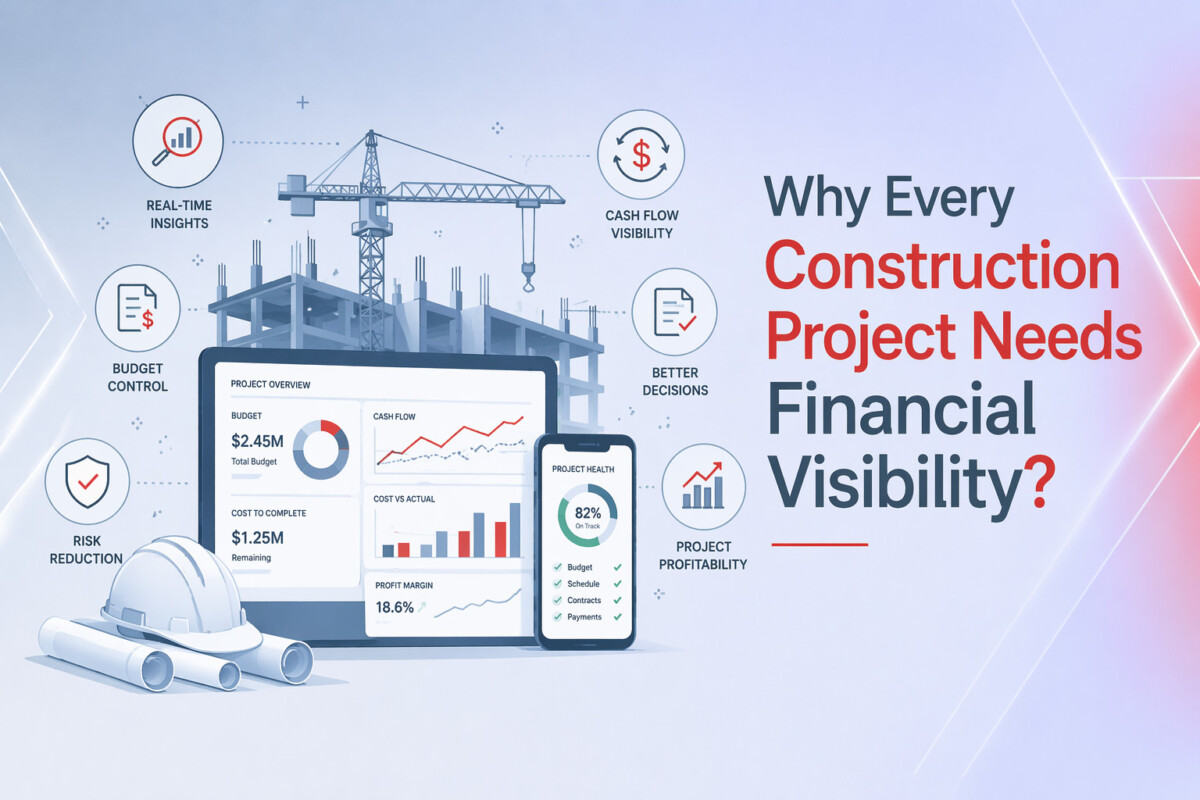
Every construction project needs financial visibility so teams can see, in real time, how budgets, costs, cash flow, and risks are evolving—and act early—rather than discovering expensive problems at the end.
On complex construction projects, you are never just managing concrete and labor—you are managing cash, risk, and expectations, and you cannot manage what you cannot see.
Construction projects are becoming more complex than ever before. Rising material costs, labor shortages, supply chain disruptions, and changing project requirements make it increasingly difficult to stay within budget. While delivering projects on time remains a priority, maintaining complete financial visibility throughout the project lifecycle has become equally important.
Financial visibility is more than simply tracking expenses. It provides a clear understanding of where money is being spent, how budgets compare with actual costs, and whether the project is progressing toward its financial goals. When stakeholders have access to accurate financial data, they can make informed decisions, minimize risks, and improve project profitability.
Whether managing residential developments, commercial buildings, or large infrastructure projects, financial visibility enables construction companies to maintain control from project planning to final completion.
The foundation of financial visibility begins long before construction starts. Every successful project relies on accurate budgeting, realistic forecasting, and reliable cost estimates. Professional estimating companies help contractors, developers, and project owners create comprehensive budgets that account for labor, materials, equipment, permits, and contingency planning. By using accurate estimates at the planning stage, organizations reduce the likelihood of costly surprises and establish a reliable financial baseline that supports smarter decision-making throughout the project lifecycle.
Without accurate planning, even well-managed projects can quickly experience budget overruns. Initial estimation errors often compound over time, making it difficult to recover financially once construction is underway.
Budget overruns are one of the biggest challenges in the construction industry. Small pricing inaccuracies, design modifications, unexpected site conditions, or scheduling delays can significantly impact overall project costs.
Financial visibility allows project managers to compare actual spending against planned budgets in real time. Instead of discovering problems at the end of the project, teams can identify issues as they occur and take corrective action immediately.
Early detection helps organizations:
The sooner financial issues become visible, the easier they are to resolve without disrupting project timelines.
Construction projects require hundreds of financial decisions throughout every phase. Managers must evaluate subcontractor proposals, approve material purchases, authorize change orders, and monitor cash flow continuously.
Without complete financial transparency, these decisions are often based on assumptions instead of reliable data.
Financial visibility provides decision-makers with current financial information, including:
Having this information readily available allows teams to make faster, more confident decisions while minimizing financial risks.
Cash flow is the lifeblood of every construction business. Even profitable projects can face operational difficulties if cash inflows and outflows are not carefully managed.
Financial visibility enables companies to monitor incoming payments, scheduled expenses, subcontractor invoices, payroll obligations, and supplier commitments. This helps ensure that sufficient funds remain available throughout the project.
Improved cash flow management also benefits clients, subcontractors, and suppliers by reducing payment delays and improving overall project relationships.
Organizations that actively monitor cash flow are better prepared to handle unexpected expenses without compromising project delivery.
Construction projects rarely proceed exactly as originally planned. Clients may request design changes, regulatory requirements may evolve, or unforeseen site conditions may require additional work.
Each change order has financial consequences.
Without financial visibility, project teams may struggle to understand the true cost impact of modifications. This can result in underpricing change requests or absorbing unexpected expenses that reduce profit margins.
With accurate financial tracking, managers can quickly evaluate:
This information supports transparent communication with clients while ensuring every approved change is properly documented and financially justified.
Every construction project involves financial risks. Material price fluctuations, labor shortages, weather delays, equipment failures, and supply chain disruptions can all affect project costs.
Financial visibility helps organizations identify potential risks before they become major financial problems.
Regular financial monitoring enables project teams to:
Instead of reacting to problems after they occur, companies can proactively implement mitigation strategies that reduce financial exposure.
Construction projects involve multiple stakeholders, including owners, architects, engineers, contractors, subcontractors, suppliers, and financial managers.
When financial information is transparent, every team member understands how their decisions affect project costs.
This increased accountability encourages:
Financial visibility creates a shared understanding of project objectives, helping teams work together toward common financial goals.
Financial visibility is not limited to monitoring current expenses. It also provides valuable insights for predicting future project performance.
By analyzing current spending trends and comparing them with historical project data, managers can forecast:
Reliable forecasting allows organizations to make proactive adjustments before financial issues affect project delivery.
Accurate forecasts also improve communication with investors, lenders, and project owners by providing realistic expectations regarding project finances.
Clients want confidence that their investment is being managed responsibly. Transparent financial reporting demonstrates professionalism and builds trust throughout the project.
When project owners receive clear updates regarding budgets, expenditures, and financial progress, they gain greater confidence in the contractor’s ability to deliver successful outcomes.
Financial transparency also simplifies discussions regarding:
Strong financial communication often leads to higher client satisfaction and increased opportunities for repeat business.
Modern construction management software has significantly improved financial transparency across projects.
Today’s digital platforms integrate estimating, scheduling, procurement, accounting, payroll, and project management into a centralized system.
These technologies provide:
Cloud-based systems also allow stakeholders to access financial information from virtually anywhere, improving collaboration and accelerating decision-making.
As construction projects become increasingly data-driven, technology plays a critical role in maintaining complete financial visibility.
Financial visibility extends beyond individual projects. It provides valuable business intelligence that supports long-term organizational growth.
Companies that consistently analyze financial performance can identify profitable project types, improve estimating accuracy, optimize resource allocation, and strengthen overall operational efficiency.
Historical financial data also supports strategic planning by revealing trends that help businesses refine pricing strategies, negotiate better supplier contracts, and improve future project planning.
Organizations with strong financial controls are better positioned to scale operations while maintaining profitability in an increasingly competitive construction market.
Financial visibility is no longer an optional advantage it is a necessity for successful construction project management. From accurate budgeting and effective cash flow management to risk reduction and informed decision-making, financial transparency helps organizations maintain control throughout every stage of construction.
Projects with strong financial oversight are more likely to stay on budget, meet deadlines, satisfy clients, and achieve sustainable profitability. As construction continues to evolve, companies that prioritize financial visibility will be better equipped to manage uncertainty, improve operational performance, and deliver successful projects with greater confidence.
Financial visibility in construction means having timely, accurate insight into budgets, actual costs, cash flow, commitments, and forecasts so teams can see how the project is performing financially at any point in time.
Financial visibility helps prevent budget overruns by highlighting cost variances early, which allows teams to adjust spending, scope, or procurement strategies before overruns become unmanageable.
Professional estimating companies strengthen financial visibility by creating detailed, realistic budgets that form the baseline for tracking costs and evaluating changes throughout the project.
Technology improves financial transparency by integrating estimating, accounting, procurement, and field data into real‑time dashboards and reports that everyone can access and act on.
Cash flow management is critical because even profitable projects can stall or strain a business if incoming payments do not align with outgoing costs for labor, materials, and overhead.