

Real estate portfolios that grow beyond 15 to 20 properties need an ERP because disconnected tools create compounding financial risk, slow closes, and unreliable lease accounting under standards like ASC 842.
Most real estate portfolios don’t hit a wall because the market turns; they hit it when the manual work between disconnected systems becomes the quiet bottleneck nobody has time to fix.
Real estate portfolios grow faster than the systems managing them. Here is why disconnected tools eventually cap growth, and what an ERP changes.
Most real estate companies do not lose money because a deal went wrong. They lose it slowly, in the space between systems, where a lease amendment sits in someone’s inbox for three weeks, or a rent increase gets applied in the property management tool but never makes it into the general ledger.
None of this shows up as a single dramatic failure. It shows up as a finance team that closes the books ten days later than it should, and a portfolio that looks profitable on paper while cash flow tells a different story.
Every growing real estate operator eventually assembles the same stack without meaning to. Property management software handles units and tenants. A separate accounting package handles the books. Lease abstracts live in a shared drive somewhere, usually as PDFs nobody has fully indexed.
Maintenance requests come in through email or a work order tool that does not talk to anything else. Each piece works fine in isolation. The problem is what happens between them.
Rent rolls have to be reconciled by hand against the general ledger every month. A regional manager cannot see occupancy and delinquency for the whole portfolio without asking three different people for three different reports, none of which use the same reporting period.
Lease escalations and renewal dates sit in a spreadsheet that only one person maintains, and when that person is out sick during a renewal window, the company either loses a tenant or renews on the wrong terms.
None of these are edge cases. They are the default state of real estate operations once a company crosses roughly 15 to 20 properties or a few hundred units, and the cost compounds.
The American Institute of CPAs has flagged manual reconciliation and disconnected recordkeeping as a recurring source of financial misstatement risk in property-heavy businesses, precisely because so much of real estate accounting depends on data that originates outside the finance department.
When lease terms, property data, and general ledger entries live in separate systems, the finance team is not closing the books so much as reconstructing them every month.
This is really what a purpose-built real estate ERP software solves. It is not about adding more reporting. It is about removing the reconciliation work that disconnected systems create in the first place, so the numbers a CFO sees on a Tuesday afternoon are the same numbers that end up in the audited financials months later.
For a real estate business trying to decide whether this is worth the disruption of switching systems, the honest answer is that the disruption is smaller than the alternative, which is continuing to run a growing portfolio on tools that were never built to be the system of record for one.
An ERP built for real estate does not add another tool to the stack. It replaces the reconciliation work by making property data, lease data, and financial data part of the same record instead of three separate ones that have to be manually matched.
The Financial Accounting Standards Board’s guidance makes clear that ongoing lease modifications, not just initial recognition, have to be tracked and remeasured accurately, which is exactly the kind of ongoing maintenance that manual processes tend to quietly fall behind on.
When a lease is created or amended, the revenue recognition schedule updates automatically instead of requiring a spreadsheet rebuild. When a tenant pays late, that shows up in the same system the CFO uses to close the books, not in a property manager’s separate tracking sheet.
The operational shift is just as significant as the accounting one. A portfolio manager overseeing 40 properties across three entities can look at occupancy, delinquency, and maintenance backlogs in one place instead of stitching together exports from four systems.
A CFO preparing for an investor update or a refinancing conversation can pull consolidated, entity-level financials without asking the accounting team to spend two days building a custom report. This is the difference between a company that reports on its portfolio and one that actually runs it.
Real estate companies tend to postpone this decision because the disconnected systems technically still work.
Nothing breaks outright. But the cost shows up as the company scales; more properties mean more manual reconciliation, more spreadsheet dependency, and more risk concentrated in whichever employee happens to know where everything lives.
The businesses that handle this well are not the ones with the most properties. They are the ones who moved their financial and operational data onto one platform before the manual workarounds became load-bearing.
The disconnected tools most real estate businesses run on were never wrong for the size they were bought for. They simply stop being enough once a portfolio grows past what one spreadsheet owner or one manual reconciliation process can carry safely.
The businesses that scale without adding financial risk are the ones that treat real estate ERP software as portfolio infrastructure, not as an accounting upgrade, and put it in place before the workarounds become the system of record by default.
A real estate business should move from spreadsheets to an ERP once the portfolio approaches 15 to 20 properties or a few hundred units and month-end closes depend heavily on manual reconciliation. At that point, the risk of misstatements, missed renewals, and delayed closes starts to outweigh the convenience of familiar tools. Early adoption keeps ERP implementation from becoming a crisis project triggered by an audit finding or a refinancing deadline.
ASC 842 makes ERP more important because it requires accurate tracking of lease liabilities and right-of-use assets over the life of the lease, including modifications and remeasurements. Spreadsheets and disconnected systems make it easy to miss changes or apply them inconsistently, increasing the risk of misstatements. An ERP designed for real estate automates the links between lease terms and accounting entries so compliance becomes a routine output of day-to-day operations rather than a special project.
The biggest signs that disconnected tools are creating risk include month-end closes that take longer every quarter, frequent manual adjustments to reconcile rent rolls and the general ledger, and reliance on one or two people who “know where everything lives.” When lease amendments, escalations, and renewal dates are tracked primarily in spreadsheets or emails, and finance must reconstruct reality from multiple systems, the organization is operating with structural fragility that an ERP can address.
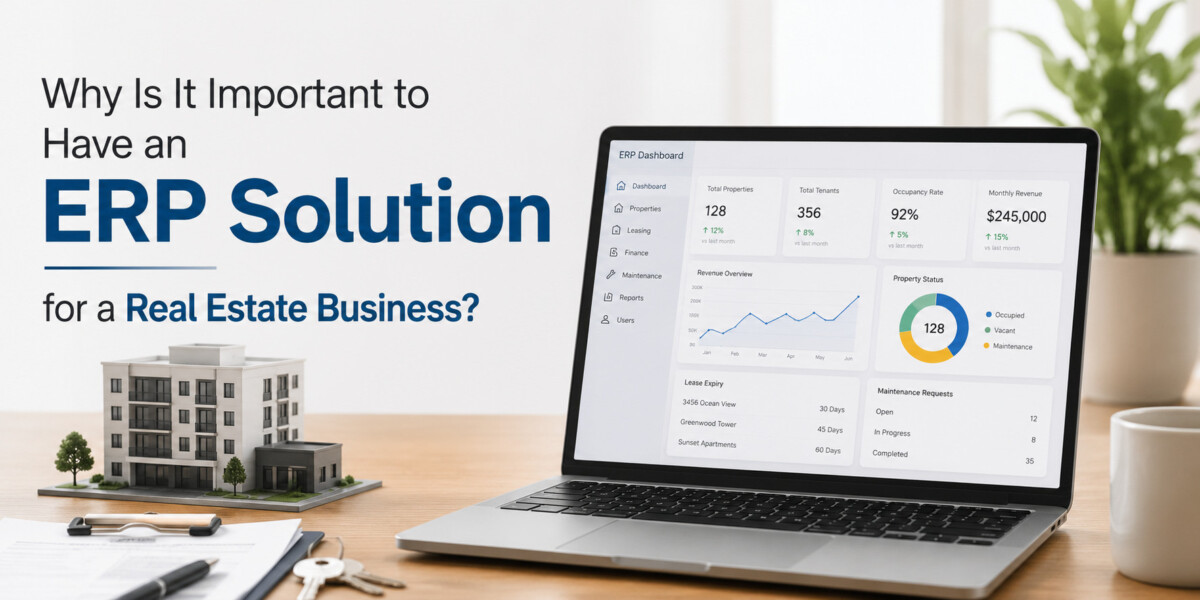
A real estate ERP changes daily work for portfolio managers by bringing occupancy, delinquency, maintenance, and lease activity into one dashboard instead of separate reports. Managers no longer need to collect exports from different tools or chase down spreadsheets to understand what is happening across the portfolio. That visibility makes it easier to prioritize interventions, plan capital improvements, and respond quickly to issues because decisions are based on current, connected data rather than lagging reconciliations.
Implementing an ERP is temporarily disruptive, but staying with disconnected tools becomes more disruptive over time as manual work and risk accumulate.
The implementation requires data migration, process changes, and training, which can take several months. However, the alternative is running a growing portfolio on systems that were never built to serve as a unified record, forcing teams to spend increasing amounts of time reconciling data and fixing silent errors. For most scaling real estate businesses, the one-time disruption of ERP adoption is smaller than the ongoing operational and financial risk of delaying the decision.





