

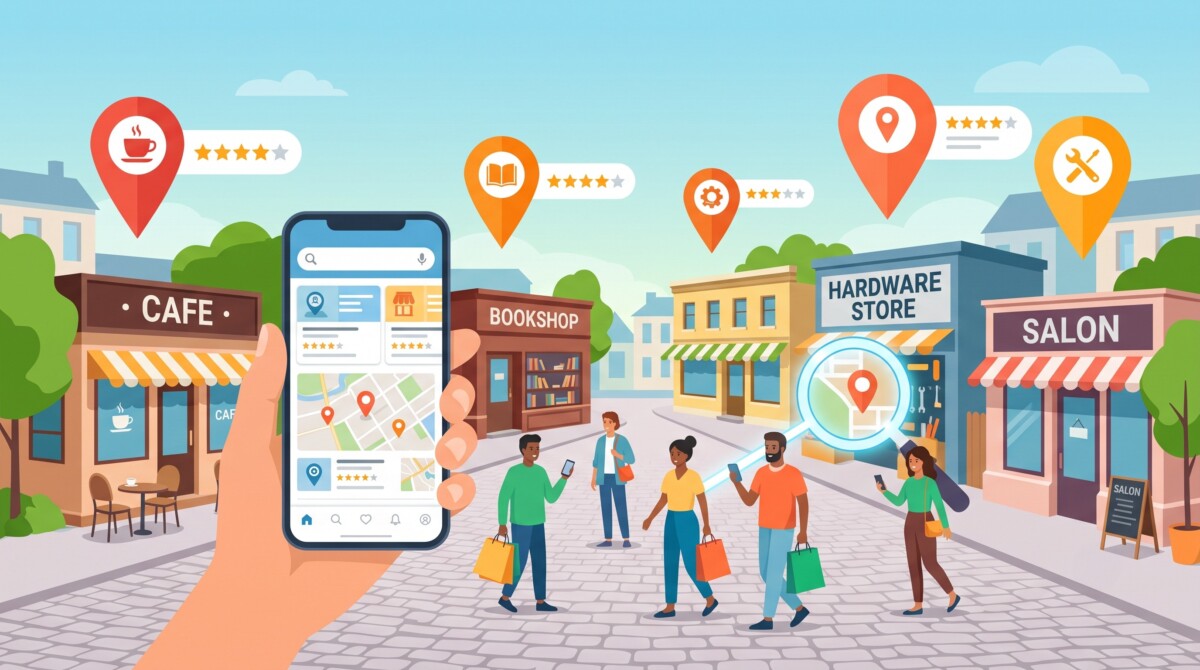
Local SEO matters because it decides whether nearby customers ready to buy find your business or a competitor, making it one of the highest-ROI marketing investments for any company that relies on local customers.
Every time someone near you searches for exactly what you sell and doesn’t see your business, you’re not just losing traffic—you’re handing a ready-to-buy customer to a competitor.
Think about the last time you needed something nearby. A plumber, a coffee shop, a dentist, someone to fix your phone. You probably pulled out your phone, typed a few words, and picked one of the first businesses that showed up. You didn’t scroll to page two. Almost nobody does.
That moment, the one where a person turns a vague need into a specific search, is exactly where local SEO earns its keep. If your business shows up, you’re in the running. If it doesn’t, the customer never knows you exist, and they hand their money to whoever did show up.
Most small businesses treat this as an afterthought. That’s a mistake, and it’s an expensive one.
Local SEO is the work of getting your business to appear when people search for products or services in your area. It overlaps with regular SEO but has its own mechanics. Google treats “coffee shop” and “coffee shop near me” as fundamentally different queries, and it ranks them using different signals.
The most visible piece is the local pack: those three business listings with a map that appear at the top of local searches, above the regular blue links. Getting into that pack is the single highest-value thing most local businesses can do online, and it comes down to a specific set of factors rather than luck.
This is the kind of work agencies handle when a business wants to own its local market. A team like a chicago seo company, for instance, spends most of its time on exactly these local ranking signals for businesses trying to dominate a specific metro. If you want to see how that gets structured in practice, Growth Logiq Chicago lays it out.
Here’s the part that surprises people. Local searches convert at a much higher rate than general ones, because the person searching is usually ready to act.
Someone searching “how does teeth whitening work” is curious. Someone searching “teeth whitening near me” is looking to book. Google knows the difference, and so should you. The local searcher is already reaching for their wallet, which is why ranking locally tends to move actual revenue in a way that ranking for informational terms often doesn’t.
A few realities worth sitting with:
Put those together and the conclusion is hard to argue with. If you serve a geographic area and you’re not visible in local search, you’re not losing traffic. You’re losing customers who were actively trying to buy.
There’s no single lever here. Local ranking comes from a handful of things working together, and the frustrating part for most owners is that you can’t skip to the fun stuff. You have to do the boring foundational work first. The upside is that most of your competitors won’t, so getting even a few of these right puts you ahead.
This is the foundation. Your Google Business profile is the listing that feeds the local pack and the map results. An incomplete or neglected profile is the most common reason a business doesn’t show up locally.
Fill out every field. Correct categories, accurate hours, phone number, website, service area, and real photos. Businesses with complete profiles and current photos consistently outperform ones with a bare listing. Google rewards profiles it trusts, and a half-finished listing doesn’t earn that trust.
Reviews pull double duty. They feed your ranking in local results, and they’re often the deciding factor when a customer is staring at three options in the local pack trying to pick one.
Volume matters, but recency matters more than people expect. A business with forty reviews from this year beats one with sixty reviews that dried up two years ago, because Google reads the stale profile as a business that might not even be open anymore. Ask every happy customer for a review, make it stupidly easy for them, and reply to the ones you get. The businesses that struggle with this almost always have the same problem: no system, so they only remember to ask when a customer is already walking out the door.
Your name, address, and phone number need to match across every place they appear online. Your website, your Google profile, Yelp, industry directories, everywhere.
When these don’t match, Google gets confused about which information is correct, and that uncertainty drags down your rankings. It sounds trivial. It isn’t. Inconsistent listings are a quiet ranking killer that most owners never think to check.
If you serve multiple areas, generic pages won’t cut it. A page built around a specific city or neighborhood, with content genuinely relevant to that area, ranks far better for searches in that location than a single catch-all page trying to cover everywhere at once.
This is where a lot of multi-location businesses leave money on the table. One “service areas” page listing twelve towns does almost nothing. Twelve real pages, each built for one place, does a lot.
The businesses that skip local SEO don’t usually notice the cost, because you can’t see the customer who chose a competitor. The loss is invisible, which is exactly why it’s dangerous.
Meanwhile the competitor who did the work shows up first, collects the calls, earns the reviews, and compounds the advantage. Local rankings tend to stick once you’ve earned them, so every month you wait is a month someone else spends building a lead that gets harder to close.
There’s also the paid ad trap. Businesses that never build local visibility often end up renting it through Google Ads instead, paying for every single click, forever. The moment the budget stops, so does the traffic. Local SEO is the opposite. It costs effort upfront and then keeps working.
You don’t need to do everything at once. Start here, in this order:
Do those five things and you’ll be ahead of most of your local competition, because most of them haven’t. Local SEO isn’t crowded at the top. It’s crowded at the bottom, where everyone has a half-finished profile and no reviews.
Local SEO matters because it decides whether the person searching for exactly what you sell, in exactly your area, right now, finds you or finds someone else. That’s not a marketing abstraction. That’s a real customer with a real wallet making a decision in real time.
Show up when they look and you get the call. Stay invisible and you never find out how many calls you missed, which is the part that makes this easy to ignore and expensive to keep ignoring. For any business that lives on local customers, that’s reason enough to stop treating it as optional.
How long does local SEO take to show results?
Faster than regular SEO, usually. A neglected Google Business profile that gets properly optimized can see movement in local rankings within a few weeks. Building review volume and location pages takes longer, but local SEO generally produces visible results in one to three months, quicker than the six-plus months competitive organic rankings often require.
Do I need a website for local SEO, or is a Google profile enough?
A Google Business profile alone can get you into local results, and for very small operations it’s a start. But a website gives you far more control, lets you build location-specific pages, and strengthens the trust signals Google uses to rank you. The businesses that dominate local search have both, working together.
Is local SEO worth it for a single-location business?
Yes, arguably more than for anyone. A single-location business competes in one market against a limited set of competitors. Winning the local pack in that one area can transform the business, and it’s very achievable because most local competitors haven’t done the basics well.





