

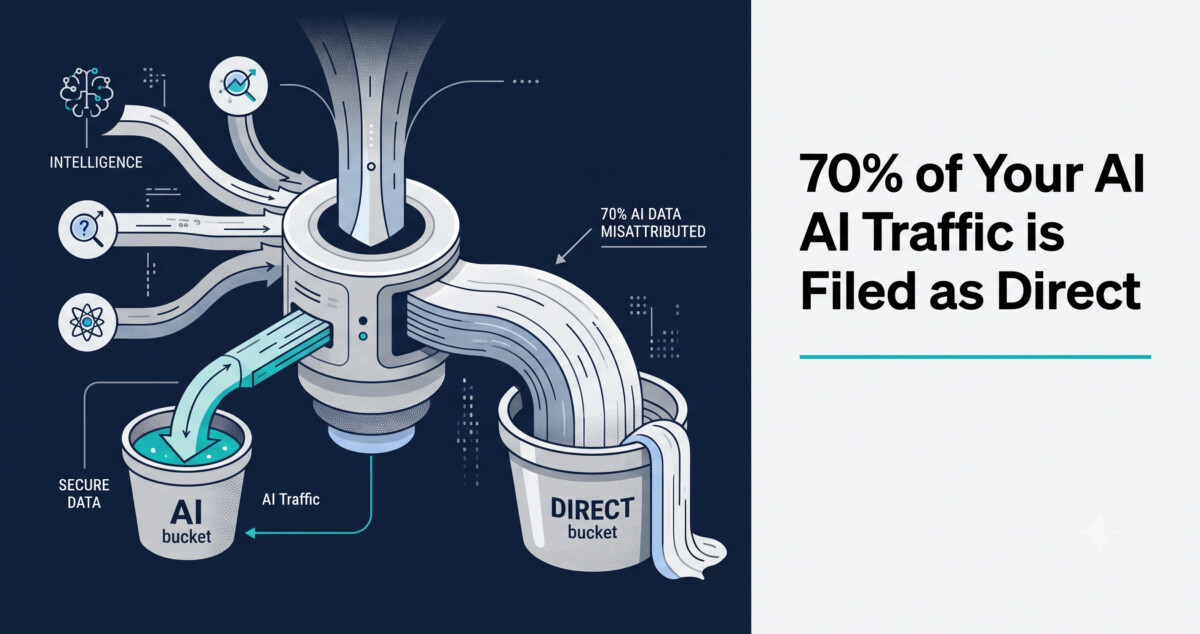
Roughly 70% of AI-referred traffic lands in your Direct bucket in GA4, and it converts nearly 4x better than non-AI traffic. AI is still under 1% of referrals, so measure it now and reallocate budget later.
The danger is not that AI traffic is huge. It is that it is small, invisible, and converts four times better than everything around it, which is exactly the profile of a channel a spreadsheet will tell you to cut.
A founder doing roughly $3M on Shopify told me in June that her Direct traffic was up 61% year over year. She had not run a brand campaign. She had not been on a podcast. Her paid spend was flat and her organic search sessions were down slightly. She was, in her words, “either doing something right or reading the dashboard wrong.”
She was reading the dashboard wrong, and so is almost everyone else at her stage. The traffic was real. The classification was not.
What follows is the part of the AI search conversation that has not made it down to the Shopify operator level yet. Not the “AI is eating your traffic” version, which the platform data does not support. The quieter and more expensive version: a small channel that converts unusually well is being systematically filed under the wrong label, and the brands most likely to make a bad call because of it are the ones running disciplined monthly budget reviews.
AI referral traffic is small today, at roughly 0.29% of search engine referrals across every AI chatbot combined as of May 2026, while Google still sends about 88% of all identified web referrals. Those figures come from Cloudflare Radar, which observes a meaningful slice of global web traffic, and they are worth sitting with before reading anything else on this topic.
The growth rate is the part that matters. ChatGPT referrals reached about 1.05% of all web referrals in the June to July 2026 window, roughly 5.5x their January level, making chatgpt.com one of the highest volume referring domains on the web for the first time. A channel moving 5x in six months from a small base is not yet a budget line. It is a measurement obligation.
Shopify’s own numbers point the same direction from the merchant side. AI-referred traffic to Shopify stores grew 7x through 2025, and AI-attributed orders grew 11x over the same period, which is why the platform built the infrastructure it now has for agent-driven discovery rather than treating it as an experiment.
So the honest framing for a $2M brand is this: AI discovery is currently somewhere between a rounding error and a rising minority channel depending on your category, and anyone telling you it is your biggest acquisition risk this quarter is selling something. The problem is not the size. The problem is that you cannot see it, which means you cannot tell whether your category is at 0.3% or 6%.
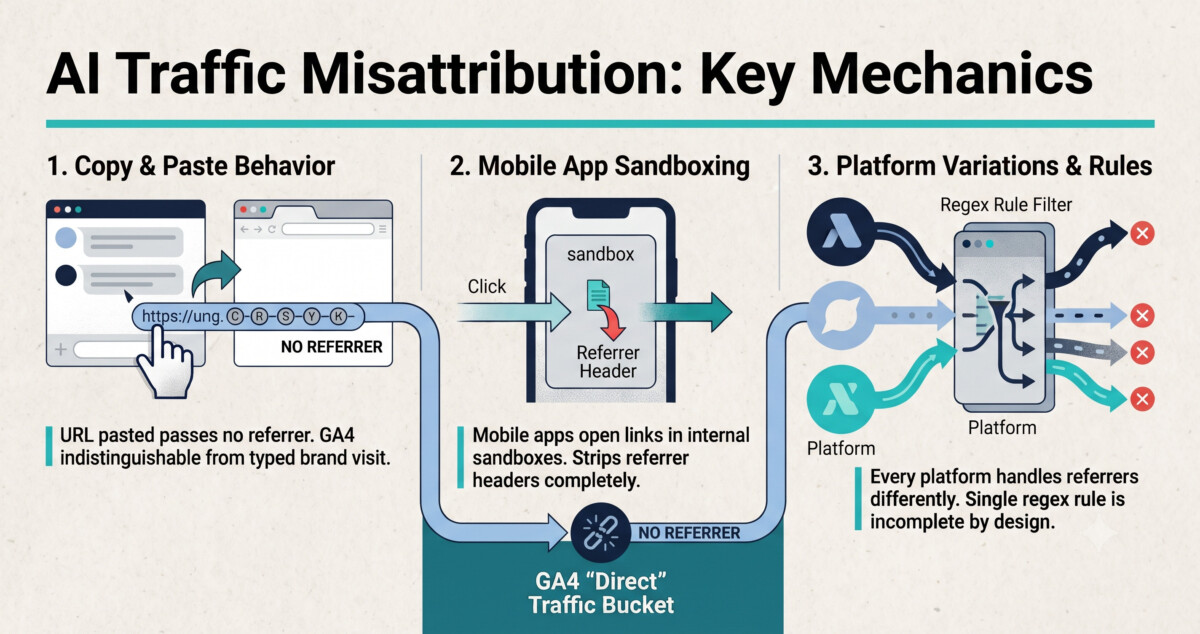
About 70.6% of AI referred sessions arrive at your store with no referrer header at all, which means GA4 has no choice but to file them as Direct. That figure comes from a dataset of 446,405 visits measuring how AI sessions get classified, where 14,413 of 20,428 identified AI visits carried no referrer. Worth naming the interest: the company behind that dataset sells detection software for exactly this problem, so treat the number as directionally strong rather than settled, and note that it aligns with what independent GA4 practitioners have been reporting since late 2025.
Three mechanics produce the gap, and none of them are fixable by you. The first is copy and paste behavior. People reading a ChatGPT answer frequently copy the URL and paste it into a fresh tab rather than clicking through, and a pasted URL passes no referrer. From your analytics perspective, that visitor is indistinguishable from someone who already knew your brand and typed it in.
The second is mobile app architecture. ChatGPT’s mobile apps open links in an internal sandbox that strips referrer headers entirely, so even a genuine click arrives naked. The third is that every platform handles referrers differently, which makes any single regex rule incomplete by design.
The practical consequence is that whatever your GA4 AI referral report shows, the real number is several times larger, and the multiplier differs by category and device mix.
Dark AI traffic converted at a 10.21% transactional rate against 2.46% for non-AI traffic in that same 446,405 visit dataset, a 4.1x advantage sitting inside your Direct bucket where it gets averaged against everything else. That averaging is the actual damage, and it is worse than simply missing a channel.
Think about what a Direct bucket contains at a $2M brand. Returning customers who typed your URL. Email clicks with broken UTMs. App traffic. Someone who saw your Instagram story. And now a growing slice of visitors who arrived pre-sold by an AI system that read your content, compared you against two competitors, and recommended you by name. Those two groups behave nothing alike, and blending them produces a Direct conversion rate that is meaningfully wrong in both directions.
The reason those visitors convert so well is not mysterious. An AI recommendation is a filtered, pre-qualified referral. The shopper already described their constraint, already saw the comparison, and already got an answer. By the time they land on your product page, most of the evaluation has happened somewhere you cannot observe. That is a fundamentally different visitor from someone who clicked a prospecting ad, and treating them as the same population inside one bucket degrades every segmentation decision downstream.
This is the same structural failure I keep seeing on the operational side, where an agent operating on dirty data fails silently rather than visibly. Broken tracking announces itself. Miscategorized tracking does not. It just quietly makes your reports slightly wrong for months while everyone acts on them with full confidence.
The predictable mistake is a brand cutting its long form content investment in Q4 because that content shows no attributable revenue, when the content is in fact the thing feeding a Direct bucket that quietly outperforms everything else. I have watched a version of this movie at every platform shift for twenty years, and the mechanics are always the same.
Here is how it plays out. A brand doing $2M to $5M runs a channel review. Paid social shows a 2.1 ROAS with clean attribution. Email shows 28% of revenue with clean attribution. The blog, the buying guides, the comparison pages, the founder’s long technical explainers all show almost nothing, because the visitors who read them and then bought arrived on a later session with no referrer. Someone reasonable looks at the spreadsheet and proposes reallocating the content budget into paid. The proposal is well argued, the data supports it, and the data is wrong.
What makes this particularly costly is that dense, factual, comparison heavy content is exactly what AI systems cite most readily. The pages with real specifications, honest tradeoffs, and testable claims are the ones getting pulled into answers. They are also the pages that look worst in a last click report. So the content most responsible for the invisible high converting channel is the content most likely to get defunded first.
The tell is simple, and you can check it in ten minutes. If your Direct traffic is growing materially faster than your brand search volume, your paid spend, and your email list, something is sending you visitors that your analytics cannot name. In 2026 the most likely candidate is an AI assistant.
Four free diagnostics will size this for you inside GA4 and Search Console, and together they take about 90 minutes to set up and 30 days to become readable. None of them require a new subscription, which matters because the vendors selling detection tools are the same people publishing the alarming statistics.
Start with a custom channel group in GA4 matching known AI referrers, using a regex against source that catches perplexity.ai, chatgpt.com, claude.ai, gemini.google.com, and copilot.microsoft.com. This captures only the minority of sessions that pass a referrer, so treat the result as your floor rather than your answer. It is still worth having, because the floor’s growth rate is informative even when its absolute value is understated.
Second, capture document.referrer through Google Tag Manager. HTTP referrer headers get stripped in cases where the JavaScript property still retains the value, so a custom JavaScript variable returning document.referrer, paired with a trigger matching AI platform patterns and a custom event into GA4, catches sessions the standard report misses. This is the single highest yield hour in the whole exercise. The full configuration sequence, including the UTM strategy that makes the reporting hold together, is covered in the guide on how to configure GA4 to capture AI referred sessions.
Third, build a behavioral proxy segment: sessions where source is direct, user type is new, the landing page is a blog post or buying guide rather than your homepage, and session duration exceeds three minutes. A genuinely direct visitor almost never lands deep on an article they have never seen. That segment is a reasonable proxy for hidden AI traffic, and its month over month trend is more useful than its absolute size.
Fourth, correlate branded search in Search Console. When an AI system recommends you by name, a meaningful share of those people search your brand rather than clicking. Branded impressions rising while non-branded organic stays flat is the clearest available signal that AI created demand you never saw arrive.
This does not mean you should rebuild your acquisition strategy around AI referral, and the data actively argues against doing so at a $2M brand this quarter. Google still sends roughly 88% of all web referrals. Every AI chatbot combined sat at 0.29% of search referrals in May 2026. A channel that size does not justify a strategic reallocation no matter how well it converts.
The imbalance is also correcting faster than the commentary suggests. Cloudflare’s measurement of how much platforms crawl versus refer showed Anthropic’s crawler at roughly 38,744 pages crawled per referral sent in mid 2025. By August 2026 that ratio had fallen to about 1,917 to 1, a roughly 20x improvement in twelve months. OpenAI’s ratio compressed on a similar trajectory. The platforms are visibly moving toward sending traffic rather than only consuming content, which changes the eighteen month picture considerably.
So the correct posture is measurement discipline now and budget response later, and I want to be specific about what “later” looks like. When your combined AI signal, meaning the GA4 floor plus the behavioral proxy segment, crosses roughly 3% of sessions and holds there for two consecutive months, it has earned a line in your channel review. Below that, checking it quarterly is sufficient and anything more is a distraction from conversion work that pays better.
The one thing worth doing regardless of your numbers is making sure AI systems can read your store at all, because measurement is useless if you have been filtered out upstream. That is a separate problem from attribution, covered in the breakdown of where AI systems filter your store out entirely, and it is the prerequisite rather than the follow up. The broader architectural shift behind all of this became hard to ignore in the week six major players all made the same bet.
The right action this quarter depends almost entirely on your revenue stage, and the honest answer for the smallest brands is to do nothing about this at all. Below roughly $250K per year, your AI referred volume is too small to produce a readable trend, and the ninety minutes this takes pays back better spent on your product page conversion rate.
Between $500K and $2M, do the measurement and change nothing else. Set up the GA4 channel group and the behavioral proxy segment, add the document.referrer capture if you already run Google Tag Manager, and then leave it alone for thirty days. The specific discipline here is that you are building a baseline, not making a decision. The failure mode at this stage is reading two weeks of noisy data and concluding something. Note also that Shopify’s own tooling covers a good deal of the discovery side for free, and Shopify’s AI commerce tooling for merchants is worth exhausting before you buy anything third party.
Between $2M and $10M, add one rule to your channel review: no content or SEO budget gets cut on last click data alone until the dark AI segment has been checked. That single guardrail is the entire practical value of this article for a brand your size. If the segment is trending up while the content it lands on shows no attributed revenue, the content is working and your attribution is not.
Above $10M, this becomes worth real tooling, and the honest note is that the vendors publishing the most compelling statistics are also selling the detection. Profound, Semrush’s AI features, and SE Ranking’s visibility products all track AI citation, which is a different measurement from traffic attribution and should not be confused with it. Before adding another subscription, it is worth auditing the tools you have quietly stopped using, because the brands that get the most from a new measurement layer are the ones that were not already drowning in dashboards nobody reads.
Growing direct traffic without a matching increase in brand awareness or paid spend is most often AI referral traffic being misclassified. Roughly 70% of AI referred sessions arrive with no referrer header, because users copy and paste URLs out of chat answers rather than clicking, and because mobile AI apps strip referrer data in their internal browsers. GA4 has no way to distinguish those sessions from someone typing your URL directly, so they land in Direct. The diagnostic is straightforward: compare your Direct growth rate against your branded search volume in Google Search Console. If Direct is climbing much faster than brand search, an intermediary you cannot see is sending you visitors.
Build a custom channel group in GA4 with a regex matching chatgpt.com, perplexity.ai, claude.ai, gemini.google.com, and copilot.microsoft.com against the session source. That captures only sessions passing a referrer, which is the minority, so treat it as a floor. To catch more, create a custom JavaScript variable in Google Tag Manager returning document.referrer, trigger on the same AI platform patterns, and send a custom event to GA4. The JavaScript property sometimes retains referrer information the HTTP header lost. Neither method captures copy and paste traffic, which is why a behavioral proxy segment of new users landing deep on article pages for three or more minutes should run alongside both.
Not in absolute volume, but the growth rate and conversion quality both justify measuring it now. Cloudflare Radar put every AI chatbot combined at about 0.29% of search engine referrals in May 2026, against roughly 88% for Google. ChatGPT alone reached about 1.05% of all web referrals by July 2026, roughly 5.5x its January level. On the Shopify side specifically, AI referred traffic grew 7x through 2025 and AI attributed orders grew 11x. So the channel is small and compounding quickly, and the sessions that do arrive convert several times better than average. Size it this quarter, act on it when it crosses roughly 3% of sessions.
Yes, substantially. Dark AI traffic converted at a 10.21% transactional rate against 2.46% for non-AI traffic across a dataset of 446,405 visits, roughly a 4.1x advantage. The mechanism is that an AI recommendation functions as a pre-qualified referral: the shopper already stated their constraint, already saw a comparison against alternatives, and already received a recommendation before landing on your page. Most of the evaluation happened outside your analytics. One caveat worth holding: that dataset comes from a company selling AI traffic detection software, so treat the specific figure as directionally strong rather than settled, though it matches what independent GA4 practitioners have reported since late 2025.
Not yet at most revenue stages, but you should add one guardrail immediately. A channel worth under 1% of referrals does not justify strategic reallocation, however well it converts. What it does justify is a rule that no content or SEO budget gets cut on last click data alone until your dark AI segment has been checked. The specific risk is defunding long form comparison and technical content, which is precisely the content AI systems cite most readily and precisely the content that looks worst in last click reporting. Revisit the budget question when your combined AI signal crosses roughly 3% of sessions for two consecutive months.




