

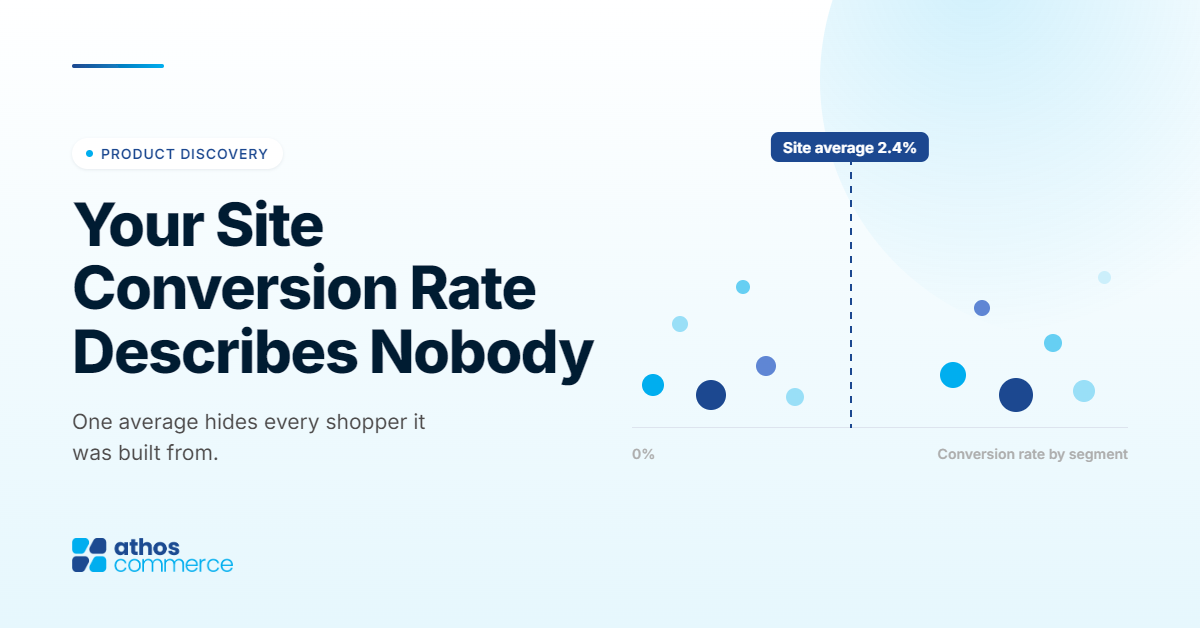
At Blue Sky Environments Interior Decor, shoppers who used on-site product search converted at 4 percent over the past year. Shoppers who did not converted at 0.6 percent. Search accounted for 25 percent of the brand’s total revenue across the same period.
A single blended site conversion rate sits between those two figures and matches neither group. Most ecommerce teams report that blended number weekly, plan against it, and set roadmap priorities from it, which means the highest-yield segment on the site stays folded into an average that hides it.
Two inputs determine what on-site product search returns: how many visitors use it, and how well the results perform when they do. Both are numbers you can move, and most retail teams currently track neither.
The pattern repeats across catalogs, price points, and verticals. Didriks found that the 16 percent of online shoppers who used on-site product search over six months produced 56 percent of online revenue, at 6.8 times the revenue per visit of shoppers who never touched the search bar. Search generated 39 percent of online orders and 51 percent of overall revenue for UTV Source in a sixty-day window, with revenue per visit running 14.6 times higher. Three quarters of HealthPost’s revenue, 76 percent, comes from site visits that include a search, and those visits convert at 24 percent. Within weeks of implementation, Jameco measured a 10.7 times higher conversion rate among visitors who engaged with on-site search.
In every one of those cases, a minority of traffic produced a majority or near-majority of revenue. That concentration should make on-site product search the most closely watched line in the weekly revenue review. It rarely is, because search enters most organizations as an implementation rather than as a channel. It has a go-live date, a vendor, and a ticket queue, where paid media has an owner, a budget, and a number that someone reports on Monday. Nobody argues that on-site product search matters less than paid media. It just has no one whose quarter depends on it.
The internal check on product search usually runs like this: someone types a product name they already know into the search bar, the correct item appears, and the feature passes. Real shoppers do not search that way.
Baymard Institute’s 2026 benchmark, built from more than 10,000 performance ratings across 170-plus ecommerce sites and apps, found that 56 percent fail to adequately support what users are trying to do when they search.1 The failures concentrate in exactly the query types that carry commercial intent. Sites mishandle feature queries 39 percent of the time, use-case queries 43 percent of the time, and compatibility queries 44 percent of the time. A shopper who types “waterproof jacket for hiking” or “cable that fits a 2019 model” is telling you their purchase criteria in plain language, and roughly two in five sites cannot act on it.
Shoppers report the same experience from the other side. In a Harris Poll survey of nearly 13,500 adults across 14 countries commissioned by Google Cloud, only 12 percent said they find exactly what they are looking for every time they search a retail site.2
A product search integration installed in 2019 can pass every internal check it is given and still leave most of its revenue potential unclaimed, because the checks confirm that it functions and never ask what it earns.
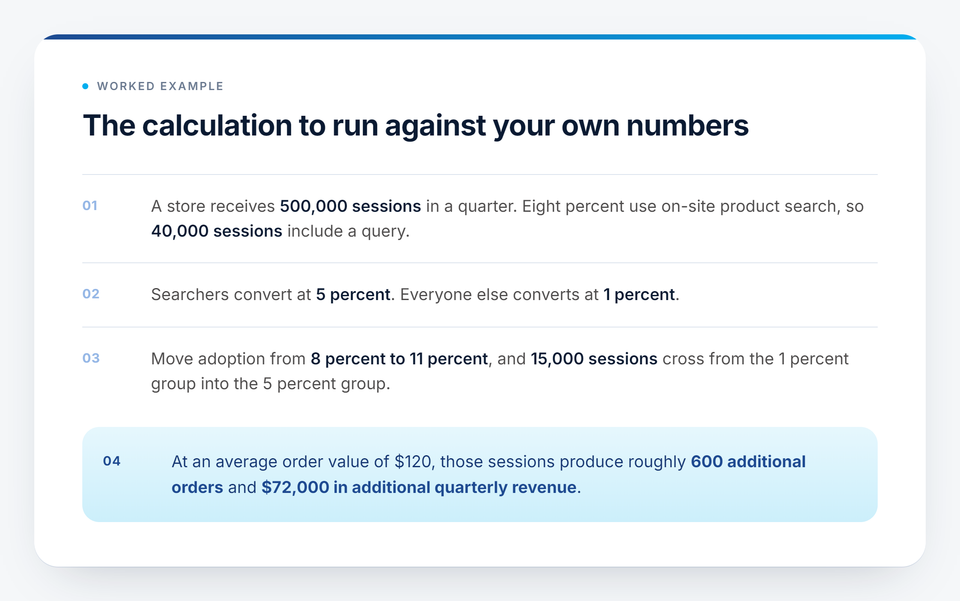
Most teams read the share of visitors who use search the way they read device mix, as fixed shopper behavior that the site inherits. Baymard’s research says otherwise: roughly half of ecommerce users prefer search over navigation as their way of finding products.3 Across the retailers cited earlier, from Didriks to St Frock, actual usage ranged from 6 to 16 percent. Half of shoppers prefer search, and one in ten of your visitors find it. Closing part of that distance is the first of the two inputs you control.
St Frock closed some of it. After a redesign, a Shopify Plus migration, and an Athos Commerce implementation, the share of shoppers using on-site product search rose from 6 percent to 10 percent, and average transaction value from search increased 20 percent over the same period.
We’re amazed to see how much revenue can be driven by search. Even though about 90% of our shoppers prefer to browse our categories, almost half our revenue now comes from search.
Romane Vernet
Senior Designer / Developer, Metro Kitchen
Four points of adoption sounds small until you multiply it against a conversion rate that runs four to ten times higher for shoppers who search.
Three structural changes raise adoption more reliably than anything else. Put the search entry point where it is visible without scrolling on mobile, where most sessions now begin. Build autocomplete so it returns products with images and prices rather than a list of suggested query strings, which lets a shopper buy straight from the dropdown. Keep the search bar prominent on category pages, because shoppers who start out browsing often reach for search only once the category has failed them.
A shopper who types a query has already stated intent. When the first result set misses, that shopper does not usually rephrase and try again. In the same Google Cloud research, 53 percent of consumers said they abandon their carts after unsuccessful searches.4 How often your first result set is right therefore decides most of the conversion multiple.
MacSales watched the improvement move through all three numbers after migrating to Athos Commerce. Bounce rates dropped 11 percent, search visitors began converting at a rate nearly 17 percent higher, and overall site conversion rose more than 25 percent. The Oodie, running Athos Commerce search on five of its nine sites, recorded conversions from search 156 percent higher than conversions without search in FY23, alongside 43 percent growth in the share of revenue attributed to search from FY22 to FY23. Bauer saw search-generated revenue rise 2.6 times within four months, with orders attributed to search 2.9 times higher than before.
When a team holds relevance at that level by hand, the cost climbs every quarter, because each new product drop, seasonal assortment, and inconsistent supplier naming convention reopens work the team had already finished.
Since integrating Athos, we’ve probably halved the time that we used to spend on manual search related tasks.
Jade Girgesons-Coates
Digital Project & Performance Manager, Topps Tiles
Adoption work and relevance work normally sit in different places. A front-end team owns where the search bar appears and how autocomplete behaves. A merchandising team owns synonyms, ranking, and what the results return. When those two functions run on separate systems holding separate copies of the product data, the same correction gets made two or three times, and neither lever reinforces the other.
On a single product data model, one enrichment changes everything downstream of it at once. Tag a jacket with “waterproof” and “hiking,” and that attribute improves the autocomplete dropdown and the ranking on the results page, and then flows through to category page filters, recommendation carousels, and the product feed going out to Google Shopping. The shopper who searches and the shopper who browses both benefit from a single piece of work.
Athos Commerce built the Intelligent Discovery Platform on this principle, running search, personalization, merchandising, and product feed management against one shared product data model. John Smedley reported a 300 percent increase in search-led revenue after switching.
An Athos Commerce search assessment will produce the first two numbers against your own catalog.
On-site product search is the one place where a shopper states what they want in their own words, before your taxonomy, your category structure, or your merchandising decisions have a chance to intervene. When a brand records four to ten times the conversion rate from search, it is serving the same customers as everyone else, at the moment those customers are easiest to serve.
You have already paid to bring that traffic to the site. What it earns from here depends on two numbers, and both of them are yours to move.




