

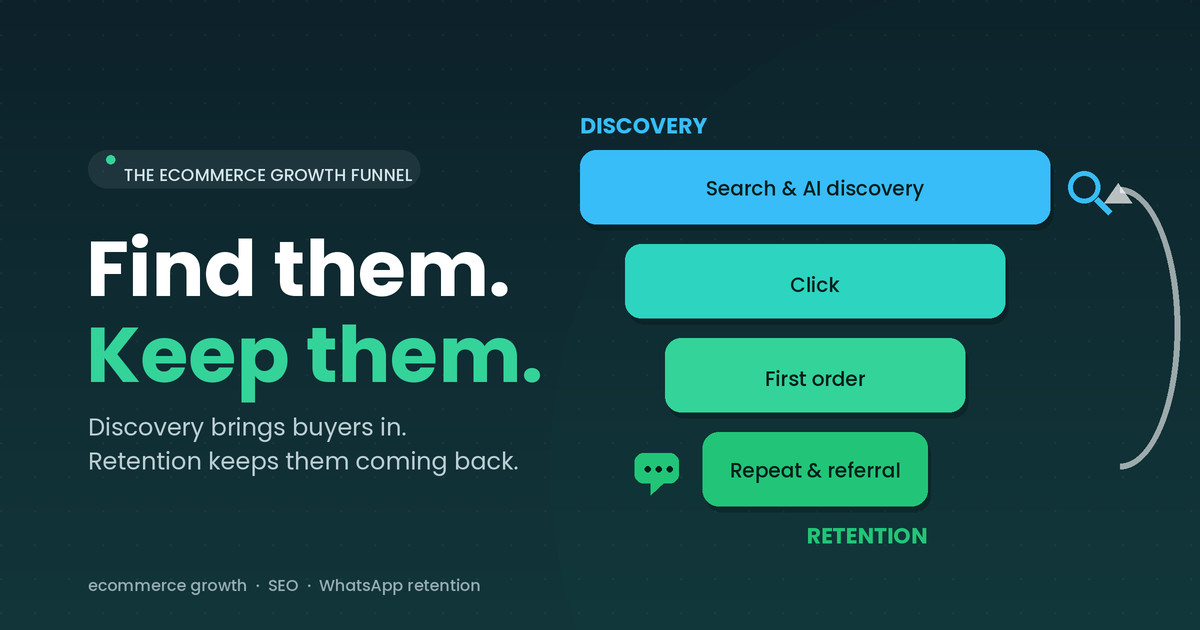
Ask most Shopify operators where their growth problem is and they will point at the middle of the funnel. The product page needs work. The ad creative is tired. Checkout could convert a little better. All of that is real, but it quietly assumes two harder problems are already solved: that new people are finding the store at all, and that the people who buy once come back to buy again. For a lot of brands, that is exactly where the money leaks. The middle gets all the attention, budgets pile into it, and the two ends of the funnel sit half optimized while everyone wonders why paid keeps getting more expensive.
The stores that break out of that cycle tend to do something simple. They treat discovery and retention as systems worth building, not afterthoughts bolted onto a media buy. It is a theme that runs through most of what operators read on Ecommerce Fastlane: the brands that win are rarely the ones with the flashiest ads, they are the ones that own their demand and keep the customers they already paid to win. Get those two ends right and the middle you already obsess over finally starts to pay off.
Paid traffic does one thing very well: it stops the moment you stop paying. Organic discovery works the other way. It takes longer to build, but once a page ranks it keeps pulling in buyers without a fresh charge on every click. Over a year the difference is enormous. A store that leans only on ads is renting every customer. A store with real organic visibility owns a slice of demand that shows up whether or not the card on file has budget left this month. That is why the brands that compound treat search as an asset on the balance sheet, not a line item in the ad account.
The mechanics are not a mystery. Where you land on Google comes down to a fairly well documented mix of content depth, technical health, page experience, and the authority signals pointing at your store. If you want the full picture before you brief a writer or a developer, it is worth reading through the core SEO ranking factors that decide your position on Google. Knowing which of them you actually control changes how you spend, because most stores waste effort on the parts that barely move and ignore the parts that do.
A quick audit usually surfaces the same handful of gaps:
Content is where most of this gets won or lost, and it is not only words. The way a product is shown carries real weight now, both for shoppers deciding to buy and for the systems deciding what to surface. Clean, consistent, and genuinely useful visuals help pages convert and help them earn links, which is why more brands are rethinking how they scale product photography instead of treating it as a one time chore.
Discovery is also splitting in two. People still search Google, but a growing share of buying research now happens inside AI answers from tools like ChatGPT, Claude, and Perplexity. Those systems read a category, summarize it, and name a few brands. Showing up in that answer is becoming its own discipline, separate from classic rankings, and the stores that start early tend to hold the position while competitors are still pretending it does not matter. The work overlaps with good SEO, but it rewards clarity, structure, and being genuinely referenced across the web far more than keyword tricks ever did.
Traffic that never converts is just an expensive way to inflate your analytics. Once someone lands, the job is to remove every reason to hesitate. That means fast pages, obvious trust signals, honest reviews, and a checkout that does not spring surprises at the last step.
Cost surprises are the quiet killer. A shopper who reaches the payment screen and suddenly sees shipping, duties, or taxes they did not expect will abandon the cart and rarely come back.
If you sell across borders, this gets worse fast, and it is worth handling deliberately rather than hoping buyers absorb it. Being upfront about duties and taxes at checkout turns a nasty surprise into a predictable line item, and predictable is what keeps a cart moving. Every point of friction you remove here makes the traffic from the last section worth more.
Acquisition gets celebrated. Retention pays the bills. A repeat customer costs a fraction of a new one, buys more often, and is far more forgiving when something goes wrong. Yet most stores pour their budget into the first purchase and then hand the relationship off to a couple of automated emails that go unopened.
The channels that actually keep customers close have shifted. Inboxes are crowded, and SMS is starting to feel the same way. Conversational messaging, WhatsApp in particular, still gets opened and still gets replies, which makes it a real channel for order updates, restock alerts, back-in-stock nudges, and the kind of two-way support that turns a one-time buyer into a regular. It feels less like broadcasting and more like a conversation, which is exactly why it converts.
There is a catch worth understanding before you scale it. Many providers charge a markup on every message, so the more successful your campaigns get, the more the channel punishes you for the win. The infrastructure you choose matters more than the tactics on top of it. Working through 360dialog, an official WhatsApp Business Solution Provider, gives you direct and compliant access to the WhatsApp Business API with predictable pricing, so a winning campaign does not quietly turn into a runaway cost. When engagement gets cheaper to scale, retention stops being a nice idea and becomes something you can actually run at volume.
Messaging also comes with responsibility. You are collecting phone numbers and behavioral data, and customers expect you to handle it properly. Clear opt-in, easy opt-out, and a current, honest data privacy policy are not just legal housekeeping. They are part of why people trust you enough to keep the conversation open. Get consent right and the channel stays healthy. Get it wrong and you burn the list along with the goodwill.
Most teams cannot rebuild discovery and retention in the same quarter, and they should not try. Pick based on where you are. If you are spending heavily on ads and margins feel thin, start at the top: the goal is to lower the cost of the average customer by earning traffic you do not pay for on every click. If acquisition is fine but repeat rate is flat, start at the bottom: a working retention channel will lift lifetime value faster and cheaper than another creative test. Either way the fix is a system you keep improving, not a one time project you check off. Ship a first version, measure it, and let the loop pull the other end along with it.
Discovery and retention feel like separate projects, but they feed each other. Strong organic visibility brings in customers at a lower cost. Good retention keeps them buying, which produces reviews, referrals, and branded searches. Those signals feed right back into discovery and make the next customer easier to earn. Fix one end and you get a bump. Fix both and the loop starts compounding in your favor while your competitors keep paying full price for every visit.
A simple way to pressure test your own funnel:
If you want to go deeper on any one of these, the Ecommerce Fastlane blog breaks each piece down in far more detail than a single article can.
None of this replaces the work you are already doing in the middle. It protects it. The best product page in the world does nothing if nobody finds it, and the smoothest checkout does not matter if every customer is a stranger you paid to meet once. Get both ends of the funnel working, keep the middle honest, and everything starts to pay off more than the sum of its parts.





