

The highest-converting copy your brand will ever write is probably already sitting in a YouTube video your team uploaded and forgot about. The question is whether you have a system to get it out.
For modern ecommerce brands, content is no longer optional—it is one of the most important growth channels.
From product demos and influencer collaborations to customer testimonials and educational videos, brands are producing more video content than ever. The challenge is not creating content. The real challenge is repurposing it efficiently across channels to maximize ROI.
For fast-growing Shopify and DTC brands, every piece of content should work harder.
This is where AI-powered workflows are becoming a competitive advantage.
Many ecommerce teams invest heavily in video marketing but only use each asset once.
A product explainer might live on YouTube.
A customer interview gets posted on social.
A founder Q&A is uploaded and forgotten.
This creates a huge content efficiency gap.
A single 10-minute video can be transformed into:
Yet most teams do not have the bandwidth to manually repurpose content at scale.
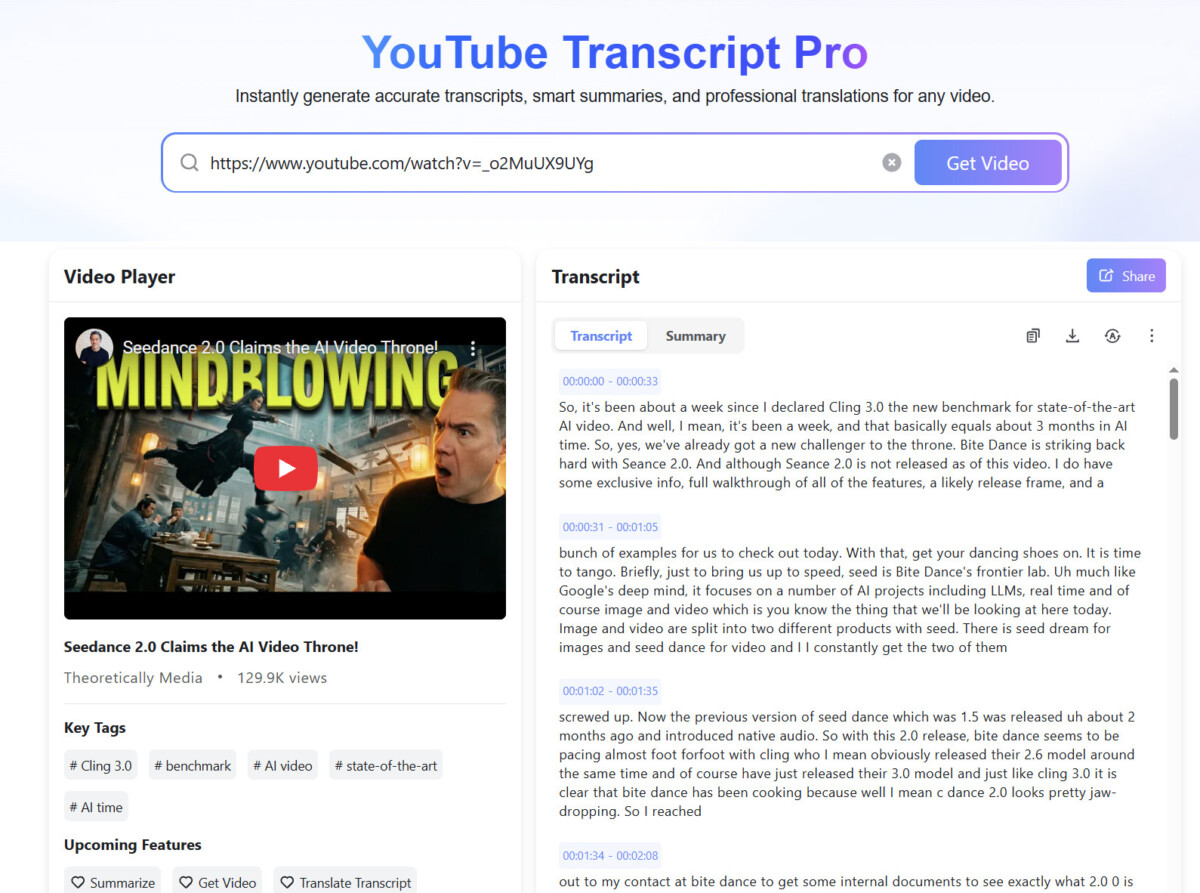
The first step is converting video into text.
Once your video becomes searchable text, it instantly becomes easier to reuse across the funnel.
Using a YouTube transcript tool, ecommerce teams can quickly extract spoken content from:
This allows marketers to quickly identify high-converting messaging, product benefits, and customer language.
For example, if an influencer repeatedly describes your product as “super lightweight and easy to carry,” that phrasing can be repurposed directly into PDP copy or paid ads.
This is often where the highest-converting messaging lives: in real human language.
One of the most overlooked CRO strategies is mining language from existing content.
AI summarization helps teams quickly identify:
Instead of watching multiple videos manually, teams can use AI summaries to surface the exact phrases customers respond to.
For example:
A 15-minute customer interview might reveal that buyers consistently mention:
These insights can directly improve:
For scaling brands, this is not just content efficiency—it is conversion optimization.
High-growth ecommerce brands win by moving fast.
But content teams are often bottlenecked by production cycles.
AI helps shorten the workflow:
Video → transcript → summary → multi-channel content
A single video can quickly become:
This dramatically reduces turnaround time for campaigns.
Instead of starting from scratch every time, teams can build from existing assets.
Video content is often difficult for cross-functional teams to work with.
Performance marketers, CRM teams, SEO writers, and founders may all need insights from the same asset.
Text-based transcripts make collaboration much easier.
Growth teams can:
This improves consistency across the customer journey.
When messaging stays consistent from ad click to checkout page, conversion rates often improve.
As brands scale, internal knowledge becomes harder to organize.
Past campaign learnings, webinar insights, product demos, and customer interviews often become scattered across tools.
Platforms like Lynote AI help ecommerce teams centralize and structure this information so that valuable content does not get lost.
This is especially useful for:
Instead of recreating messaging from scratch, teams can leverage proven content assets.
For DTC and Shopify brands, growth increasingly depends on how efficiently teams can create, test, and iterate content.
AI is not replacing marketers.
It is helping them move faster, extract better insights, and maximize the value of every content asset they already produce.
If your brand is already investing in video, the next step is making that content work across every stage of the funnel.
The brands that do this well will not just create more content.
They will convert more from the content they already have.
Ecommerce brands repurpose YouTube videos into marketing content by first extracting a transcript from the video using a tool like Descript, Otter.ai, or Castmagic, then mining that transcript for conversion-focused language including customer pain points, value propositions, and objection-handling phrases. That language is then adapted into product page bullets, email campaign copy, ad scripts, social captions, and blog content. A single 10-minute video typically generates enough raw material for a full week of cross-channel content without starting any piece from scratch.
The most widely used tools for YouTube transcript extraction and video repurposing in ecommerce content teams are Descript (best for teams that also edit video), Otter.ai (best for interview and meeting transcription), Castmagic (best for teams that want transcript, summary, and social content in one platform), and Opus Clip (best for short-form social clip extraction). For teams that want a knowledge management layer that keeps video-derived insights organised and searchable across the team over time, Lynote AI provides AI-assisted note-taking and content organisation built specifically for this use case.
Customer and influencer video content is valuable for ecommerce copywriting because it contains the natural language real buyers use to describe the product, including the specific pain points it solves, the comparisons they make to alternatives they tried, and the emotional triggers that drove their purchase decision. This language, extracted from transcripts and used directly in product page copy and ad scripts, consistently outperforms copy written from scratch by internal team members because it reflects how the target audience actually thinks about the product rather than how the brand assumes they do.
An AI-assisted video repurposing workflow typically reduces content production time by 60 to 80% compared to creating each asset from scratch. A content team that previously spent two to three days producing a blog post, five social captions, and three email variations from a single video can complete the same output in three to five hours using a transcript-to-content workflow. The time saving compounds as the workflow becomes systematic, because each new video feeds into an established process rather than requiring a fresh production cycle from the beginning.
Lynote AI is an AI-powered knowledge management platform that helps teams capture, organise, and reuse insights from video content including YouTube recordings, webinars, customer interviews, and internal meetings. For ecommerce teams, it provides a searchable library of video-derived insights that the whole team can access, rather than leaving transcripts and summaries scattered across individual files. It is particularly useful for scaling brands where team growth and staff turnover create institutional knowledge loss, and for content operations that need to maintain consistency across campaigns over time.





